Baby Spiders

I love my outdoor plants. And often I’m asked, “Is there anything you don’t grow?” For me, the struggle is real when it comes to indoor plants. I pick up in the language of outdoor plants. I think I get confused when it comes to the dialect of indoor plants. “What are you telling me?!”

It was this past year when I was gifted me a clipping and an indoor propagation unit that I decided to give indoor plants another whirl.

Back in August I was thinking of winter months, being shut in with no fresh air. So I picked out a few end of season clearance plants that are known for being air purifiers in the home.

One that I bought was a Spider Plant (Chlorophytum Comosum Vittatum).

This is a great plant for those who struggle to keep indoor plants alive. We were gifted with a spider plant back when I was an event decorator and my hours were horrible. That plant lived for about two months of forgotten watering before it finally gave up on me.

I picked a spider plant this time around because of how hearty this plant is and it deals with neglect better than other types of indoor plants. Plus, with my homeschoolers who love commandeering my indoor plants and calling them theirs, this is a great one for young kids to learn about plant care with. My kids love over watering and this one loved their over attention

In fact, after the fourth or fifth time I had to empty my overflow bowl from a standing puddle, I noticed that this spider plant had started producing baby plants. The day after the first baby showed up, a second formed. And about a week later two more popped up.
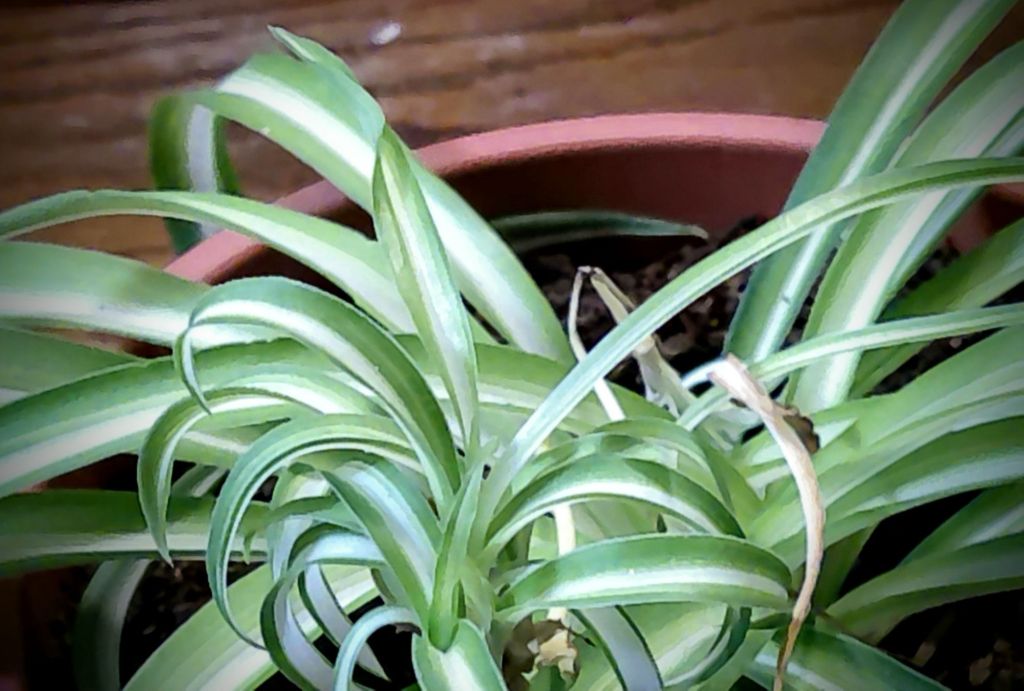
I wasn’t counting on this plant living our home so we’ll to put off four babies almost right away. But since I’m now part of a bartering group, I figured that nurturing these babies over winter will give me four plants to barter with come spring. Or seeing how the boys have taken these baby plants over, I’ll let them take them to an event to barter with. (It’s a life skill that they’re starting to become comfortable with.)

Advertisements

How To Propagate the Babies

The first thing you’ll notice growing from your mother plant, when a baby is going to be produced, is a long rigid stem. Have you seen a rigid stem of an orchid? The baby spider stem reminds me a lot of an orchid stem. On this end of the stem, you will see a miniature spider plant start to sprout its leaves.

At this point many people say that you’re supposed to bend that stem over toward a new pit, set the baby in that soil, and stake it down until its root system grows. Then you can cut the stalk.

The reason for not cutting the stem first is because it acts like an umbilical cord and gives the baby spider plant nutrients while it grows its root system.

That way makes sense and I’ve seen it done as a child. But I didn’t go that route with propagation this time. I tried to wait and let the stalks grow so that they were long enough to lean over into a new pot. None of these stems grew longer than 9 inches.

Instead I went with the Water Propagation Method.
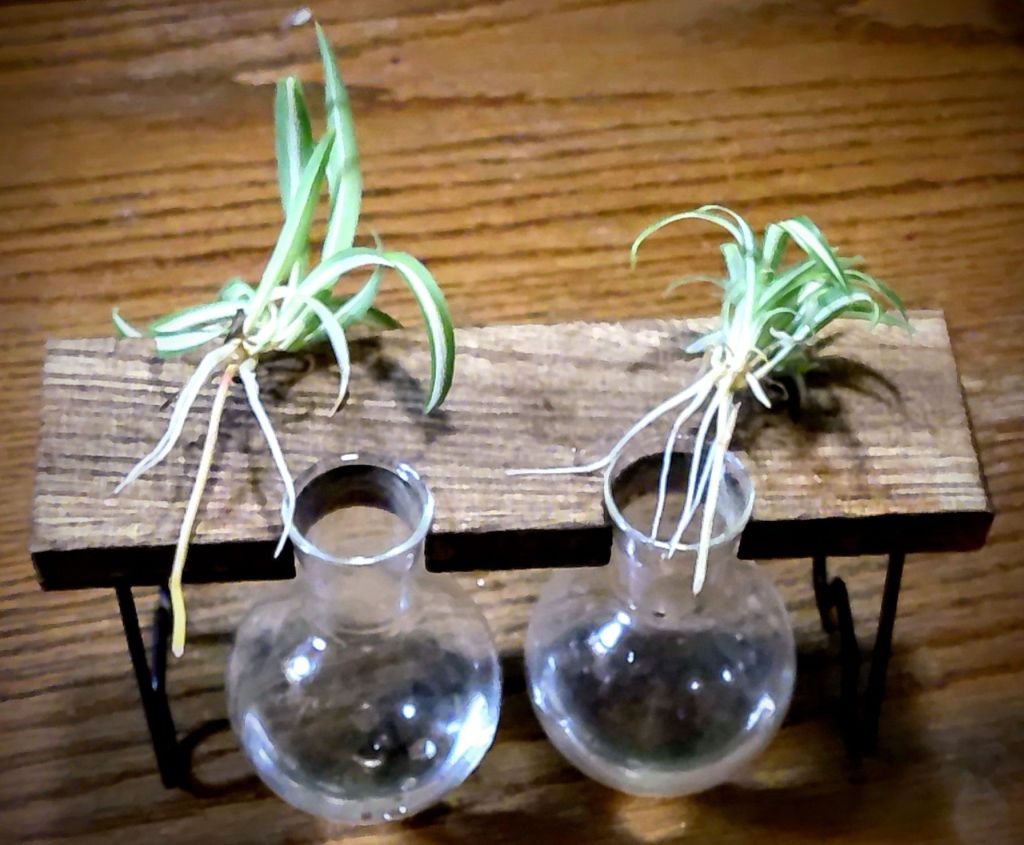
Here you can see the root growth from the Water Propagation Method that I started 4-6 weeks ago. I cut the stem of the baby spider plant a few inches long and then place them in these water propagation tubes.

The trick with this method is keeping the water level up to the base of the leaf cluster. As you can see from the pictures, this is where you see the root growth coming from. By keeping the water level high, it ensures that the emerging roots have contact with water at all times.

From there I simply place the stand in a window so the plants get sunlight. And then I wait for the roots to grow.

Here you see the far right and far left plants are the babies that I rooted several weeks ago and I’m ready to put them in soil. The center two babies are the ones that I just cut from the mother plant and are now ready to start the rooting process. I wanted to show you these side by side so that you can see the stems (which on my plant are a pale yellow) in comparison to the new roots (which are white).
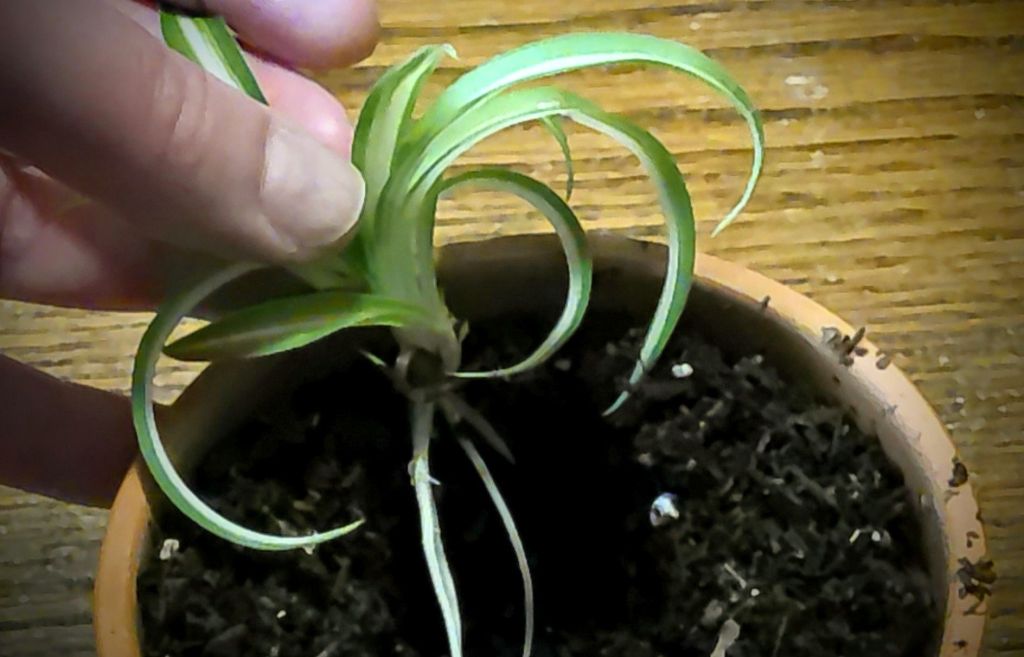
With these newly rooted baby spider plants, I put some potting soil in a clay pot. I hollowed out the center of the soil, where I want the plant to sit in the soil. (I create the hole for the roots because they are tender and I don’t want to damage these young roots. After a few months, when I’m ready to repot, I’m not as concerned with the roots because they’ve had a chance to establish themselves in the soil. For now they are going to go through a little shock because they are changing from water to soil environment. Their function is going to change in this new medium.

While holding up the leaves of this baby plant I fill in the hole (with the roots held in place below surface level) with more potting soil. Once the hole is filled, I gently pat the soil down to give the plant a little stability. Not much is needed because these roots are around 2 inches long (some a bit longer).

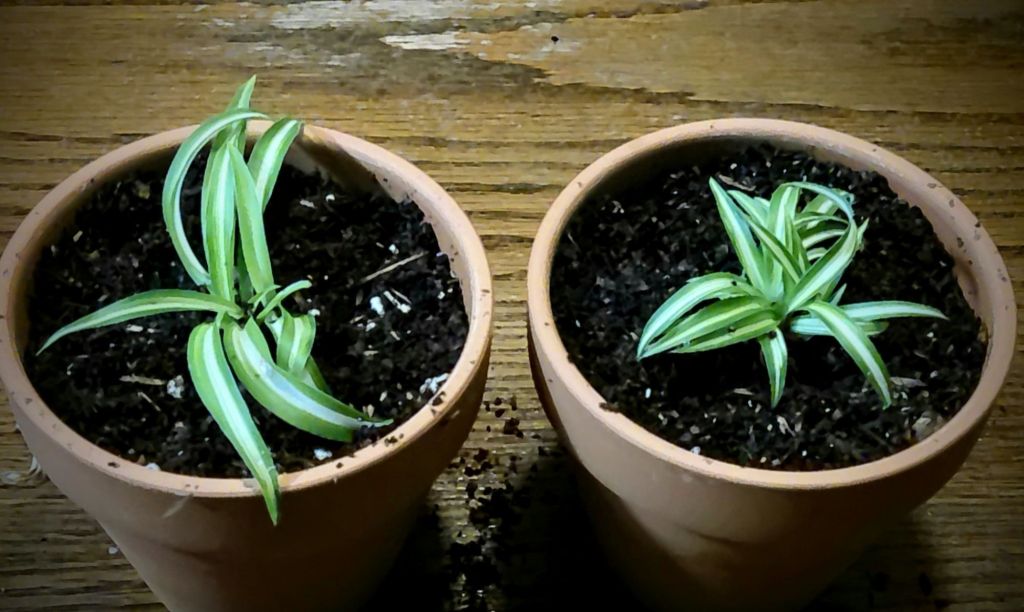
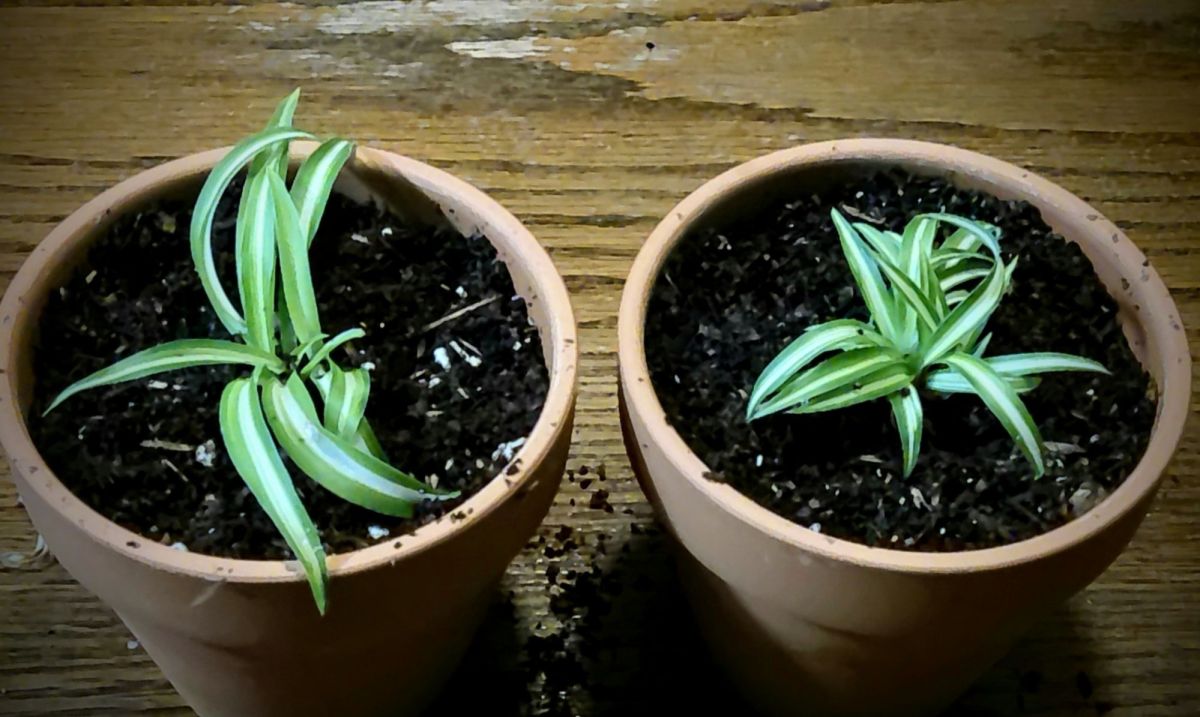
And here are how my new baby spider plants look in their new 4″ terra cotta pots. I gave them a bit of a watering and then set them back in the window.

Other than the time it took to allow the roots to grow, the setting up of this propagation took less than five minutes. And potting the rooted baby spider plants took another 5 minutes. This is something that doesn’t require much of your time, if you have limited time to care for indoor plants. And with spider plants, I water mine once a week. It’s been about 4 months since I first brought the mother plant home, so on my to do list is to give them a good fertilizing on their next watering.

Advertisements

Word of Warning for Propagation Equipment

This water propagation set up was gifted to me from a friend who hated it. It was my “transportation” unit for taking home a clipping of another plant for my drive home. After working with this stand for a year now, I fully understand why she didn’t like it. And yes, I am still that type of person that still uses it even when I hate it myself.

I look at it as a personal challenge to make it work!

If you’re looking to water propagate plant cuttings, let me walk you through this set up so you can have a little walking knowledge for choosing the set up that you end up purchasing or getting from a buy nothing group, or any other opportunity.

The reason why this stand is such a fail is because of the holes that the tubes slide into. In the above left picture you can see that the center of gravity of the holes are way off. They needed to be set back into the center of this board.

You can probably guess that when these tubes are filled to the top with water, they become front heavy and tip forward spilling water and cuttings everywhere.

In fact, in just this short period of time that I took to take all the photos for this post, the filled tubes fell forward not once… but twice!

To make matters even more entertaining, my husband decided to watch the process and freaked out with each of the dumpings. Water spread not just all over the table but also the floor. And that leads to the picture where I put the pot in front of the filled tubes. As much as I enjoy a good challenge, I really didn’t want to clean up a third water mess.

Advertisements

And that leads me to the solution of how I make this failed unit work for me.

When I have a new set of clippings to add to the tubes, I set the rack down in the window with the tube side facing the glass. When the rack leans forward, under the weight of the water, it leans into the window and holds itself up.

There are two other options that I have to fix this unit once these baby spiders are ready to be potted.

  1. I’m going to check to see if I have a drill bit that’s the right size so I can make the hold deeper into the wood so the tubes sit more center in the unit.
  2. If that doesn’t work, I’m going to take some thin crafting dowels and put legs in the front corners.
  3. And in case I need a third option… I’ll drill a hole in the back corners that’s big enough for a long screw that I can add enough nuts to create the correct counter balance to keep the unit upright even under all the water weight.

No matter what the situation, a solution can be found!

Advertisements

Final Task before Putting All the Plants Away

This mother plant has been so amazing to me that I just needed to take a couple of extra minutes and tend to her so that she can keep being a happy plant for me. I trimmed away some of her discolored and battered leaves and cut the remainder of the baby stems down to their base.

Why the trimming?

The stems were no longer supporting baby plants, so they no longer needed the energy being directed to them. The leaves were damaged and there’s no need for plant energy to go to them to see to the trauma. The overall health of the plant is very good and with plenty of healthy leaves, trimming away what I did would not affect the photosynthesis of the plant. But the trimming returns that amount of energy back to the mother plant to go elsewhere: whether new leaf growth, existing overall grown, it’s cellular immune health, or even gearing up for a push of new baby plant growth.

This mother plant is now ready for the next phase of whatever cycle she is on to now. And with the next watering combined with fertilizer, she’ll have all the nutrients she needs to move forward.


Here are some propagation units that I’m eyeballing for my next adventure in rooting plants.

I have not had a chance to see or use these units, but I wanted to share with you what other ones I’m looking that you can have an idea of what is out there.

This post contains affiliate links to products. We may receive a commissions on products purchased through these links, but at no extra cost to you. These items listed here are from Amazon but may be purchased at local markets.

3 Test Tube Glass Planter Terrarium Flower Vase with Wooden Holder

Plant Propogation Tubes, 2 Tiered Wall Hanging Plant Terrarium

Leave a comment

Processing…
Success! You're on the list.
Advertisements
Advertisements
Advertisements
Advertisements

Fill Up On The Fillings

The holidays are all coming up. And this can bring many feelings to different feelings. When adulting, the hardest part of the holidays are when finances are tight.

To help lighten the mood and bring a little cheer with the gift of flowers.

I’m going to show a simple and easy to make arrangement that you can personalize any way you want because it’s a blank slate. The beauty of it is that I reused some items and others were given to me. I had no out of pocket expenses to share this post with you.

So let’s start with the materials.

Vase

What inspired this post was the vase that my mom had sent me some flowers in.

Fall is my season. I love pumpkin everything. In fact I grow and purchase pumpkins to have all my pumpkin goodness that I can preserve for the rest of the year. And yes, I make pumpkin scones year round because their deliciousness transcends what is in season.

Unfortunately I can’t send you a picture of what the floral arrangement was that my mom sent. Mostly because I want to keep the blank slate in your mind and spark your creativity.

What I like about this white pumpkin is that if you remove all the floral it is literally a cookie jar. So feel free to use this idea any time of year and use cookie jars, old tea pots, water pitchers, even a shoe box (hello baby shower with baby shoe boxes!) Literally, use what you have on hand that brings you inspiration.

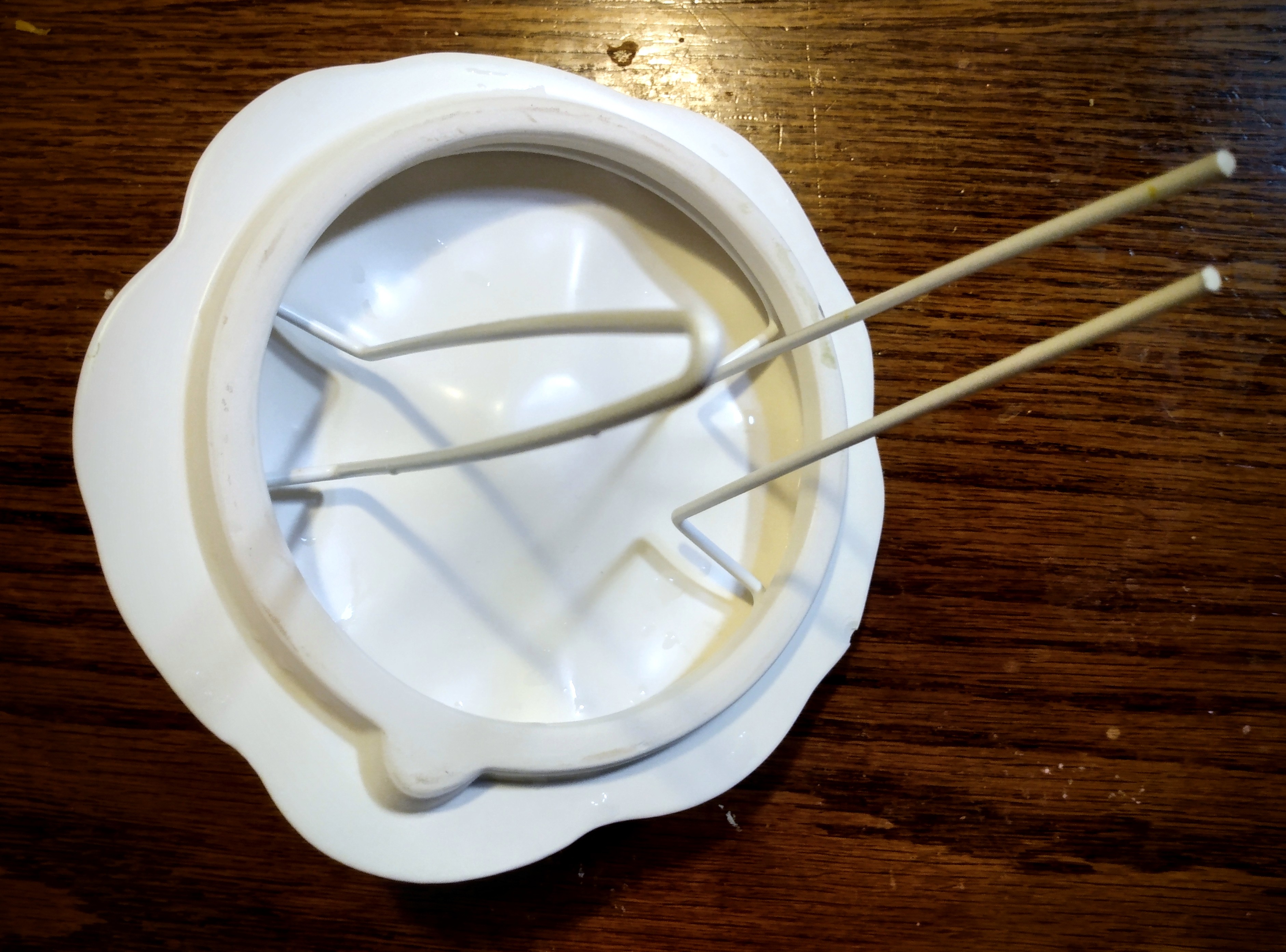
If you’re using a cookie jar or anything else with a lid, let me show you the parts of this vase and how it works.

This lid stand/holder is very specific for floral. I’m sure with today’s online offerings, you could find these. But you’re going to have to know what your lid size is and go from there. I have one other cookie jar, but the lid is smaller and this stand/holder definitely will not fit in it.

However I do have two options off the top of my head that I could use from items I have in my house.

I have porcelain dolls from my childhood, and this stand/holder immediately reminded me of the doll stands I have that go around my dolls’ waist. The tension part is too small to fill the lid like in this pumpkin vase, but with two or three I could position them in the smaller lid to make the tension and platform to raise the lid.

Another option is making one from a thick gauge wire. If your local store has a DIY floral department or aisle, you will find wire thick enough to hold its shape and hold the weight of a lid. If you want to price comparison shop, go to an automotive shop or aisle. You’ll often find that you will get a better price in that department, but also walk out with a larger quantity of wire.

Once you have the wire, you can make your own custom holder/stand by leaving several inches of one leg sticking out as you then go in and create a loop of wire inside the lip of your cookie jar lid. I would make a few loops inside that lid to ensure that when you move and manipulate the legs that you don’t shrink your loop and allow your lid to fall. Once you’re confident in you loop, bring out a second leg and then use wire cutters to cut the wire. You can always add more than two legs if you feel like you need to add more stability.

Advertisements

Inner Stability

For lid placement, you will need something to anchor the stand into.

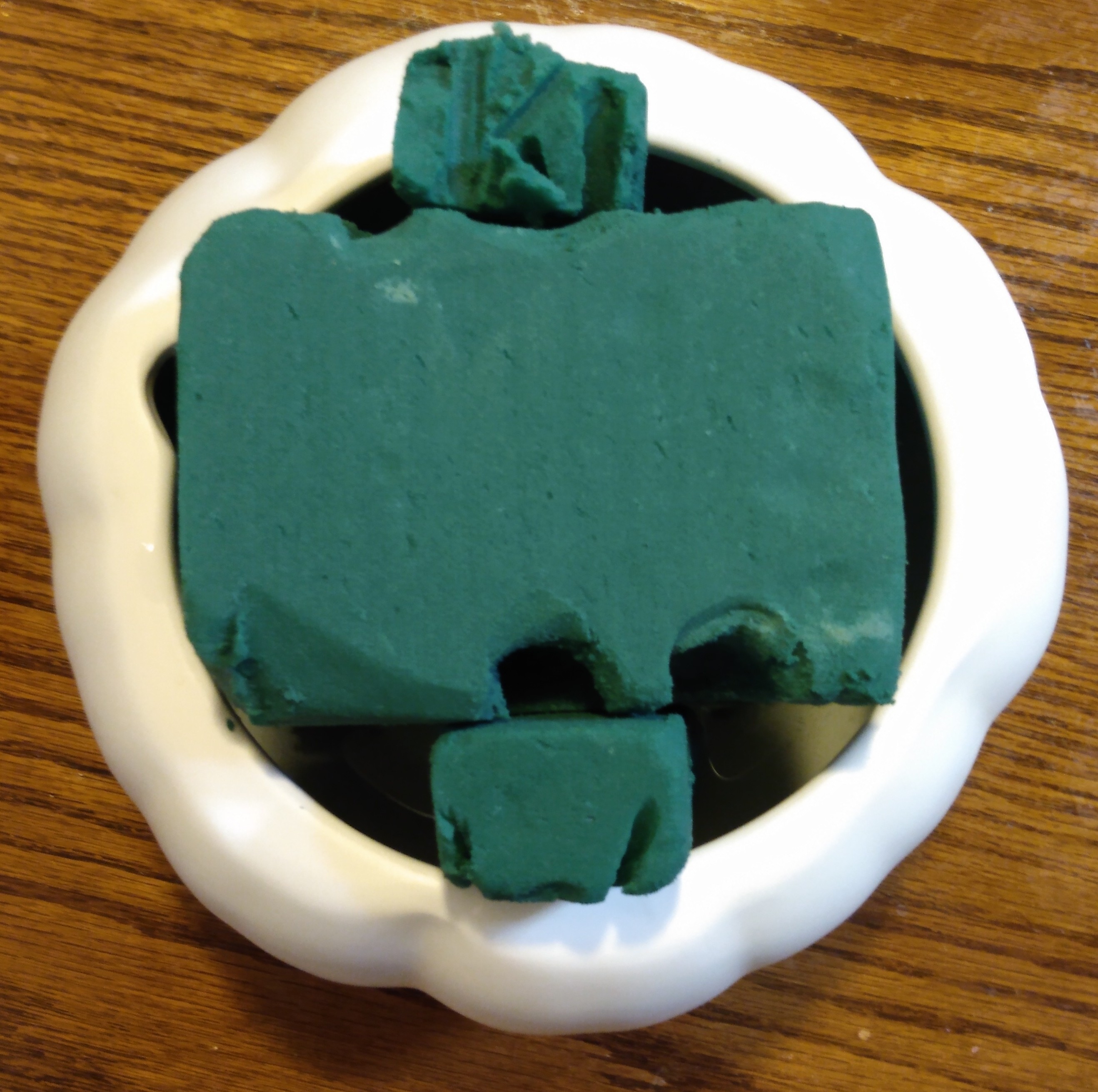
I’m choosing to reuse the oasis that came with the flowers my mom sent me. This is an amazing product because it not only allows you to place flowers like a pin in a pin cushion. It also allow absorbs and holds water, keeping your flowers in water much longer than free standing in just a vase of water.

If you want to use silk flowers that you have on hand, feel free to use a Styrofoam ball or block. (I don’t recommend styrofoam for fresh flowers because the plastic will kill your flowers and won’t allow them to be properly hydrated.

Once you’ve decided what you’re using as a structure (of if you’re even using a structure), you may find that you need to piece bits together to keep them from falling into your cookie jar and becoming lost. Flower stems are enough to keep bits together. However if you need everything to be in place before you get started on your flowers, know that toothpicks or a couple inches of wire are your best friend.

As you can see here, a single toothpick is all that was needed to hold up a water logged piece of oasis.

This is a beneficial trick if you only have a small sliver of oasis that doesn’t touch the bottom of your vase. Or even if you find that your oasis fell apart on you. Or maybe some oasis you salvaged was a different size than the vase you are working with. You can certainly make your oasis fit the vessel you choose to use.

TIP: Please note that placing a toothpick or wire in a 90° angle is going to cause frustration. The weight of wet oasis and flowers are going to collapse. So instead, angle the toothpick at a 45° angle. That way when gravity starts to work against you, the toothpick will hold its place. This will be further reinforced by the flowers that you soon add.

Advertisements

Flowers

The Flowers that I was gifted after an event I attended was baby’s breath and eucalyptus. Often we look at these as just fillers to make an arrangement look larger than the more desired stems.

I wanted to use these fillers specifically because they are often overlooked for being used as flowers on their own. Maybe you have a lot of fillers left over from other arrangements that you made. Or maybe your budget is tight and these are the only flowers that are in your price range.

There are so many other fillers that you can find in your grocery store. So please keep your eyes open. And not all stores offer the same offerings. The grocery stores don’t supply very many filling options. However, stores like Trader Joe’s offer the best selection of filler flowers in my area. And their prices are quite affordable.

TIP: If your local store doesn’t offer many choices for filler flowers take a look at what is available for discounted flowers. They’re the ones that have the more delicate flowers that are wilted. These discounted bouquets are often cheaper than just fillers flowers, but the fillers used in these bouquets still have a long life to them. There are a huge number of flowers that will last weeks without even having water available to them. So know that even all that you can afford is a heavily discounted, on its last leg bouquet, if there’s a decent amount of fillers included, you can make a decent arrangement even if you have to throw out the wilted roses, lilies, and other delicate petal flowers.

Advertisements

Arranging

When looking at using long stems of filler, like eucalyptus, you will be happier in how these stems lie when you hold them up and see which direction they are naturally bending. (See the right picture below.) If you want the stem to cascade down, angle the bend down and also put it in the oasis by entering from the bottom and putting the stem upward. This can be seen in the picture on the left.

See the difference between placing firm eucalyptus stems. Using the left picture (above) the stems you see in the bottom right corner are the stems that I angled from the bottom of the oasis and pushed upward. The one stem that is in the upper left corner is the one that I pushed from the top and downward. But this stem I also used a second trick. Even with the curve of this stem, it had the tendency to stand upright. So I curved the stem in a C shape and kind of hooked the stem in the oasis. Then I put the pumpkin lid over this stem to weigh it down. Even with this trick, the stem never gave a cascading down effect like you see with the bottom right corner stems.

How you place the stems is everything about how it stands up or lays down.

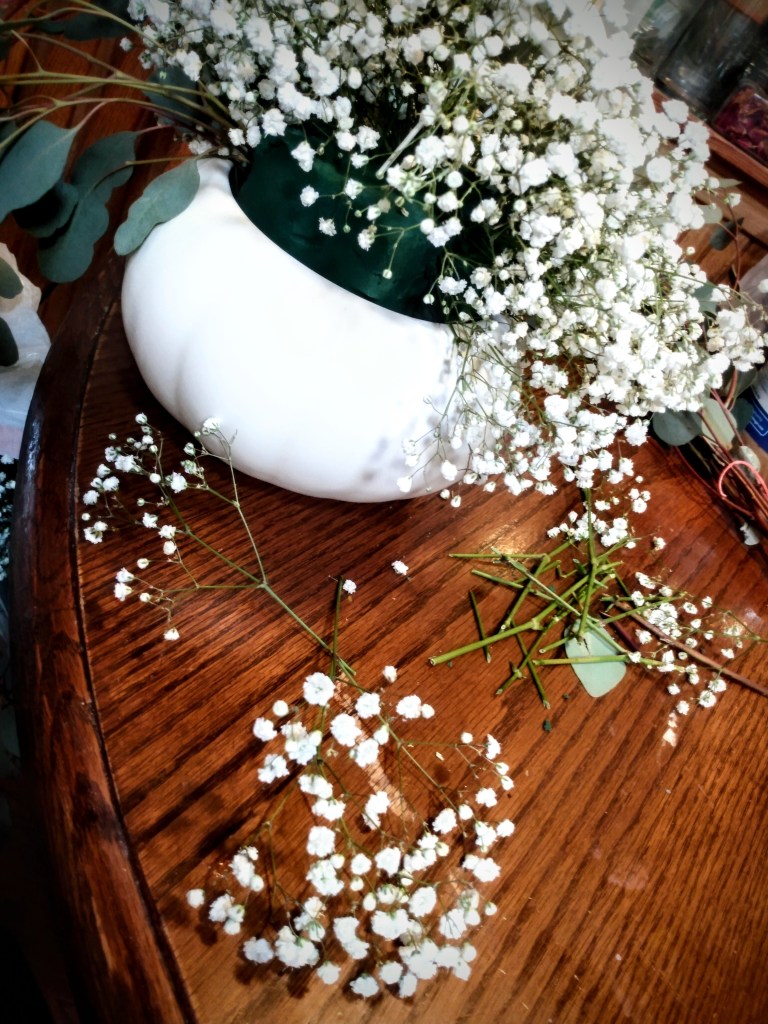
The baby’s breath is much easier to shape the way that you want. For this cookie jar I used about four stems of baby’s breath and snipped them down into smaller branches. And with an arrangement like this, there’s no need for long pieces. All you need are the “scrap” pieces or bits that are the size of your hand or smaller.

If you “scrap” pieces or the bits that you cut down are too small, it just means that you need more of them to fill larger spaces.

One work around for filling empty spaces quicker is to take larger pieces like this. In the below picture on the left is a stem that is about the length of my elbow to my wrist. It could have been trimmed down into four smaller stems, but I wanted to fill a large hole with just this one piece.

To close up the gap spacing between these branches, slide your fingers up the main stem, gathering all the stems up the main stem. That gathering bunches all the stems up to achieve what you see in the right picture. You will have to hold you stem in this position until you push it into the oasis. At that point, the foam holds bunching in place.

Before you place your first gathered stem, I want to draw your attention to a stem feature that has the potential of causing you some up front frustration.

The weakest part of the baby’s breath stem is the joint where all the branches merge. The times that stems snap, when placing them in oasis, is when I try to push these joints in without giving them assistance.

If you have an arrow tip like you see above, it’s easiest if you just snip that off. It causes resistance, when pushed in the oasis, that you don’t need, because those stem numbs have no flowers.

Look further up on the stem and you see what it looks like when you have attached flowering stems. When I don’t need the height from the stem, I snip it right there at the base of where all the stems merge. Then I slide my fingers down to make more of an arrow point instead of a tear drop. That fat end of the tear drop is difficult to push into oasis. However, if you make a sharper point, or a smaller surface area to push in, the stem slides right into the oasis.

If there are any other merges in the stem, it’s easiest if you pinch it smaller to get it to go into the foam. Depending on how large of a cluster you have, there may be a few of these joints that you have to manipulate into the foam.

Advertisements

Final Adjustments

Once you’ve filled in all your empty space, there’s a few decisions to make.

  • Do you add more of one filler or the other?
  • Was there too much and some needs to be removed?
  • Does placement need to be adjusted?
  • Is something missing?

I looked at the final arrangement here and went through these same questions. All the holes I filled with baby’s breath as that’s what I chose to be primary flower out of these two fillers.

The thought crossed my mind to add more eucalyptus. But I opted with the creative decision of having less leaves on my pumpkin “vines”. So that meant instead of removing branches of eucalyptus I chose to weave the branches through the clusters of baby’s breath.

As far as “am I missing anything?” that is the question that is always there when you have a blank canvas for an arrangement.

Right now this is how my pumpkin sits in my living room. But it also allows me to keep this long lasting arrangement in season through the rest of the year. For Thanksgiving, I could add fall leaves or any other fall accent pieces. For December all the fall accent pieces can be pulled out of the oasis and winter pieces added. For example, I would put in snowflakes or mini presents. In fact, I’m eye balling some mini glitter snowflakes while writing this. The question is if I want to keep with the white color and add silver glitter snowflakes. Or do I want to add a splash of color and put in gold snowflakes?

But that’s the beauty of making a simple arrangement like this. I can dress it up and change it.

In fact, I could keep this up for the New Year and put in foil clusters that look like fireworks.

For now I’m just going to have to contain myself and not entertain my kids. It’s so easy to grab their small stuffies and other toys and use them as props to make little scenes. We don’t do Elf on the Self in our house, but just like there’s millions of Pinterest posts on Elf on the Shelf ideas, there’s just as many possibilities for arrangements like this. It doesn’t matter if you have a pumpkin cookie jar like vase (like I used here) or a teapot or coffee cup. No matter what you are using as a unique vase, you have just as many options to accessorize and decorate without limits.

How would you dress up a pumpkin arrangement like this?


Leave a comment

Processing…
Success! You're on the list.
Advertisements
Advertisements
Advertisements
Advertisements

Ombre Fun

While I made a component for last weekend’s Maker’s Market I played with glitter. I slowed down my mass production to share an easy way of creating an ombre effect that’s nearly effortless and will take every time for me.

The secret is all about your glue choice.

Growing up I always used Elmer’s Glue for sticking power. For ombre work, I find it’s the worst glue. There’s a few reasons for this, but for me the biggest problems I had was holes between two colors, awful looking clumping, and stark lines that just looked weird.

I’ve switched to using cheap watery glue instead.

Have you ever watched a professional cookie maker flood the icing to get that smooth design? Using watery glue has the same effect for creating glitter ombre!

So whether you’re new to crafting with glitter or use glitter on everything, more fluid glue is going to be your best friend. You can glue the sections you want to use one color glitter. Or you can lay down all your glue at once. The fluid movement of this type of glue is going to cause the glitter to drift a little and cause a natural blend. Not only that but if you have to go back in and add more glue because a spot was unexpectedly dry, a single drop will fill that hole and spread into the already laid glitter with no gaps.

Advertisements

Laying Down the Glue All at Once

This is my favorite way of doing ombre, particularly because I want to move quickly and optimize my production time.

First I get my glitter selection lined up. This is what allows me to lay a handful of colors while the glue is still wet.

Before I lay down the glue, I also decide which direction I want my colors to run; horizontal, vertical, or diagonal.

With that all prepped, that’s when I go ahead and lay the glue. I start at one end of my element and shake the glitter side to side to make a straight line. (Or a zig zag if I want peaks and valleys.)

If I’m going to make my own color blend, I’ll go ahead and shake out all the colors at once, without stopping between colors to put them back in their containers.

However, if I’m keeping my colors true, then I’ll lay that first edge color. Then shake off the excess with the glitter side down. Put the glitter away. Then grab the next color, shake out that next line. Shake off the excess with glitter side down. And repeat the whole process until all my glitter is put away.

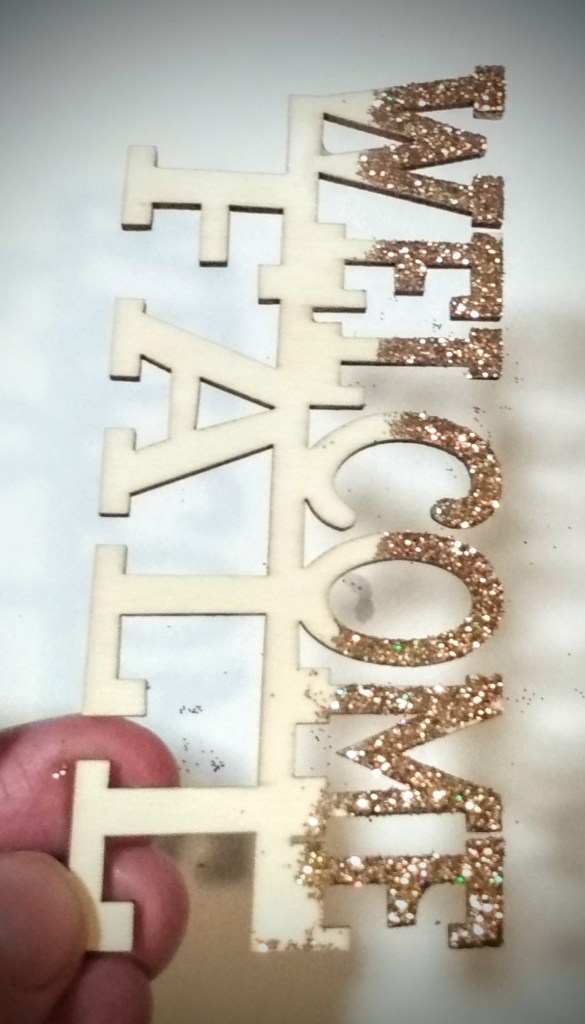
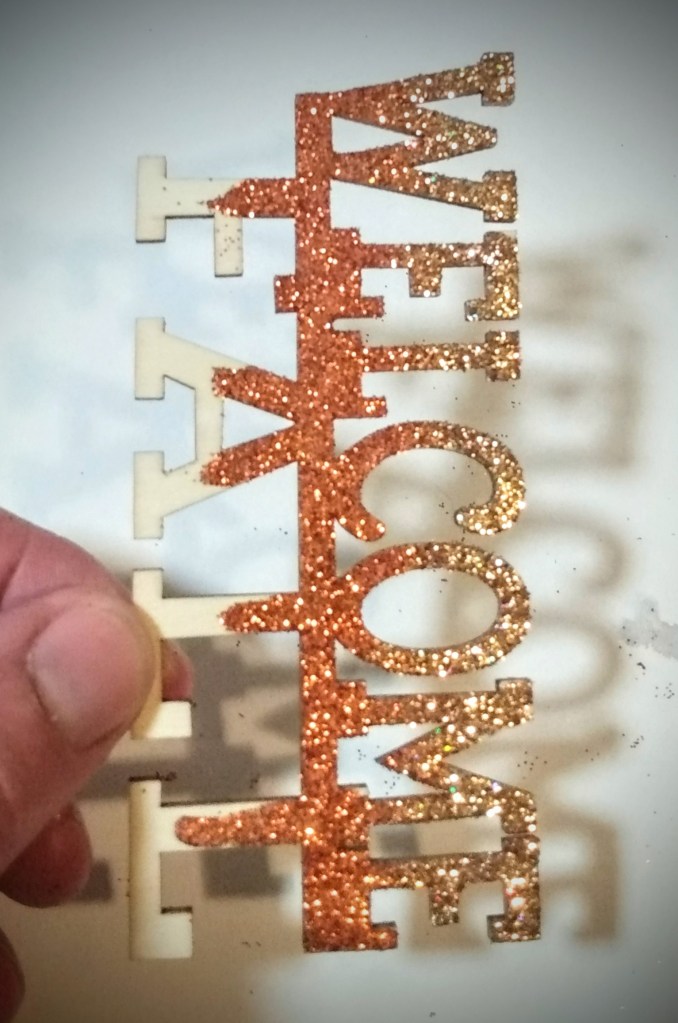
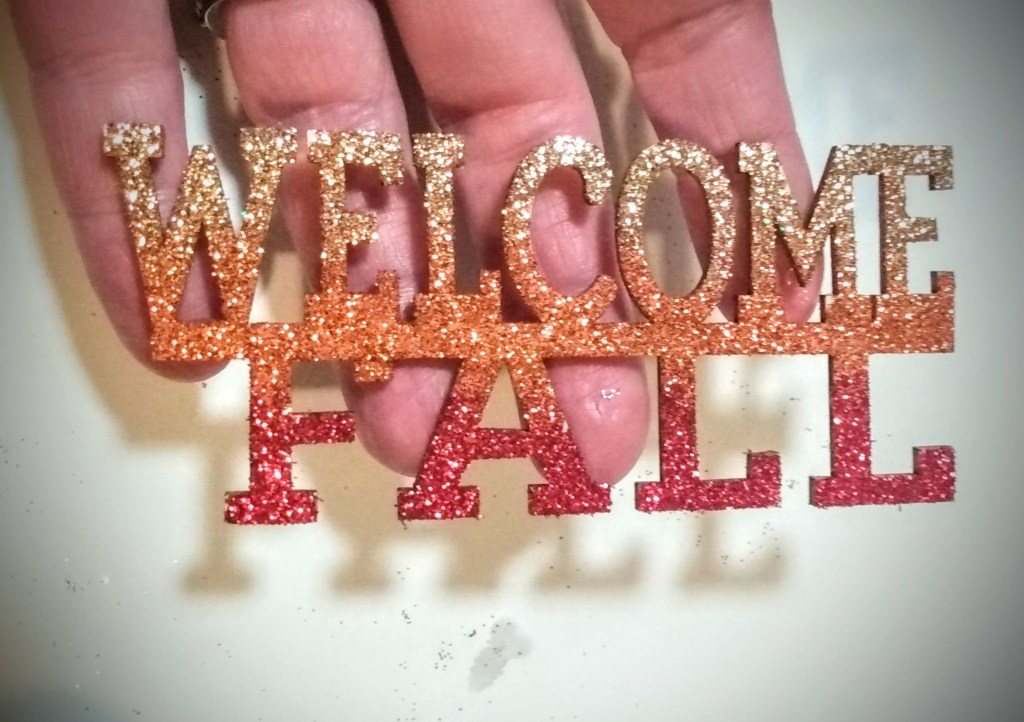
Just so that you can go into this with confidence, I want to share with you the colors that I used here in Welcome Fall. The first color I used was a pale gold (as opposed to the bright and bold gold you usually see during Christmas). I followed that up with a bright pumpkin orange. And the final was a cherry red. I didn’t have concerns with the gold and orange because they had a similar base color that matched perfectly. The red doesn’t look bad here. I pulled it off in the final project that this was going on. However if you ever find that you’re questioning your color choices before you glue, I highly recommend taking some of the neighboring color and adding it in with the color you are hesitant with. This will tone down, and help bring the color into the family.

OR… another option, which you’ll see in the second picture above, let your middle color slide down on the glue and creates a drip effect. This will help from creating a stark line that can potentially form with colors of glitter that compete with each other.

Advertisements

Making Your Own Blend

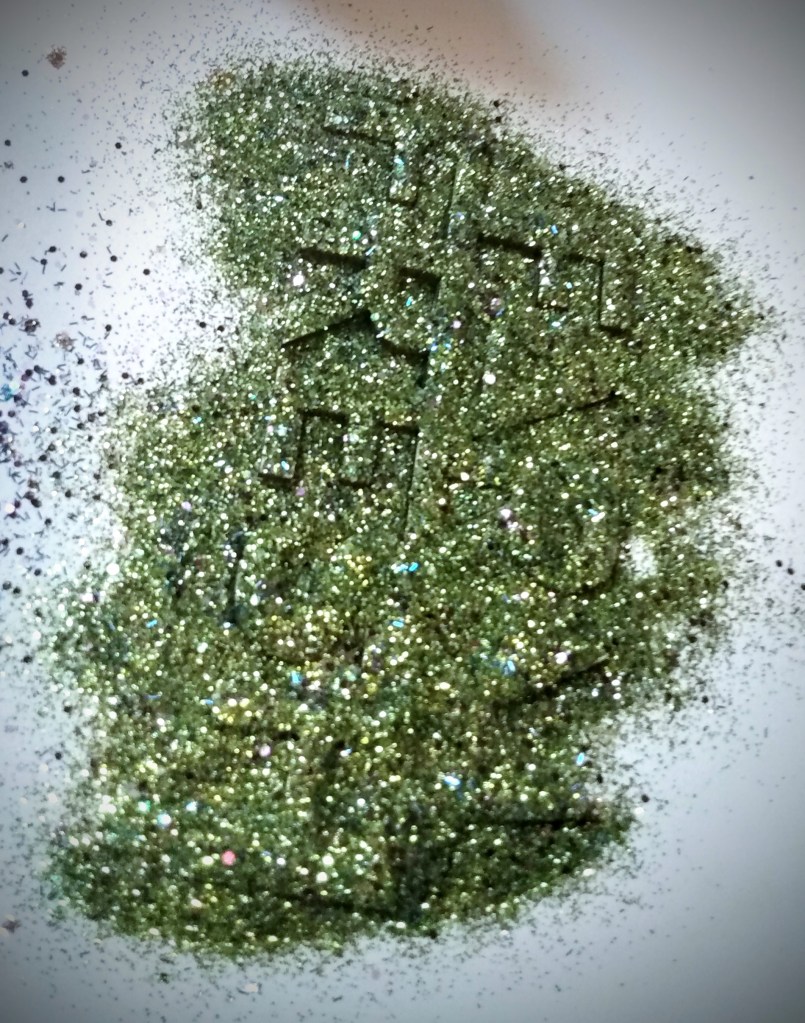
As I mentioned above, you can blend your colors together. This green that I made is a perfect example of what happens when you blend.

The only green glitter I had on hand was a lime green that I bought from a spring line of glitter. There was no way that I could make that Easter egg green work in a fall theme. So I grabbed my blue and purple glitters to blend a darker green. If you look closely at this picture, you might be able to pick up the different colors. Around the middle, you’ll see some grains of blue that has a turquoise to it. And then around the perimeter you see the darkness of the purple glitter.

Maybe, you don’t want to make your own darker shade of green. Maybe you want a different color. How do you mix it?

Think about mixing paint and how when you use primary colors (red, yellow, blue) you make secondary colors (orange, green, purple). Glitter is going to work in the same manner. The big difference is that you’re not changing the individual grains of glitter to a new color. You’re creating the illusion of a new color by mixing different colors.

For the green that I made, I used the blue to take away the brightness of the lime. These two colors still have a fresh spring green color, so the addition of a darker color, like purple, makes the green dark. I didn’t use precise measurements. I added a little bit at a time so I don’t use my whole glitter stash and run out of colors to make corrections. Over all, it came down to the ratio of the lime taking up 50-60%, blue 30-40%, and purple 10-20%

The cherry red that I mentioned earlier, I partnered it with maroon that I absolutely love. The thought crossed my mind that I might need to make more of it because I bought it last fall and haven’t seen it since. My plan was to take the cherry red, mix a little bit of navy blue glitter (bright reds have an orange base and rich reds have a blue base–my reason for adding blue), and then black to get the red darker without changing the base color of the read. Brown would be an option if I wanted a lighter maroon. But for this dark maroon, black is the go to glitter.

The added bonus of mixing your own glitter blend is that you add dimension and something dimension to look at. Don’t get me wrong, glitter is enticing enough on its own. But the next time you play with glitter, mix a small batch of a color and look at it in comparison to the original flat color. You’ll understand what I’m talking about when it gives you something a little more.

Other Ideas

Before I close this post, I want to offer one more idea of what you can do to give your glitter work some dimension and adding a little “extra” to your work.

Take a look at “Give Thanks” in the picture above.

This one is a bit more subtle than the striped ombre, so you may need to get a closer look at this wooden tag. The picture doesn’t do it justice in comparison to what it looks like in person. But this is two different shades of gold. The darker (and more orange) gold is applied as a shadow on the left hand side of each of the letters.

Earlier I mentioned shaking glitter in a v or w shape to create a chevron pattern.

You can easily make poke a dots by dropping spots in one color and then surrounding the dots with a different color.

Feel free to not just play with colors, but also experiment with shapes and patterns. Depending on what pattern you’re making, you may need to be specific with how you lay down your glue. But there is no reason why you can’t make leaves, plaids, or anything else in glitter. If it becomes difficult to maintain shapes, take breaks between your layers. This will keep the glue from running and distorting the shape/pattern you make.

Advertisements

A Finishing Tip

The one disadvantage to working with fluid glue is that your glue might shed glitter because it doesn’t have the stick to keep the glitter in place. There are a couple of options that you have to seal in your glitter to minimize or eliminate shedding.

The first thing that I used, many many many years ago, was hair spray. This has the least about of stick out of the options I’ll share. It’s great if you’re in a pinch and don’t have any other products on hand. But the only shedding this is going to stop is contact shedding when you tap it. There will be some transfer if you run your finger in the glitter.

I love using clear acrylic spray! This is a great sealant that dries in a couple of minutes. The disadvantage is the fumes. But those disappear when the spray paint cures. I really don’t notice glitter loss through touch or contact/tapping. The finish is also the best option. However, you might see a dulling of the glitter’s sparkle depending on which brand you use.

If you have the time, polycrylic paint is the best as far as it goes to completely seal in all the glitter. This can be the determining factor if someone in your house, or the person you’re gifting too, hates glitter with a passion. This is completely sealed and there is no glitter loss. Just be aware that the fumes are strong and curing can take 24-48 hours. But the fumes will dissipate. I highly recommend that you dab polycrylic on. If you try to brush it on, you will get streaks, glitter will clump on your brush, and there will be brush tracks in your glitter.

How do you like using glitter?

Leave a comment

Processing…
Success! You're on the list.
Advertisements
Advertisements
Advertisements
Advertisements

Reverse That Frame

While getting ready for an upcoming Maker’s Market, I’m reminded of a time I was in a crafting group. A couple of times a year the group would do a special session of crafting binges. One of the first things I made with this group was a reverse canvas. It’s one of the simplest crafting transformations that is so satisfying.

If you haven’t heard of a reverse canvas, or have yet to make one yourself, grab a framed canvas, screw driver or staple remover, paint, exacto knife, and stapler or staple gun. This is all you need to make your own reverse canvas.

At any of your craft stores, or even dollar store, you can find two types of canvases: frames canvas and canvas flat. The flat looks like canvas that has been glued to a piece of cardboard. (You can make this in a similar fashion as you’ll see with this reverse canvas.) A canvas frame is the one where you see the canvas stretched over a wooden frame.

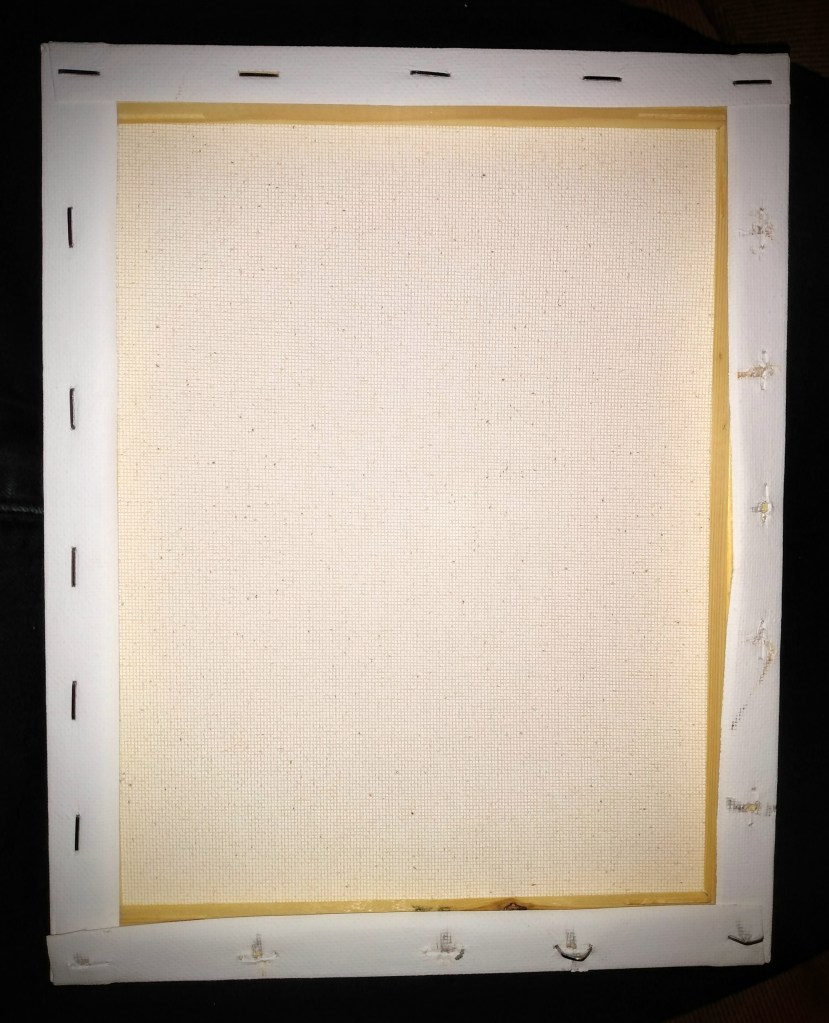
First, you want to flip your canvas frame over and remove the staples from the back. I’ve had some frames where this was easy. And there have been a few frames where I had to work to get those staples off. If you find that the staples don’t want to release from the wood, grab a piece of needle nose pliers. This will give you enough leverage where you can wiggle the staples out.

Don’t worry if your prying scars this side of the frame. With all the holes and splintering, this side of the frame will remain the backside that no one will see.

I’ve heard many crafters recommend using the exacto knife and cutting the canvas free from the frame by cutting on the side of the staple between the staple and the outside edge of the frame. If you don’t want to spend the time removing the staples, this is the method that you will love. The down side of this option is that the finished back of your reverse canvas is not going to be smooth as it could be But as I mentioned before, no one is going to see the back of the frame once it’s on the wall.

The rest of this walk through is under the assumption that you remove the staples. There are also other ways of reapplying the canvas, such as using hot glue, but I’m going to show you how to stretch the canvas. This is going to give you the best quality and make it look less DIY and more professional in finish.

Paint to Dress It Up

Of course you have the option to paint your frame and canvas at any point in time. My timing of choice is to paint the frame and canvas once they are separated from each other.

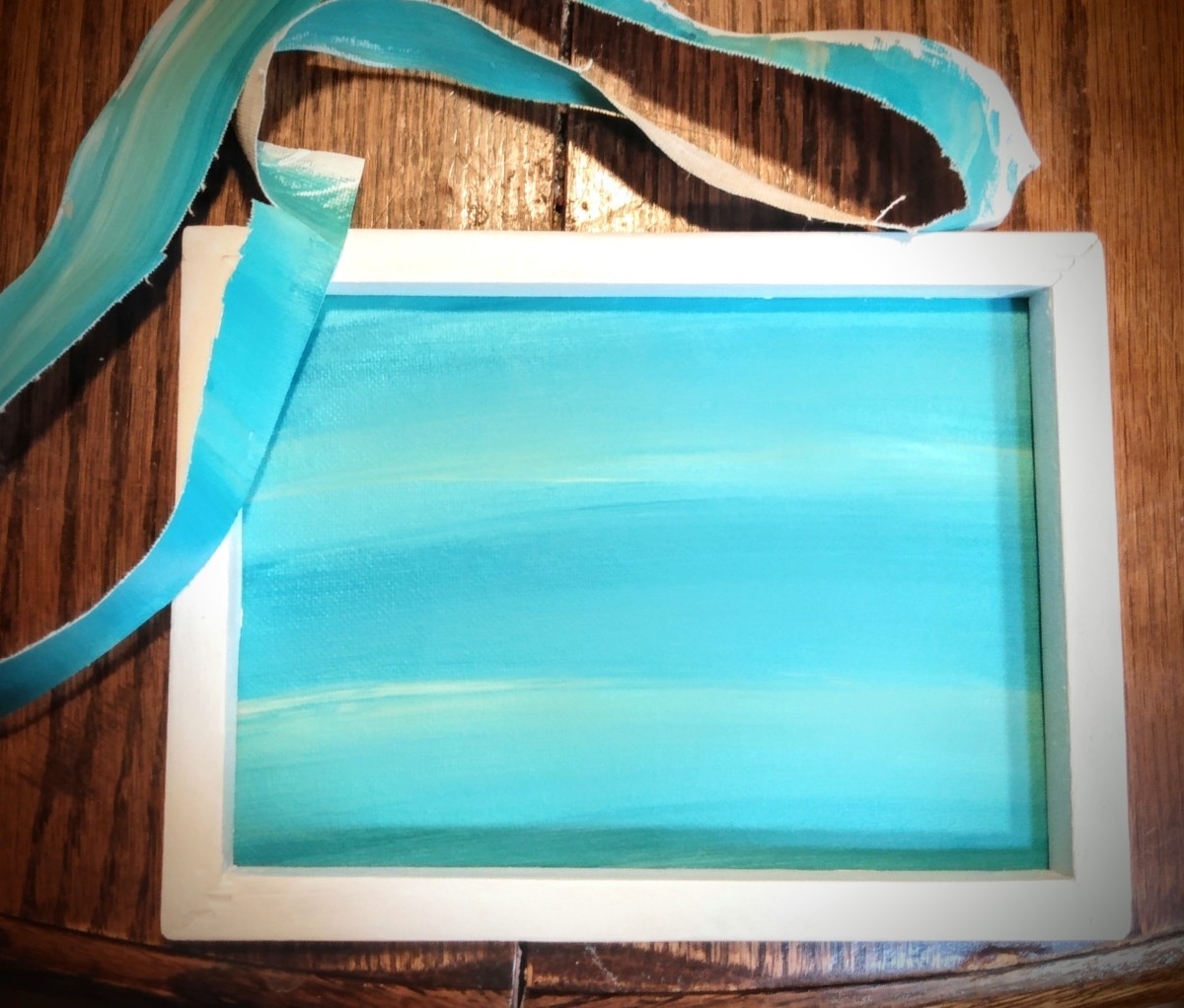
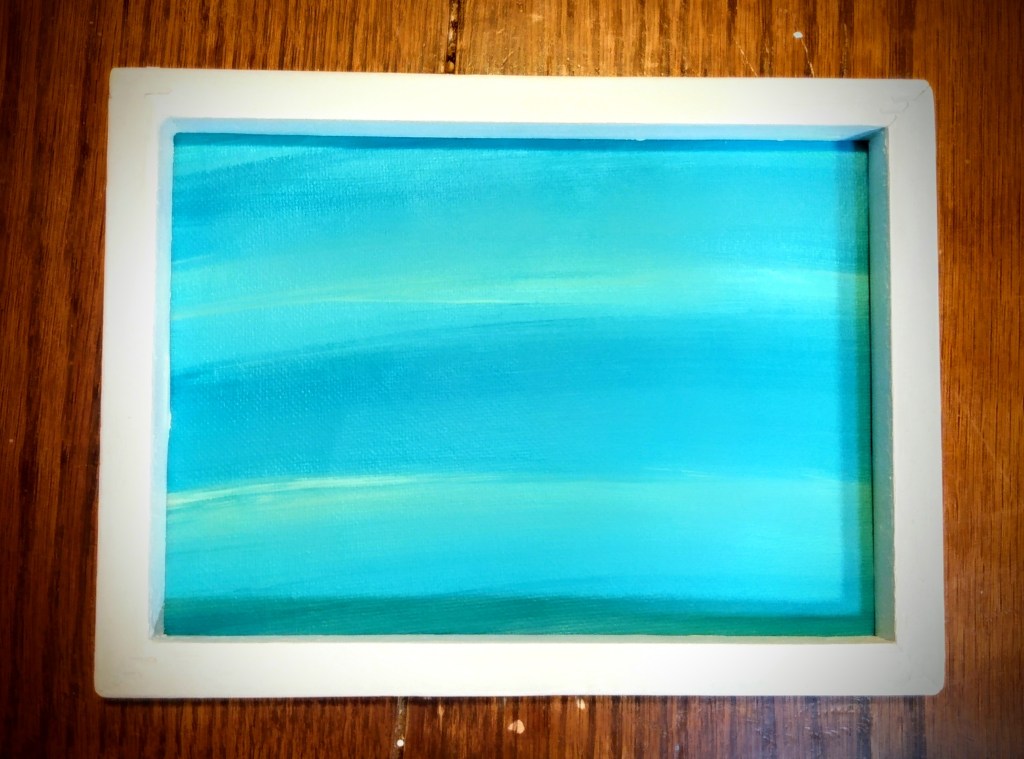
As you can see here, for one of my Market products, when you paint them separately, you are free to personalize and customize your project anyway that you want.

If you want to spray paint, you can. You can use glitter or other crafting medium. When the pieces are separated, you will never have the accidental over spray or find the need to tape off to protect one element while you’re working with the other. And if you want to try your hand at free hand painting one element, you can work absolute certainty of the work that you’re doing.

Once canvas and frame are dry, you are ready to put your canvas back on your frame.

TIP: If you wanted a pattern on the canvas (like I did above), make sure you take a look at your frame on top of your canvas. Make sure your lines, design, landscape or portrait are lined up like you want them in the frame. You may find that what you painted on the canvas doesn’t line up inside the frame like it did when you were just looking at the canvas.

Advertisements

It’s Time to Stretch

If you pre-lined up your canvas and frame (as described in the tip above), you will need to hold on to both pieces and carefully flip it over. Make sure that the canvas doesn’t slip. If it does, you may need to reposition it.

If you have a solid canvas, or one that doesn’t need positioned, start of by putting your frame front side down on your table or work surface. The staple holes side should be up. Next, place your canvas down with paint side down.

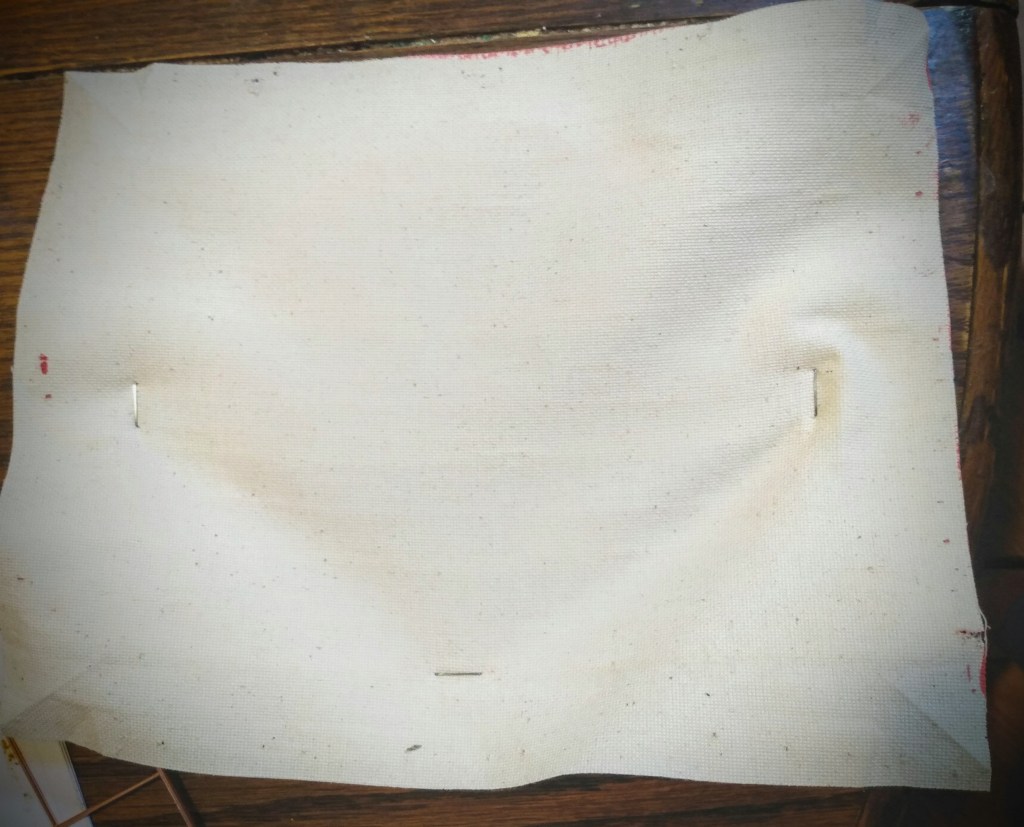
Find the center of the long side of your frame and staple your canvas to that spot.

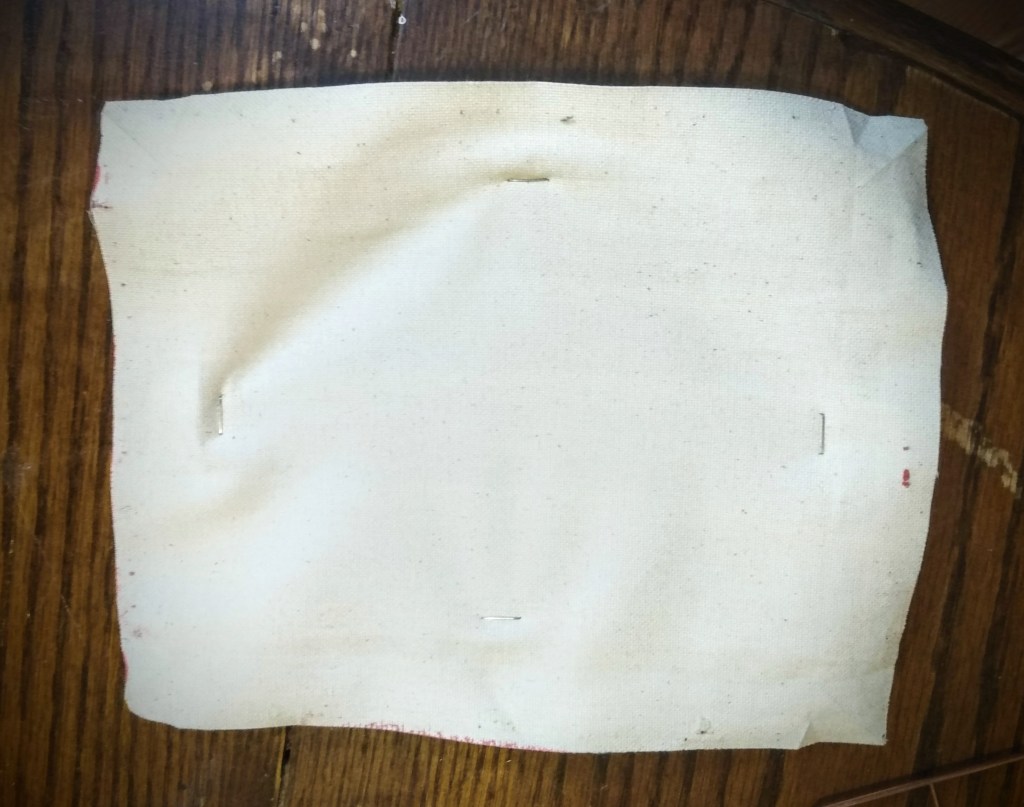
Next, find the center of the other side of your frame and pull the canvas tight to that spot. You may need to use both hands. This will give you control in how tight you will make the canvas in the end. Once you feel the tension, staple the canvas, tight, to the center of that frame arm.

Find the center of the short end of your frame. Pull the canvas tight to that point. You should notice that you can pull it more than you did with the first pull you made. Staple it in place.

Find the center of the last side of the frame and pull the canvas tight. At this point, I start pulling the canvas to the outside edge of the frame and using the frame edge as leverage to keep the canvas tight as you staple.

As you look at these pictures you are going to really see the warping in the canvas just from these initial 4 staples. This is normal and in no way reflects the final product. In fact, the more that I pull the canvas, the more tension that I add. I find that if I gradually add more tension as I go the least likely I am of ripping my canvas from pulling too hard.

After these initial staples are in place, the next step is to aim your stapler about 2 inches to the side of center staple. Pull and stretch the canvas toward the nearest corner, in a diagonal pull. The original pulls were in an up/down directional pull. But after you place the first 4 staples, you want to pull diagonally to prevent bubble like ripples from forming around already set staples.

Another benefit to diagonal pulls is that this is how I get my canvas to keep tight like the skin stretched on top of a bongo.

Another truck to keeping a tight canvas is that as you start pulling diagonally, you want to alternate directions that you’re pulling in.

For example, if your frame (after the 4 initial staples) is orientated in front of you with the long frame size on the top and the short on the sides, keep your frame in this orientation. Start with a staple 2 inches to the right of the staple on you top long side. Then drop to the bottom long side and pull the canvas to the bottom left corner with adding a staple 2 inches to the left of the the bottom long frame side center staple. Then for the short frame side on your right hand side, pull the canvas toward that right bottom corner and place your staple 2 inches below the center staple. Finally move to the left hand side short frame side, pull the canvas toward the upper corner , and place the staple 2 inches above the center staple.

Advertisements

With these four staples in place, we’re now going to staple on the other side of the center staple to balance out the tension that we’re putting in the canvas.

The last pull was toward the upper left corner (on the short side). So now we’re going to go to the bottom right corner (on the long side). Pull to the lower right corner and staple to the right of the bottom center staple. Next, pull to the upper left corner and staple to the left of the upper center staple. Then pull to the upper right corner and staple above the right center staple. Finally pull to the lower left corner and staple bellow the left center staple.

At this point the canvas has an even pull and it’s a good time to check the front to see if any adjustments need to be made. If there is no design to the canvas you can keep stretching and stapling in opposite directions until the canvas is fully attached to the frame.

If you have a design, now is a great time to check to make sure that you are stretching with enough balanced tension that the design is still straight.

Is the design pulling or warping toward a short/long side of the frame? Then you pull the canvas tighter in the opposite direction. This will take pulling toward the two corners opposite of where it was gravitating toward.

If the design is gravitating toward a corner, you want to pull tightest on the opposite corner to bring the design back to its original orientation.

Once you’ve made the corrections that needed to be made (keep checking back to the front after each set of 4 staples to keep an eye on what you need to do), continue with the stretching and stapling until the canvas is reattached to the frame.

Time for a Trim

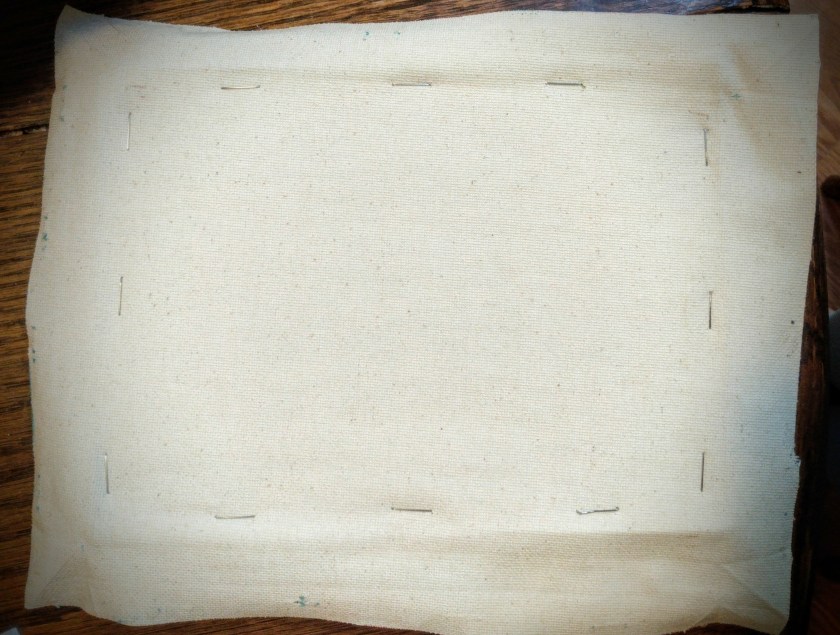
As you see here, all of the original funkiness from the 4 original staples has worked itself out. The center is smooth and tight. On the outside edges of the canvas you can still see bunches and creases of where I pulled tight against the frame (using it as leverage to pull the canvas tighter). None of this matters because we will trim off the excess canvas.

Flip the canvas over so you can see the front face. Grab your exacto knife. You are going to cut into the canvas at about a 45° angle behind the frame. This will cut enough of the canvas back so that you won’t see the edges from the front of the frame. The benefit of the exacto knife is that you can run the flat edge of the knife against the edge of the frame and cut a straight line.

It is possible to cut away the excess canvas with a pair of scissors. You will want to pay a little extra attention to where you are cutting. You will want to get the scissors in there so that you are cutting behind the frame. But at the same time you want to make sure that you aren’t cutting too close to or between the staples. Just like any taunt fabric, canvas will rip along the grain. This is particularly true when you have the tension that we built in with stretching the canvas.

And now you see the final product with the excess canvas cut away!

This particular canvas is ready for the next step in the product that I’m making, which is a 3D wall art.

But you can consider this as a crafting blank that you can add anything to it. You can stencil paint a design on it. Maybe you want to mod podge a photograph or note from a loved one. Or there could be a decal that you want to attach to this canvas. You could also have an early childhood stick figure drawing from your child or grand child that you want to frame in a unique way. This may be what you’re looking for.

There are so many different things that you can do with a reverse frame. You are only limited by your imagination.

One last thing I want to mention, before you add your favorite decorations to this canvas, think about how you want to hang this reverse canvas. The frame can stand by itself on a counter or table top as long as what you add is very light. Otherwise, like in my case of 3D art, you will want to add a mode of hanging.

Some options for hanging your art are:

  • drill a couple of holes into the back of the frame where finishing nails can hold up your frame on a wall
  • staple a long bit of ribbon to the two top corners of your frame
  • nail a portrait anchor on the back

You’re not limited to these ideas. But they are a few of the most common ones.

How do you use reverse frames?


Leave a comment

Processing…
Success! You're on the list.
Advertisements
Advertisements
Advertisements
Advertisements

Make a Reusable Food Wrap

This past week I just had my application to a local Maker’s Market accepted. (If you’re unfamiliar with Maker’s Markets, think Farmer’s Market with a little more lean toward the things that you make.) One of the products that are on my list to sell is reusable beeswax wraps.

I’m super excited to present this item, not just at the market but also here because this is a traditional item that was used before the convenience of plastic that will it doubt come into popularity again.

There are so many reasons why you might be interested in how to bring a reusable wrap into your home. Maybe you’re budget is tight and $5-20 saved in a grocery trip means something to you. Or your family could be one who is looking to reduce the amount of plastics that are used and thrown away in your home. Perhaps you or a loved one is facing a health moment that requires you to reduce the amount of chemicals that are used in your home. Or maybe there is another reason that stands out in your mind.

Beeswax reusable wraps can meet those needs and many others because it’s made from very few ingredients; 100% cotton or linen cloth and beeswax are the two items that you have to have to make this. I also include pine resin (for additional tackiness) and jojoba oil (for flexibility that prevents the wax from cracking)

Originally I wanted to make these wraps for my family because half of our glass bowls do not have lids. And all of our lid bowls always seem to be in use and unavailable when we need something with a lid. So I have more usable bowls, but I can also meet other needs in my kitchen: my homemade bread won’t dry out on the cut end, less chemicals are being transferred into our left over foods, takes up less space than Tupperware, and easy enough that my kids can use them.

While listening to others who’ve been making these for years, I learned about a few other beneficial features. When the wax wears thin, these wraps have not met the end of their life. You can reapply the wax (or wax/resin/oil combo) and 5e wraps are just like new. But if the cloth itself becomes damaged, the wrap can be composted because there are no synthetic materials that are used.

Advertisements

How to make or revitalize a previously used wrap

There are a few different methods of making these. So please don’t think there is one way. Find a method that works for you and makes sense with the resources that you already have available in your home.

The oven method. You place your cloth on a cooking sheet, with your wax of choice (plain beeswax or a beeswax combo) scattered across the top of the cloth. Your cooking sheet is placed in the oven, around 200 degrees F, until the wax melts. You then use a brush and make sure to spread the hot wax evenly across the cloth.

I did not use this method because none of my cooking sheets have a lip on them. So I would end up having wax in the bottom of my oven. And I didn’t want to buy new cooking sheets just to have them for crafting. I don’t have the space to store them or the money to buy them. So I went with a different method that I already had the resources for.

Advertisements

The water bath method: I used one of my small saucepans and filled it halfway full with water. I pulled out a hot water safe container to put my wax combo in, and then set that inside the saucepan. It took a bit of time for the water bath to melt my beeswax and pine resin, but that step was a success. What didn’t work for me was pouring the wax combo on the cloth or dipping the brush in and brushing the fabric. This method was a fail for me because my brush clotted with the wax as it cooled. There was no way to warm that up to turn it back into a liquid or to clean my brush. I know some homesteaders who love using a brush when making beeswax wraps. I’m not one of those people. But I did try it.

The Ironing method: I’m going to walk you through the steps of this method below. This one takes a few additional manufacturing items to make. But once I was set up I didn’t have to prep anymore. And I kept making wraps until I ran out of one of my ingredients. This is not a zero waste method. However it is the method that minimizes the loss of wax ingredients and is the easiest to clean up.

Prepping for the Iron Method

Before setting up my work table, I needed to get my ingredients ready.

I buy my beeswax from local bee keepers. That means I generally get the wax in a brick form. And whether I’m using the wax for wraps or other products I make, I have to great it down to make the melting process a little quicker.

Foraging pine resin is on my to-do list. I have not done that yet. So I purchased pine resin. It arrived in a bag of crystalline chunks. Resin takes a higher heat to melt than beeswax, so I needed to crush the resin to minimize its melt time. The quickest way to do this is put some resin in a paper bag and hit it with a hammer until the resin becomes as small as you want it. (Powder is ideal for this method.)

What I learned when crushing resin— when you hit it properly with a hammer, the resin is going to break through a paper bag. If you use the wood handle you keep the bag pretty much intact, but the resin is let going to turn all the way into a powder. But if you use the side of the hammer (the largest flat surface of the metal portion of the hammer head) you maximize the amount of resin turning into power with very little resin escaping out of a crack in the bag.

With the ingredients ready to go, the next step is to set up your work station. Half the videos I watched had crafters working on exposed countertops. I DO NOT recommend going that route. The short story is that the wax combo got on my table. Fortunately I have my tricks to lifting wax off of my table. And I will not be doing that again!

So learn from my mistake and find an old towel that you do not mind using for crafting purposes from here on out. Shop rags are amazing for this. I just didn’t have any that were large enough for me to make my Rage wraps on top of. So I decommissioned a towel.

Since I knew I was going to work on my large wraps, I grabbed that size of cloth and set it on my towel. From there I sized out 2 long sheets of parchment paper with a few inches of over hang on all sides. (Your wax is going to spread and needs this buffer to keep the wax off your iron.)

The wax is going to slide through the sheets of parchment. To prevent this I taped my sheets together. This time I used a packing tape. And once I taped the parchment together, I flipped it over so that the tape side was down on the towel.

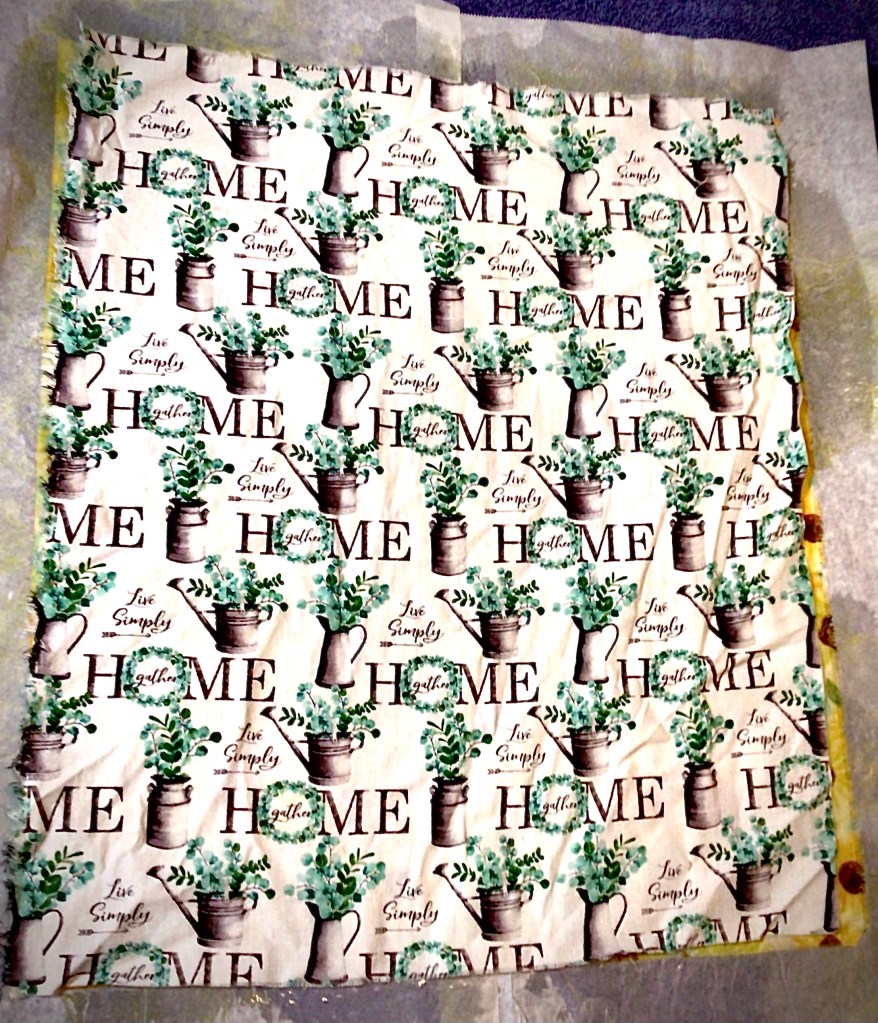
I placed the cloth that I’m making the wrap out of on top of this bottom sheet of parchment. Then I made a second double sheet of parchment to place on top of the fabric. This time I kept the tape side face up. And to keep the iron from melting this tape, I placed one single sheet of parchment over the tape.

Now it’s time to make a wrap!

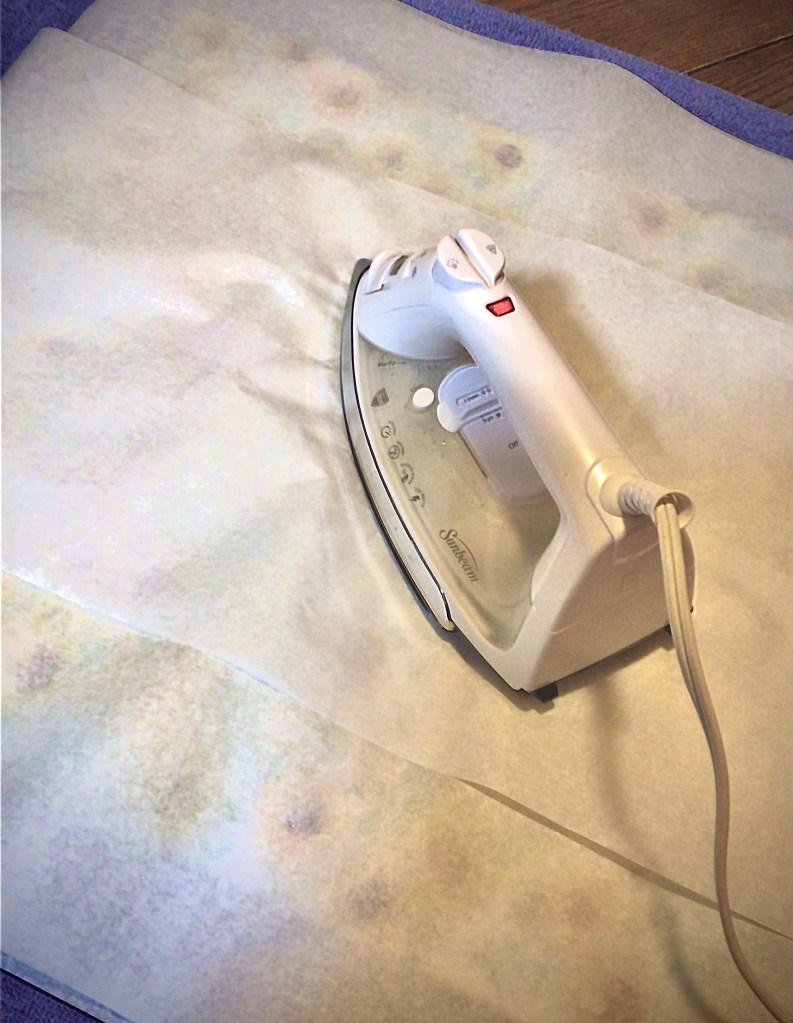
Preheat a clothing iron to the highest/linen setting. Even if you’re working with cotton, don’t be afraid to use the highest setting. The wax, and especially pine resin, needs the heat to turn into a liquid and for you to work quickly.

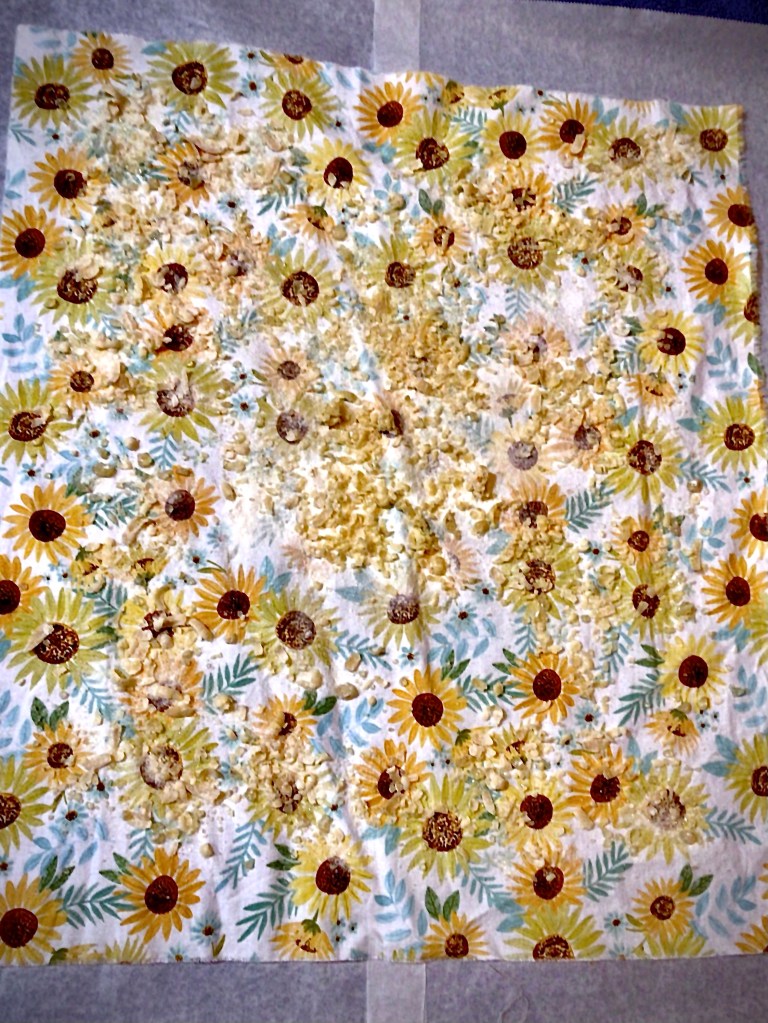
In a cup I weigh out equal parts of beeswax and pine resin. (If you’re making just beeswax, there’s no need to measure the ingredients unless you figure out the precise amount of wax you need for the size of cloth you’re working with.) Then sprinkle your ingredients all over the face of your cloth.

Cover with the top layer of parchment paper and start to iron.

If you are using resin, and used some small shards instead of all powder, you will want to show patience up front here. Set the iron down on top of the stones and wait while the resin melts. If you immediately glide your iron back and corn, the resin shards are going to rip the parchment and then all the waxes are going to end up on your iron face.

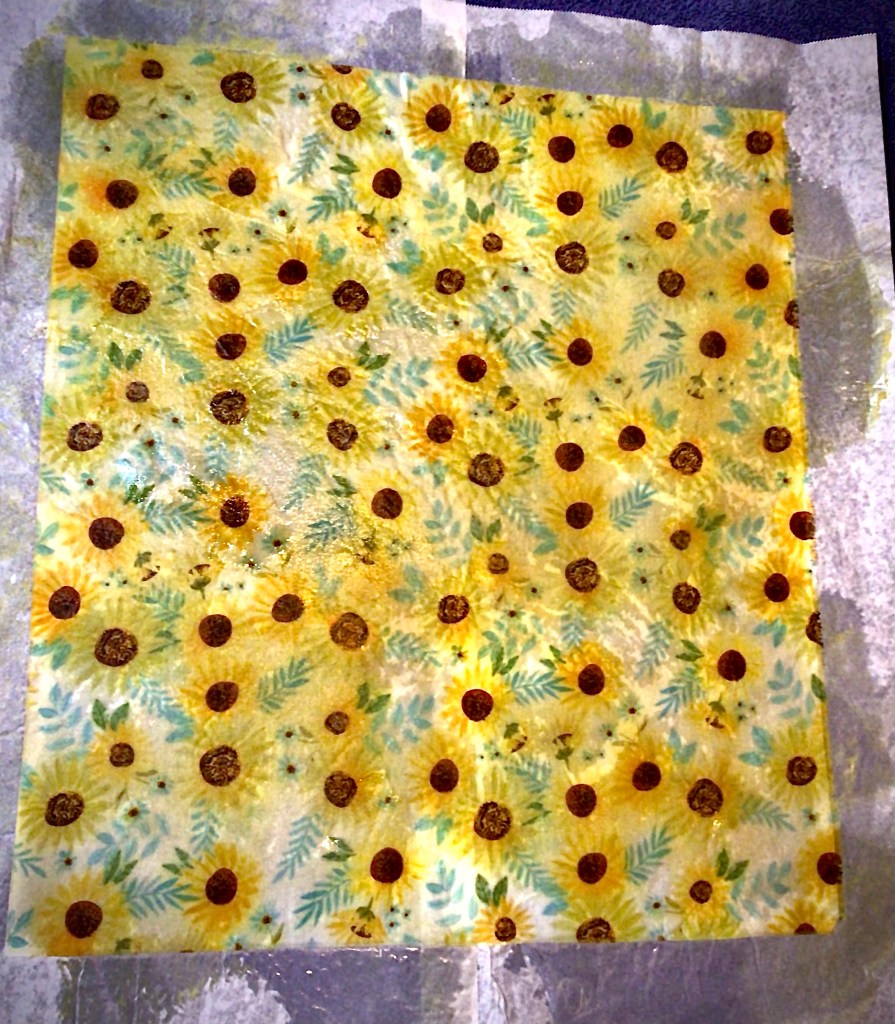
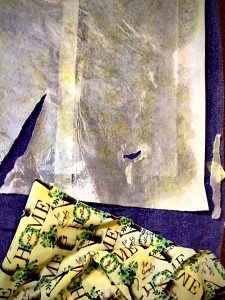
As you can see in this middle picture, below, you will see your waxes through the parchment. This is useful because you will get a general idea of where the wax is in comparison to the edge of your fabric. Work in the center and push the wax out to the edges.

There will come a moment when you think you have the wax spread over all the fabric. Lift the parchment and take a quick leak. No matter if you’re working with light or dark fabric, you will be able to notice where I here are patches of fabric that have not been covered with wax. In the third picture above you will notice the white fabric that has obviously not been covered by the yellow tint of the beeswax.

If there are still pools of was on the cloth, lower the parchment paper and use the iron to push the wax over to those blank spaces. If the fabric seems a bit “dry”, with no extra wax to move around, add a little bit more wax over the dry spots, lower the parchment, and melt the wax into place.

Once you’re satisfied with your coverage, take a look at the amount of wax present. You want just the right amount where the fabric has a matte like finish too it. If it’s shiny or has pools of wax, you will want to absorb that excess wax off. You can do this by placing a new piece of fabric on top, lowering the parchment and ironing over the entire surface of the new cloth. Once all the excess wax has been absorbed, you can pull out the first cloth (and leave the second cloth to add more wax to any dry parts.

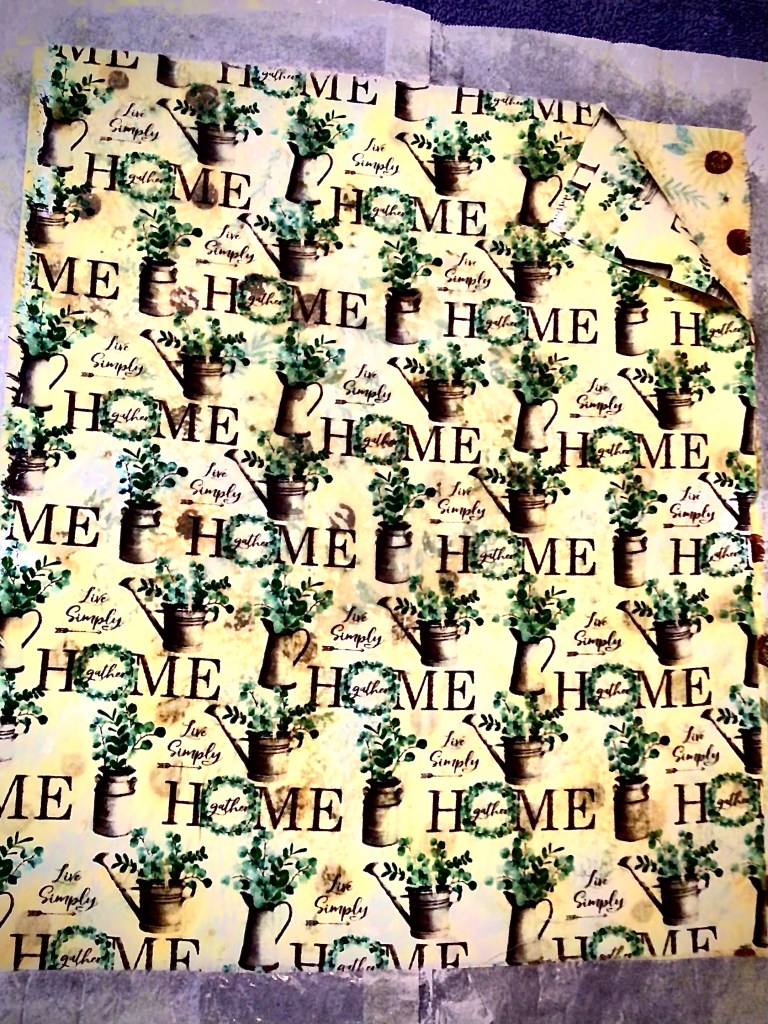
When a cloth is finished, pull it free from the parchment papers, hold it by the corners and wave the cloth back and forth. You want to cool down the wax before you set it on something to finish drying. (I use chair backs.)

A Pine Resin Problem to be Aware of

One bit of information I didn’t hear from anyone is a potential problem to look out for when working with pine resin. If there is a spot where the resin is not in equal parts with the beeswax, it’s going to act like glue to the parchment paper.

The first sign of this is when you go to lift the parchment paper and it feels like it’s locked in place. You didn’t do anything wrong and nothing is ruined. All you have to do is iron over that spot. When the resin is hot again, you can lift the parchment paper and it won’t be stuck anymore.

If you try to force the peel, the parchment will rip. And if you’re not done making wraps, you will want to take a new sheet of parchment to cover the holes and rips. It’s just easier to get the resin hot again and then peel the parchment back in one piece.

Caring For Your Reusable Wrap

Everything about a beeswax wrap is oil based and meant to manage moisture. It keeps food moisture in and humidity out. Because of this feature, you absolutely do not want to use a grease fighting detergent when cleaning a wrap after use. You can use a gentle soap and the wrap will be fine. However grease lifting detergents are going to break down the wax and fat molecules in the wrap, which in turn will wear down the wax and make it less effective in holding to itself and your kitchen equipment.

Remember, we used heat to set the wax on the cloth. Hot water will warm up the wax and makes it easy for the wax to be removed from the fabric. So when you wash or rinse off a beeswax cloth, keep the water tepid. By keeping the water temperature cool, you will prolong the life of a beeswax wrap.

Advertisements

There are some things that you absolutely do not want to do with a beeswax cloth:

  • Do not use in a microwave.
  • Do not clean in a dishwasher.
  • Do not leave onto of a heat source (in a hot car, on a sunny and hot windowsill, on any heat source).
  • Do not use to store raw meats.
  • Do not use with hot foods. Cool them down safely and then cover cold food with a beeswax wrap.
  • Do not leave in standing water.

When properly maintained, beeswax wraps are absolutely safe to wrap your foods in. Beeswax has antimicrobial properties. Depending on how you care for a wrap, it is possible for one to last a year or several.

Advertisements

A Couple Ways to Use a Beeswax Wrap

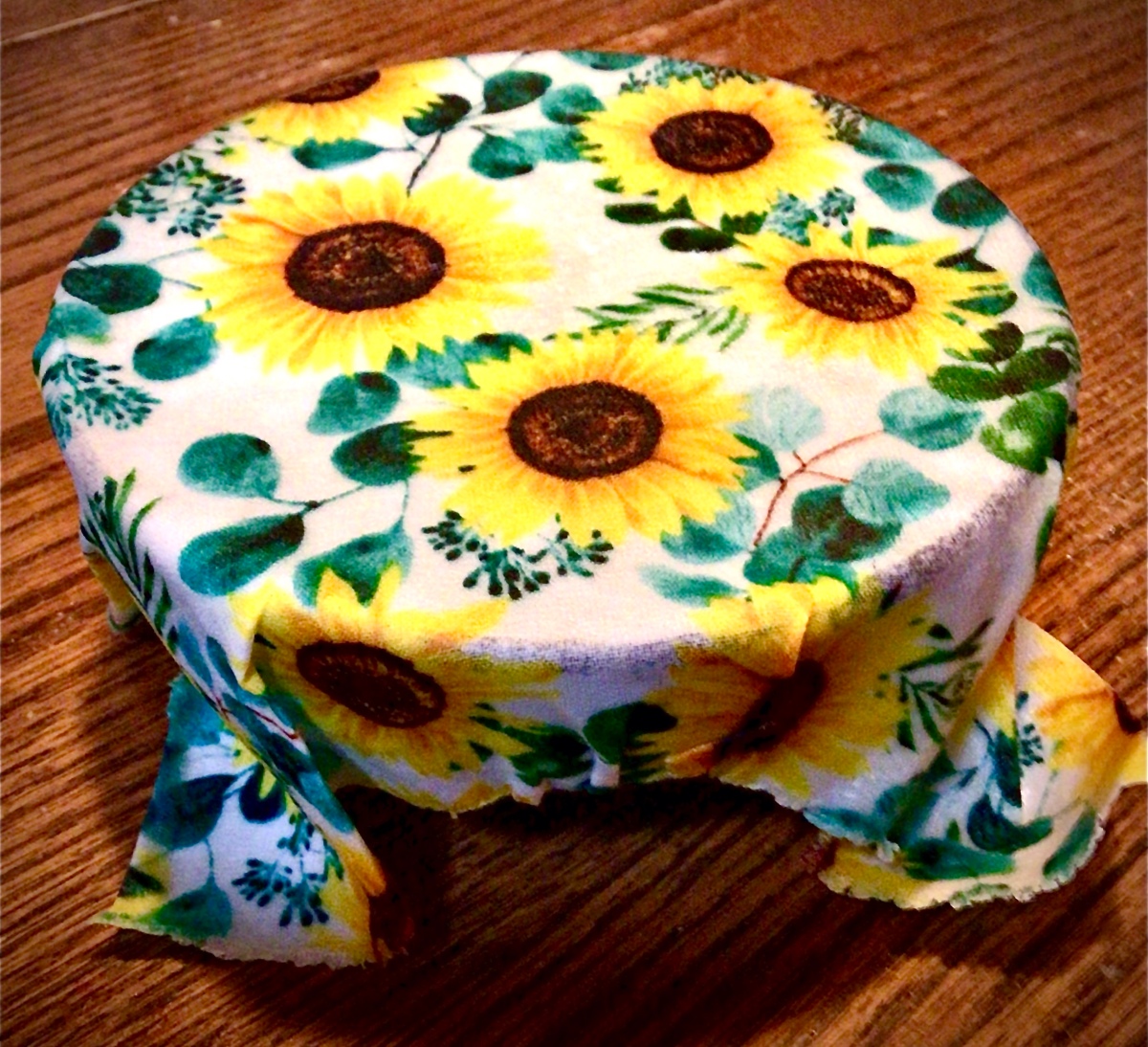
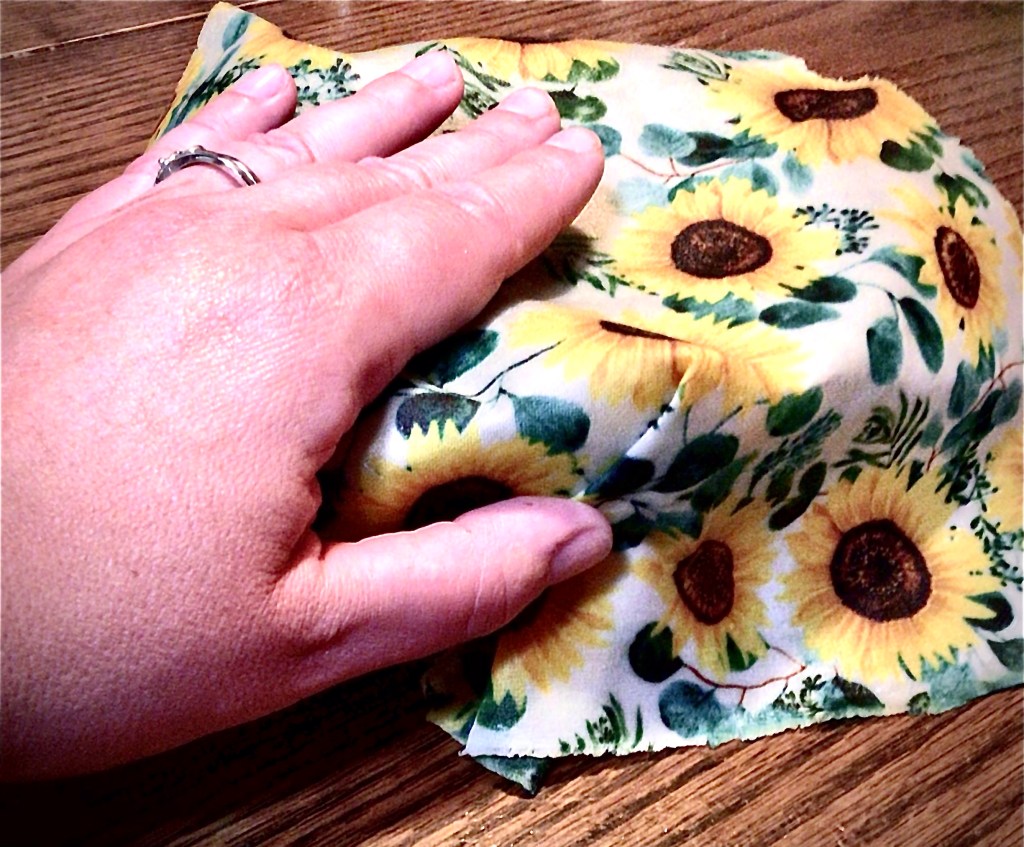
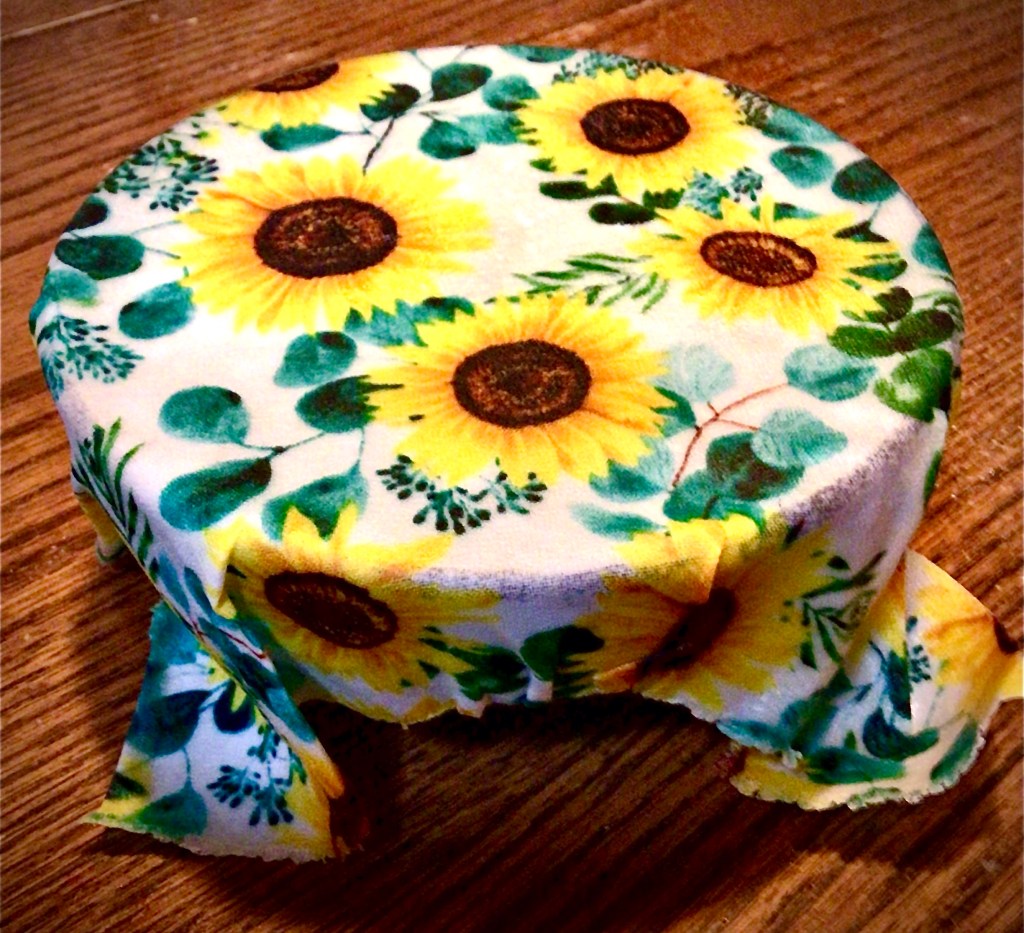
As I mentioned before, I wanted these to use on bowls that I do not have lids for. In this example I have a standard glass coup bowl and my small wrap. Simply place the wrap over the bowl. Then press the wrap down much like a sheet of press and seal food wrap.

The heat from your hands is what softens the wax. Its tacky nature naturally sticks. To be fair, the wrap sticks better to itself over the smooth edges of a glass bowl.

I found that just pressing the wrap down formed less of a seal and more of a fitted cap of a lid.

For better results, crease the wrap and seal it on itself. As in the case of this bowl, the folding of the fabric and making it taper down the side of the bowl, this tapering down gives the resistance for the wrap to stay firmly secure to the top of the bowl.

But the wrap doesn’t need to have a structure to seal up. You can have the wraps become its own container and never have to buy a sandwich bag again.

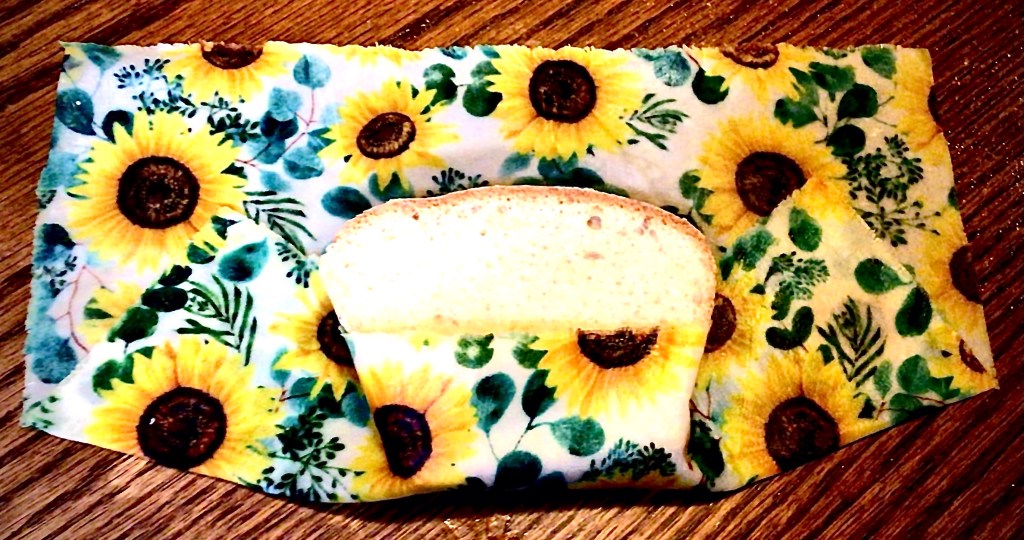
Simply lay your sandwich in the center of a wrap and seal it to itself.

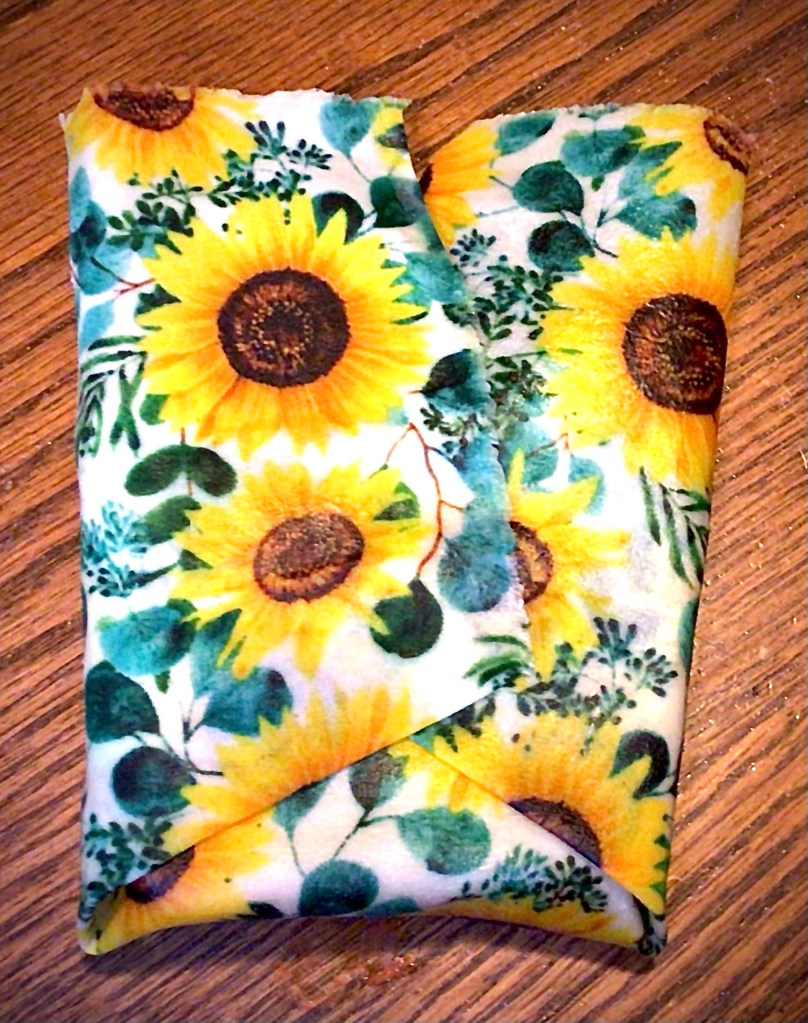
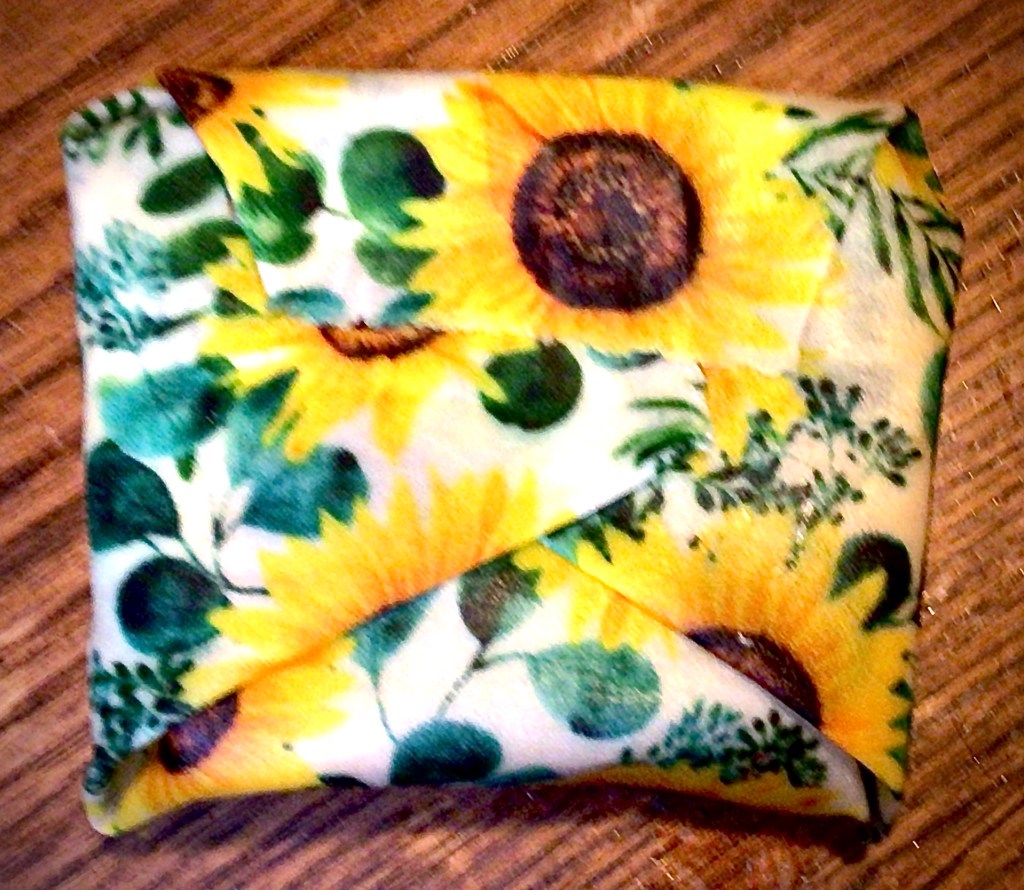
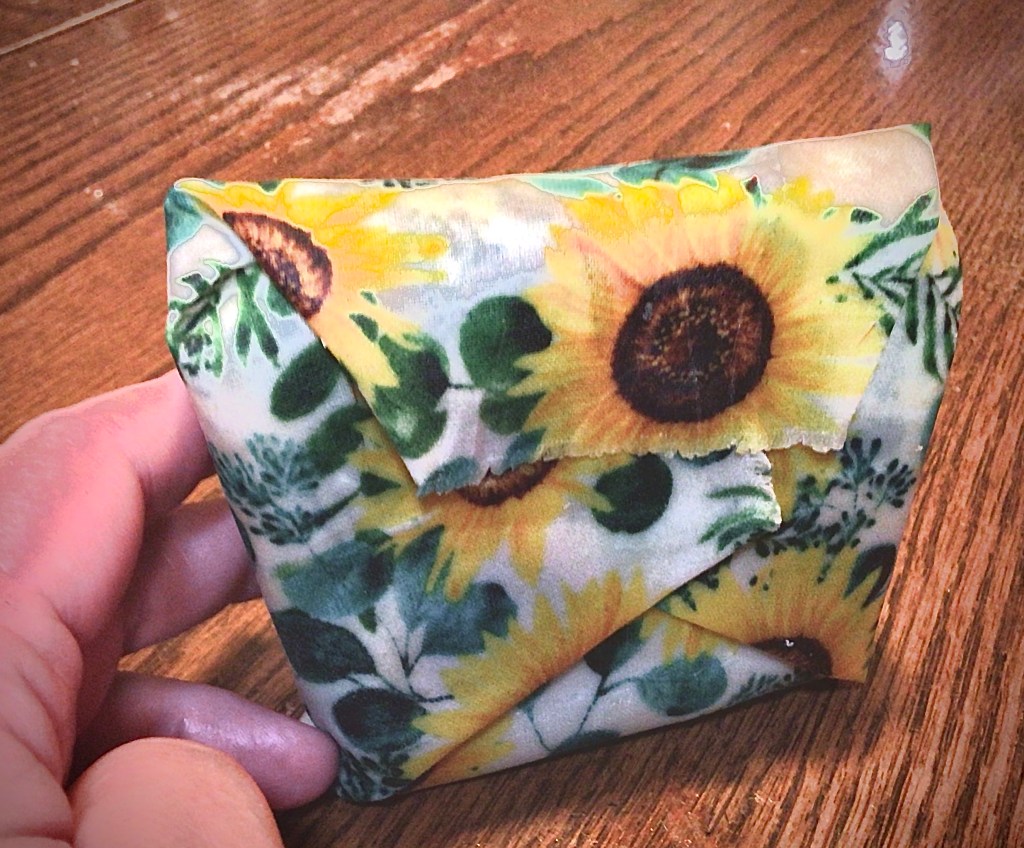
In the second picture, I folded the bottom of the wrap up and pressed the fabric down the sided of the sandwich and pressed the fabric into itself to create a seal. The sides I folded over over and the top down.

In this last picture, I wanted to show you that even when I stood the sand which up, it did not unwrap himself at all!

Again, these are only a couple of ideas on how to use these. Another idea is on a hiking trip. If you forgot to bring a foraging container, but saw something you wanted to gather, you could pinch together the sides of a wrap and make a little basket.

This is genuinely one of those kitchen utensils that have many uses and are user friendly.

For those of you who are local, come by the Maker’s Market on October 7th and you can play with the demo wrap and see just how user friendly these are!


Leave a comment

Processing…
Success! You're on the list.
Advertisements
Advertisements
Advertisements
Advertisements