Baby Spiders

I love my outdoor plants. And often I’m asked, “Is there anything you don’t grow?” For me, the struggle is real when it comes to indoor plants. I pick up in the language of outdoor plants. I think I get confused when it comes to the dialect of indoor plants. “What are you telling me?!”

It was this past year when I was gifted me a clipping and an indoor propagation unit that I decided to give indoor plants another whirl.

Back in August I was thinking of winter months, being shut in with no fresh air. So I picked out a few end of season clearance plants that are known for being air purifiers in the home.

One that I bought was a Spider Plant (Chlorophytum Comosum Vittatum).

This is a great plant for those who struggle to keep indoor plants alive. We were gifted with a spider plant back when I was an event decorator and my hours were horrible. That plant lived for about two months of forgotten watering before it finally gave up on me.

I picked a spider plant this time around because of how hearty this plant is and it deals with neglect better than other types of indoor plants. Plus, with my homeschoolers who love commandeering my indoor plants and calling them theirs, this is a great one for young kids to learn about plant care with. My kids love over watering and this one loved their over attention

In fact, after the fourth or fifth time I had to empty my overflow bowl from a standing puddle, I noticed that this spider plant had started producing baby plants. The day after the first baby showed up, a second formed. And about a week later two more popped up.
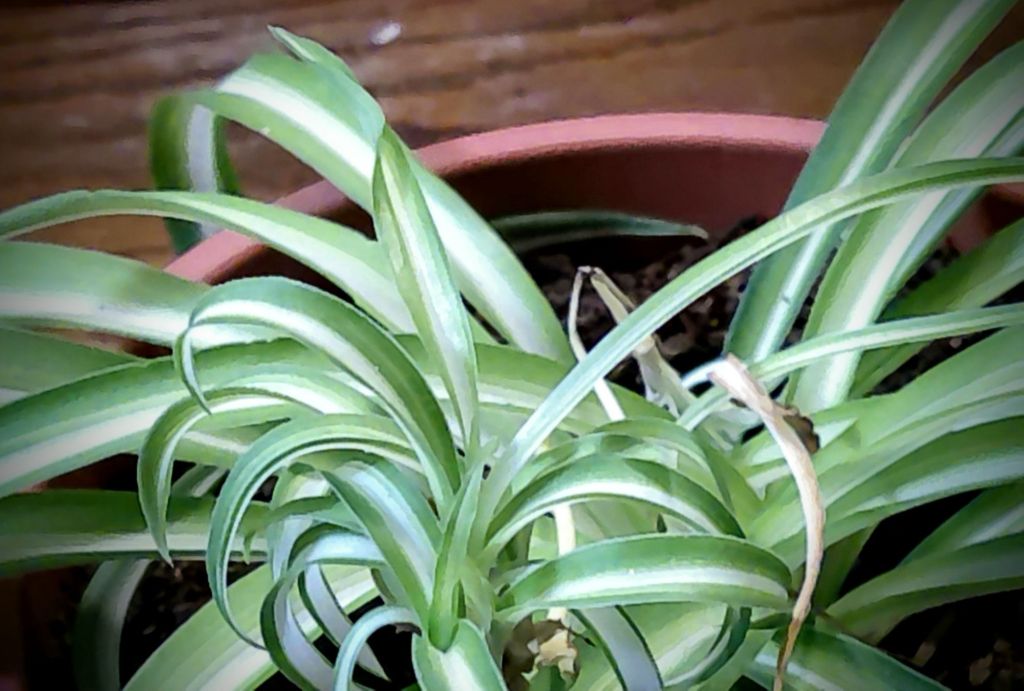
I wasn’t counting on this plant living our home so we’ll to put off four babies almost right away. But since I’m now part of a bartering group, I figured that nurturing these babies over winter will give me four plants to barter with come spring. Or seeing how the boys have taken these baby plants over, I’ll let them take them to an event to barter with. (It’s a life skill that they’re starting to become comfortable with.)

Advertisements

How To Propagate the Babies

The first thing you’ll notice growing from your mother plant, when a baby is going to be produced, is a long rigid stem. Have you seen a rigid stem of an orchid? The baby spider stem reminds me a lot of an orchid stem. On this end of the stem, you will see a miniature spider plant start to sprout its leaves.

At this point many people say that you’re supposed to bend that stem over toward a new pit, set the baby in that soil, and stake it down until its root system grows. Then you can cut the stalk.

The reason for not cutting the stem first is because it acts like an umbilical cord and gives the baby spider plant nutrients while it grows its root system.

That way makes sense and I’ve seen it done as a child. But I didn’t go that route with propagation this time. I tried to wait and let the stalks grow so that they were long enough to lean over into a new pot. None of these stems grew longer than 9 inches.

Instead I went with the Water Propagation Method.
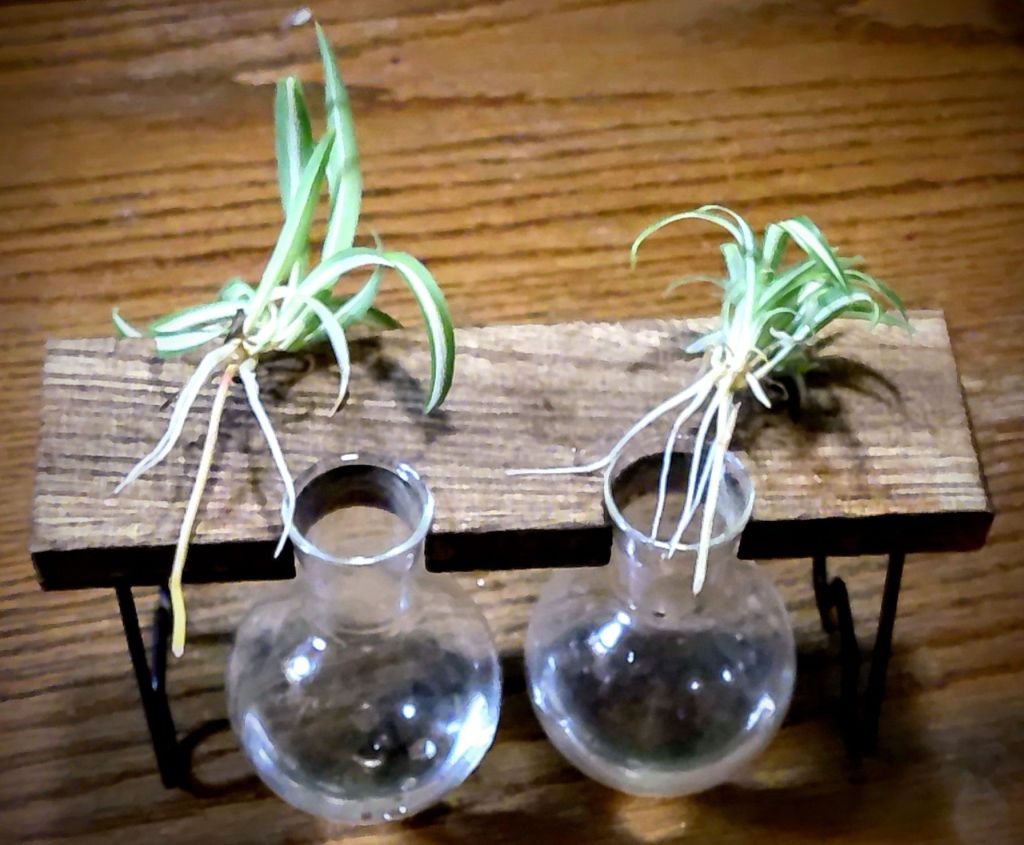
Here you can see the root growth from the Water Propagation Method that I started 4-6 weeks ago. I cut the stem of the baby spider plant a few inches long and then place them in these water propagation tubes.

The trick with this method is keeping the water level up to the base of the leaf cluster. As you can see from the pictures, this is where you see the root growth coming from. By keeping the water level high, it ensures that the emerging roots have contact with water at all times.

From there I simply place the stand in a window so the plants get sunlight. And then I wait for the roots to grow.

Here you see the far right and far left plants are the babies that I rooted several weeks ago and I’m ready to put them in soil. The center two babies are the ones that I just cut from the mother plant and are now ready to start the rooting process. I wanted to show you these side by side so that you can see the stems (which on my plant are a pale yellow) in comparison to the new roots (which are white).
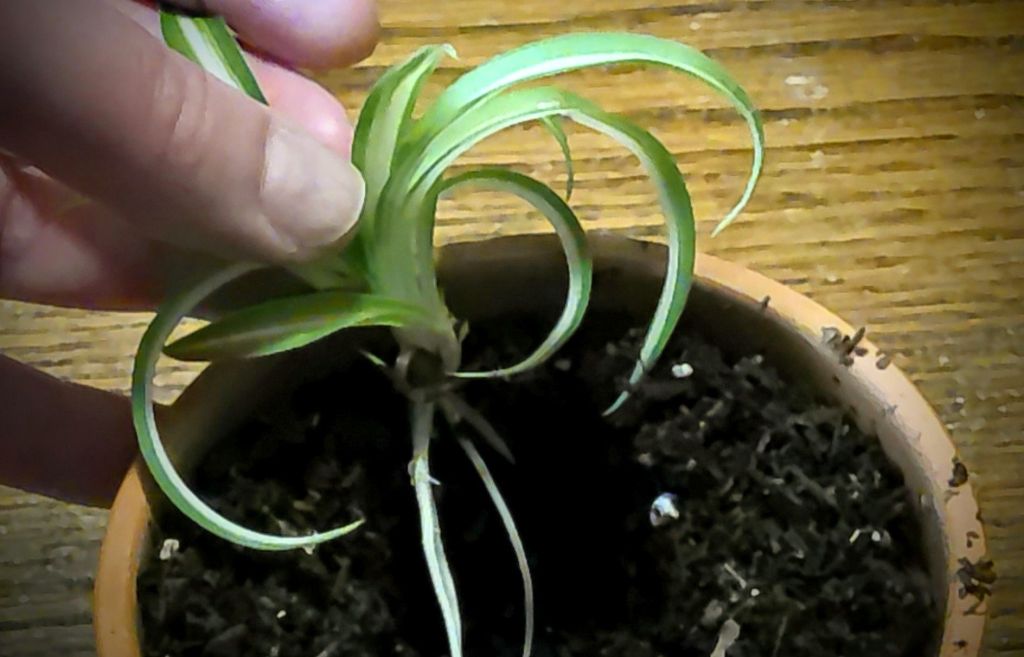
With these newly rooted baby spider plants, I put some potting soil in a clay pot. I hollowed out the center of the soil, where I want the plant to sit in the soil. (I create the hole for the roots because they are tender and I don’t want to damage these young roots. After a few months, when I’m ready to repot, I’m not as concerned with the roots because they’ve had a chance to establish themselves in the soil. For now they are going to go through a little shock because they are changing from water to soil environment. Their function is going to change in this new medium.

While holding up the leaves of this baby plant I fill in the hole (with the roots held in place below surface level) with more potting soil. Once the hole is filled, I gently pat the soil down to give the plant a little stability. Not much is needed because these roots are around 2 inches long (some a bit longer).

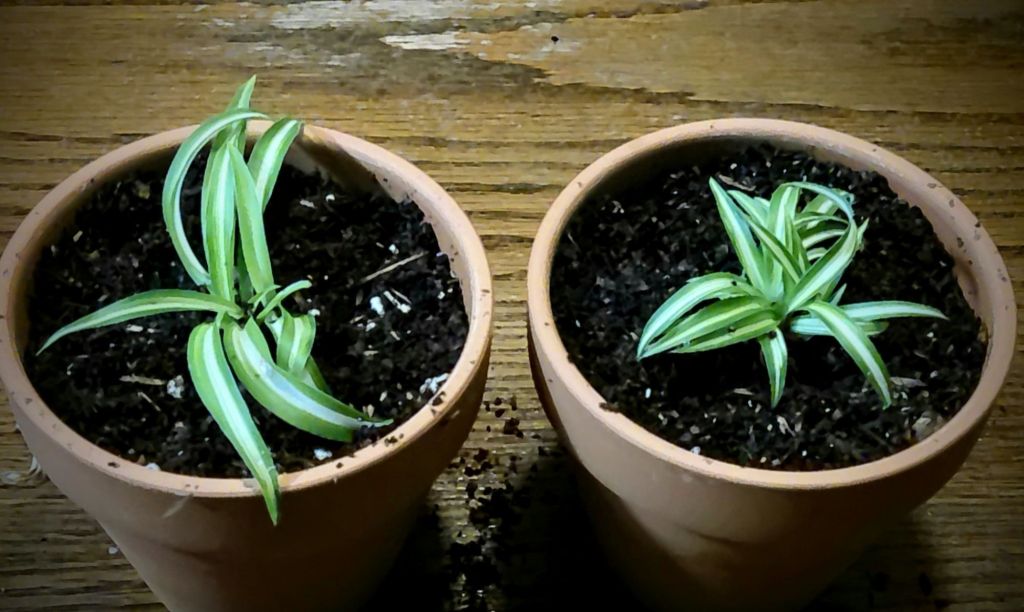
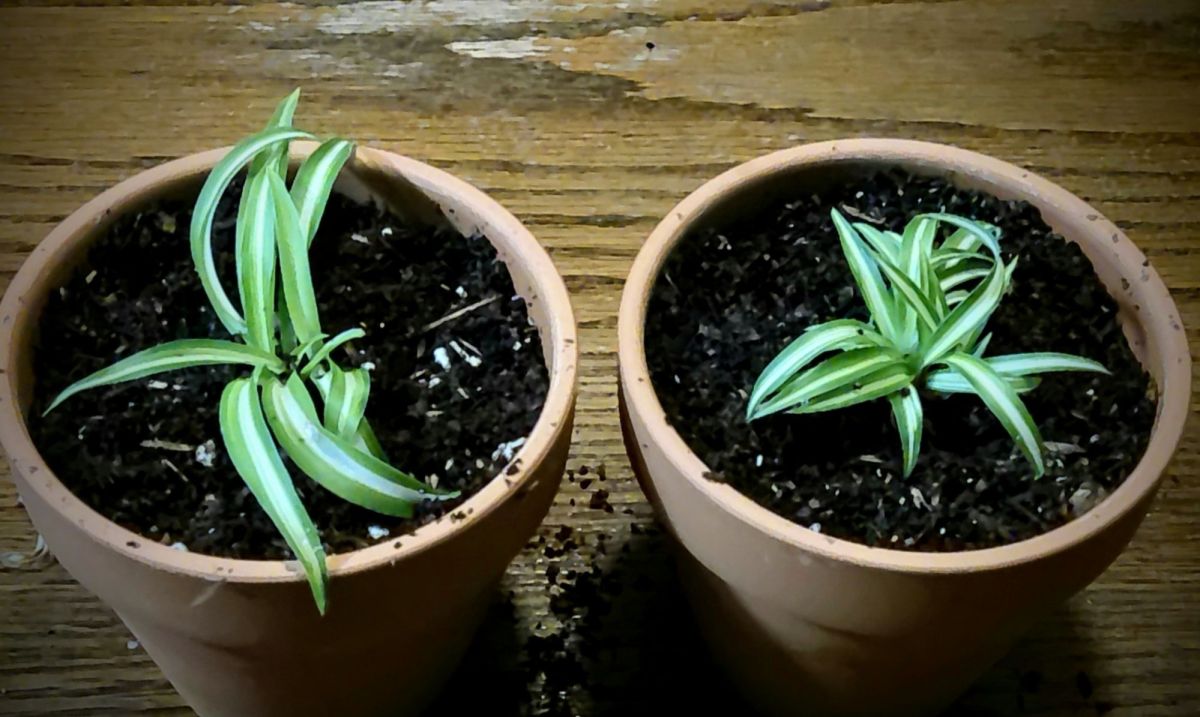
And here are how my new baby spider plants look in their new 4″ terra cotta pots. I gave them a bit of a watering and then set them back in the window.

Other than the time it took to allow the roots to grow, the setting up of this propagation took less than five minutes. And potting the rooted baby spider plants took another 5 minutes. This is something that doesn’t require much of your time, if you have limited time to care for indoor plants. And with spider plants, I water mine once a week. It’s been about 4 months since I first brought the mother plant home, so on my to do list is to give them a good fertilizing on their next watering.

Advertisements

Word of Warning for Propagation Equipment

This water propagation set up was gifted to me from a friend who hated it. It was my “transportation” unit for taking home a clipping of another plant for my drive home. After working with this stand for a year now, I fully understand why she didn’t like it. And yes, I am still that type of person that still uses it even when I hate it myself.

I look at it as a personal challenge to make it work!

If you’re looking to water propagate plant cuttings, let me walk you through this set up so you can have a little walking knowledge for choosing the set up that you end up purchasing or getting from a buy nothing group, or any other opportunity.

The reason why this stand is such a fail is because of the holes that the tubes slide into. In the above left picture you can see that the center of gravity of the holes are way off. They needed to be set back into the center of this board.

You can probably guess that when these tubes are filled to the top with water, they become front heavy and tip forward spilling water and cuttings everywhere.

In fact, in just this short period of time that I took to take all the photos for this post, the filled tubes fell forward not once… but twice!

To make matters even more entertaining, my husband decided to watch the process and freaked out with each of the dumpings. Water spread not just all over the table but also the floor. And that leads to the picture where I put the pot in front of the filled tubes. As much as I enjoy a good challenge, I really didn’t want to clean up a third water mess.

Advertisements

And that leads me to the solution of how I make this failed unit work for me.

When I have a new set of clippings to add to the tubes, I set the rack down in the window with the tube side facing the glass. When the rack leans forward, under the weight of the water, it leans into the window and holds itself up.

There are two other options that I have to fix this unit once these baby spiders are ready to be potted.

  1. I’m going to check to see if I have a drill bit that’s the right size so I can make the hold deeper into the wood so the tubes sit more center in the unit.
  2. If that doesn’t work, I’m going to take some thin crafting dowels and put legs in the front corners.
  3. And in case I need a third option… I’ll drill a hole in the back corners that’s big enough for a long screw that I can add enough nuts to create the correct counter balance to keep the unit upright even under all the water weight.

No matter what the situation, a solution can be found!

Advertisements

Final Task before Putting All the Plants Away

This mother plant has been so amazing to me that I just needed to take a couple of extra minutes and tend to her so that she can keep being a happy plant for me. I trimmed away some of her discolored and battered leaves and cut the remainder of the baby stems down to their base.

Why the trimming?

The stems were no longer supporting baby plants, so they no longer needed the energy being directed to them. The leaves were damaged and there’s no need for plant energy to go to them to see to the trauma. The overall health of the plant is very good and with plenty of healthy leaves, trimming away what I did would not affect the photosynthesis of the plant. But the trimming returns that amount of energy back to the mother plant to go elsewhere: whether new leaf growth, existing overall grown, it’s cellular immune health, or even gearing up for a push of new baby plant growth.

This mother plant is now ready for the next phase of whatever cycle she is on to now. And with the next watering combined with fertilizer, she’ll have all the nutrients she needs to move forward.


Here are some propagation units that I’m eyeballing for my next adventure in rooting plants.

I have not had a chance to see or use these units, but I wanted to share with you what other ones I’m looking that you can have an idea of what is out there.

This post contains affiliate links to products. We may receive a commissions on products purchased through these links, but at no extra cost to you. These items listed here are from Amazon but may be purchased at local markets.

3 Test Tube Glass Planter Terrarium Flower Vase with Wooden Holder

Plant Propogation Tubes, 2 Tiered Wall Hanging Plant Terrarium

Leave a comment

Processing…
Success! You're on the list.
Advertisements
Advertisements
Advertisements
Advertisements

Ombre Fun

While I made a component for last weekend’s Maker’s Market I played with glitter. I slowed down my mass production to share an easy way of creating an ombre effect that’s nearly effortless and will take every time for me.

The secret is all about your glue choice.

Growing up I always used Elmer’s Glue for sticking power. For ombre work, I find it’s the worst glue. There’s a few reasons for this, but for me the biggest problems I had was holes between two colors, awful looking clumping, and stark lines that just looked weird.

I’ve switched to using cheap watery glue instead.

Have you ever watched a professional cookie maker flood the icing to get that smooth design? Using watery glue has the same effect for creating glitter ombre!

So whether you’re new to crafting with glitter or use glitter on everything, more fluid glue is going to be your best friend. You can glue the sections you want to use one color glitter. Or you can lay down all your glue at once. The fluid movement of this type of glue is going to cause the glitter to drift a little and cause a natural blend. Not only that but if you have to go back in and add more glue because a spot was unexpectedly dry, a single drop will fill that hole and spread into the already laid glitter with no gaps.

Advertisements

Laying Down the Glue All at Once

This is my favorite way of doing ombre, particularly because I want to move quickly and optimize my production time.

First I get my glitter selection lined up. This is what allows me to lay a handful of colors while the glue is still wet.

Before I lay down the glue, I also decide which direction I want my colors to run; horizontal, vertical, or diagonal.

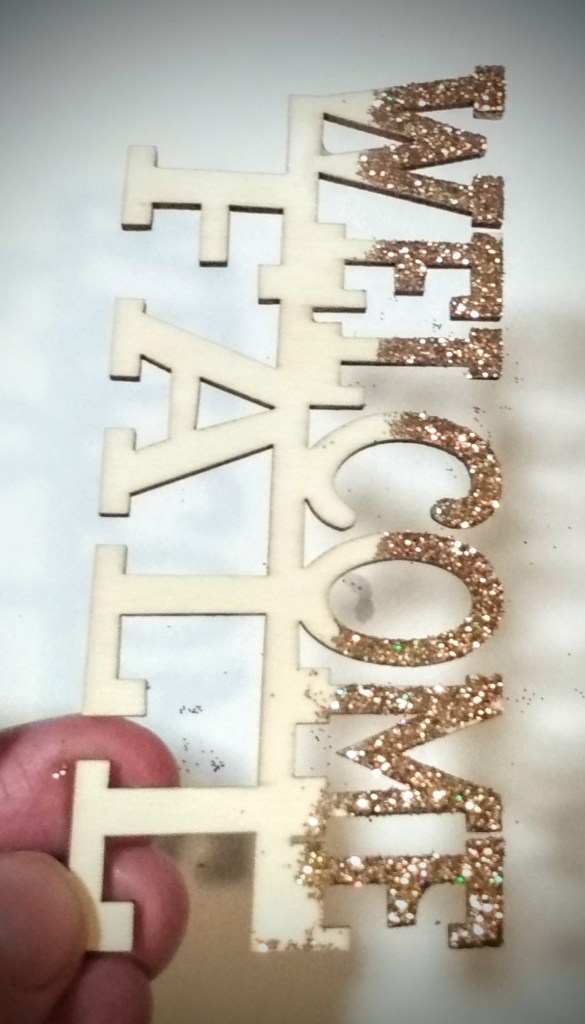
With that all prepped, that’s when I go ahead and lay the glue. I start at one end of my element and shake the glitter side to side to make a straight line. (Or a zig zag if I want peaks and valleys.)

If I’m going to make my own color blend, I’ll go ahead and shake out all the colors at once, without stopping between colors to put them back in their containers.

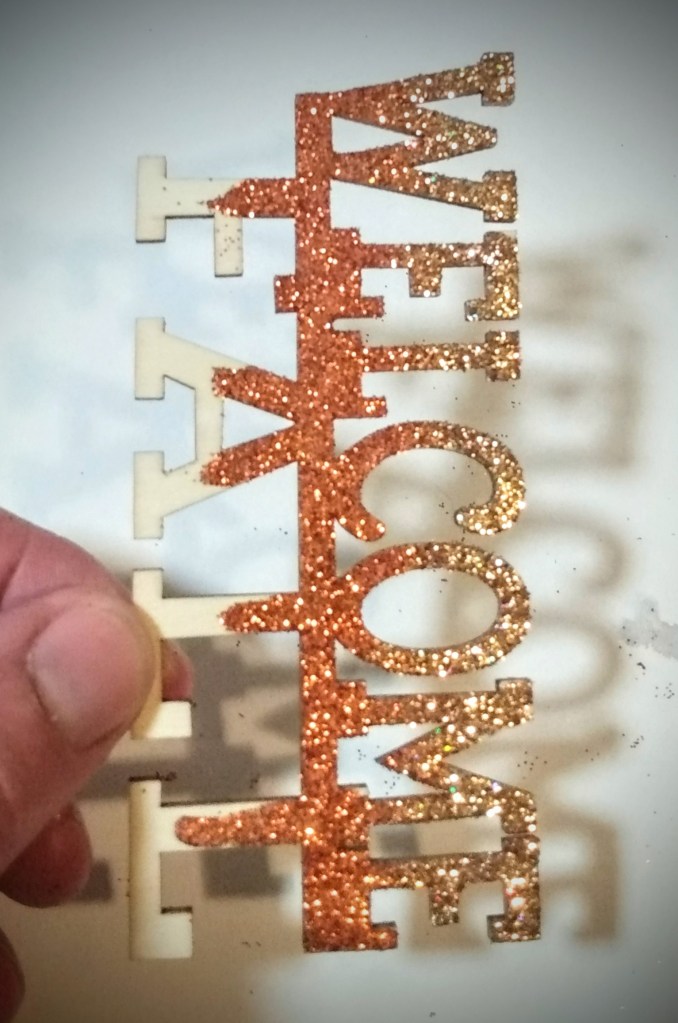
However, if I’m keeping my colors true, then I’ll lay that first edge color. Then shake off the excess with the glitter side down. Put the glitter away. Then grab the next color, shake out that next line. Shake off the excess with glitter side down. And repeat the whole process until all my glitter is put away.

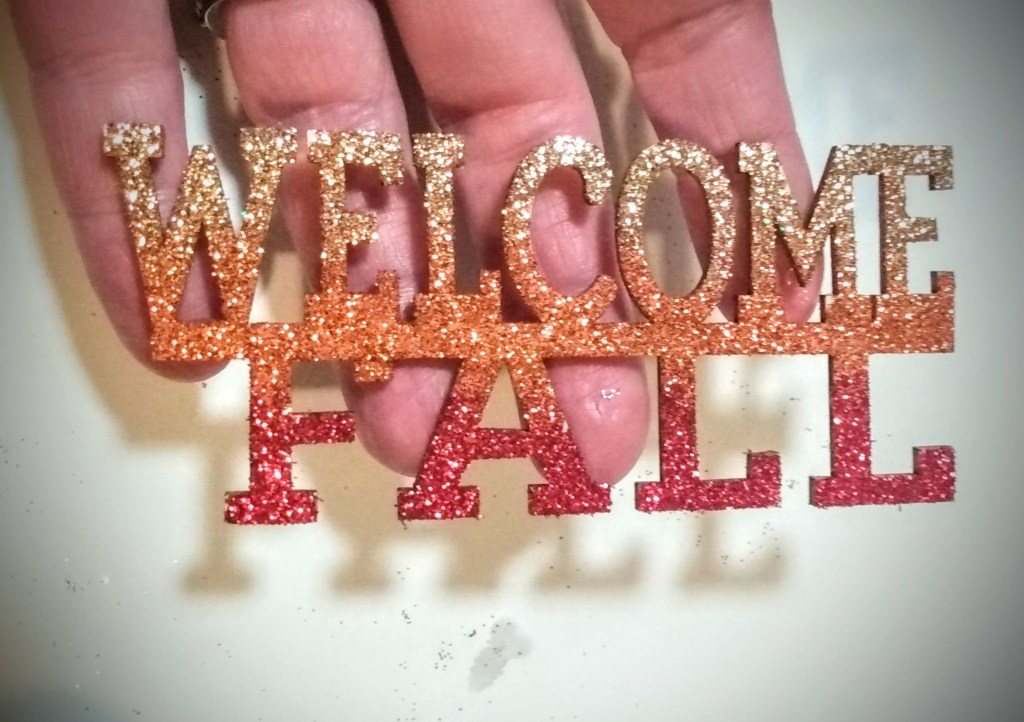
Just so that you can go into this with confidence, I want to share with you the colors that I used here in Welcome Fall. The first color I used was a pale gold (as opposed to the bright and bold gold you usually see during Christmas). I followed that up with a bright pumpkin orange. And the final was a cherry red. I didn’t have concerns with the gold and orange because they had a similar base color that matched perfectly. The red doesn’t look bad here. I pulled it off in the final project that this was going on. However if you ever find that you’re questioning your color choices before you glue, I highly recommend taking some of the neighboring color and adding it in with the color you are hesitant with. This will tone down, and help bring the color into the family.

OR… another option, which you’ll see in the second picture above, let your middle color slide down on the glue and creates a drip effect. This will help from creating a stark line that can potentially form with colors of glitter that compete with each other.

Advertisements

Making Your Own Blend

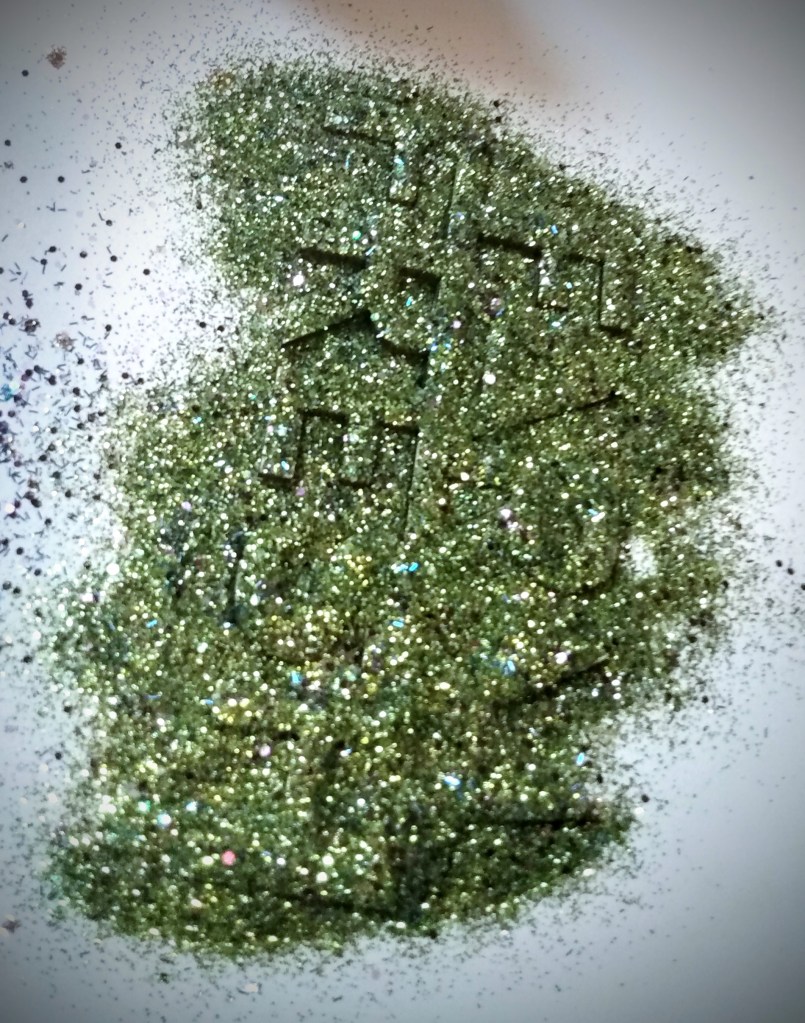
As I mentioned above, you can blend your colors together. This green that I made is a perfect example of what happens when you blend.

The only green glitter I had on hand was a lime green that I bought from a spring line of glitter. There was no way that I could make that Easter egg green work in a fall theme. So I grabbed my blue and purple glitters to blend a darker green. If you look closely at this picture, you might be able to pick up the different colors. Around the middle, you’ll see some grains of blue that has a turquoise to it. And then around the perimeter you see the darkness of the purple glitter.

Maybe, you don’t want to make your own darker shade of green. Maybe you want a different color. How do you mix it?

Think about mixing paint and how when you use primary colors (red, yellow, blue) you make secondary colors (orange, green, purple). Glitter is going to work in the same manner. The big difference is that you’re not changing the individual grains of glitter to a new color. You’re creating the illusion of a new color by mixing different colors.

For the green that I made, I used the blue to take away the brightness of the lime. These two colors still have a fresh spring green color, so the addition of a darker color, like purple, makes the green dark. I didn’t use precise measurements. I added a little bit at a time so I don’t use my whole glitter stash and run out of colors to make corrections. Over all, it came down to the ratio of the lime taking up 50-60%, blue 30-40%, and purple 10-20%

The cherry red that I mentioned earlier, I partnered it with maroon that I absolutely love. The thought crossed my mind that I might need to make more of it because I bought it last fall and haven’t seen it since. My plan was to take the cherry red, mix a little bit of navy blue glitter (bright reds have an orange base and rich reds have a blue base–my reason for adding blue), and then black to get the red darker without changing the base color of the read. Brown would be an option if I wanted a lighter maroon. But for this dark maroon, black is the go to glitter.

The added bonus of mixing your own glitter blend is that you add dimension and something dimension to look at. Don’t get me wrong, glitter is enticing enough on its own. But the next time you play with glitter, mix a small batch of a color and look at it in comparison to the original flat color. You’ll understand what I’m talking about when it gives you something a little more.

Other Ideas

Before I close this post, I want to offer one more idea of what you can do to give your glitter work some dimension and adding a little “extra” to your work.

Take a look at “Give Thanks” in the picture above.

This one is a bit more subtle than the striped ombre, so you may need to get a closer look at this wooden tag. The picture doesn’t do it justice in comparison to what it looks like in person. But this is two different shades of gold. The darker (and more orange) gold is applied as a shadow on the left hand side of each of the letters.

Earlier I mentioned shaking glitter in a v or w shape to create a chevron pattern.

You can easily make poke a dots by dropping spots in one color and then surrounding the dots with a different color.

Feel free to not just play with colors, but also experiment with shapes and patterns. Depending on what pattern you’re making, you may need to be specific with how you lay down your glue. But there is no reason why you can’t make leaves, plaids, or anything else in glitter. If it becomes difficult to maintain shapes, take breaks between your layers. This will keep the glue from running and distorting the shape/pattern you make.

Advertisements

A Finishing Tip

The one disadvantage to working with fluid glue is that your glue might shed glitter because it doesn’t have the stick to keep the glitter in place. There are a couple of options that you have to seal in your glitter to minimize or eliminate shedding.

The first thing that I used, many many many years ago, was hair spray. This has the least about of stick out of the options I’ll share. It’s great if you’re in a pinch and don’t have any other products on hand. But the only shedding this is going to stop is contact shedding when you tap it. There will be some transfer if you run your finger in the glitter.

I love using clear acrylic spray! This is a great sealant that dries in a couple of minutes. The disadvantage is the fumes. But those disappear when the spray paint cures. I really don’t notice glitter loss through touch or contact/tapping. The finish is also the best option. However, you might see a dulling of the glitter’s sparkle depending on which brand you use.

If you have the time, polycrylic paint is the best as far as it goes to completely seal in all the glitter. This can be the determining factor if someone in your house, or the person you’re gifting too, hates glitter with a passion. This is completely sealed and there is no glitter loss. Just be aware that the fumes are strong and curing can take 24-48 hours. But the fumes will dissipate. I highly recommend that you dab polycrylic on. If you try to brush it on, you will get streaks, glitter will clump on your brush, and there will be brush tracks in your glitter.

How do you like using glitter?

Leave a comment

Processing…
Success! You're on the list.
Advertisements
Advertisements
Advertisements
Advertisements

Quick Accent Piece

The one thing about approaching holidays is that you really get smacked in the face with everything that needs to be done.

Whether you’re decorating sideboards for an Easter get together or just looking for something quick that fits in a space as small as a window sill to add a little color before spring finally unfurls. This quick craft is for you.

What you need:

  • 1 Stemless Wine Glass
  • 1 Bag of stones 18 oz/794 g
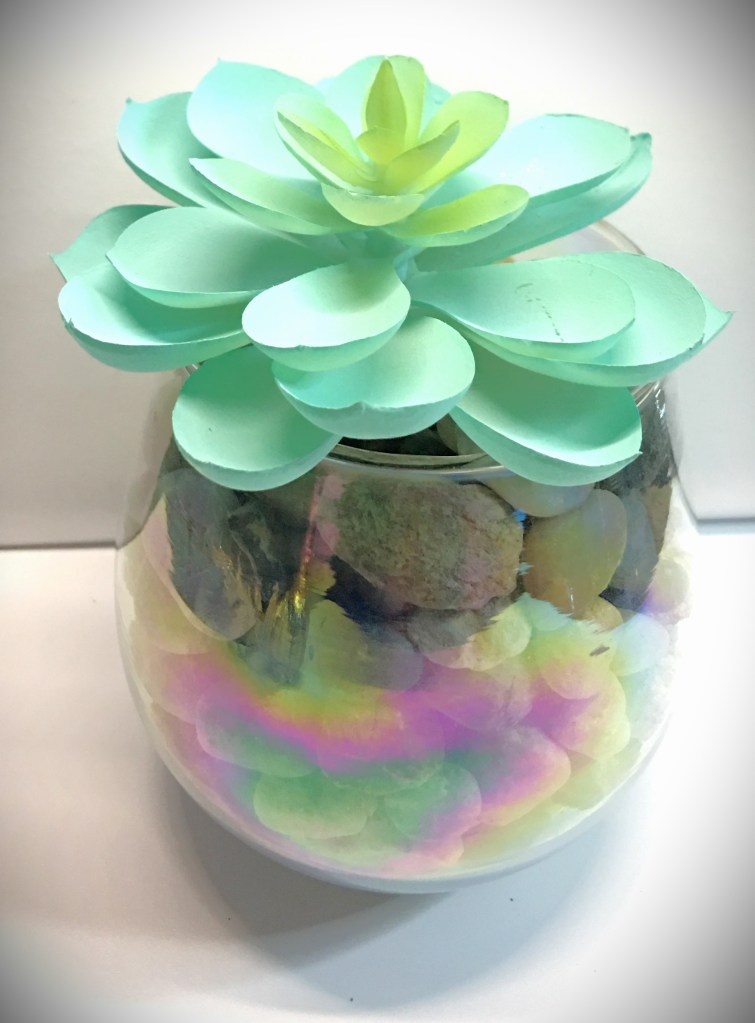
  • 1 Faux Succulent
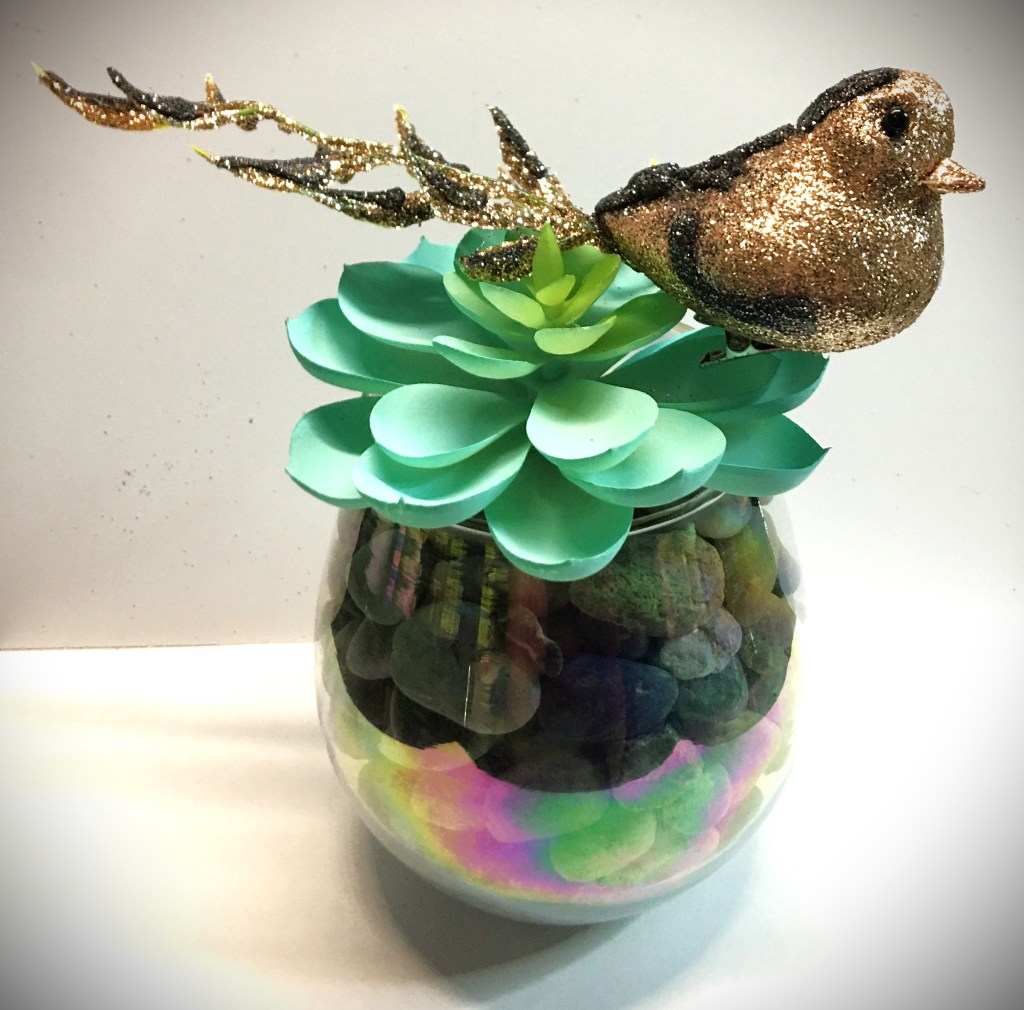
  • Any other accent piece that you would like to add (I chose a glittery bird)
  • Glue Gun
  • Accent Glitter

5 Minute Version

If you just want to toss something together, all you need is the glass, rocks, and succulent.

The succulent that I chose had a very thick stem. Because it was sturdy, I could pour the rocks in the glass and push the succulent stem into the rocks and moved on. (If the rocks have resistance, give the succulent stem a little swirl and it will sink right in.)

For whatever reason if the succulent just does not want to go into the rocks, never fear. Pour out the rocks with the exception of some in the bottom (or the level that you can easily push in the succulent). Then lift up the leaves on one side (and then the other) to add the stones in, around the stem.

Want to use real succulents?

You can do this using a real succulent of your choice. Make sure you verify if the succulent you want to use can life in rocks or if it needs cactus potting soil.

If your succulent needs soil, but you prefer the look of the rocks showing through the glass, you will need to take a little extra time layering the rocks outside and putting the soil in the center

Advertisements

Ten Minute Version

Follow the directions for the 5 minute version to get the glass filled and succulent set. The remaining time is dressing up accent piece that you are adding.

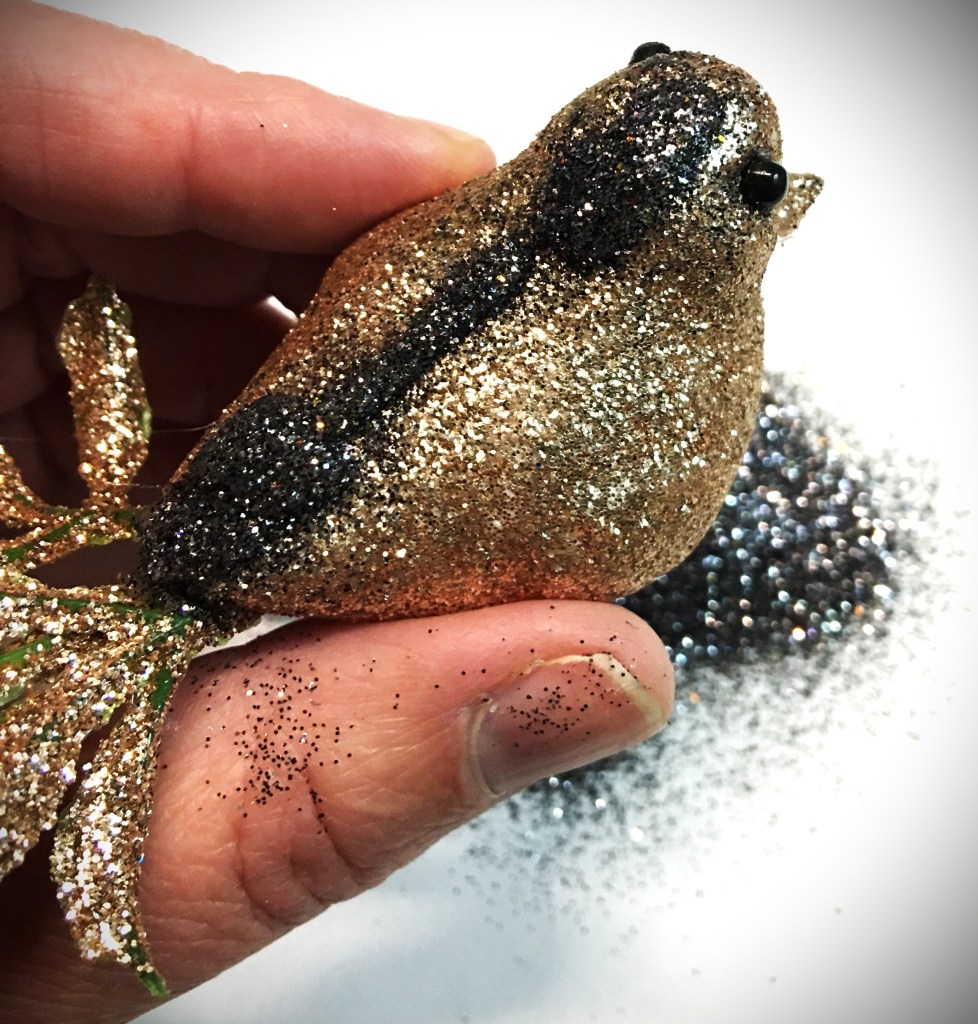
For example, the glitter bird that I’m using came from the dollar store and I wasn’t 100% satisfied with it. If I had feathers in my crafting room, I would have added feathers for the wings as well as the way it was set up with feathers on the tail. Unfortunately, I don’t keep feathers. So I needed to pull off the pink ones that came with the bird. The black eyes also seemed to stick out awkwardly. To remedy this, I grabbed my glue gun and black glitter and added glitter detail work to add dimension and character to the bird.


Thanks for spending a few minutes with me today. If you’re anything like me, you have a list as long as your arm to get done in less than 48 hours. My kiddos always look forward to a newly designed shirt. I haven’t got a fully developed idea for that yet. But I do have a spring edition ready to go dressing up some sock bottoms. They enjoyed the ones that I made for them for christmas. So I thought I would make a few more for them. You can check out sock designs here:

What are your Easter or Resurrection Sunday Traditions that you do with your family?

I’m always looking for new ideas!

Processing…
Success! You're on the list.

2 responses to “Quick Accent Piece”

  1. Naoma Avatar

    I truly enjoyed reading this article and learned some useful information. Thanks for sharing your insights with your readers.

    Like

    1. Pacific Northwest Event Design Avatar

      Thank you for reading and commenting. I love hearing from those who find me.

      Like

Leave a comment

Advertisements
Advertisements

On The Court

Winter sports have started and parents everywhere are volunteering for coach their kid’s park and recreation teams. And I am that parent-coach.

After spending quite a few years working with kids, you learn firsthand that not all kids learn the same way. But one learning style that all kids have in common is that they have to have a visual of some kind. And when you’re on a sideline, during a game, and you can’t walk out on the court/field to physically show your team what you want them to do, the next best thing is a whiteboard clipboard of your court/field. (So you don’t have to wait for school athletics for kids to be learn from this court map.)

For whatever reason, if you want to have the benefit of having a court/field dry erase board but don’t want to go through the expense of buying one, I’m going to show you a couple of different ways that you can make one rather inexpensively. (This is a huge perk for summer camps where counselors are coaching and you don’t want to worry about misplacing or breaking a nice board.)

Advertisements

Laminated Court

I went this route because I already had in my craft room a clipboard, laminating machine, laminate, paper, printer, magnets, white board pen, ink pen (you never know when you need an ink pen), and hot glue gun. All in all, for the materials I spent under $4. So this is really inexpensive and gets the job done.

First you either want to make or down load a copy of a basketball court (or any other court or field you’re coaching) and print it off.

Run it through a laminating machine with a laminate cover. And as soon as it’s cooled, this mock white board is ready to write on.

I can’t tell you how many different of these “white boards” I’ve made for homeschooling with worksheets that I want to use over and over again. Yes, some colors like to stain the laminate (red and blue are the two colors that cause problems in my house). BUT they’re super easy to clean up. Take a cotton ball with rubbing alcohol and you’re back to a crystal clear “white board”. And if you’ve ever found out that you grabbed a permanent market instead of a white board pen. Don’t worry! Rubbing alcohol will also take that right off. Or if you ran out… simply take a dry erase pen over the permanent marker and erase. The permanent marker comes right off! (It’s the same trick for with a real white board.)

Now I modified my white board. After my first practice I got tired of fishing my pen out of my pocket. So on the back of my clip board I hot glued a magnet for my dry erase pen and for my ink pen. I hot glued magnets to my pens, in a place where they wouldn’t interfere with how I hold my pens (near center, in the crook between my thumb and first finger).

Advertisements

Depending on your pen, hot glue may not work. Hot glue works like a dream on plastic finishes, but if you grab a metal pen like I did its 50/50 if the glue will hold. My pen popped off with a minimum amount of glue. This second time I used a very generous amount (where I had to wipe off a large glob of left over glue) and the magnet has stayed on the pen. My back up for another glue failure is to switch over to liquid cement glue that is formulated to work on metal and ceramic. I didn’t start with that glue because I didn’t want to rig up something to hold the magnet in place while the glue dried.

As you can see, I don’t have to worry about making sure I have pockets while coaching and my pens are taken care of without having to worry about tying my pen to the clip on the clipboard.

But what if you don’t have a lamination machine that you can use???

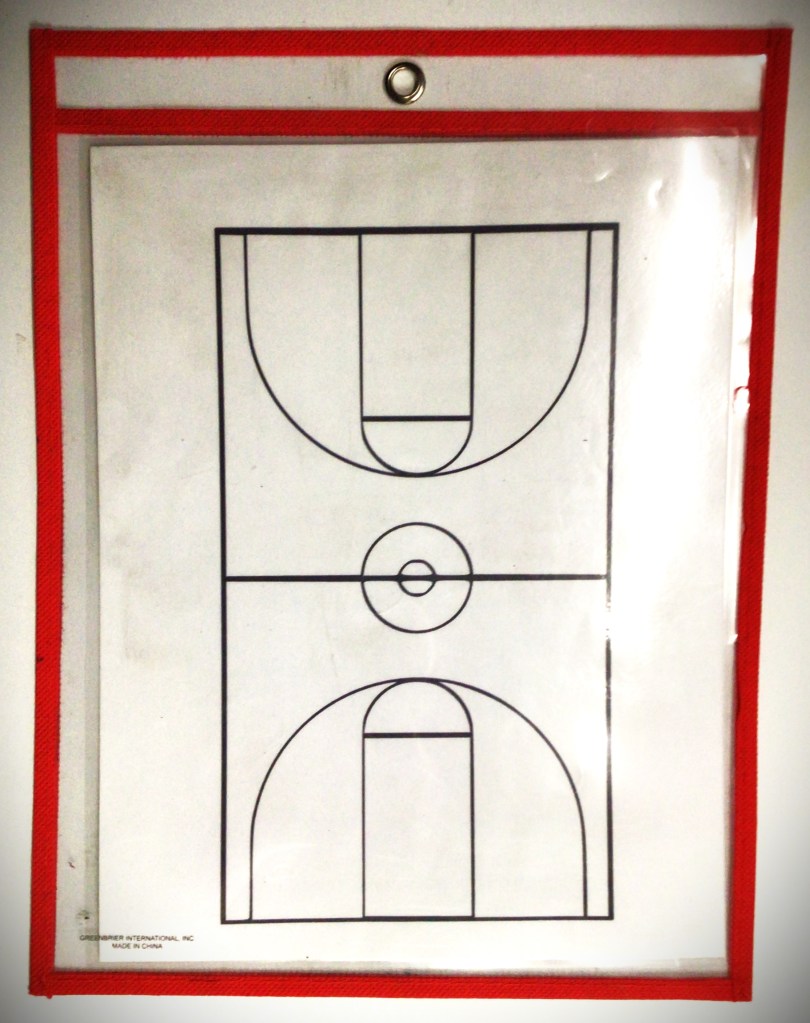
Plastic Holder

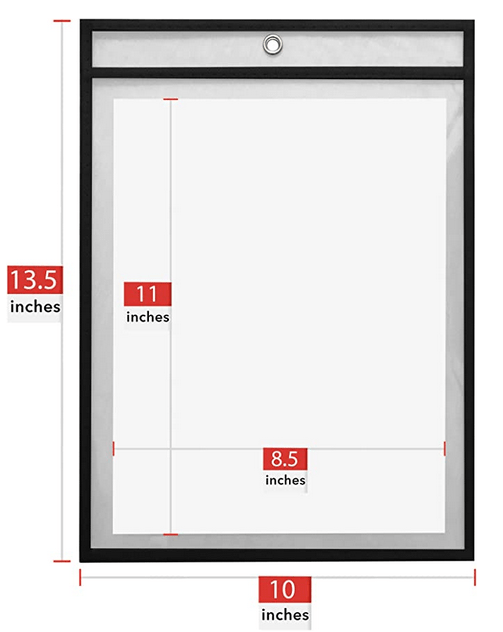
This one is another one of my homeschooling hacks. And I love it for absolutely everything, including a recipe protector in the kitchen if you have a sauce or frying and you get liquids flying next to your stove.

So far I’ve only seen these plastic holders at the dollar store. If anyone else has found them anywhere else (other than Amazon), please comment below!

But with this option, all you have to do is find a court or field that you want and print it out on a piece of letter sized printer paper and then you just slide it in. White board pens work on this plastic just the same as the laminate option above and white boards! So for under $2 this is really affordable for any scenario where your “basketball clipboard” will go missing. Or even if you have young kids who want to pretend play “coach”!

This option is also good if you want to be hands free coaching, but want your board with you. Connect it to a lanyard or a retractable key set on your belt loop. It’s handy when you need it and the pouch can also hold your pen.


Files Used For This Project

Don’t want to hunt down another basketball court image to print? You can use this PDF file here. Other sports fields and courts will be added to this link. If you don’t see the one you’re looking for, please leave a comment!

Other Items that may interest you

This post contains affiliate links that give us commissions on products purchased at no additional cost to you. These items listed here are from Amazon but may be purchased at local markets.

15 mm disc magnets I know these can be found in your local store. I used magnets, of this size, that I had found at my local dollar store (traditional black refrigerator magnets).

Processing…
Success! You're on the list.

Leave a comment

Advertisements
Advertisements

A Cup for Me and You

Being crafty, I love it when I have the opportunity to bring a craft to any of my kiddo’s class. This week I got to dress up and have fun in a 3’s Preschool Class for their Harvest Party.

Whether you’re a parent, teacher of a class, or helper in a co-op class, you find out real quick how quickly the sticker price adds up on crafts. Needless to say, a dollar store is very handy when gathering items for a craft, especially when you can find blanks that are in a bundle.

I found these cocoa cups and thought they were perfect for a craft. (The co-op preschool class that my kiddo is in is a wonderful blend where not everyone believes in celebrating all the holidays on the calendar. And I love these classes because there’s an opportunity to bring a little different.) So for this craft, I focused on embracing this comfort drink for the cooling weather.

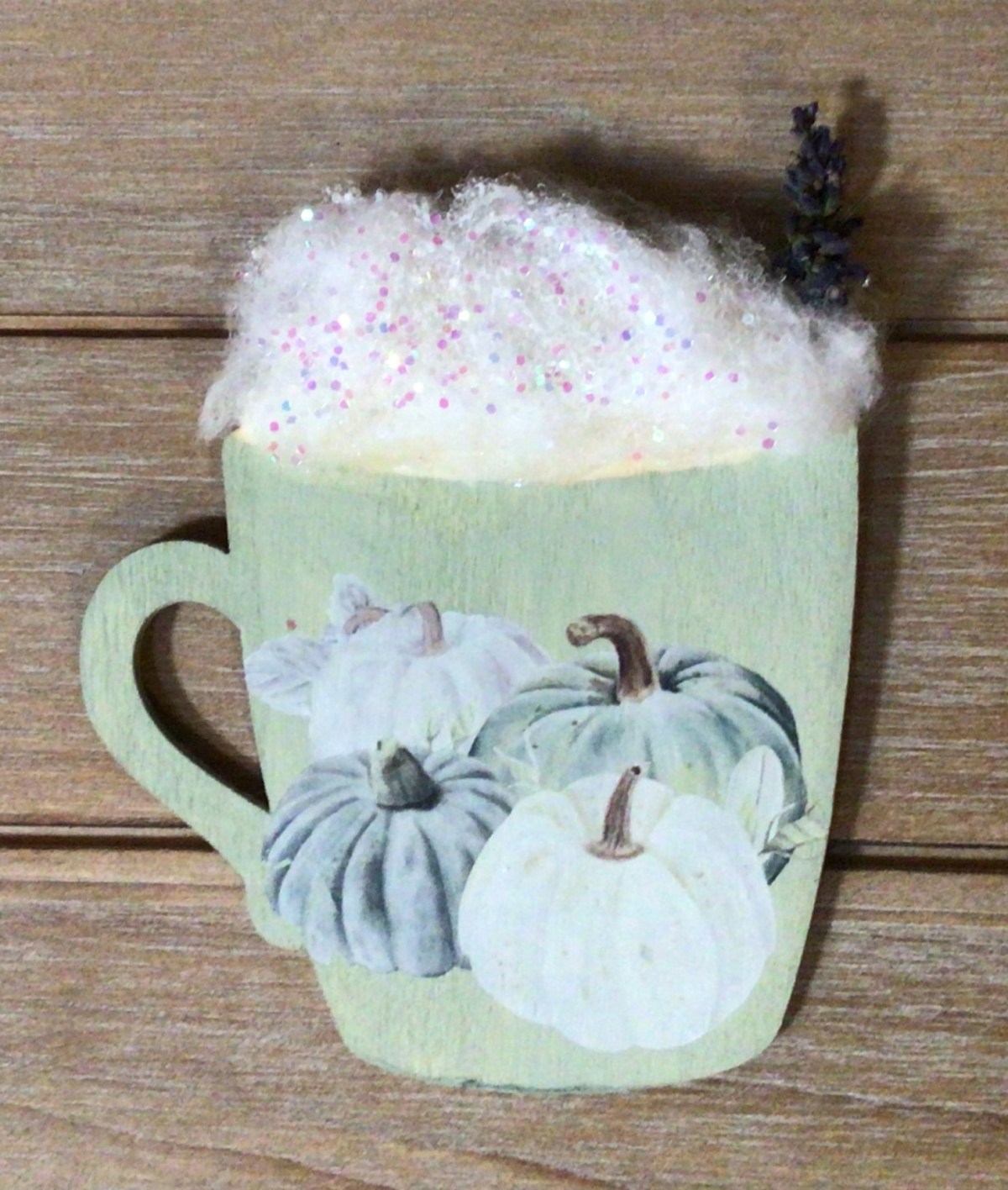
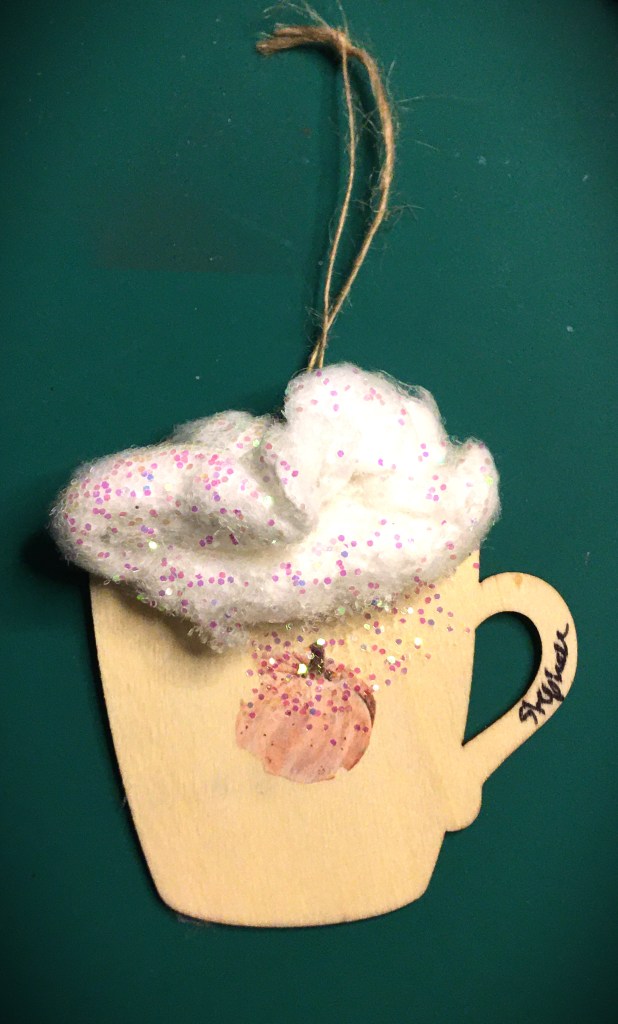
For the mock up that I made for the teacher, I painted the mug with a single coat of sage colored acrylic paint. The one thing I love about balsa wood crafts is that it absorbs the paint and dries rather quickly with great coverage.

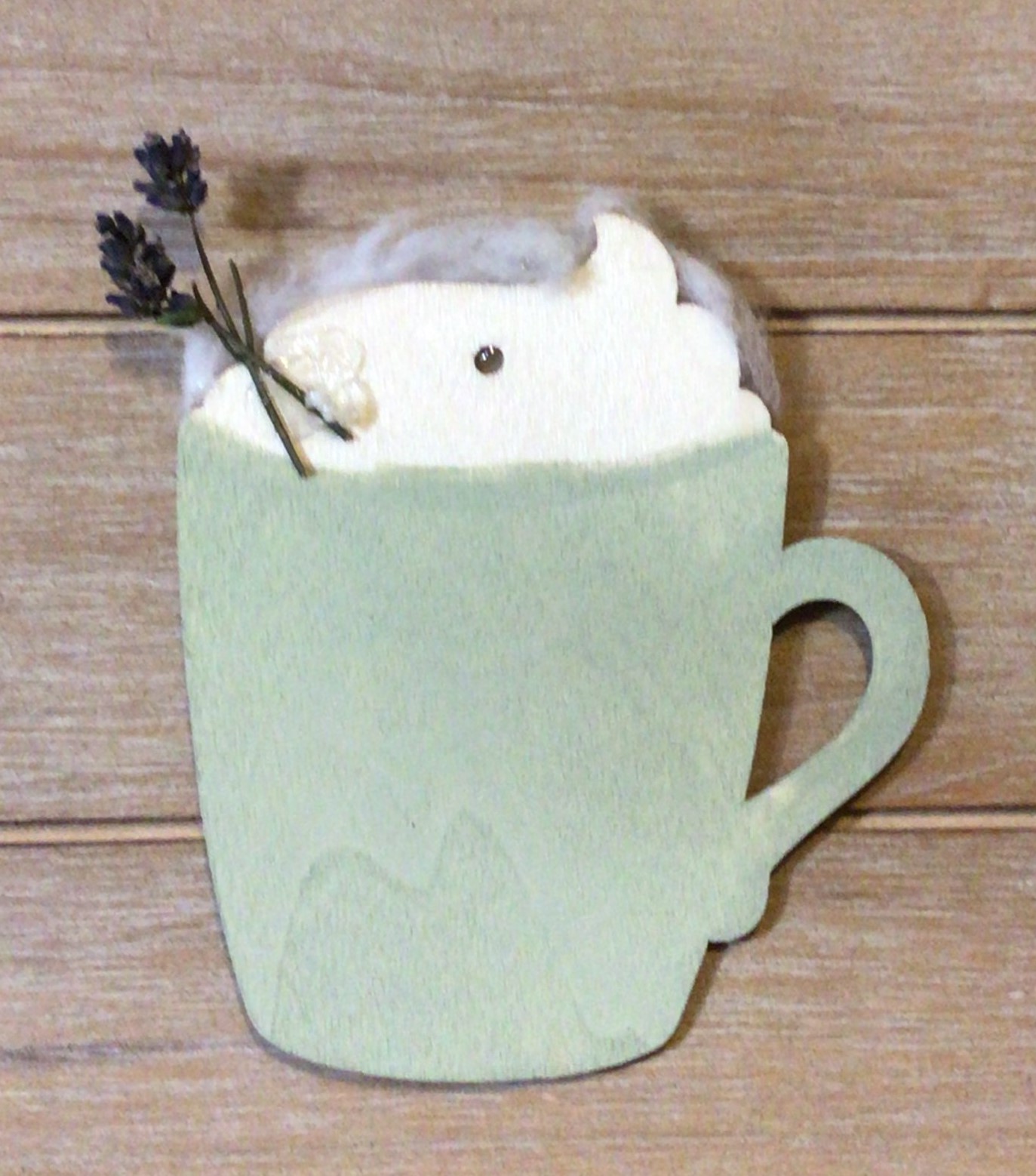
The next step was to add the whipped cream. For this I used hot glue and a cotton ball. For playing around purposes, to build up a 3d effect, I started with putting down a line of glue at the top of balsa wood swoop. I pressed the cotton down and pulled it up to keep a wispy and light effect. Then I added one more line and applied the cotton (continuing to pull it upward) and worked my way down to the lip of the mug. There were about 4 rows that I put in, with additional spots added, to fill in any bald spots.

On the flip side I glued on two sprigs of lavender before laying down the cotton on the back side. If lavender is not your thing, the mini coffee stirring straws would be perfect substitutes because they’re thin enough for the cotton to overlap without any bulges and gives the illusion of something coming out of your cocoa.

Advertisements

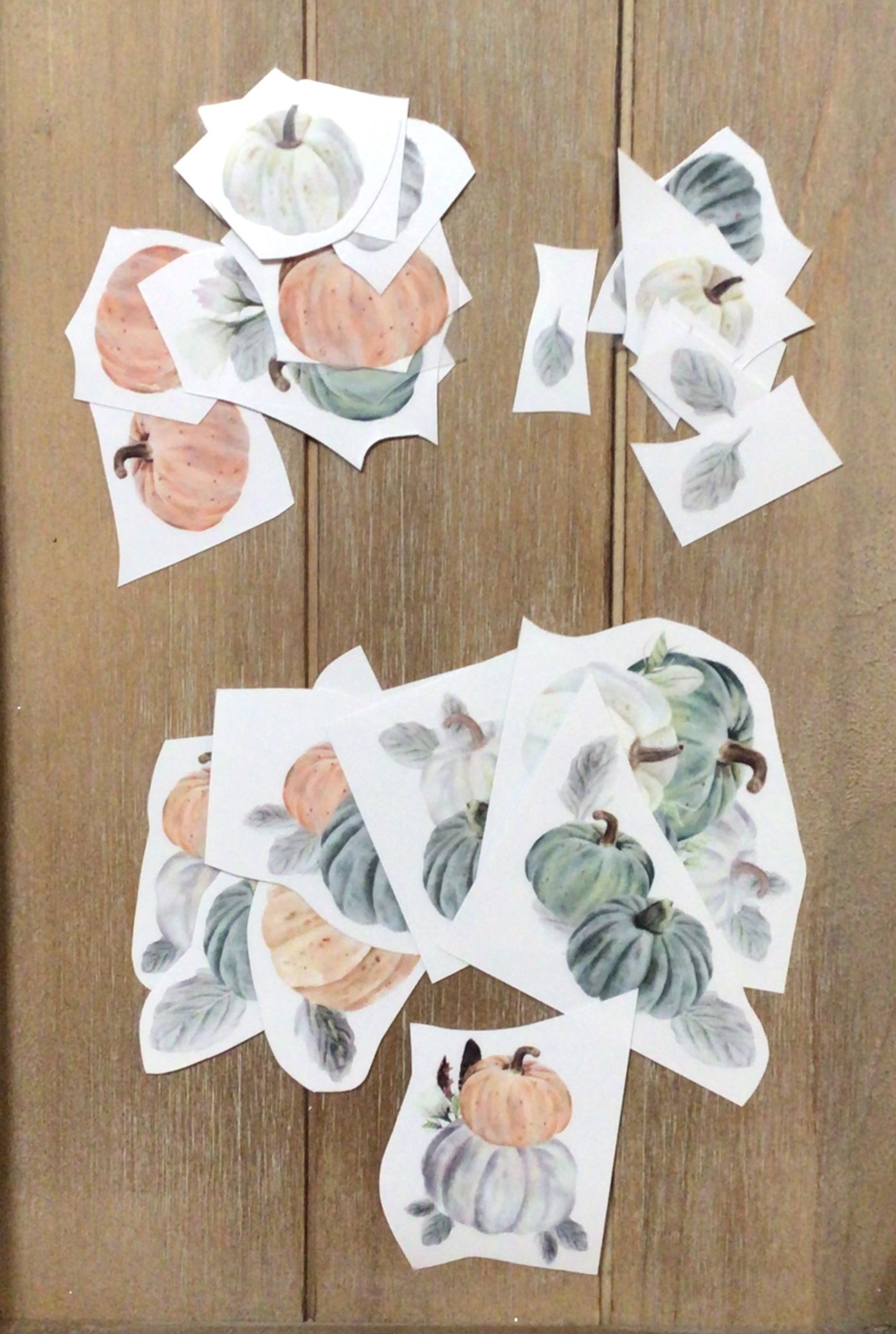
To decorate the mugs with a fall theme, I also grabbed these rub-on transfers from the dollar store as well. Each packet of transfers was enough to decorate the packet of 8 mugs.

In order to prevent fussing with all the elements with preschoolers, I put a mug and 3 transfers (a large, medium and small) in an envelope. Mainly I did this to keep things fair so the first group of kiddos wouldn’t take all the large pumpkins and leave the smallest leaves behind for the last group.

Here’s the thing with these transfers, they take some work. My original expectations were that these would be true to their name and take a little bit more rubbing than traditional stickers. In fact, the directions on the back of the package inferred such an expectation. But that’s not what I experienced. They don’t rub on at all. You have to scrape these babies onto your surface. I used a plastic crafting scraper and that tool failed to apply the rub on. I didn’t try using a coin like a scratcher ticket, but that idea is still in the back of my mind. The thing that worked for me was scraping the rub on with my finger nail.

Even with a thorough scraping of my nail, the transfer didn’t apply fully on the larger pumpkin groupings. And this was my biggest disappointment. BUT the transfers are forgiving. You can line these failed transfer sections back up and apply with relative success.

My biggest tip with these transfers is to take your time and gently lift up the clear transfer sheet. If the transfer doesn’t release, put the transfer back down and scrape it some more.

The original plan was to have the right above picture the completed project. The fact that I could see the hot clue peak through on the cotton prompted me to pull out my can of spray glue and glitter. Just by adding this little additional detail was enough to transform matted rough looking cotton back into something frothy and light looking.

That and I like glitter!

Advertisements

I kept this mock up to be pretty basic in design because I wanted it to be re-creatable for the preschoolers. Now if I were making this mock up for older kids or even a MOPS (or other ladies’) group then I would have dressed up the mug and made it more ornate with either some hand designs with acrylic paint pens, glitter pens, metallic embellishments, or so many other crafting items. In fact, I really wanted to take a small cluster of crafting fall leaves and make a little thin ribbon embellishment on the top of the mug handle.

There are other options for the whipped cream portion as well. I used cotton and my hot glue gun because I wanted the kids to be able to take their mugs home that day. But if you have more time with your class, you can use other materials and glues. I thought it could be fun using more glitter, or the tiny foam balls. Chunky white yarn could be amazing, especially for incorporating more whipped cream swirls. And I know kids would have amazing fun gluing marshmallows on top of the mug. (But I’ve seen kids pull off and eat food items off of crafts way too often. So I tend to opt out of that option. But… if I were to throw caution to the wind and let the kiddos play with marshmallows, then I would skip the glue entirely. Instead of glue I would use a royal icing. It dries like glue but is much more child friendly for those who eat crafts!

How did the craft turn out?

Oh my goodness! That day was just as chaotic as you think it’s going to be when you sign up to help in the class on a party day.

First, the schedule got blown out of the water and my party craft was slotted for right before the end of class, and parent pick up. I think it pretty much averaged where the kiddos made these mugs in about 3-5 minutes each.

Fortunately, this craft is easy to punt with and save time. First, skip the painting! Balsa is a wonderfully creamy color. And with the “rub-on” transfers, the focus goes to the transfers. To be honest, one of the girls really did beg to paint her mug the “pretty green”. She loved it and wanted it too. Fortunately the glitter saved me from a meltdown.

Advertisements

Kids love glitter!!!

I probably should have sprayed not just the cotton, but the whole mug to let them glitterfy the whole mug in lieu of the painting portion.

For the cotton portion, I just stretched the cotton ball out and handed it to the kiddo. I applied a liberal amount of hot glue and let the kids put the cotton down. (There was no incident with the glue. This 3’s class did an amazing job!)

The last step was to spray the cotton with spray glue and send the kids back to the table to finger sprinkle glitter onto their whipped cream over a paper plate. (If you spray from the mug toward the top of the whipped cream, you keep the spray entirely on the cotton.)

All of the mugs turned out differently. Some added more transfers than others. These kids lost interest in the transfers because they were not able to scrape hard enough to get them to apply. So if you’re doing this for young children, find a tool that lets you (preferably the kids) to apply with ease.

Advertisements

I wish I would have had time to take pictures of the ones that got made. This one was the one my kiddo made. Of course the one that followed me home was one of the less decorative one. So please don’t assume that this craft was too much for young kids. Time was the failure for this craft. My 6, 5, and 3 year olds were all excited for this craft and I stashed the extra mugs so that they could make them this weekend. I’ll update this post with how the mugs turn out when kids have time to do this project at their pace with the materials they want to use.

Now that November is around the corner, and winter on its’ heels, there is still plenty of time for a craft like this! Change up the colors and decoration add ons for Thanksgiving, Christmas, New Years, and even Winter Theme for January and February. Cocoa is something that kids love year round. (In fact, mine begged me for cocoa regularly during the summer!) So feel free to incorporate this easy craft into your curriculum or busy box for when you need something for kids to do. Or even do this yourself for those moments when you want to let loose on some creative steam but need to have it finished in a 10 minute crafting window!

Let me know how your crafts turn out!!!

Processing…
Success! You're on the list.

Leave a comment