Cake Dreams

One of the memories that we are so quick to build are children’s birthday parties. So how do we make memories that last?

Make a cake!

I can’t begin to tell you all the cakes that I remember through the years. There’s the Holly Hobby cake my mom made from me (a popular baby doll from the 70’s). There was the cake that got locked in the trunk on my sister’s birthday. The cakes my sister’s and I made for our parents because finances were tight but the box cake was a big way we could show they mattered. The cake my husband made for me with marshmallow frosting. The cakes I made for my kids.

The list goes on and on….

I could tell a life story just off of the cakes I’ve made through the years.

And I want you to know that you can make cakes that make memories without going to culinary school and gaining the education of a baker!

You can make cakes!

You can make memories!
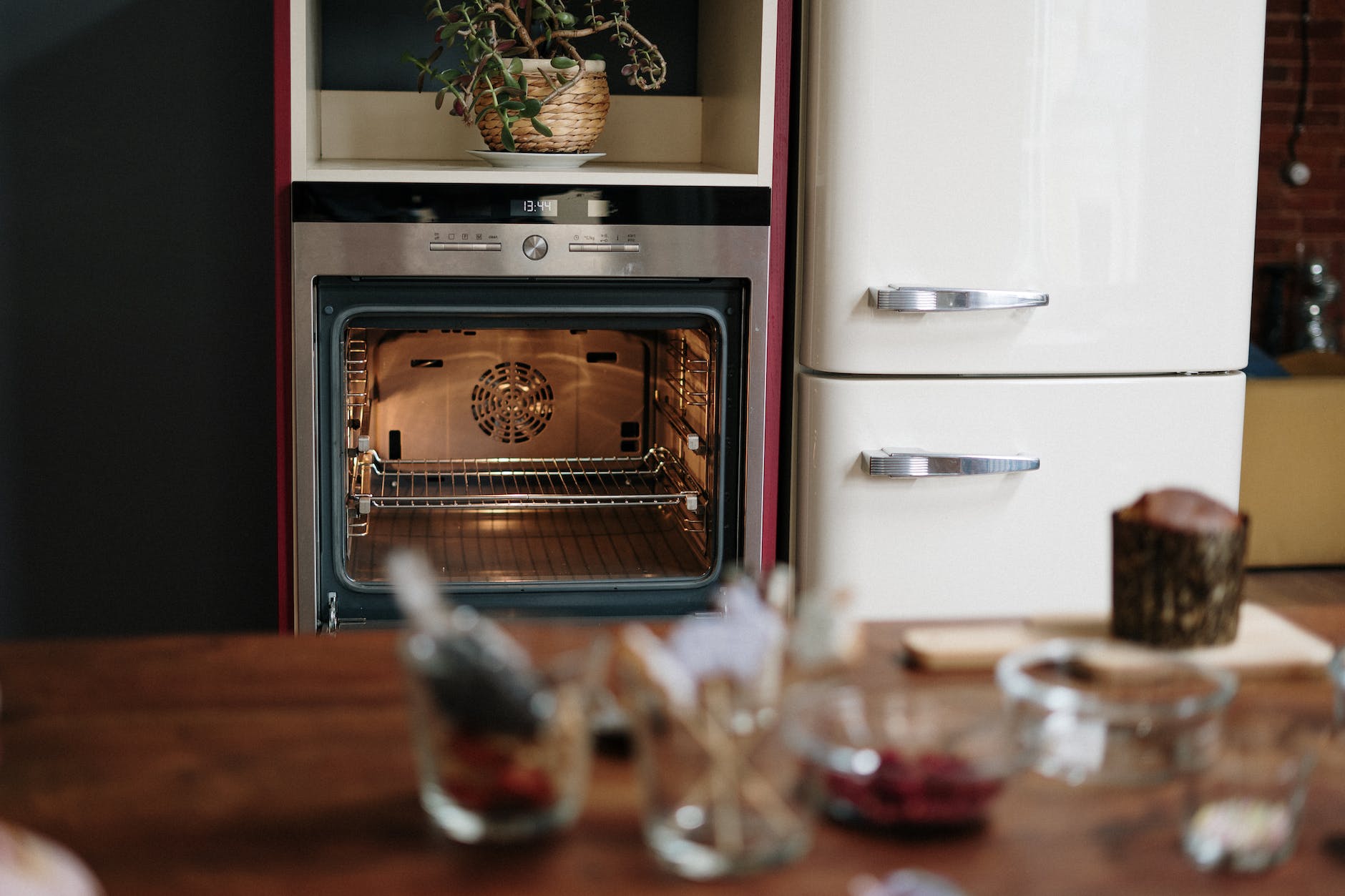
Photo by cottonbro studio on Pexels.com

Even though I have cake recipe books which put a world of recipes from scratch, I’m going to show you how you can make a memorable cake using a box cake–which is in everyone’s price range. And in this age of inflation, when you can still find boxes of cake mix for a dollar, I want that to be available to you.

Box cake mixes are great. The directions are easy enough for my kids to follow and make on their own. (In fact I just made a cake for a local mom and my boys wanted to help because they love baking cakes with me. They had to skip out on this one, but I had to promise that they could make their dad’s cake all on their own without me!)

TIP: you can test the doneness of you cake sponge by poking the cake with a toothpick in the center. When you pull the tooth pick out, and it’s dry, your cake is done. You want no moisture or batter on the tooth pick. Although you might see cooked crumb–that is still done.

Or….

TIP 2: When your timer goes off take a temperature reading in the center of your cake. When you reach an internal temperature of 200°F, your cake is done.

This particular tip is invaluable. If you’ve watched baking competitions you see people testing cakes by poking it like a chef pokes a steak. The amount of resistance tells you the internal state of being done.

The average person doesn’t know what a done cake feels like. We can easily
learn the feel of an under done cake and an overly done (and dry) cake. I’m
going to save you the head ache and just tell you that you only need to reach
200°F and your cake will be perfectly done no matter what. This works for all
elevations. AND it gives you a more accurate unit of measurement to direct you
in how much longer to cook your cake when it’s under 200°F.

Now that you know you do not have an undercooked cake, you’re halfway done.

Some people find the cake (or sponge) cooking the most intimidating. Others find the frosting to be intimidating. But frosting a cake doesn’t have to be intimidating either, because I’m going to show you a trick that I used with the Pinterest inspiration picture that was given to me for the cake I made the other day.

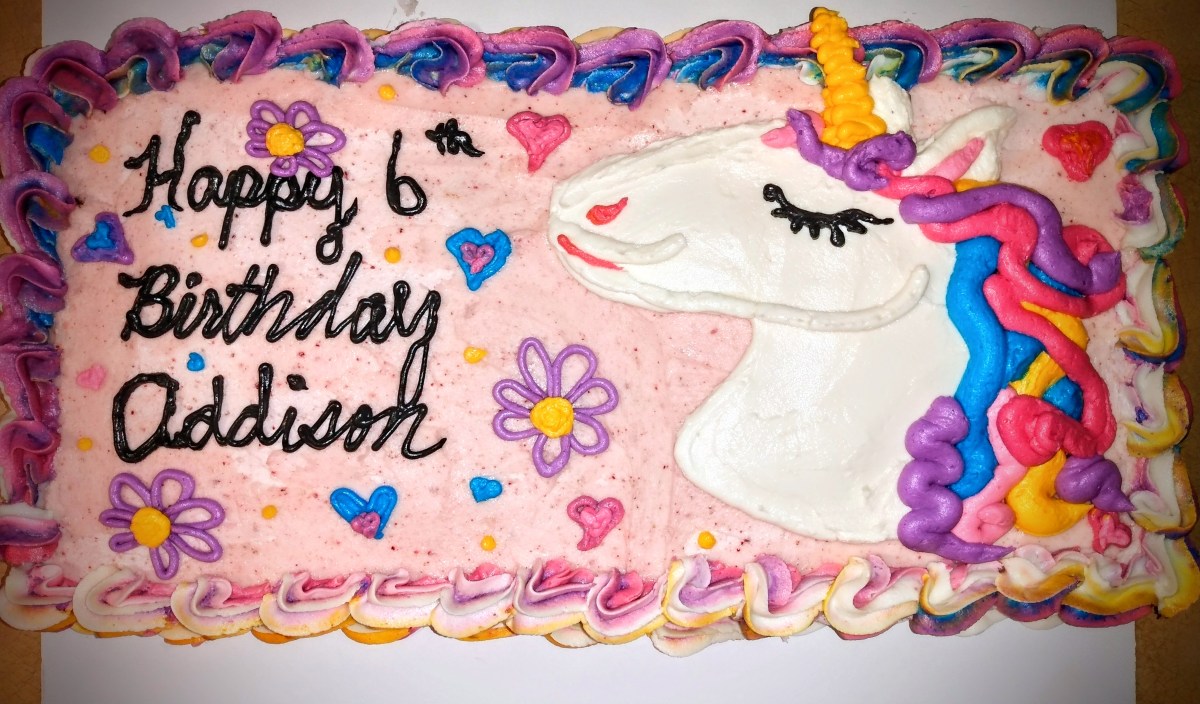
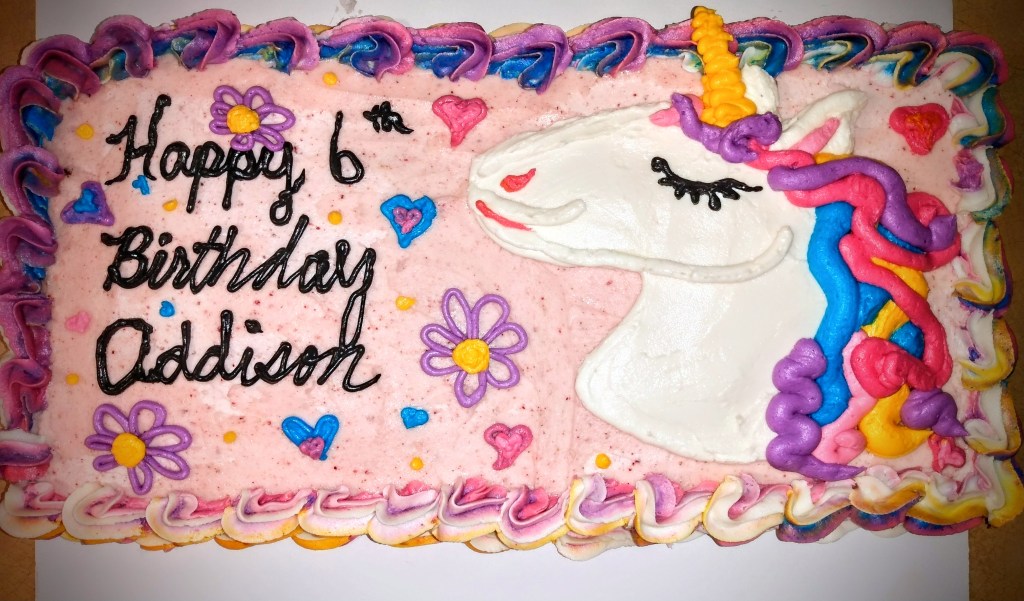
My go to frosting is formulated by Wilton. I’ve successfully modified this recipe to make it flavored. But this recipe gives you three different consistencies. I used two of these for the following Unicorn Cake that I recreated, stiff and medium. I used the medium for the filling between two layers and doe the exterior frosting. The stiff consistency I used for the decorative elements.

When it comes to coloring your frosting, the stores give you the choice of the liquid food dye or gel. The gel will give you vibrant colors for less.
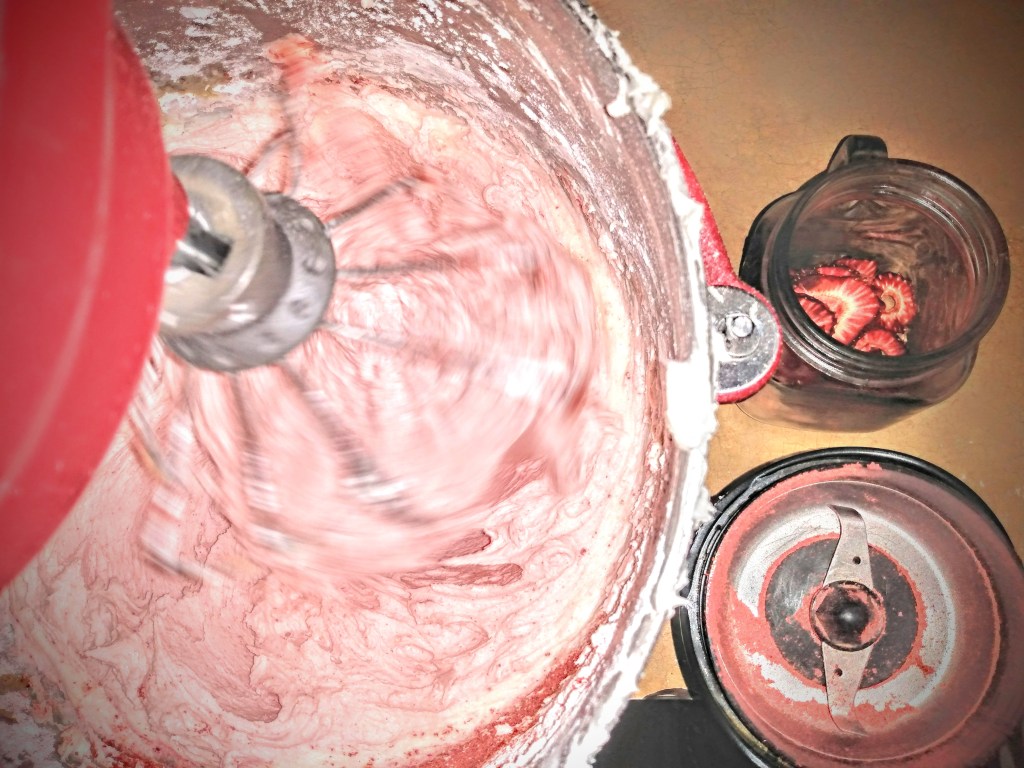
TIP: If you’re a family that is conscientious about food dyes, you can still color your frosting. What you’re going to do is plan in advance and dehydrate the fruit, vegetable, or edible flower for the colors you want. Don’t worry about the vegetables. The Wilton frosting is sweet and can overpower the vegetable flavor, if that is a concern for you.

As a point of reference, it took me about half a pound of strawberries (sliced, dehydrated, than powdered) to turn a single batch of Wilton frosting pink and mild strawberry flavor. I had the pink color to the frosting long before the strawberry flavoring that was requested by the birthday girl.

TIP: When you use a fruit with high water content, you definitely want to turn it into a powder in order to prevent your frosting from becoming watered down.

Frosting the cake is going to look a little differently depending on what kitchen tools you have available. If you can pipe the frosting onto the cake before you spread the frosting, you will be able to do a thin layer of frosting without getting crumbs of cake into your frosting.

Don’t have piping tools (pastry bag, coupler, and decorative tips), that’s okay. The trick is to take your butter knife (if that’s all you have), put dollops of frosting onto your cake, and then spread the frosting around using the flat of your knife.

The number one cause of crumbs in your frosting is your knife hitting the cake’s sponge. If you just move the frosting around, with your knife only touching your frosting, you should eliminate all crumbs.

If you still find you have crumbs, the other reason is that your frosting is too thick. This is particularly a problem with cakes that are light and fluffy. Not a problem!

If your frosting doesn’t spread easily, stop. Remove the frosting and put it back in the bowl. Add a teaspoon of water (or less) and mix it into your frosting to loosen it up. Test the consistency by trying to spread your frosting on your cake. It shouldn’t grip your cake like Velcro, but smoothly spread like mashed potatoes. Once you can easily spread your frosting, make that cake beautiful!

Want to make decorative elements, like an inspiration picture, but don’t feel confident in your piping skills? You will want this trick.

Don’t worry. You can use this trick even if you’re only comfortable using the tubes of colored frosting!

Print out your inspiration picture (with the elements blown up to the size you want them on the cake). If you have face details you want to recreate, make a copy for the body, and a second copy for the face. (The same is true for detailed that are stacked but not faces.)

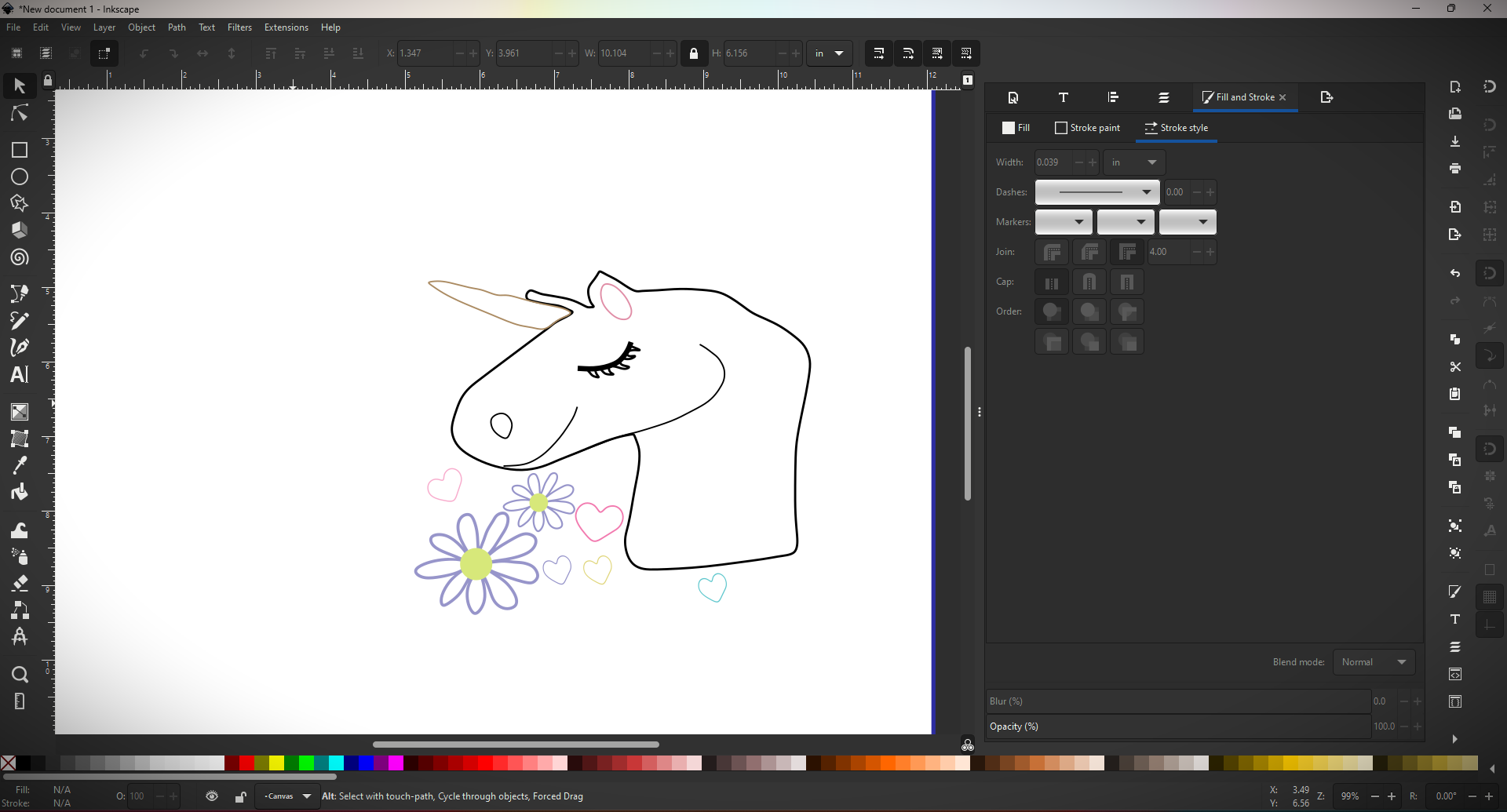
For example, here’s the inspiration that I was working with.

The original creator had freehanded the design of this cake. I’m fortunate if I can draw a horse head on paper with a pencil, so I needed this trick.

I do have skills in Inkscape where I took the picture and traced the elements and made my own stencils. After I printed out the stencils I put them on top of a metal cooking sheet. To keep them in place, I used a loop of tape. Then on top of the stencils I taped down a sheet of waxed paper.

Once my different colors of frosting were put in piping bags, I started tracing the stencil lines with the planned out colors.

In the instance with the unicorn head, I made the outline, then filled (flooded) the inside with frosting, smoothing everything out with a knife to make it look like a solid piece.

When all my decorative elements were piped out, I put the cooking sheet in the freezer.

You’ll want to plan this one ahead of time. The frosting will take time to freeze. Even with the stiff frosting, you will want this to be in the freezer for at least over night.

When the frosting is frozen, you can transfer the elements from the waxed paper to the cake.
A memorable cake doesn’t have to cost a fortune. In fact, making a cake shows the person that you love them. And it doesn’t have to be perfect.

My favorite cake my husband made was the marshmallow frosting cake. And I guarantee that none of us will make that frosting again. It was not user friendly because it was a pouring frosting instead of a classic spreadable one.

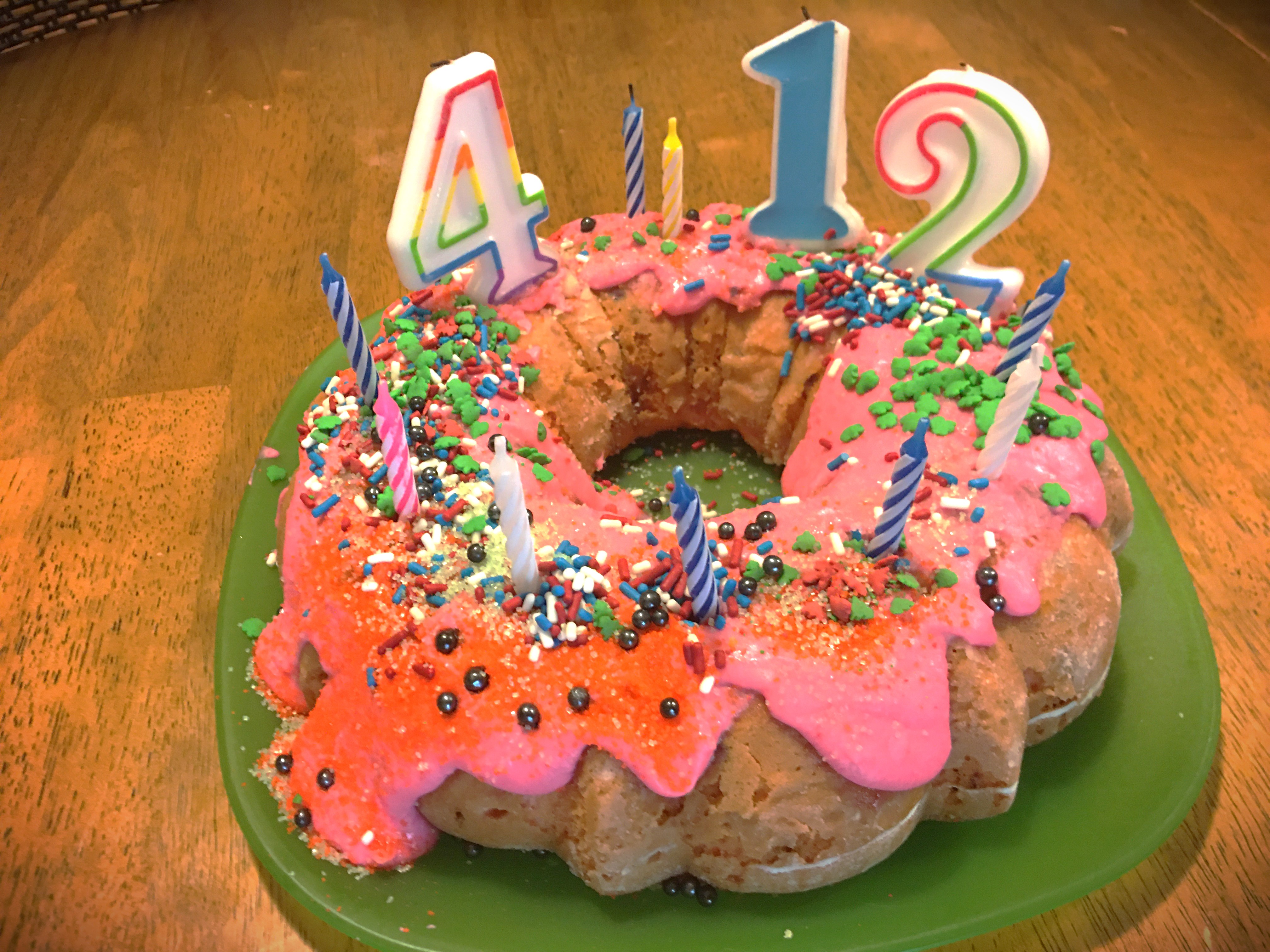
This isn’t the marshmallow frosting cake. But it is the one my boys made on their own, for me.

The most memorable cake I made was my son’s bubble cake. He wanted a bubble cake so I made a tall multi layer cake in the shape of a bottle of bubbles. That sponge would not keep shape. It wanted to disintegrate on me and there was not enough support I could put in to make it stay. Let’s just say I’m glad I made it a fondant cake, because that fondant was the only thing keeping it together. I was in tears. But my son was dancing with happiness over having a bubble cake.

I tell you these stories so that you know that sometimes the best memories come from the imperfections in our cakes. After all, my favorite childhood cake, the Holly Hobby one I mentioned at the beginning, wasn’t all perfection. I look at the pictures from that birthday and only see love. My mom looks at those pictures and sees the cramping in her hands because of all the piping that cake took. She finished that cake with tears of pain. But it meant the world to me.

So don’t be afraid to make that cake for your loved one!

It may turn out to be an imperfect but testament of love that lasts through the ages. Or it may be the cake that blows your mind because you never thought you could do it, but you did! No matter the outcome, it is always worth it to make that cake!
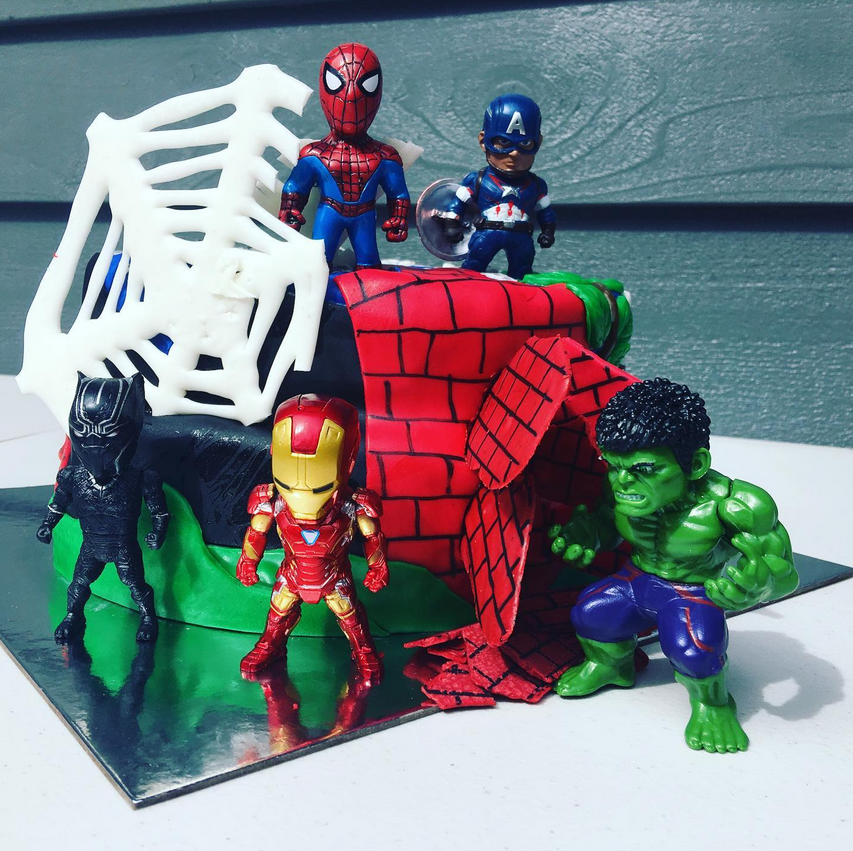
Super hero birthday

Navy Retirement Cake. Inspiration cake and my cake with the medalion that was placed against the center wave in the flag.
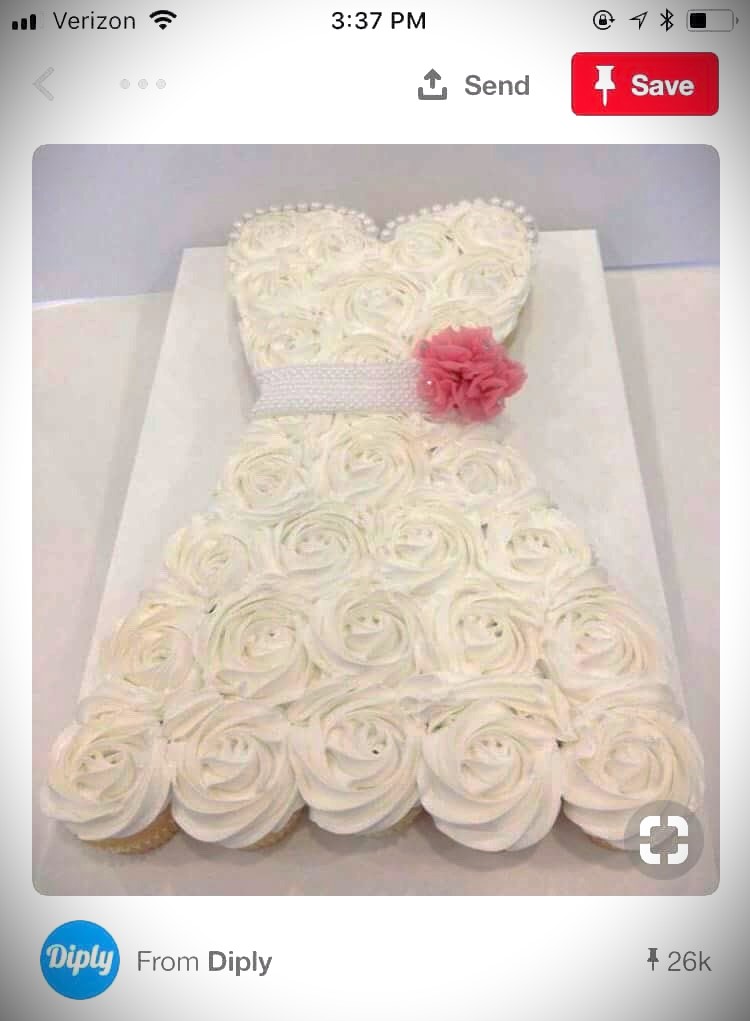
Bridal shower cupcake cake.

Quick Accent Piece

The one thing about approaching holidays is that you really get smacked in the face with everything that needs to be done.

Whether you’re decorating sideboards for an Easter get together or just looking for something quick that fits in a space as small as a window sill to add a little color before spring finally unfurls. This quick craft is for you.

What you need:

  • 1 Stemless Wine Glass
  • 1 Bag of stones 18 oz/794 g
  • 1 Faux Succulent
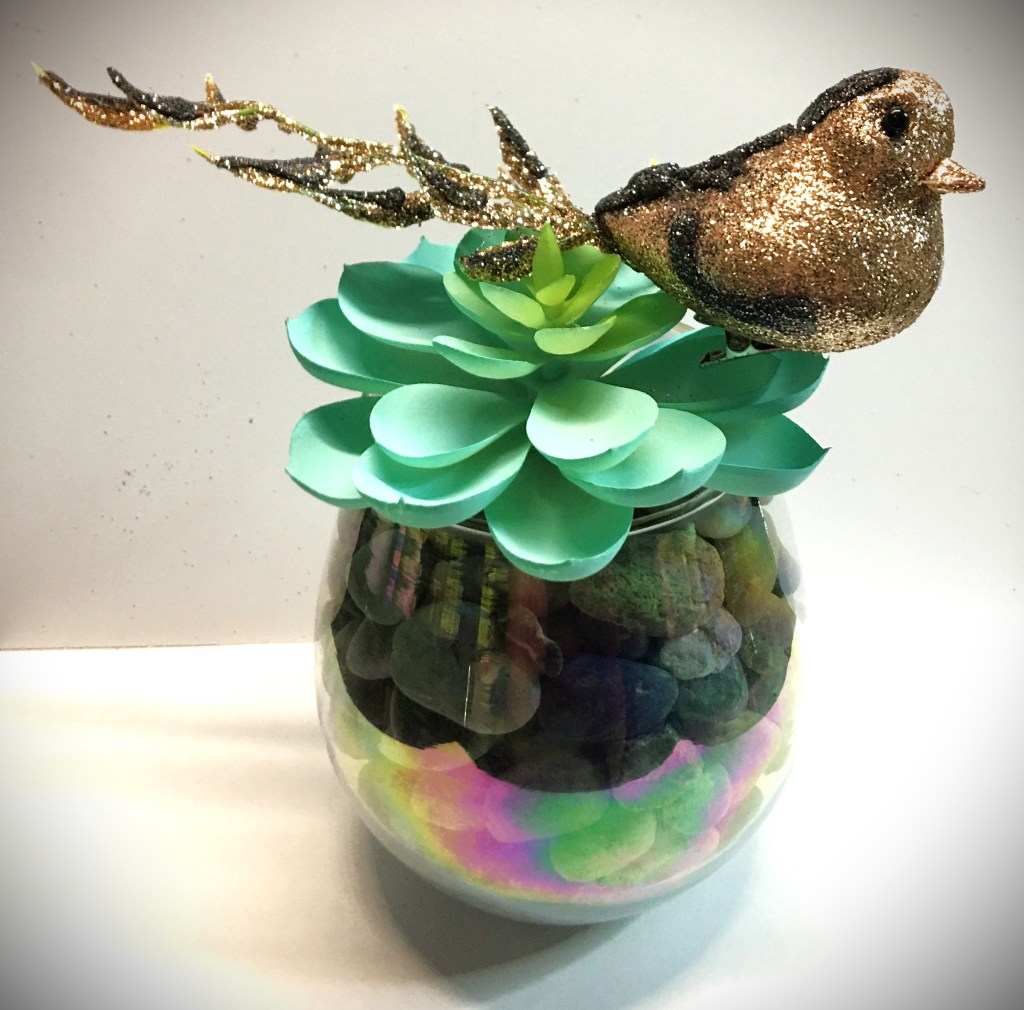
  • Any other accent piece that you would like to add (I chose a glittery bird)
  • Glue Gun
  • Accent Glitter

5 Minute Version

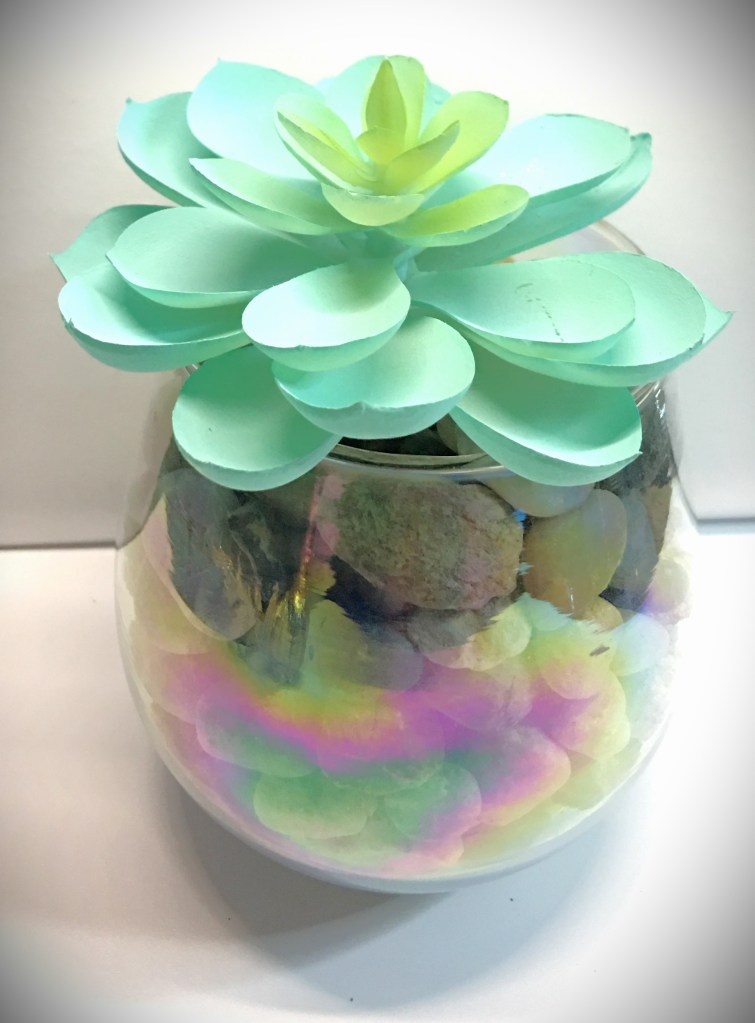
If you just want to toss something together, all you need is the glass, rocks, and succulent.

The succulent that I chose had a very thick stem. Because it was sturdy, I could pour the rocks in the glass and push the succulent stem into the rocks and moved on. (If the rocks have resistance, give the succulent stem a little swirl and it will sink right in.)

For whatever reason if the succulent just does not want to go into the rocks, never fear. Pour out the rocks with the exception of some in the bottom (or the level that you can easily push in the succulent). Then lift up the leaves on one side (and then the other) to add the stones in, around the stem.

Want to use real succulents?

You can do this using a real succulent of your choice. Make sure you verify if the succulent you want to use can life in rocks or if it needs cactus potting soil.

If your succulent needs soil, but you prefer the look of the rocks showing through the glass, you will need to take a little extra time layering the rocks outside and putting the soil in the center

Advertisements

Ten Minute Version

Follow the directions for the 5 minute version to get the glass filled and succulent set. The remaining time is dressing up accent piece that you are adding.

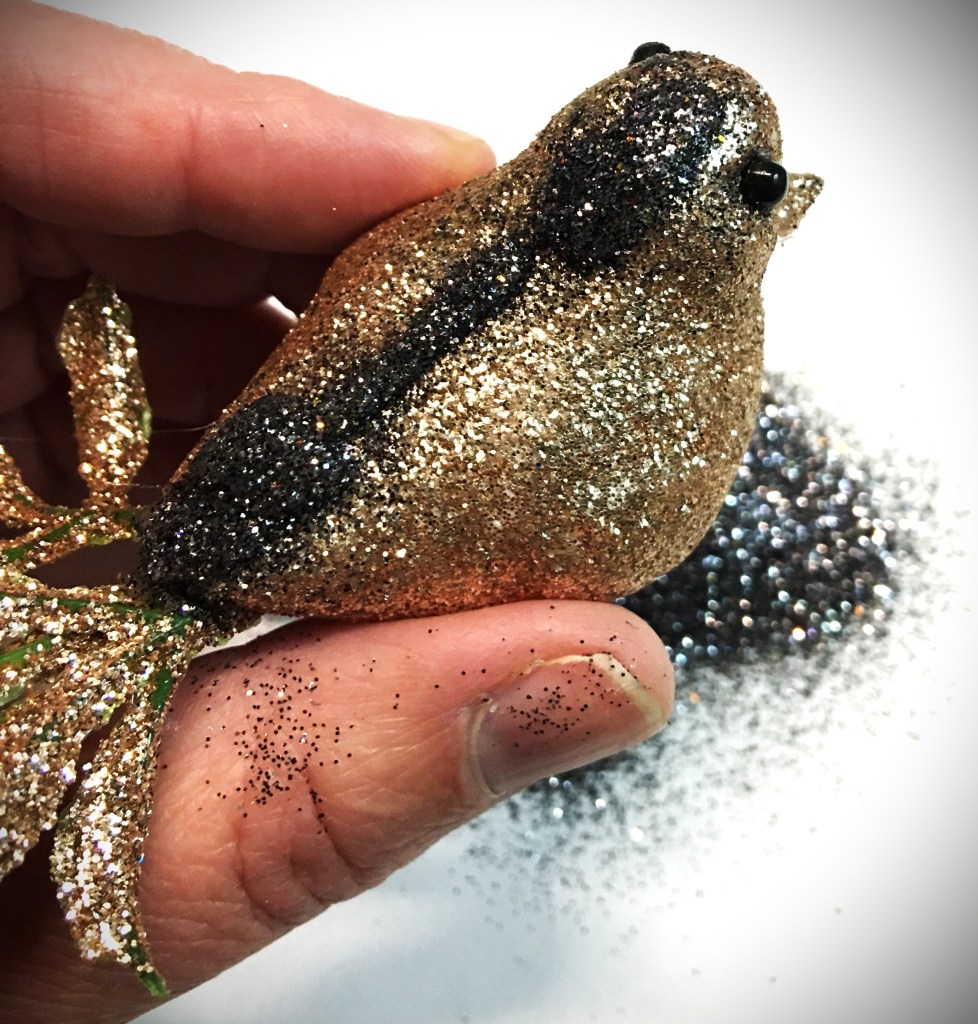
For example, the glitter bird that I’m using came from the dollar store and I wasn’t 100% satisfied with it. If I had feathers in my crafting room, I would have added feathers for the wings as well as the way it was set up with feathers on the tail. Unfortunately, I don’t keep feathers. So I needed to pull off the pink ones that came with the bird. The black eyes also seemed to stick out awkwardly. To remedy this, I grabbed my glue gun and black glitter and added glitter detail work to add dimension and character to the bird.


Thanks for spending a few minutes with me today. If you’re anything like me, you have a list as long as your arm to get done in less than 48 hours. My kiddos always look forward to a newly designed shirt. I haven’t got a fully developed idea for that yet. But I do have a spring edition ready to go dressing up some sock bottoms. They enjoyed the ones that I made for them for christmas. So I thought I would make a few more for them. You can check out sock designs here:

What are your Easter or Resurrection Sunday Traditions that you do with your family?

I’m always looking for new ideas!

Processing…
Success! You're on the list.

2 responses to “Quick Accent Piece”

  1. Naoma Avatar

    I truly enjoyed reading this article and learned some useful information. Thanks for sharing your insights with your readers.

    Like

    1. Pacific Northwest Event Design Avatar

      Thank you for reading and commenting. I love hearing from those who find me.

      Like

Leave a comment

Advertisements
Advertisements

More Than Arm Candy

I have to love my husband who loves to give practical gifts. Usually he stays away from gifting flowers because they last for a few days before they’re composted. However, there are so many uses for not just roses but other flowers as well. While I’m going to be talking about roses here, there are so many other flowers that can be used in the exact same way!

For those who are unaware, roses are edible. (Before you do eat rose petals, make sure that they haven’t been sprayed with chemicals, pesticides, insecticides, or anything else that is harmful to you.) Roses contain vitamins A & C, Niacin, Potassium, Iron, Calcium, and Phosphorus. Some places where you’ll find fresh petals are on a dessert/cake or in beverages such as teas.

Advertisements

It’s not just the petals that are usable to our bodies. Rose hips (the bulb at the bottom of bud, harvested at the end of the rose season from the rose bush) is used in the beauty industry and baby products for the benefits it has to the skin.

The benefits to the skin is the primary reason why I decided from this last bouquet of roses that was given to me that I was going to use the petals for my next batch of soap.

I started making soap because I’m not okay with all the chemicals that are being used in soaps in the commercial market. Other than using soap dyes (which I’ve had my tub and skin discolored from bath bombs and other products) the mission I’m on is finding natural dyes to color my soap. For pink soap, I’ve seen soap makers use dyes or French clay.

Now Calendula is a well known floral natural food grade colorant. For red/pink colorant, Beets can be used in food. But anyone who’s worked with beets knows that your skin and clothes can be discolored. So I wanted to find a different red/pink colorant for my soap that I can grow in my garden. So I came to roses.

Advertisements

How to Process Roses

There’s two easy ways of doing this.

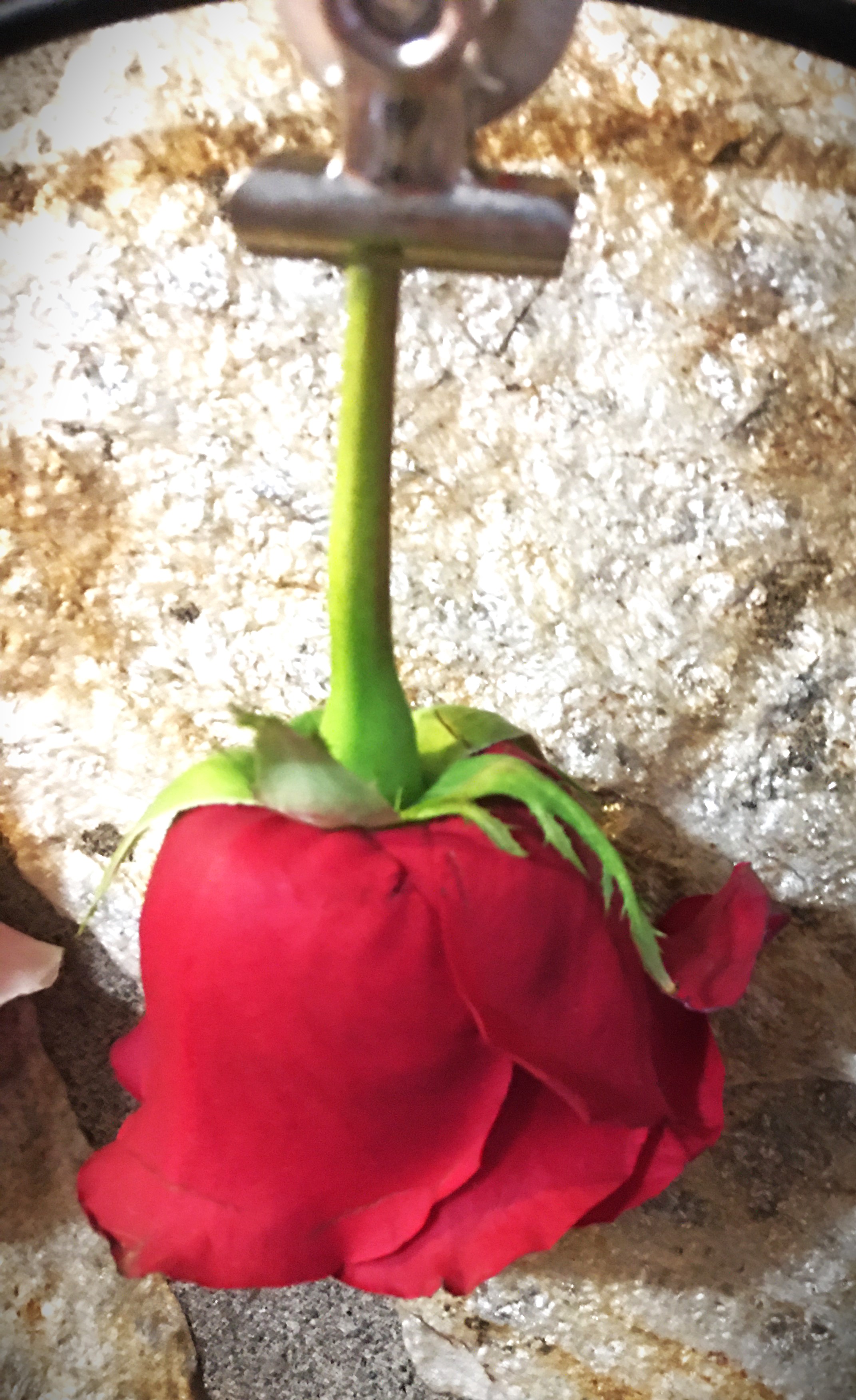
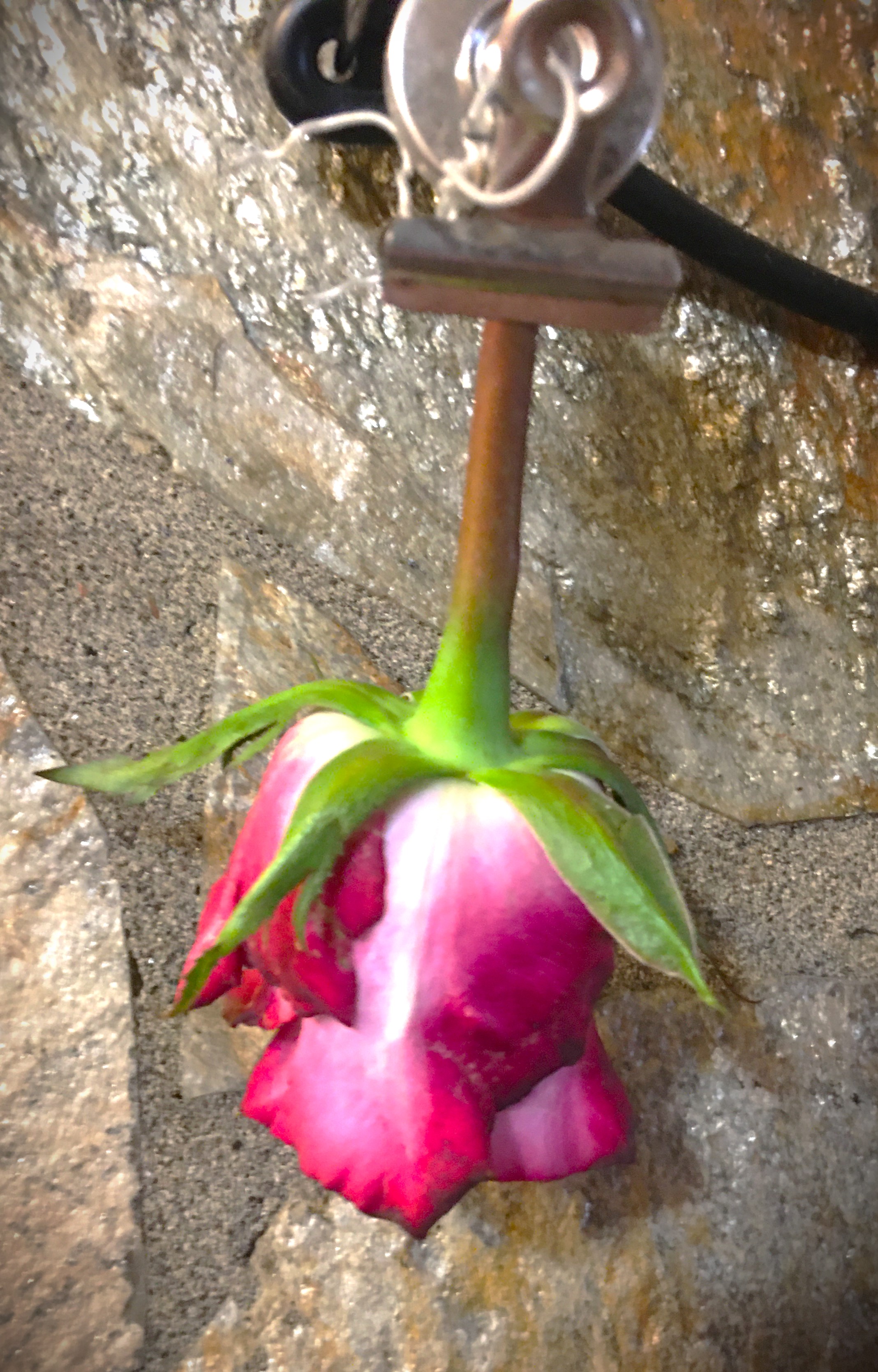
The first is to hang the roses upside down to slowly dry them out. The benefit of this method is that all the vitamins and natural compounds that our bodies benefit from are at a higher concentration when they are dried at a low temperature and slowly.

Ideally, the most benefit would come from using the petals fresh. And while it is possible to use fresh ingredients in soap making (I make orange colored soap using pumpkin puree), there’s no way of breaking down the petals for a smooth and consistent colorant unless you want to use a blender and puree it with the water content of your soap. While it’s not a bad idea, unless you grow roses year round (which I don’t) you have a limited supply due to the window of fresh flowers available. (This is the reason why dried petals are best for me.)

This drying method is slow and takes time. Also any white component will yellow as it dries out. This can affect your over all final color depending on which rose you use. With the red rose, not so much. But the other two, the tinge will be noticible.

So there’s the second method, using a dehydrator.

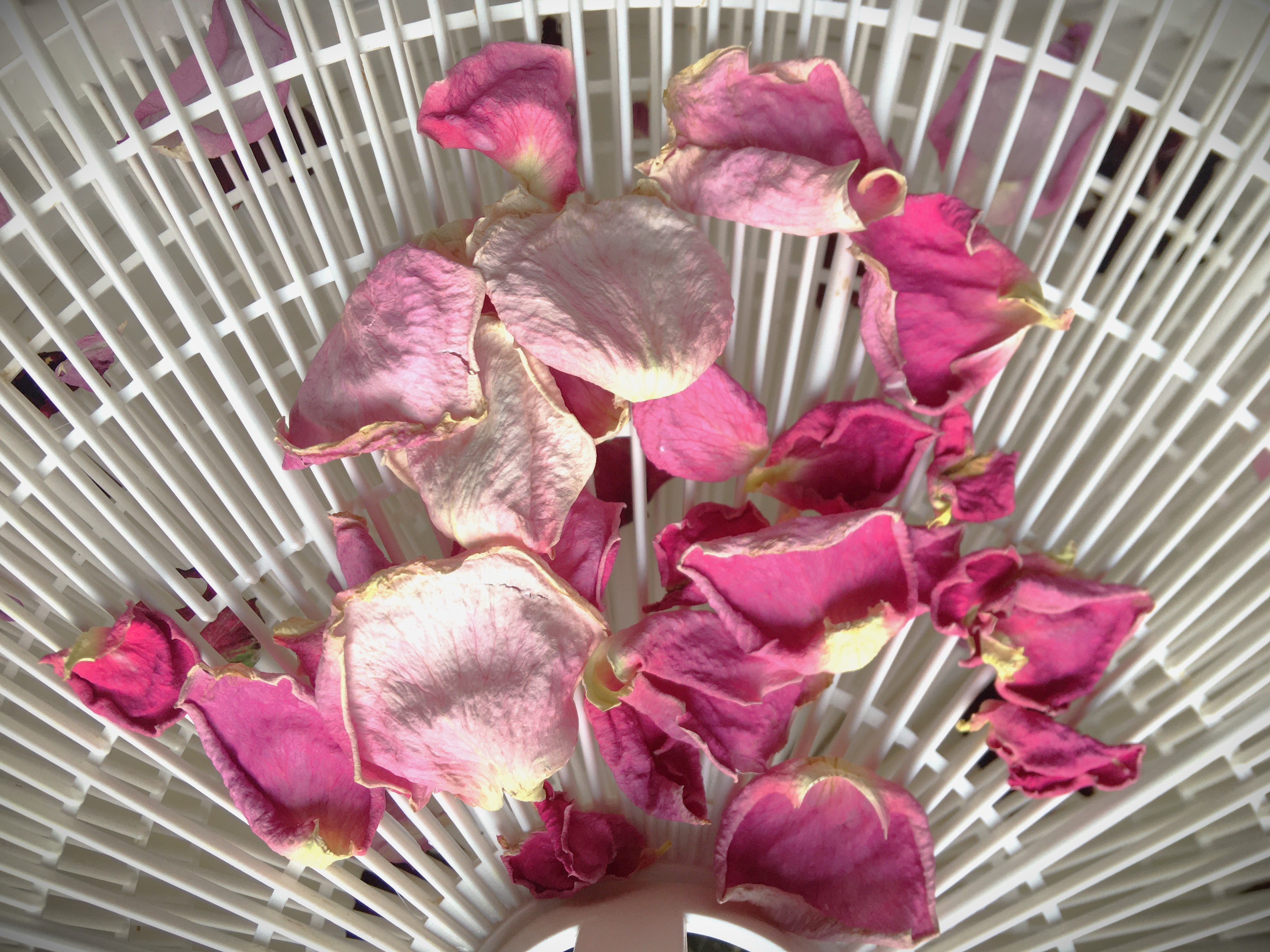
The benefit from using a dehydrator is that petals are finished drying in about 24 hours (at 90°F, the lowest setting on my dehydrator) and their colors are only affected by growing darker.

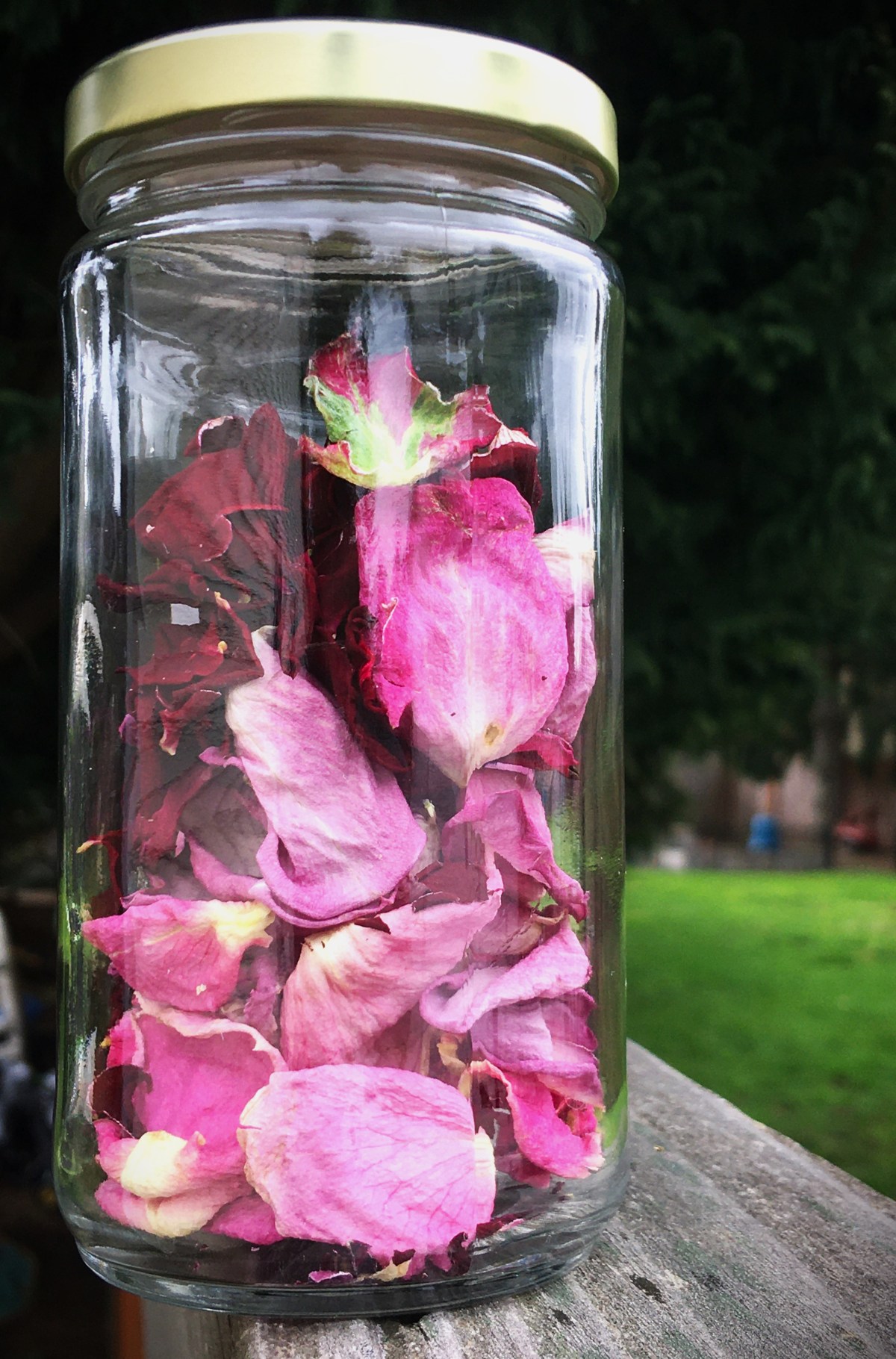
As you can see here, the white component on the pink flowers have not discolored too much. This is great because when I turn these petals to powders, I’ll retain a pink like quality.

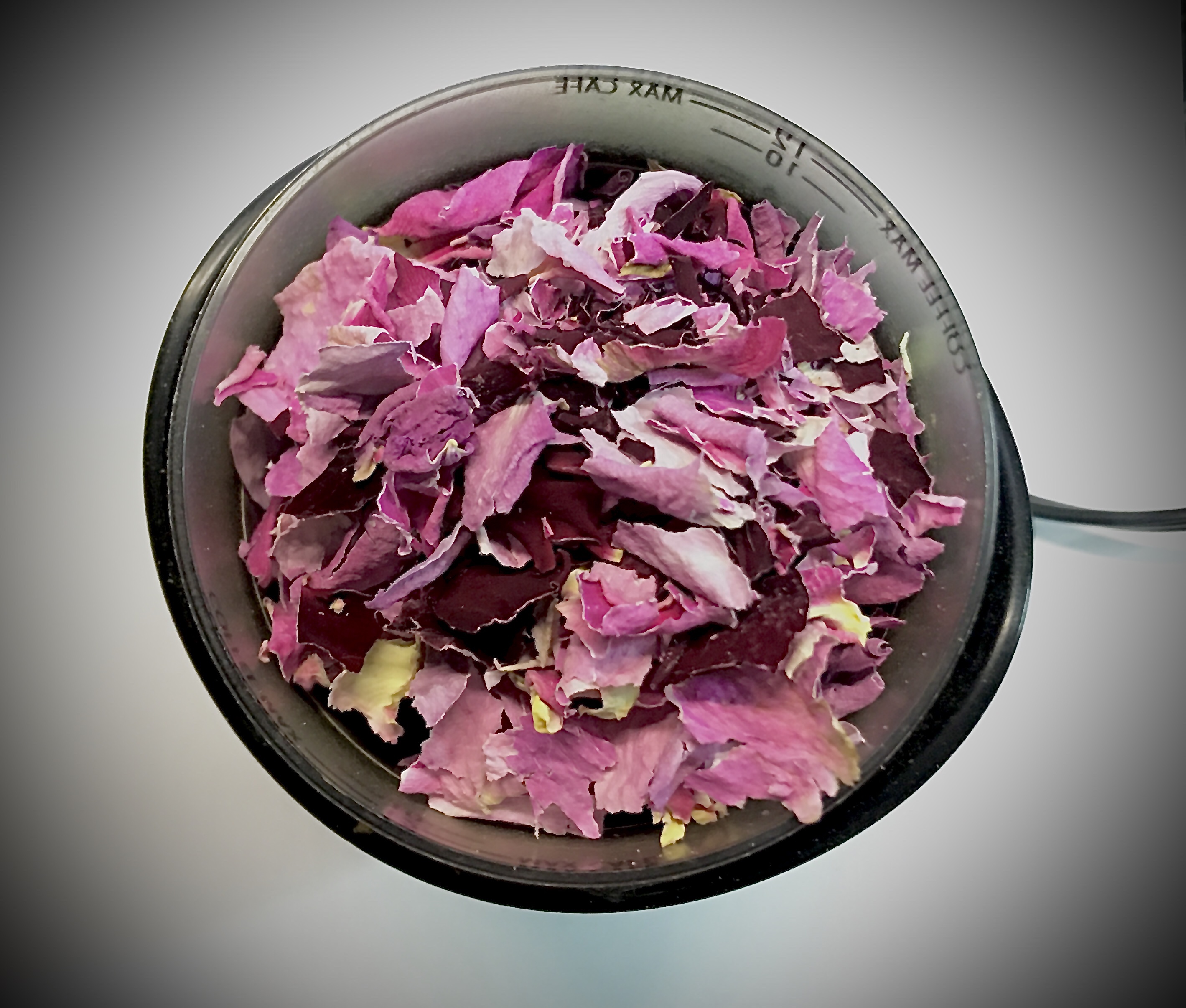
Before I move on to finishing these petals, I want to mention that if you want to make a natural confetti for cake decorations or throwing for a party/wedding celebration, all that you need to do is crush your dried petals by hand and store them in an air tight container (like a lidded glass jar) to prevent them from rehydrating due to humidity in the air.

As you can guess, with the fact that there were lavender inner petals on the second rose (the one with the variegated pink and white outer flowers), this is the reason why I blended in the red petals with the pink ones, to keep the pink and stop the transitiontoward purple (although I’m not opposed to purple soap.)

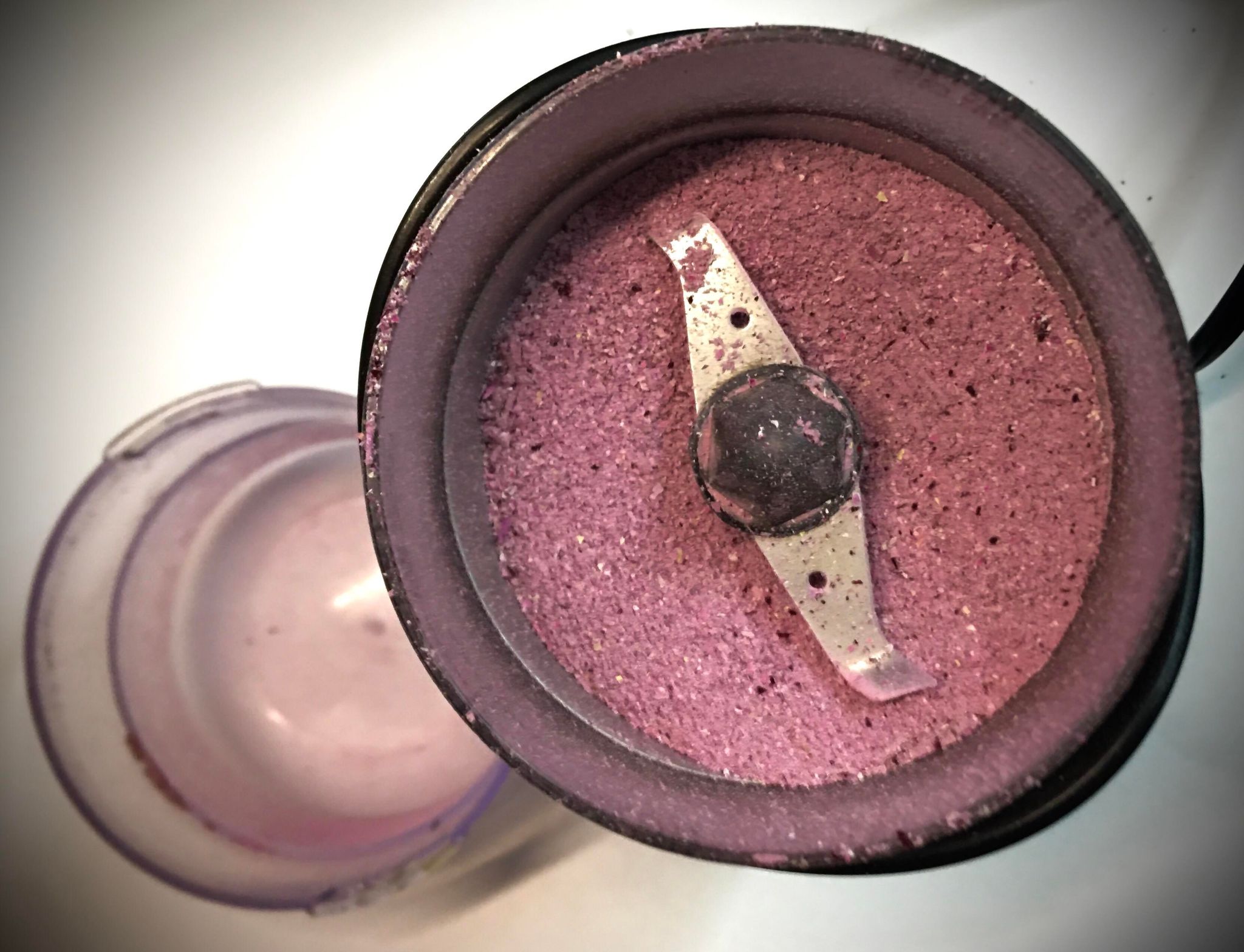
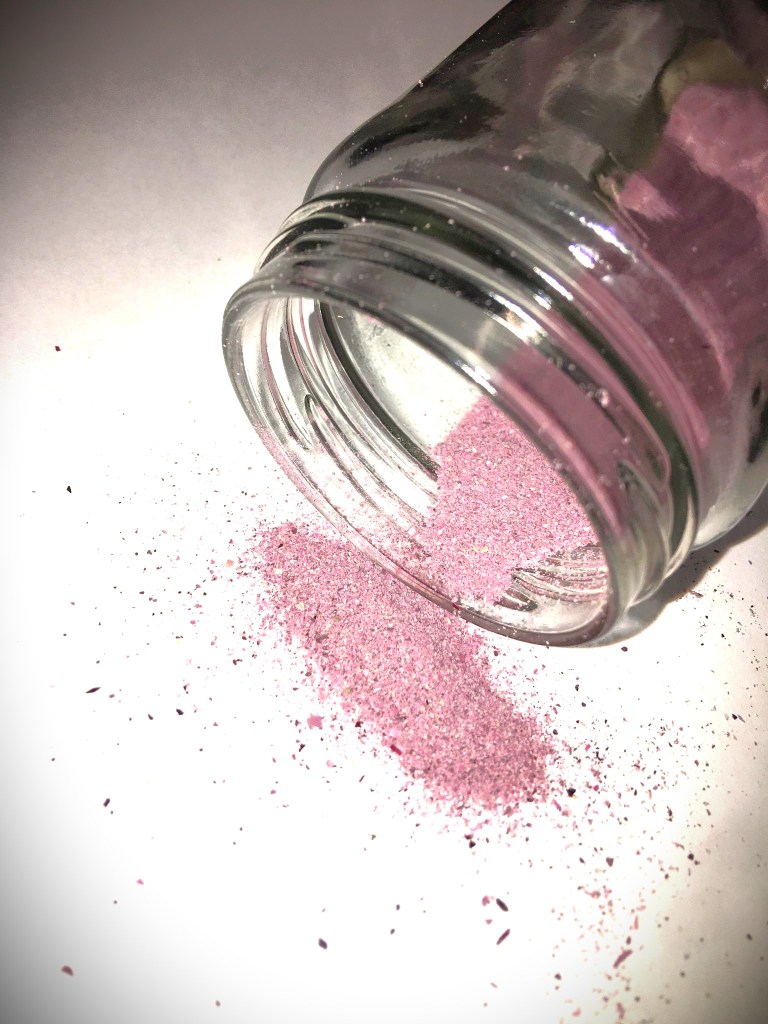
To make Rose Powder, all you need to do is put the crushed petals into a coffee or herb grinder and run it until you get the consistency that you are looking for. Because I’m looking to make a colorant for my soap and don’t want to have flower chunks in it, I took the powder down to a very fine grind.

The fun part about Rose Powder is that you’re not limited to use it as a natural dye or colorant. You could dust this on the icing of a confectionary dessert. If you want to make pink pasta, use this powder as part of your dry ingredients. Mix the powder with a sugar or salt and you have a pink sugar or salt rim to your favorite beverage.

No matter what celebration you have coming up, keep this idea in mind. If you want to dress put your Easter cup you can make a sugar rim using all sorts of different colored edible flowers. Calendula gives you yellow/orange, Violets blue/purple, Hibiscus yellow/orange/pink/blue/purple, there are so many other flowers. If you want to see a quick list of different edible flowers, here’s a jumping of point here.


What unique way do you use flowers?

Processing…
Success! You're on the list.

Leave a comment

Advertisements
Advertisements

Space Saving Spring Decor

Depending on the space you’re looking to decorate for spring and Easter, you might find that you want a little sparkle in a small place. Maybe it’s a window ledge, a office desk corner, a mantel piece, or just a side table. This is something quick that you can put together and adds as much or little color as you like. The best part is that with the exception of glue drying time, you can have this project done in under an hour!

Materials Needed:

  • Clear Glass Salad Plate
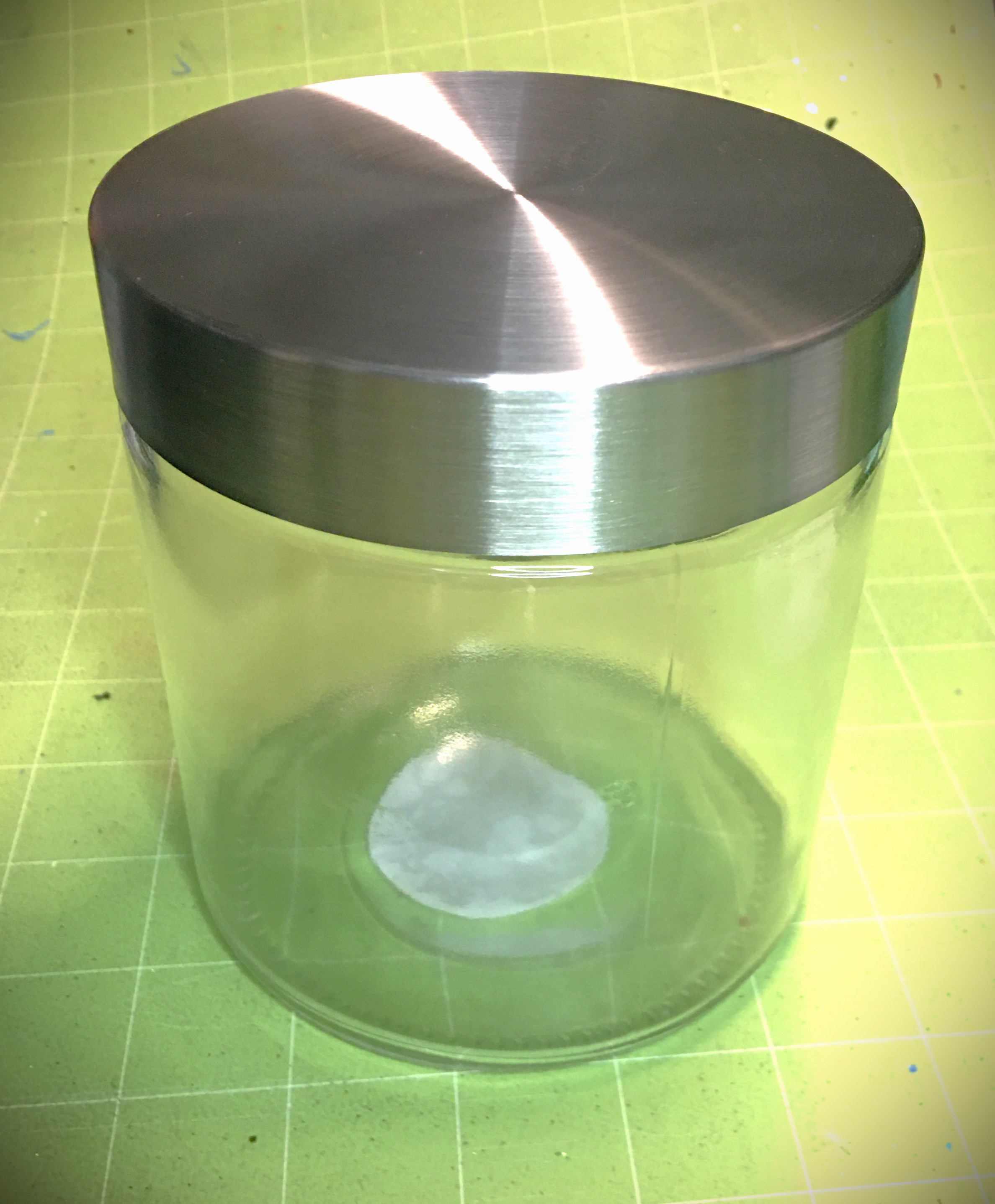
  • Clear Glass Cylinder Container (with lid)
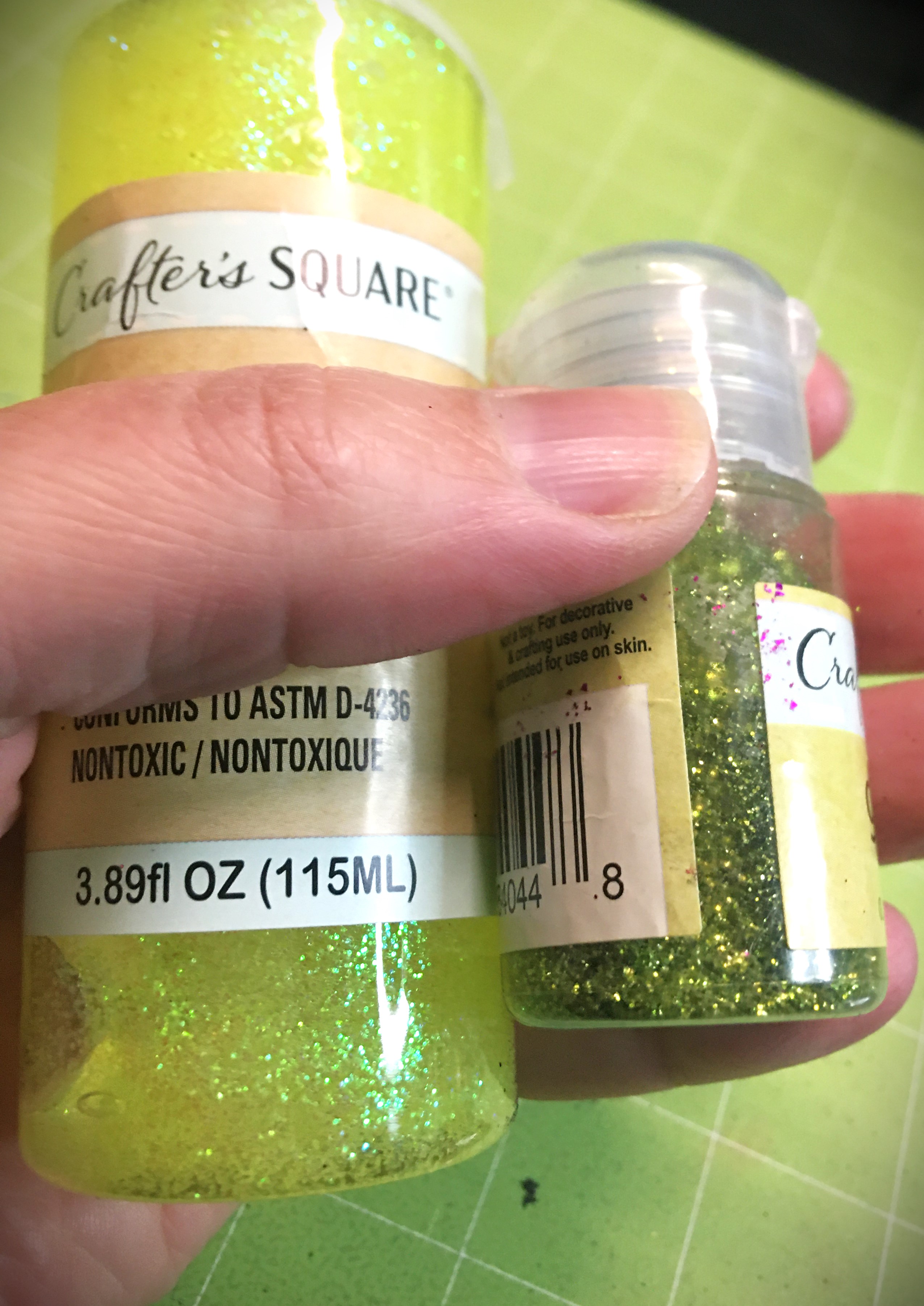
  • Glitter (color of choice)
  • Glitter Glue (complementary color)
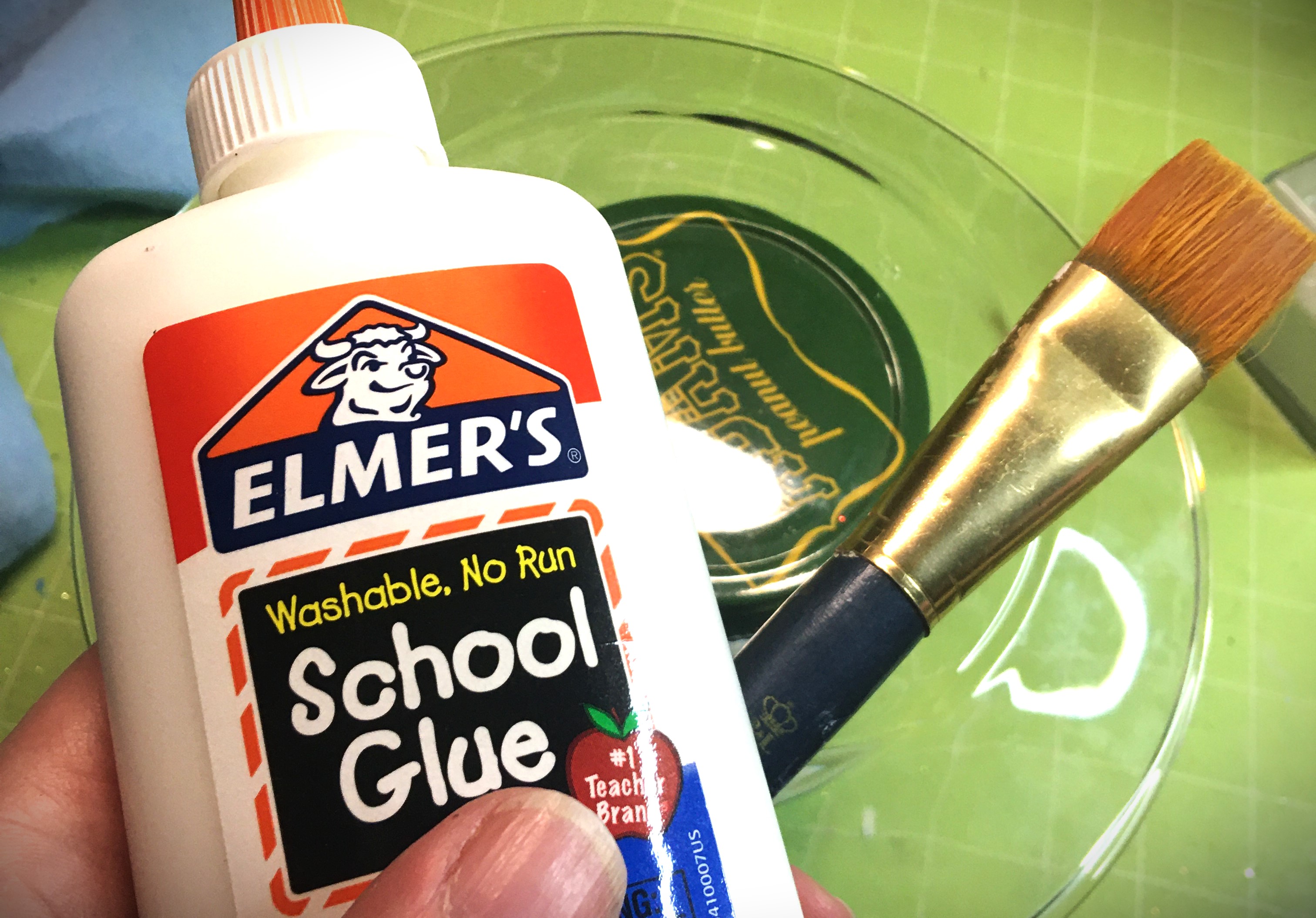
  • Elmer’s Glue
  • Paint Brush
  • Paper and Wire Decor Eggs
  • Tall Candles (colors of choice)
  • Fairy Lights (optional)
  • Polycyclic or Clear Acrylic Spray Paint (optional)
  • Vinyl Decals/Stickers (optional)
  • Silk Flowers (optional)

Everything you see here I sourced at my local dollar store, with the exception of my Elmer’s glue and polycyclic. Hello mom of young children here! I found that I’m least likely to cry with accidents when I buy things from the dollar store. And accidents happen.

Advertisements

Let’s Make It

Jar Stand

This one is a multifunctional component. I’m showing you how this holds a decor item, the paper and wire eggs. Instead of the eggs, you can use the plate for treats. Or you can set the plate aside and use the jar as a plate holder for part of your Easter Brunch.

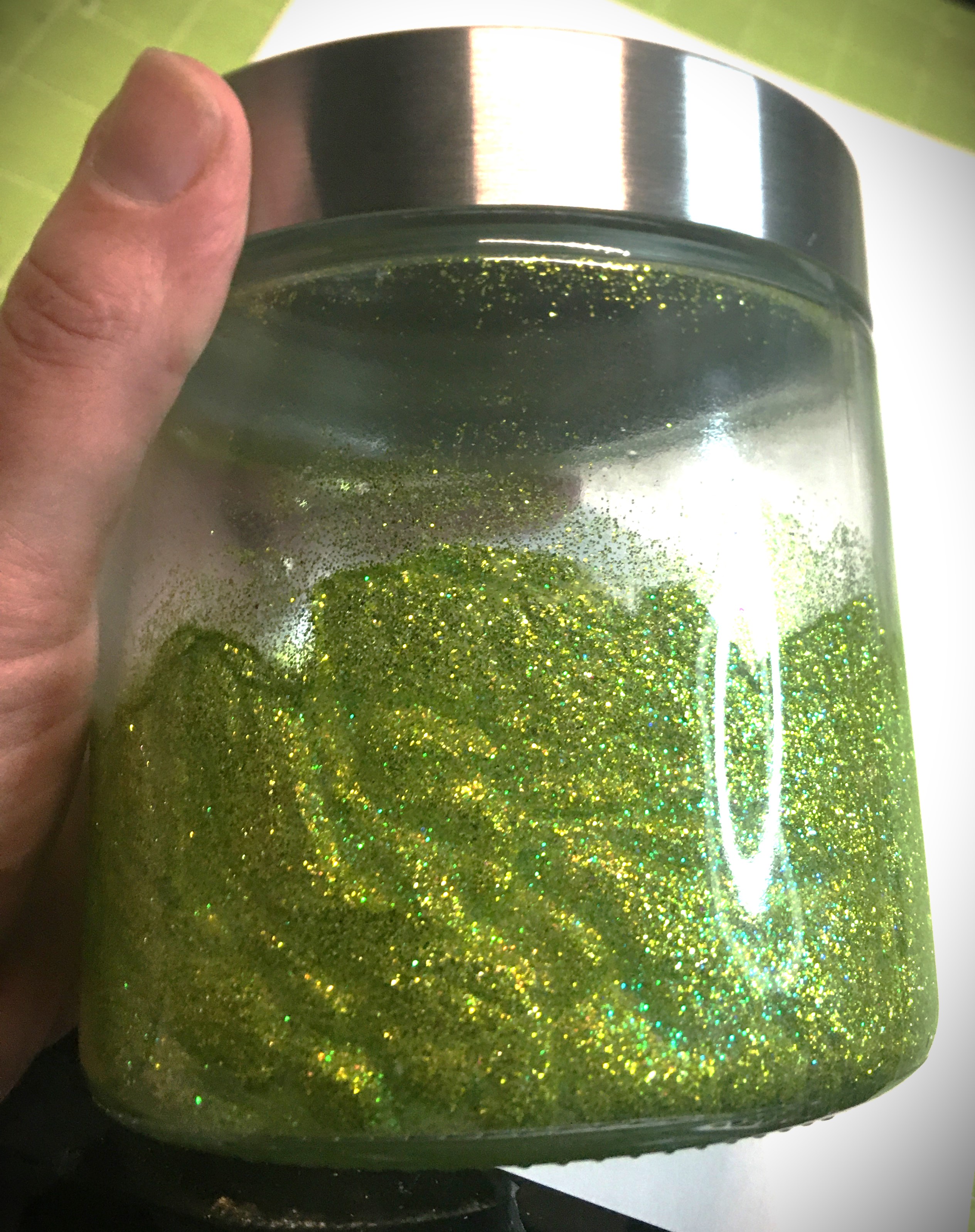
  1. Inside the glass jar paint in your glue in the bottom portion of the jar. I used a yellow glitter glue to complement the green glitter. When using glitter glue, it’s important to pat the glue on your project and not paint it on. This type of glue does not have the holding power that Elmer’s glue has. I chose to stop the glue a little over halfway up the jar and stroke upwards to create a grass like effect. If you want to use Elmer’s glue you’ll have a little better control over the glue and a quicker dry time. Just make sure to add a little secondary color of glitter into your original glitter choice. This will give dimension to your color and keep it from becoming flat looking.
  2. Dump a good portion of glitter into the bottom of your jar and swirl it around on top of the glue. For the sides of the jar, I turned and tilted the glitter from the bottom of the jar down toward the mouth. I also hit the sides as I turned the jar, so that with it came to knock out all the excess glitter, there was very little that came out.
  3. Allow to thoroughly dry.
  4. You may find that you need a dry loose bristle brush to brush out some stray glitter that likes to stick to the clear glass.
Advertisements

Egg/Treat Plate

In order to keep this plate safe for treats, make sure to apply the glitter to the underside of the plate. This makes the face hand washable.

  1. Apply a thin layer of Elmer’s glue to the area of the plate that you want to add the glitter. For me, I love the silver coloring of my jar’s lid and want that to shine up through the bottom of the plate. So I only applied glue to the lip of the plate.
  2. Sprinkle glitter over the wet glue. The more thorough you are on the shaking off of excess glitter makes the final step easier to apply without lifting the glitter.
  3. Once the Elmer’s glue is dry, seal in the glitter with polyclinic sealant or clear acrylic spray. This is an important step if you want to make sure that you won’t leave glitter trails when handling the plate. If you choose to use polycyclic, you want to tap the sealant on instead of brushing. Brushing actually ends up stripping glitter off of the glass. If you tap it on, the only glitter that comes off is whatever is loose to start with. If you’re like me and want to minimize the amount of glitter loss, clear acrylic spray is perfect. There is no loss. Plus the acrylic spray has the additional bonus of retaining the sparkle of the glitter more.
  4. Allow to thoroughly dry.
Advertisements

Assemble the Accessories

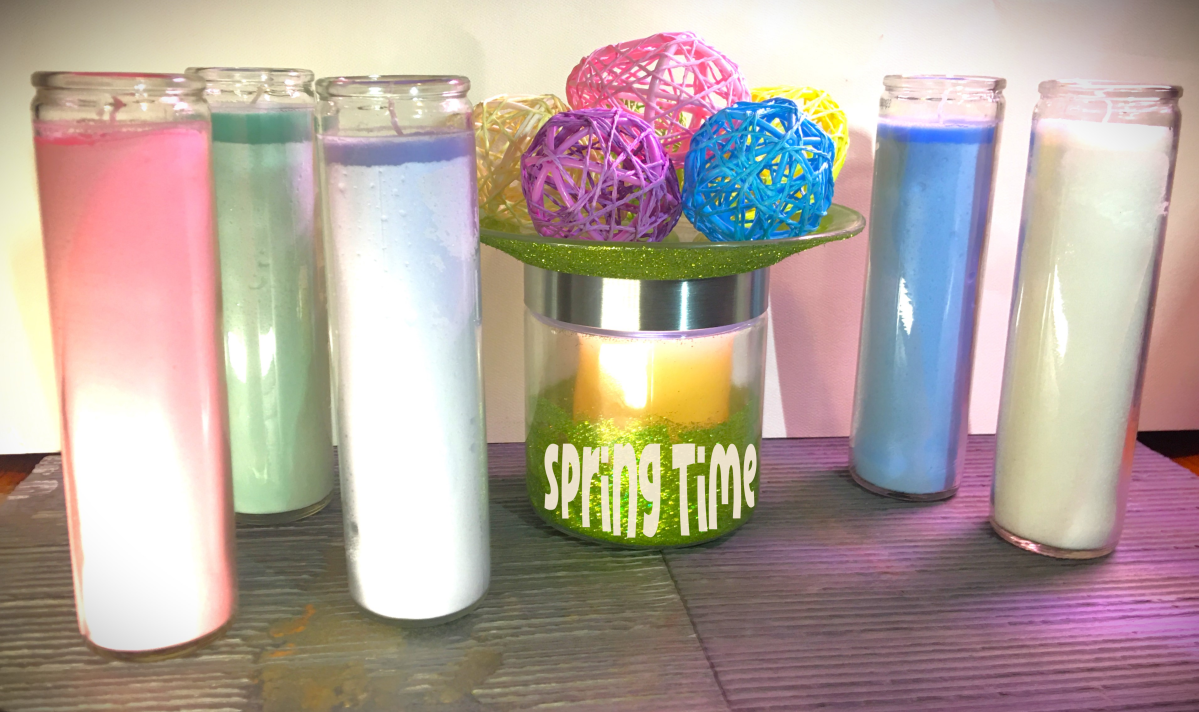
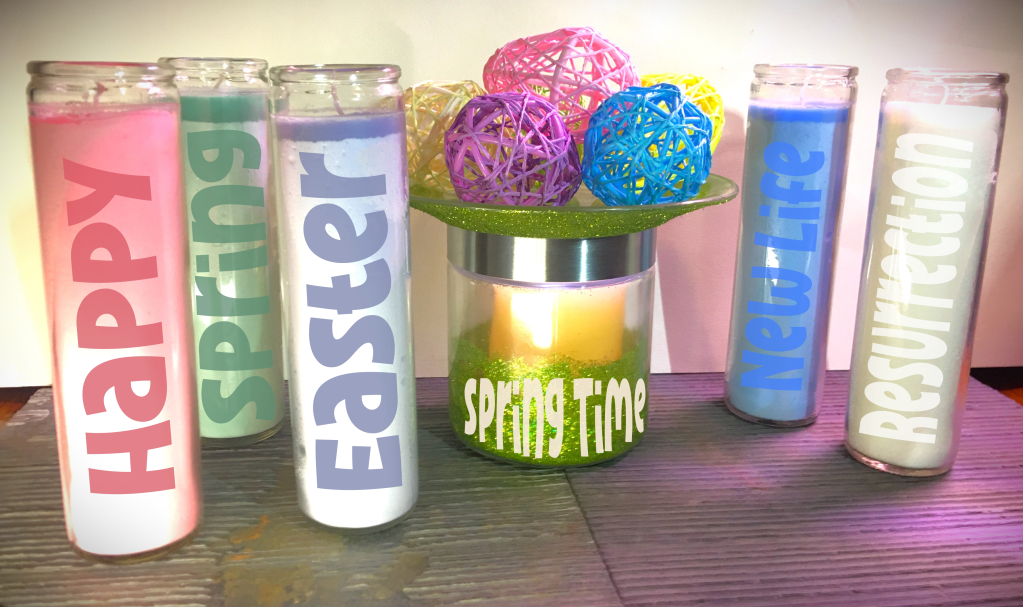
For my display I chose to go with the multi colored paper and wire eggs and different pastel colors of tall candles. This is where even more personalization can happen. If you have rattan balls, you can use those here and keep with white candles to keep a clean minimalistic look. (In this instance a white frosted paint or white glitter might be your choice of decorating the jar and plate.)

For the candles, if you choose to go the color route, you can mute the colors by frosting the outside of the glass.

Or perhaps you have ribbon from other decor you already have up. You can hot glue a band of that ribbon around the candle.

For this set, I’m going to apply vinyl decals onto the glass. Also I’ll apply a decal on the jar.

Coming back to the jar, you might choose to further decorate the inside. Perhaps you want to add battery powered tea or short pillar lights. Maybe you love fairy lights. (For this one I would recommend hot gluing the switch the bottom side of the lid. This allows you to turn on the light just by lifting the lid and not having to fish for the switch on the bottom of the jar.) You could be a flower person. You could arrange your favorite silk flowers inside. Combined with fairy lights could be very dreamy looking. I think I’m going to have to find where I stashed my silk butterflies. The wing span is about 6″ and I could arrange 1 or 2 butterflies on the inside and have a little whimsy on the inside of my jar.

Advertisements

Put It All Together

Even with all the different ways of personalizing this project, it’s all going to take on a different life depending on how you will set this up. Will you use a colorful table runner? Or maybe you’ll display this set with absolutely no further modification. I can totally see the white frost, rattan balls, white candles set on a reclaimed wood side table.

How will you set this up in your home?

Vinyl Decal designs can be found here:

Easter Candles (Decal)

Processing…
Success! You're on the list.

Leave a comment

Advertisements
Advertisements

Holiday Cover Up

Let’s be honest. I panicked when I looked at the calendar and saw that I’m hosting a family get together on Christmas Eve.

I panicked a lot.

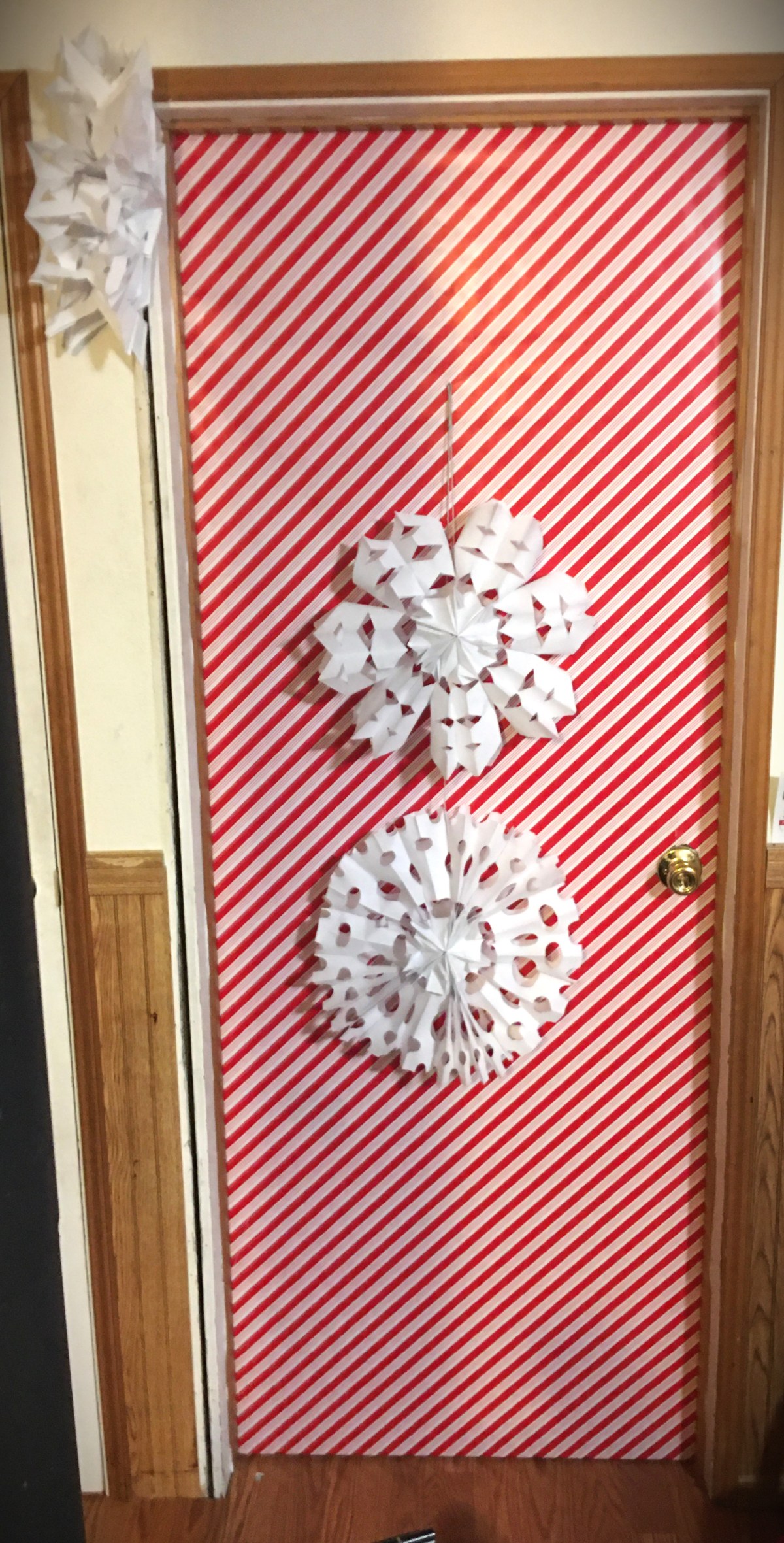
My house is tiny and very much lived in by three small children. And the state of this door says it all.

That hole in the paint, that’s where my oldest scrubbed the door until the paint came off. It was a stubborn pen stain. And who knew you could scrub the door so much the paint would come off???

We’ve lived in our house for over a decade. And I know it’s past time to repaint everything. In fact I have the vision for how I want to update our house interior. But I seriously can’t pull the trigger until we’re out of the color on the wall phase. All three do it. The oldest knows better but does it to push buttons when he’s angry at us. And evidently scrubbing his retaliation isn’t enough to break these outbursts.

Let’s just say that with all three back to back, I tell people it’s kind of nice because when you hit a phase you absolutely hate you only have to go through it once. Well the “wall art” phase is the first one that I hate. I just have to make it past this phase and I won’t have to go through it again!

Advertisements

The inspiration for this “hide my ugly doors” Holiday Cover Up was inspired by this YouTube video from Life of Style Blog, Dollar Tree Christmas DIYS 2022. I can’t improve her walk through for making a Paper Bag Snowflake, so I’m going to direct you to the 4:50 minute mark in the video. However I will give you some tips on how to make the snowflakes without making some easy to avoid mistakes.

Paper Bag Snowflake Tips

The paper bags that I used were not brown paper lunch bags. I happened to have white paper 2 lb bags that measure 4″ x 2.5″ and 7.5″ tall. Yes, my bags are smaller in proportion than the ones used in the video. But the shape of the bag is going to behave the same way no matter the size of the bag. I do want to mention that this 2 lb bag created about a 16″ snowflake. So if you do go with a lunch bag size paper bag, you are going to end up with a beautiful large snowflake!

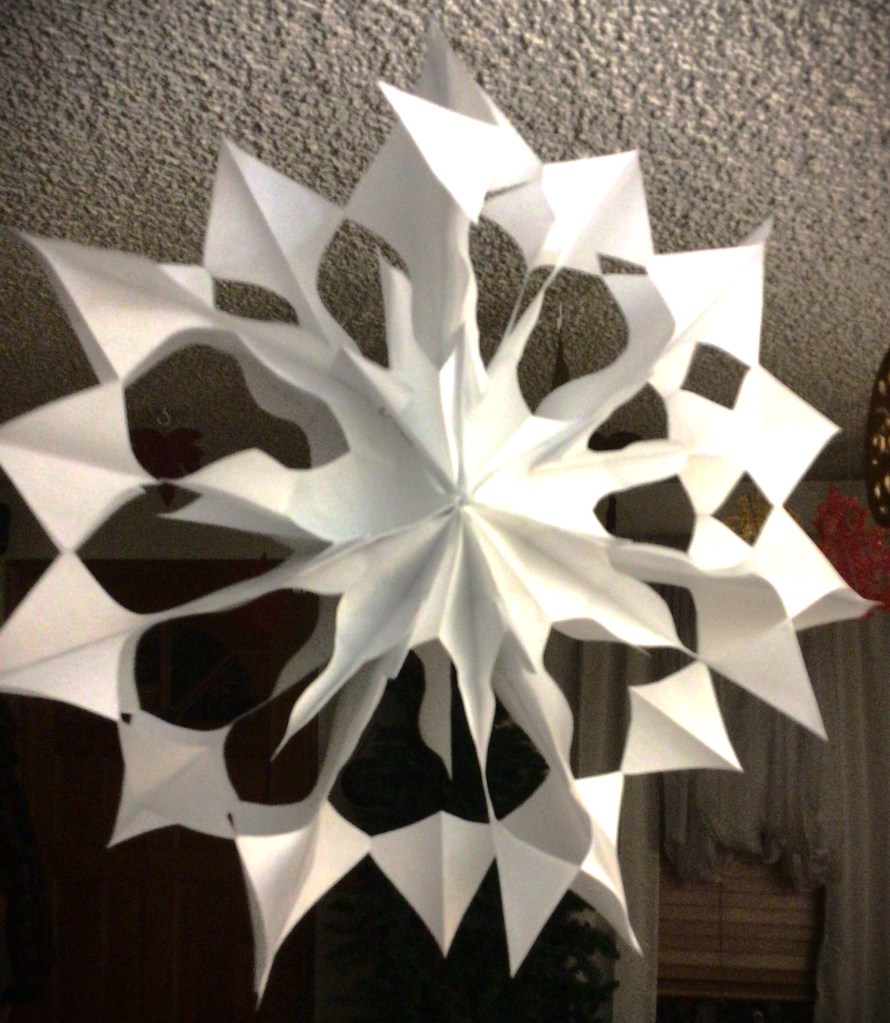
  1. Leave large spaces between your cuts. I tried making delicate lines. And as you can see (picture 1 above) the spokes snapped when I glued the snowflake together.
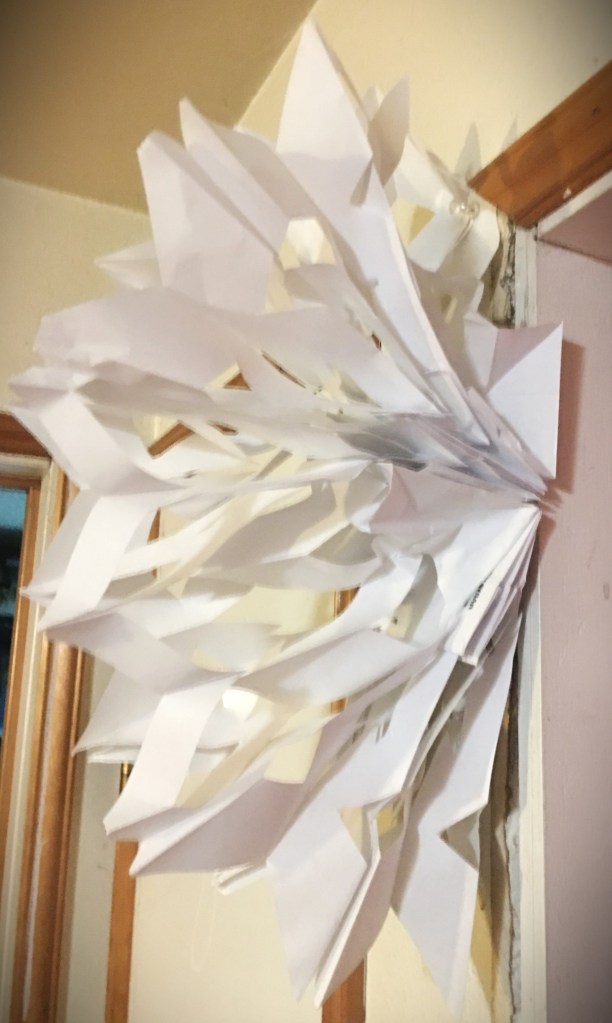
  2. If you glue to the bag’s open end corners, 7 bags is only going to give you a half circle. Picture 2 shows you how stressed the paper becomes when you take it to the bag corners. You end up taking away the flexibility of the paper because you limit yourself to the length of the small side of your bag base. In my case, I limited the distance between spokes down to 2.5″.
  3. If you glue to the edge of the bag’s open end, 7 bags may not be enough. (Picture 3) I started off with 7 bags, but when I went to fold the two ends together, the 3D snowflake structure started to collapse and flatten. I cut more of the pattern and added in 2 bags first, but found that wasn’t enough. At that point I just made another 3 to bring the number to 12 bags and that was enough to take the stress out of the paper. It no longer looked like it was going to collapse and flatten.
  4. If you glue to the middle of the bag, the snowflake will be loose enough to not be stressed looking. I was most happy with everything about picture 4 (below). The paper was not stressed at all. There was flexibility. And it was the least frustrating in closing the snowflake. (If you are craft challenged, I think this tip will be the option that you will find most forgiving and less stressful for you.)

If you want additional ideas on who to close the snowflake AND make it reusable, check out the comments under the video. The velcro comment is ingenious and I will be making reusable snowflakes for the rest of the ones that I make for the season.

And let me just say this, I will not make a snowflake the old way again! Until a new idea comes around, this is my go to for making snowflakes. Depending on how intricate your cut design, I estimate that it took me about 7 minutes to make the snowflake (below) with three triangles down each side.
Please don’t limit this craft to just snowflakes. You can easily purchase bright fun color gift bags and make bunting for baby showers, birthdays, bridal showers, anniversaries, and anything else that you are celebrating. If you opt for the bunting, non-snowflake option, I highly recommend Tip 3 (above). It gives a full circle that reminds me of Latino bunting. And the airiness fits perfectly with Boho style.

Advertisements

Rigging Snowflakes

As I mentioned earlier, I have a small house. Most decorations I use are the ones that I can hang somewhere. So I made these snowflakes with a hanging line installed in the hot glue between two bags.

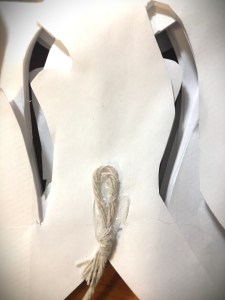
The easiest way of doing this is to make a loop on the end that you will be putting in the hot glue between the bags. Experience, through the years, has shown me that just gluing in the string with no further feature for the glue to hold on to, the string is just going to pull right out. So I’ve always used a loop, like you see here.

The loop allows glue to connect and hold on to three points of the string. Think of it acting like a Y. There is a natural pooling space between the arms of the Y and in the arm pits. And with paper also glued on either side, the string is anchored in pace.

In fact, my youngest swung at a snowflake hanging from my ceiling, with a roll of wrapping paper, like a piñata and the paper broke but the string held its place.

Hide the Ugly Door

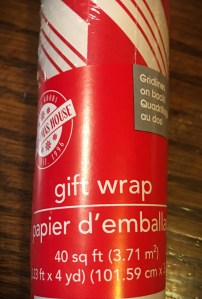
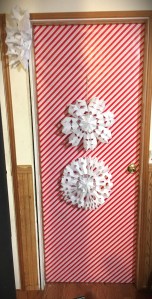
At the Dollar Store I found rolls of candy striped wrapping paper. 1 roll of 40 square feet is enough to cover one door (front and back with a little left over for patch work).

I decided to wrap my doors instead of scrubbing and/or painting them because I have zero time to move this task to the top of my to-do list. I don’t have time to paint on top of the normal craziness that December brings every year. Not to mention that the only space I have to paint doors is outside and currently we have off and on snow. Wrapping the door did take me somewhere between an hour and two as it was. I couldn’t keep an active count because I did this while chasing and feeding kids. So I count this a success.

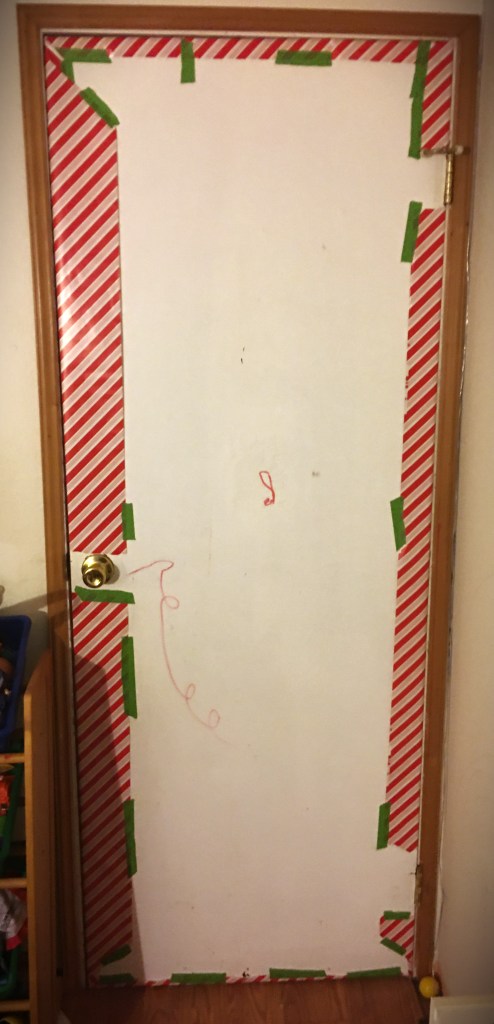
This door, I wrapped while it was still on its hinges. I’m pretty sure that this was the time suck because of how much time I had to spend in sliding the paper under the door and through the hinge space.

With the exception of working around the door handles, wrapping a door would most certainly be easier to do when it’s removed from the doorway.

That being said, I’m going to show you how I did this while keeping the door in place.

Do the front of the door first.

With some prepped pieces of painter’s tape, I draped the top of the paper over the top of the door and held it in place with a piece of tape. This freed me to go to the back side of the door and position the paper before anchoring it down.

TIP: Painter’s tape is amazing for this first part because it’s strong enough to keep the paper in place but release the paper and door without ripping the paper.

Now that the wrapping paper is going to stay in place, I went back to the front side and dealt with the door knob.

Take an exacto knife. With your free hand, run the paper down smoothly from the top of the door down to the top of the door knob. With the paper held in place, cut around the edge of the door knob with the exacto knife.

If you find it difficult to cut smoothly without ripping your paper (I did because the Dollar Store paper is cheap and very thin–it rips when you look at it funny) than cut an X or + over the door knob. This allows the knob to come through the paper and becomes easier to work around.

TIP: If your cuts are too big, it’s not a problem. Grab your clear tape that you use for wrapping presents. No one is really going to notice if the tape is glossy. They have to look for it to see it. But if you want to be thorough, use a matte finish tape. It will become invisible and no one is ever going to find it.

Advertisements

TIP: If the cut lines are jagged and uneven, don’t worry. When you’re all finished you can hide this by tying a thick ribbon around the door knob, hang a door decoration or even a stocking from the knob. When in doubt, place an accent decoration piece over the rough edge.

Once the door knob has a clean cut circle around it, this is now another anchor point to help you wrap the paper around the edges of the door.

For the hinges and the latch for the door, use the exacto knife and cut from the edge of the paper to the edge of the door. The flap that you want to remove you can either cut it off or fold it and slide it behind the paper on the face of the door.

TIP: The most difficult areas for me to work around were the top and bottom corners on the hinge side of the door. If you need to, cut the diagonal so that you’re only wrapping around one side at a time rather than two at the same time.

When you come to the bottom of the door, cut the paper from the roll a little longer than you think. I thought I gave myself about two or three inches to come up the back side of the door, I just barely had enough to come up onto the back face of the door. So don’t be afraid to give yourself more paper than you think you need.

Once the front face is all taped down, pick up the remnant of paper and hold it up to the back of the door. Find out where you need to cut to cover the exposed door, width wise. Lengthwise you will see that there’s not enough. And that’s okay. The excess width that you cut off will be enough to cover that bottom section and some pieces to patch around the other side of the door knob and anything you want to clean up (like painter’s tape that you used to tape down the front face).

With the pieces cut and ready to go, start taping those up. I started with the bottom so I could hold those pieces up with painter’s tape (which would then be covered by the larger back face paper). With these edges being seen (much like a present that you wrap in a piece meal fashion because of an oversized box or using paper scraps because you ran out of paper on Christmas Eve), use the clear tape and be as liberal as you would like to.

TIP: With the right printed pattern, it is possible to make everything line up perfectly and not have that piecemeal look. I had hoped that this candy cane print would have done that, but I got caught a few times where the stripes just wouldn’t line up.

Decorating the Door

There are so many options that you can go from here.

For example, one of the fads right for the last couple years is wrapping mirrors or paintings on the wall as presents. The door can be decorated the same way with ribbons and bows.

Don’t have enough wide ribbon. I found colored metallic duct tape in the auto aisle of my local dollar store. They weren’t on my shopping list, but I did take note. And if you hate ribbons slipping (like they will on a door), the metallic duct tape would be a perfect alternative because those “ribbons” will definitely stay in place once you lay them down.

Another idea is to take a poster board and make a “Do Not Open Til Christmas” sticker. (I probably won’t do it this year, but it’s on my list for future ideas.) Or an over sized gift label.

The Paper Bag Snowflake Video that I shared with you above was one video that my kiddos watched with me and they wanted to make those. So the snowflakes are my go to this year for decorating. It’s an easy enough craft that they can do with me. And now that I know how to optimize our production, even my young preschooler can practice his cutting skills and be able to make something for Christmas.

Please share with me your snowflake or door decorations.

How did these crafts go for you? What accent pieces did you use to complete your projects?

Processing…
Success! You're on the list.

2 responses to “Holiday Cover Up”

  1. Pacific Northwest Event Design Avatar

    When I add the comment block, I hit the + (add block icon) and type “comments” in the search bar. The comment plug in is then automatically added into the post. (It’s a feature that is already available and no additional download was needed.)

    Like

  2. 015 Avatar

    I hasve read so many posts regarding thhe blogger lovrs excep thi arrticle
    iis iin fact a nice article, keep iit up.

    Liked by 1 person

Leave a comment