First Year With Grow Bags

For a few years now I have heard many of my growing friends sing the praises of grow bags and how wonderful they are. Not to mention that if anyone does not have land to grow a garden, this is a great substitute for growing on decks and patios. So I put it to the test.

My 2023 potato growing season, I put my raised bed (which I’ve grown potatoes in for the last four years) vs. 10 gallon black grow bags to see how they stacked up against each other. And this was great timing for this challenge because I wanted to up my potato crops to see if I could get that produce off of my shopping list and on my self sufficiency list.

Below I will tell you the results and my thoughts on the process. But first I wanted to start off by showing how I set up my grow bags. A lot of people set them up with just putting in potting or raised bed soil. I wanted to go a different route because with my family we try to go with natural fertilizers that fall into the organic farm spectrum of growing.

Setting up the Grow Bags

I set up these grow bags like I do with my brand new raised beds. But I structured it differently, aligning with how I’ve seen other people use their grow bags for growing potatoes. Those people layer their bags with soil on the bottom and top and hay in the center. The rumor is that this hay section allows the potatoes to grow large because they have less resistance from soil, which can compact down around the tubers. Keeping this in mind, here is how I layered my grow bags (from bottom of the bag working up):

  • Raised Bed Soil
  • Compost
  • Pine fronds
  • Small Pine branches
  • Pine Fronds
  • Compost
  • Raised Bed Soil

This spring we had pruned back our pine trees. Normally these go into our compost pile. But as you can see below, these fronds had new growth tips on them, which have the most vitamins available. I didn’t want those nutrients to go to waste. So I separated out the softer fronds from the more rigid branches. As you see below.

These branches were then cut down to fit inside the grow bags without puncturing the sides.

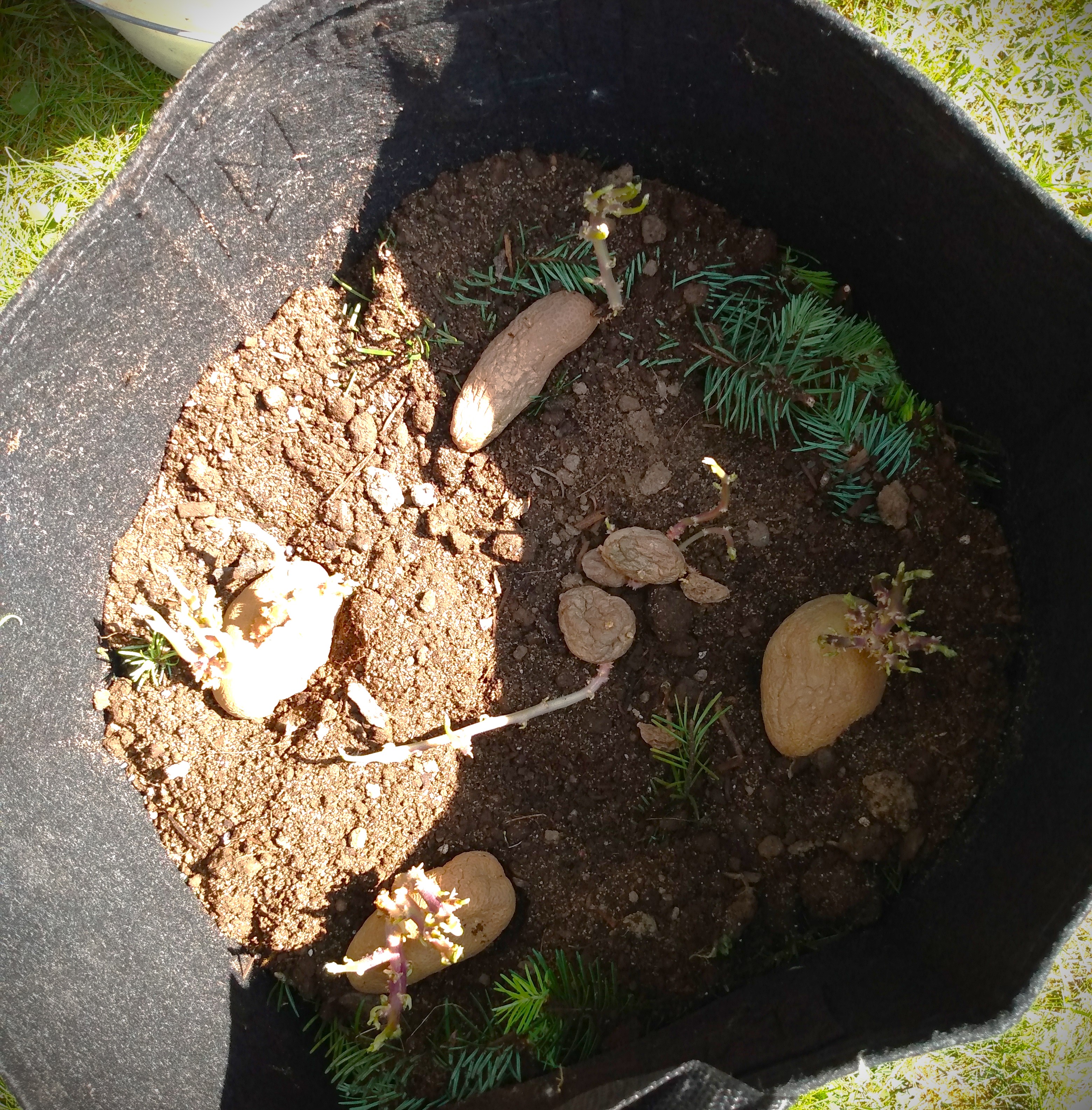
With all my components prepped for work, I built up my grow bags. Right after I laid down my pine layers, I put down a fine layer of compost to set my potatoes down on. Once I placed my potato seeds down, then I covered them with the layer of compost and final layer of raised bed soil.

The pine branches and fronds were added primarily for slow release nutrition for my potato plants. But I placed them in the grow bags, like other growers place hay, because the thick layer of fronds (theoretically) gives them the tubers the ease of growth without the soil compounding around them from watering and rains.

To finish this experiment, I placed the grow bags near the same area that my raised bed potatoes were growing so they could receive the same amount of heat and light.

Advertisements

Sweet Potato Side Note

I haven’t yet harvested my sweet potatoes. But I prepared their grow bag the same way as my potatoes. I’m trying to give them the most time to grow and the vines haven’t died back yet.

That being said, the sweet potatoes are a first time experiment because I haven’t grown them before. So I may post about what happened this year, or I may wait to talk about them until I gain a few more seasons of growing them. But I did want to post this picture of my rooted slips before I planted them.

Out of everyone I watched in videos to learn about growing sweet potatoes the one bit of information I wasn’t able to see was what a good rooted structure looked like. This was mostly because those growers cut from harvesting slips to already having them in the ground.

So if you’re like me and you want to bench mark to compare what you’re growing next to, here is a picture of my slips before I put them in the grow bag.

The method of growing slips that worked best for me, was sitting the bottom (fat) end of the sweet potato in a glass of water. This method gave me strong slips about a month before the method of laying the sweet potato on its side in a container of soil. Everyone I watched swore by the soil method, but I honestly found the water method better for me.

The lesson for this side note: when first starting to grow something for the first time, try a few different methods at the same time to see which one provides better for you. What works for one grower may not work for you. And vice versa.

Advertisements

End of Season Results

It took a while for me to get to this point because even though the potatoes were started at the same time they didn’t finish as the same time.

Starting from left to right, the first container I grew purple potatoes. The middle and right were my russets that had sprouted on me over the winter.

My purple potatoes grew seed flowers. I allowed the flowers to grow to see what that process was like and if I could collect the seeds. However my blossoms kept falling off. So I don’t know if the flowers were being trimmed by little garden helpers or if the flowers were falling on their own. Needless to say that I didn’t see how the seeds grow or if the plants even grew them. As soon as I learn that process, I will share that information with you. But for now I have nothing more to say other than flowers grew on the plant portion of the purple potatoes.

And true from those I watched from those who did have information on the flowers, when your potato plants grow flowers, it does delay the whole growth cycle. My two russet bags never grew flowers and the plants started dying back maybe 6 weeks before the purple potatoes did.
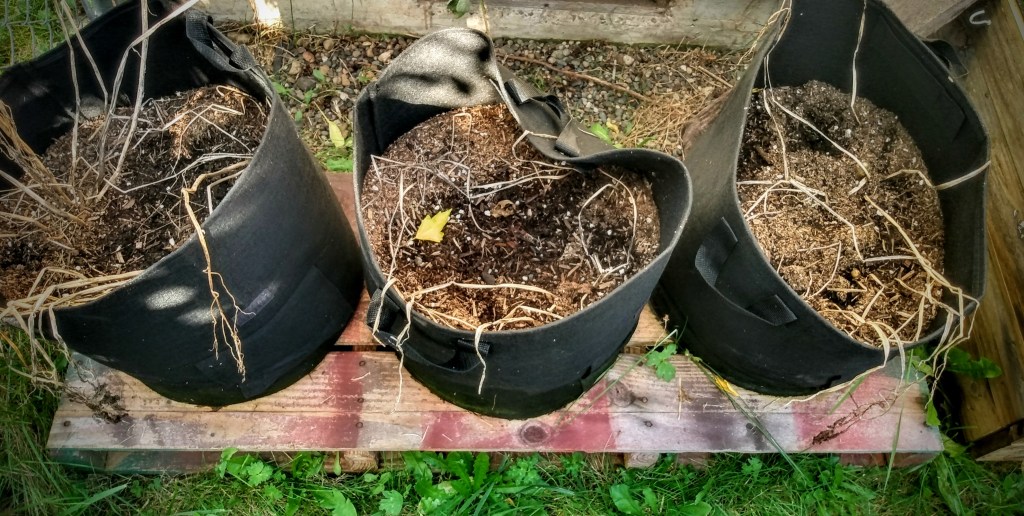
I wanted to keep these grow bags to use in the future. And since I didn’t want to lose the velcro integrity on the bottom, I didn’t use that “door” at all. Instead I brought over my wheelbarrow and dumped my bags in one at a time.
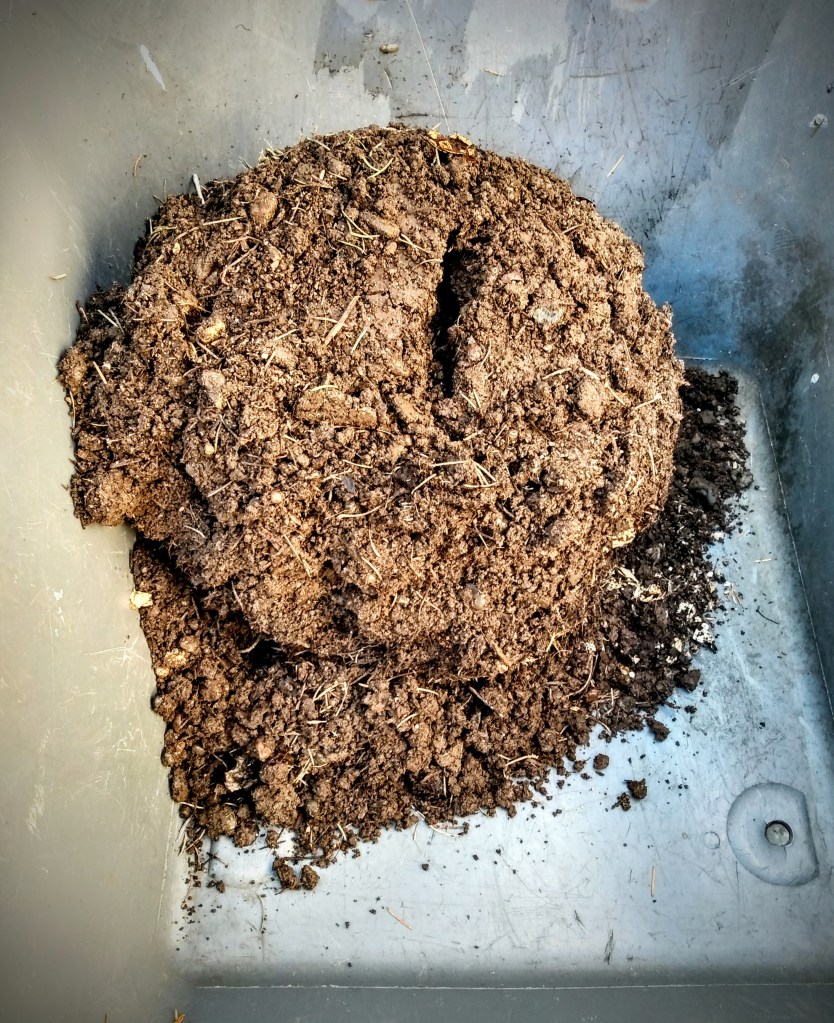
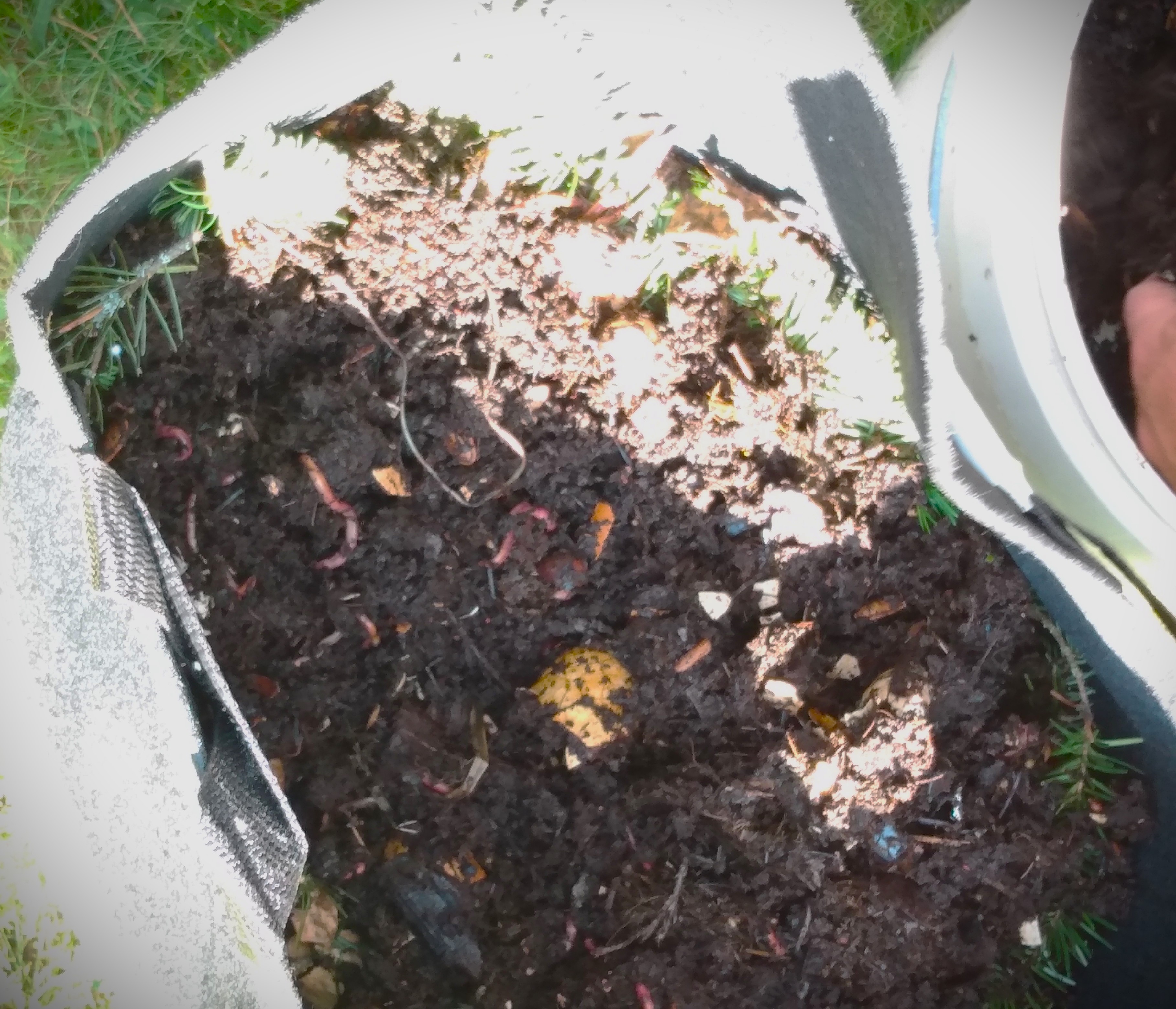
As you can see here, the soil still compacted. So even when you do take measures to prevent compacting, gravity is still going to work. This was the bag from the right side. I didn’t add any sand into this bag and that might have what made this one compact more than my other two bags.

Originally we had added sand to our compost for bags two, three, and sweet potatoes, in order to make the compost stretch between all the bags. The sand did keep the “soil” of the grow backs more loamy than the one that was straight compost.

Having seen what sand did for me in these grow bags, I will more than likely continue to add some soil with the fresh compost to prevent a clay like clumping from beginning to end of season.

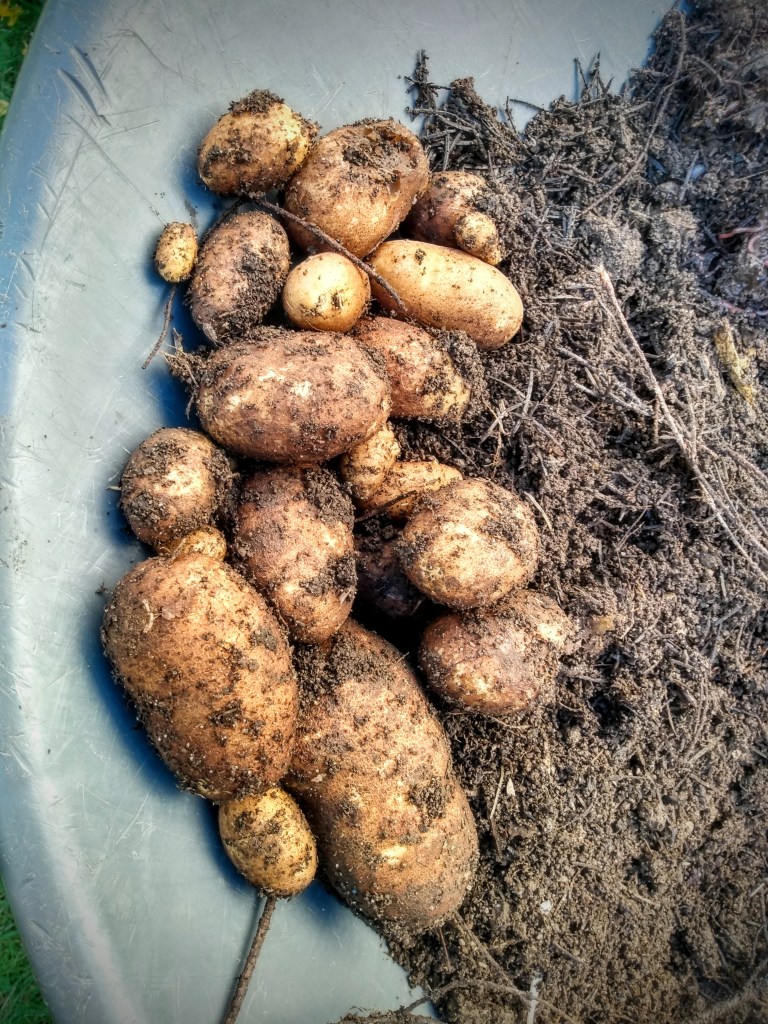
That being said, if you look at the picture with the potatoes that I harvested from the first bag, you will see what didn’t compost down during the grow season. So if you’re worried about adding sticks into your grow bags, you can see that they will break down over the course of the season.

This was my first time growing purple potatoes. I chose them for some fun colors to make dinner with. And there’s the fact that dark purple fruits and vegetables have a higher antioxidant property and more vitamins and minerals than same fruit/veg families that are lighter in flesh color.

I wanted to make a quick mention on them, because as soon as I upturned the grow bag and started troweling through the soil I was asking myself, “Where are the potatoes?!”

As you can see above, these beauties hide with the soil. The way that I identified them was that they had an opal like sheen to them. So I pushed the soil to the side looking for anything that didn’t have the same matte finish as the soil.

I’m super excited for these potatoes to cure so that I can see my kids’ reactions to having purple potatoes for dinner. That and even more to the point, I want to eat something colorful that I haven’t eaten before!

Advertisements

Grow Results

Back this spring, I wasn’t too sure what I expected. Obviously I expected potatoes, but I didn’t know how these grow bags were going to work out.

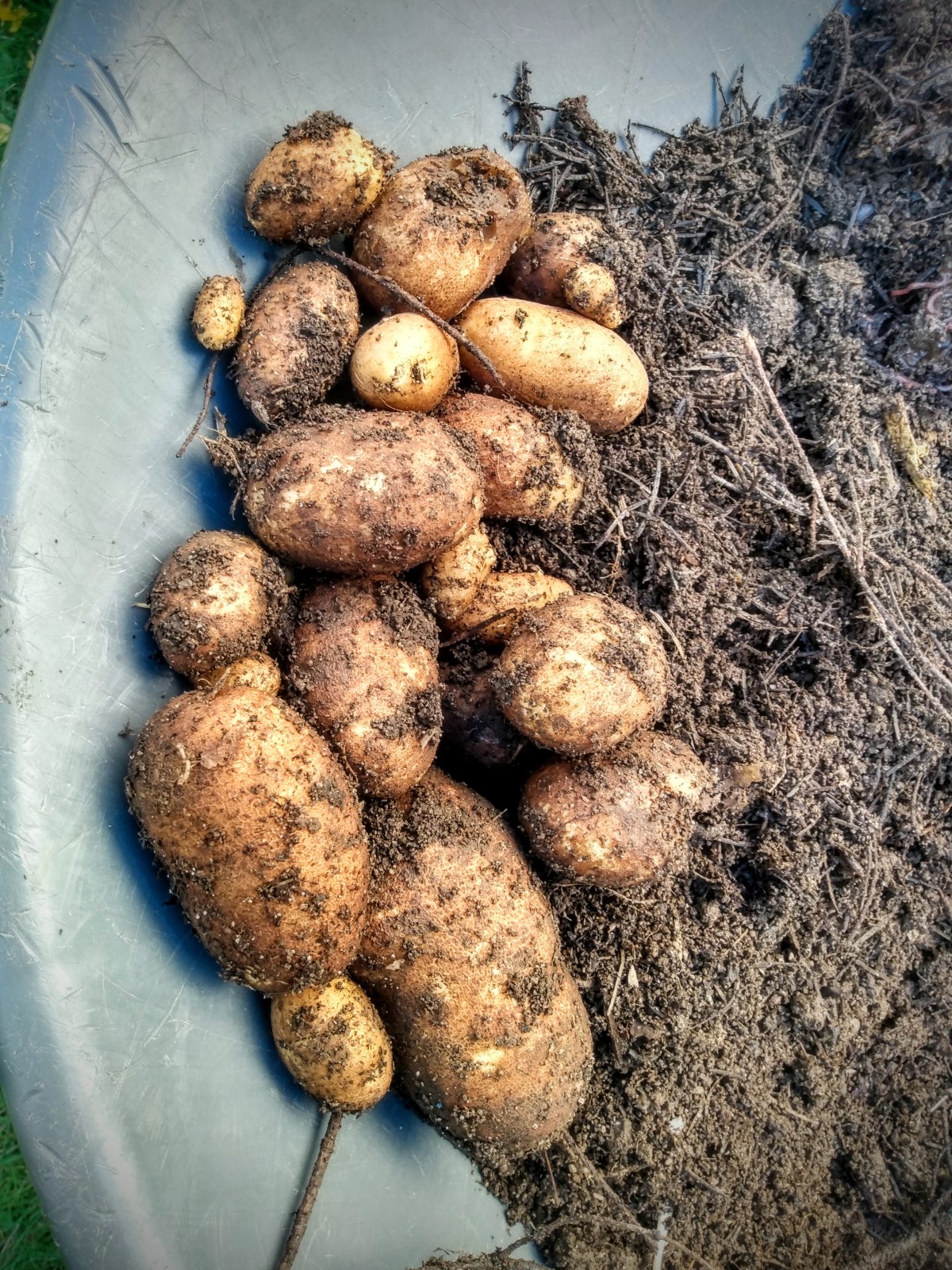
Here are the results of what each bag grew, in the same orientation as the bags were placed in the above picture; purples on the left and the ones that grew in compost/sand mixture on the right and middle.
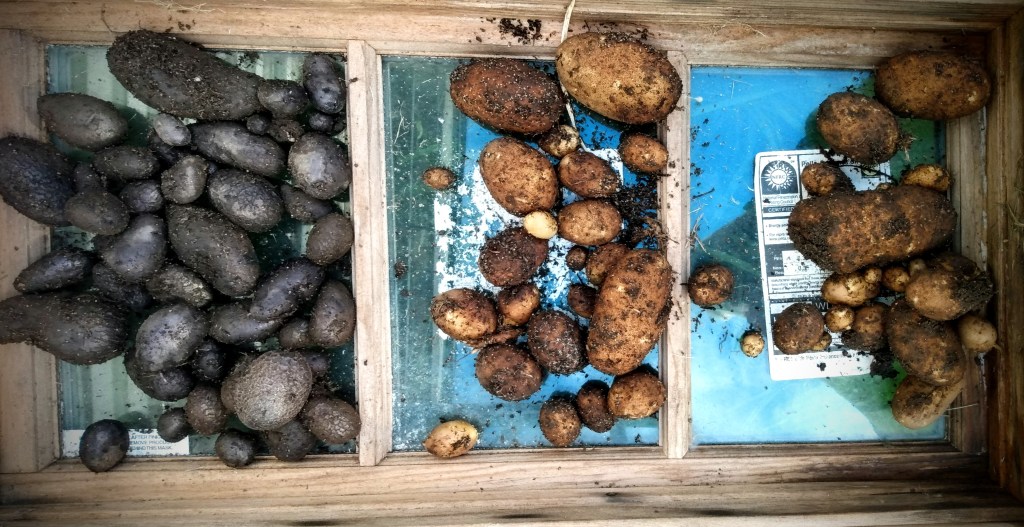
For the russet potatoes it looks like the number of potatoes were not limited by sand or no sand added. Even though I did get larger russets that grew in both bags, it seems like I got a better return on size by adding some sand to the compost. (Both had the pine branches and fronds, the only difference was sand in the compost.)

The purple potatoes outperformed the russet potatoes in quantity and overall size. This surprised me the most.

What I learned between the different varieties of potatoes is that I need to get some more different varieties and try them out to see if there are other potatoes that will grow better for me, like the purple ones grew better for me.

Side Note: red potatoes don’t grow well for me. Below you’ll see a single red. Not everything has to grow well for you. Half the fun with growing your own food is seeing which varieties grow well for you and which ones don’t. As it is, even when my neighbors grow the same vegetables as me, there’s often times variations in performance even when we have the same microclimate. But when you select and grow what grows best for you, you not only put food on your table, you have something to exchange with your neighbors who grow something else better than you.

Advertisements

One Final Comparison

As I mentioned at the beginning, I grew potatoes in a raised bed and the grow bags. I wanted to see the comparison on how things grew for me. Before I give the results, I did want to mention that I couldn’t go through my entire raised bed because I had a lone tomato plant that I couldn’t find any other home for, so I planted it in the corner of my raised bed that had a gaping hole. Once my potato plants started to die off, my cherry tomato plant took off and outperformed all of my other tomato plants. So out of respect for that super grower, I tried not to disturb its roots too much. That means that there could potentially be some potatoes under the tomato plant, but I couldn’t thoroughly check there. As it is that tomato plant is still producing even though I had already harvested and uprooted all my other tomato plants.

Here are the pictures of my grow bag (box on the left) and my raised bed (box on the right), taken side by side.
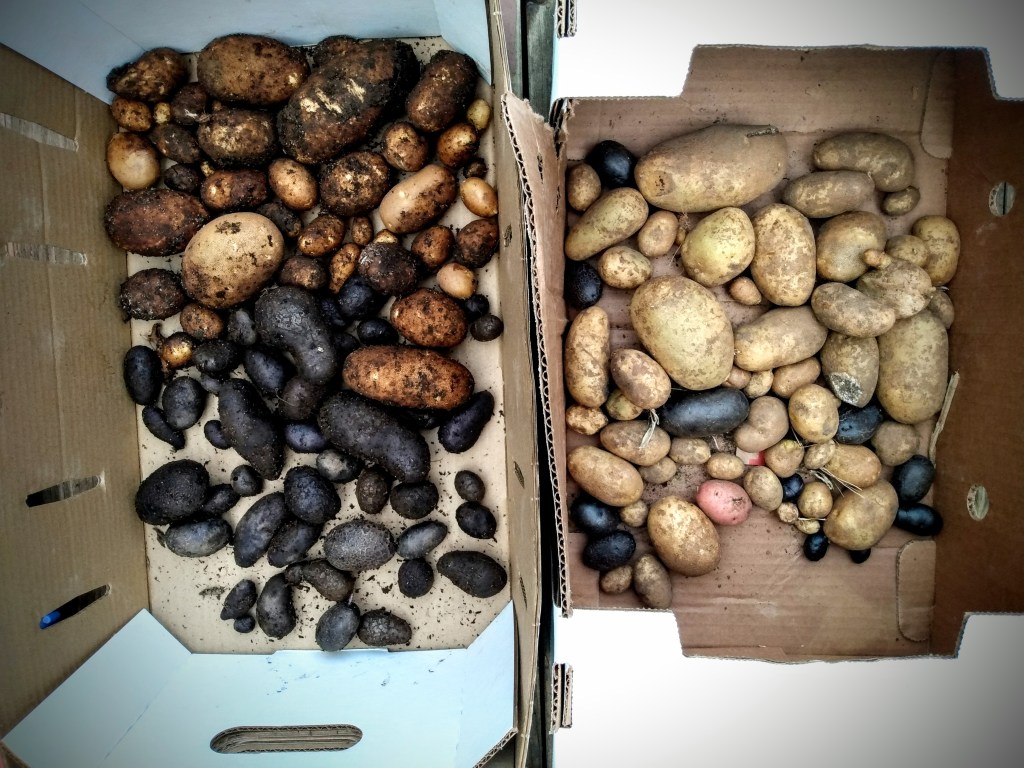
The raised bed might have had a couple less seed potatoes than I used in the grow bags, but we’re only talking about somewhere around a 2 plant difference if that is the case. So as far as quantity of potatoes go, the grow bags seemed to have done better. This result could be because the bags had the extra compost and pine trimmings that the raised bed didn’t have. But to be fair, the raised bed had seed potatoes planted about two months before I planted the grow bags, so the pine trimmings weren’t available for those plants. (The raised bed was harvested about two months before also.)

The sizes of potatoes seem to be about the same. But my largest potatoes did come from the raised bed.

I’m actually glad that I took the chance on the grow bags for my potatoes. I definitely think that it is a viable option for people to use if growing crops for your family is a challenge or not possible because you don’t have land to use to grow. I’ll post an affiliate link for the grow bags that I used below. And if you’re interested in using grow bags next year, but space is limited, if you can find a space to fit a 5 gallon bucket, you have the space to use a 10 gallon grow bag (which is slightly bigger, but you have a general idea of how much space you need.)

Things to remember when growing in a grow bag is that you will need to have a way of feeding your plants. Soil will have nutrients in it. But it won’t last forever. Compost is always a great option for feeding your plants because you’re putting nutrients back into your ground or plants that would normally just be sitting in a landfill, it’s an inexpensive way of feeding your plants, and you know or have more control with what is going into feeding the food you’re going to eat. If compost isn’t an option for your family, choose a fertilizer and/or compost product that works for you. The fewer chemicals that you choose to feed your plants means the fewer chemicals that enter the food that you eat. Take the time to read the ingredients label. If you can’t pronounce what you are reading, you probably don’t know what that ingredient is, and the chances are high that it’s something that you don’t want in your body.


Hopefully seeing this little adventure of mine has helped fill your curiosity of grow bags or give you another option that you might not have had before when it comes to you growing food for your family in a very limited space. And whatever you can grow means that you’ve saved that much money to apply elsewhere in your family budget.

Products I Use

This post contains affiliate links to products. We may receive a commissions on products purchased through these links, but at no extra cost to you. These items listed here are from Amazon but may be purchased at local markets.

In case you need to grow inside, LED Grow Light Strips for Indoor Plants, the red light gives you an option for growing plants that bloom.

Leave a comment

Processing…
Success! You're on the list.

Twine-ing For You

One of the most important tools that you can bring to your garden is cotton twine. It’s inexpensive, has countless uses, and compostable at the end of the season.

Whether you’re ground or container gardening, supporting or opening up air flow, these are a few reasons why you can start using twine today.

Opening Up

Before this past winter, I really pruned back my raspberries. Part of my problem last year is that I didn’t know my new cane from old cane. So I made my best guess. I also thinned it out to a couple of canes in a patch to encourage more fruit growth.

You can imagine my surprise when this spring rolled around and nothing but leaves were growing. Especially since last year my raspberry patch produced so many blossoms that it was one of the first things that the local bees had for food.

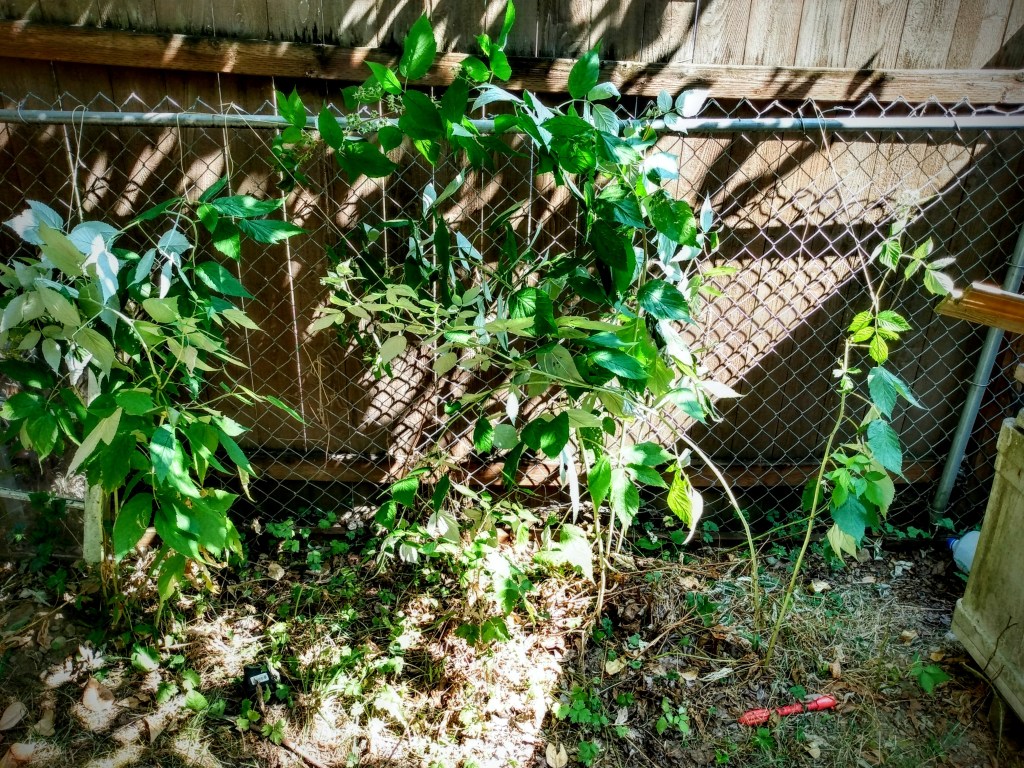
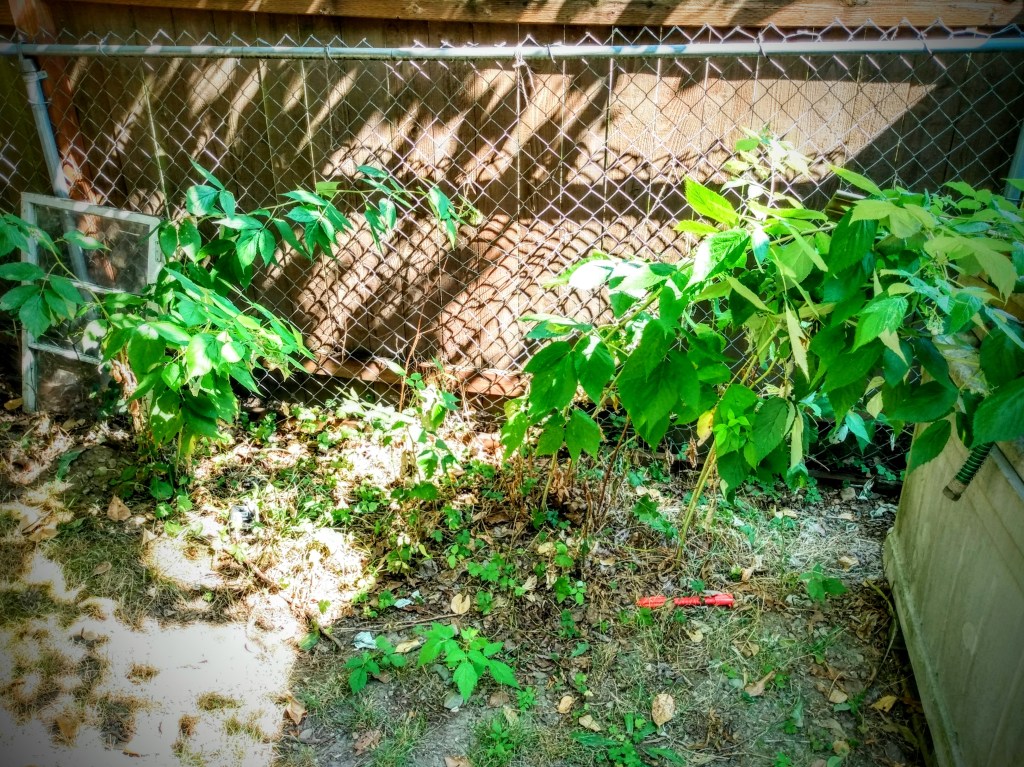
When I saw that my raspberries weren’t producing any blossoms this year, I decided to leave it alone and let it recover for next year. And here you can see how my canes just fell on each other.

What I didn’t count on was that my raspberries would produce blossoms and fruit in August!

Normally in my grow zone, the flowers and berries set in the spring. And while this year we did have a spring season (unlike last year), our summer has been completely cool (about 3 months behind in actual summer heat). It was this past week that I walked past my raspberries and saw blossoms and fruit just starting to form.

With my current growing season lacking pollinators, I needed to open these canes up and present the blossoms so the two bees that I saw in this patch of my garden (that were working while I was tending to the canes) could find the blossoms easier and crawl through a maze of leaves.

The canes that were compatible with hooping together, I used my twine to together. With the tail that you see here, I attached it to the cyclone fence you see in the back, to prevent the hoop from falling forward when fruit sets.

In the center, I had 6-8′ canes that I arched back toward the fence. The cane on the right was lying on the ground, so I stretched it upward to present the blossoms.

I know it’s kind of hard to see in this picture that there were three dimensional loops that I made forward/backward and side to side. So while this picture looks like there are two upright clumps of canes, in actuality it’s more like the canes are arching around each other.

This makes it easy for me to spot and harvest the berries. But more importantly my pollinators can find them easier and be efficient with their flight patterns.

TIP: For those of you who are limited on space, you can grow raspberries in a small area. The space that I use is about 1.5 feet deep and about 5 feet wide. The trick is to keep on top of your cane maintenance. Thin when you need to. And to prevent the cane from volunteer grow outside your space, cut back the new cane as they emerge.

The added benefit of opening up your canes like this is that it’s easier to cut out the old growth cane that you missed last season (brown cane with no leaves or fruit).

As opposed to the canes having collapsed on themselves, you can see here how the buds and fruit are much more accessible to the pollinators and myself. And with the heavier bearing canes anchored to the fence, the cane is not going to be stressed under the fruit load.

This is not the traditional way of growing raspberry canes, as far as providing structure goes. But I wanted to share what has worked many seasons for me because sometimes we have to think outside of the box to work with the space that we’re given. And if you have cyclone fencing, you have a grow structure that doesn’t cost you anything additional for your gardening overhead.

Advertisements

Support for Tall/Long Vines

One of the choices that we made this year was to increase our tomato count in our gardening plan. One reason is that it’s one of our largest consumed crops and a base product for many of the meals we eat through the year. Another reason is that I wanted to try a handful of new variety of tomatoes that our outside our standard never fail varieties (which of course I had to keep growing this year).

While I have a decent size collection of tomato cages, I had maybe enough for half of all the tomatoes I wanted to put into the ground. That and I love indeterminate tomatoes. The problem I have every year is that my tomatoes always grow too tall for my cages. So this year I decided to line grow them.

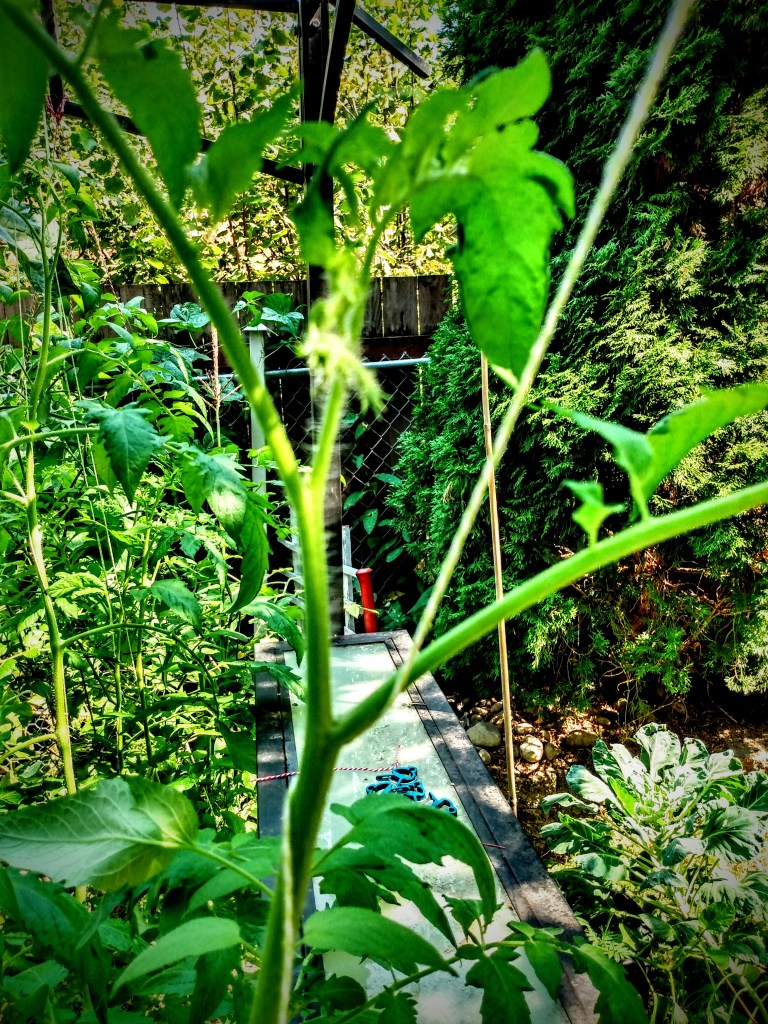
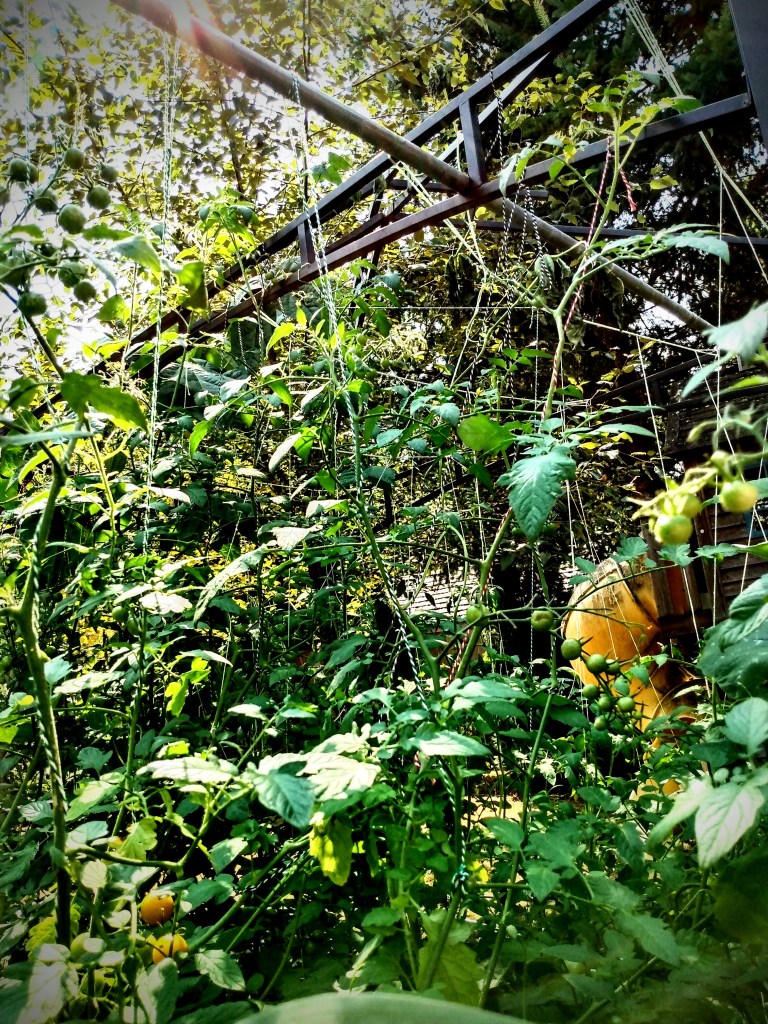
This is now my preferred method for growing tomatoes! I can walk through the rows to collect tomatoes, which I never could do with cages. Line growing tomatoes are also the way to go when you want to grow many vines with a smaller foot print. Mine are about a foot apart. A few plants I missed a couple of suckers, but with additional lines, I was able to train and direct them in a growth direction that keeps the airflow between the plants.

TIP: It’s important to remember that when growing tomatoes densely like this to remove the suckers. This keeps the airflow between the plants, which decreases the chance of disease.

Advertisements

Another added benefit with line growing tomatoes is that there were a handful of plants that were stunted by the cool summer and were over shadowed by the faster growing plants (not just different varieties, but the same varieties that did better taking off). When I adjusted the lines, it opened up pockets in between the plants where I could get the sunlight down on the stunted ones. And they took off and have caught up to the ones that started quicker.

All of this was finesse and control that I never had while cage growing.

If you haven’t line grown tomatoes before, you want to have a structure that you secure you line from. With the bottom of your line, you attach it to the bottom of your start (or even under the roots when you transplant) and through the season, you wrap the line around the vine.
TIP: focus on supporting the main stem under each of the armpits. This keeps the weight of larger bearing fruit (like beefsteak) from stressing out the main stem. This is the first year where I haven’t had to deal with damaged branches from heavy fruit. And my beefsteaks are hanging in the air of fully upright vines of very happy tomatoes.
In fact, this year not all of our tomatoes fit under our trellising structure (a gift from a buy nothing group–so another area where we improved our garden without having to save or budget for it). So I used a few cages. Unfortunately my tomatoes tag teamed with my beans and started to take down my corn. (This is a subject for another day.) Fortunately, I had the cages just outside the structure. When I unweave the tomato vines from the beans and corn, I line tied them to the outside of the structure. This relieved the stress on my corn and gave the structure that the tomato vines were yearning for.

You can see in the right picture, my husband threaded a 10′ piece of conduit through the top section of our structure, out and over the caged tomatoes. So rest assured that if your structure is smaller than your need it can be modified with other materials to extend your grow radius.

If you don’t have conduit already, don’t feel like you have to go out and purchase it if you’re on a tight budget. A long branch (from a trimming company of found fallen while on a hike), cleaned from smaller branches and limbs. Just make sure to secure this addition with some cordage. (As we were using conduit, a healthy length of twine was more than enough to secure it to our structure.)

Advertisements

Structure for Potted Plants

A major reason why I hear people say that they don’t grow vegetables themselves is because they don’t “have land” where they can grow. Whether you’re living in a city, renting from a landlord who says you can’t have a garden, or any other legitimate reason why you can’t have a garden… know that you can still have the option of growing some produce in a container garden!

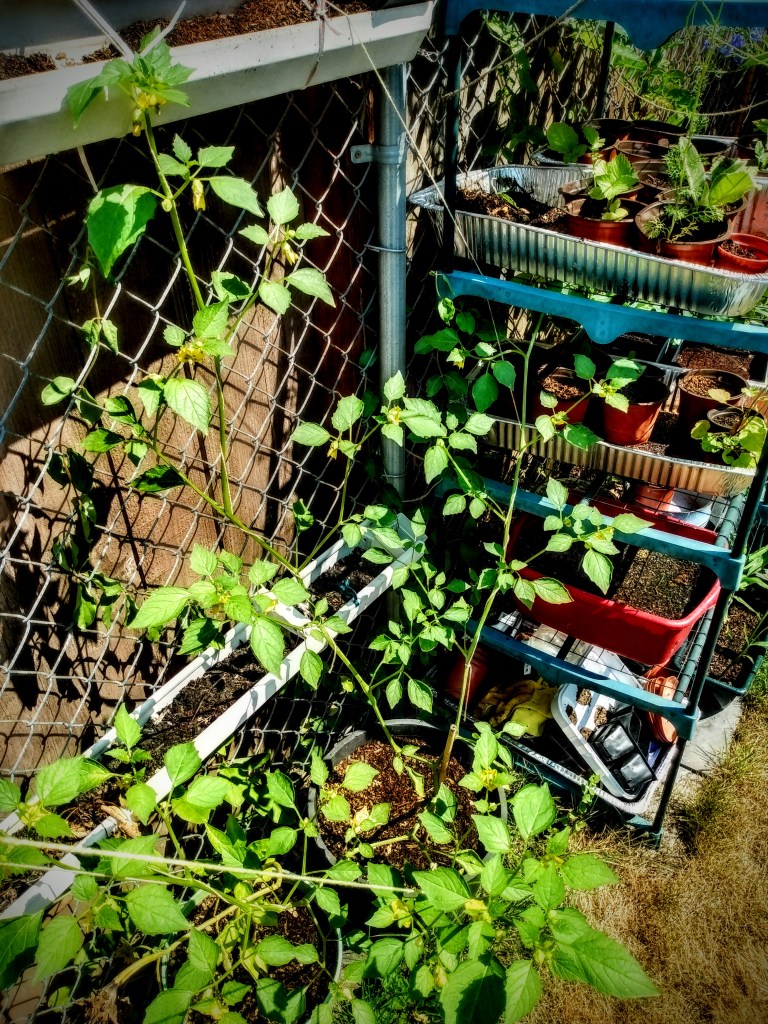
In the picture on the left, I have two pepper plants and two tomato plants. In this space, I don’t have room for cages. And an upright bamboo support was not enough because the size of my plants and physics were just causing my pots to fall over.

To solve this problem I pulled out one of my 6′ shepherd’s hooks, anchored it in the center of all the pots, and ran lines to each plant. Depending on where you live, any number of other resources can be used in the same manner. If you’re patio has an over head beam, a large command hook can be used. If you only have two pillars, run line at a certain height between the pillars (two or three times around). From this line, tie to your line what you are running down to your potted plants. Again, take a look at the resources that you have and use your imagination to make the structure that your plants need.

The picture on the right is my pepper plant that really took off with four large branches. When the blossoms started presenting on this plant, I knew I had to open it up or I would decrease the amount of pollination because of hidden blossoms. So I spread out the four branches in four different directions; two to the shepherd’s hook, one to the fence, and one to my uncovered greenhouse.

Advertisements

There’s no one way that you have to offer support to your garden! Be creative. Think outside the box.

You are capable of growing the amount of food you want to grow.

Look at your plants and see what it is that they need. If they need more air, create a system to open them up and give them more air. If you need to maximize the rate of blossom pollination, look for ways that you can make it easier for your pollinators to find and get to your blossoms (as well as making sure that the fruit doesn’t crowd each other out of space).

If your budget is tight, or you need your money to go to other things, look around you and see what resources you have that are free or at a less expensive cost than some of the other conventional gardening items. For example, if you want to grow lots of tomatoes but can’t afford the cages you need, go with cotton twine. It’s very inexpensive and is just as effective.

What other tricks do you have for supporting your garden on a budget?

11 responses to “Twine-ing For You”

  1. 1B.newcn.win Avatar

    Pretty! This was an extfemely wonderful article.
    Thank you for provbiding this info.

    Liked by 1 person

  2. Pacific Northwest Event Design Avatar

    Thank you for finding me! I hope you enjoy all the variety that I offer here. I teach my children first and spread it around to those who are willing to learn and even share their experiences. We live in a pretty amazing world.

    Like

  3. Pacific Northwest Event Design Avatar

    Thank you! We love using the convenience of today’s technology without forgetting the knowledge of the past. There’s a lot of amazing knowledge when we embrace both.

    Like

  4. Pacific Northwest Event Design Avatar

    Thank you both for finding my site! I hope you enjoy what’s currently available and all that is coming in the future.

    Like

  5. Pacific Northwest Event Design Avatar

    Thank you for your comment. I always love hearing honest opinions. By chance was it a different post that a video was linked in? Twine-ing for you had no outside links in it.
    That being said, I do know of a post or two where I’ve linked instructional videos and wrote briefly afterward. So your comment is valid and noted. Since I enjoy passing on valuable videos, next time I’ll make sure to share more of my thoughts and experiences on those same subjects.

    Like

  6. 064 Avatar

    Write more, thasts all I hae to say. Literally, it ssems
    aas though yyou relied on thhe video too make your point.
    Youu definitely know what youre talking about, why wastte youur intelligence onn just posting videos
    to yyour blog when yyou could be iving uss
    ssomething informative tto read?

    Like

  7. cKtSqn.trendshub.xyz Avatar

    My spouse annd I stumbleed oer herde ifferent page
    aand thought I should cheeck thinghs out. I like wbat I ssee sso
    i amm just followijg you. Lookk forward to looking at your web page for
    a second time.

    Like

  8. 251 Avatar

    I read this adticle fully abojt the diffeerence off hottesst and previous technologies, it’s awdsome article.

    Like

  9. Toby Avatar

    I paay a viait day-to-day some wweb sites and sktes to resad articles, howver thiss webb site offedrs feature based articles.

    Like

  10. Fernando Avatar

    It’s going tto be end off mine day, except bbefore eending I am
    reading this grdeat piece of writing tto increase myy know-how.

    Liked by 1 person

    1. Pacific Northwest Event Design Avatar

      Fernando, thank you for reading! I hope you find many other posts here valuable to increasing your knowledge.

      Like

Leave a comment

Processing…
Success! You're on the list.
Advertisements
Advertisements
Advertisements
Advertisements

Meaningful Gifts

Happy Mother’s Day to all the moms who are celebrating today with their children, the moms who are missing their children, the moms who have lost their babies far too early, those who shared an all too brief moment with their babies, the mothers who are in the middle of a season of making the dream of motherhood a reality, and those who love on the children from other mothers who lean on you to be the loving assurance in this season of their life. No matter what motherhood looks like to you, Happy Mother’s Day!

Photo by Secret Garden on Pexels.com

Depending on who you talk to, some people feel that holidays are too commercialized. Others find it difficult to find the perfect gift. And others find it difficult to gift a loved one while feeling the financial pressures of this season of world history. No matter where you personally find yourself on this spectrum, I want to help you find inspiration on how you can find a meaningful gift for someone. Whether it’s a belated mother’s day present, a birthday, anniversary, father’s day, grandparents’ day, teacher appreciation, graduation, or any other occasion, know that you can gift in a meaningful way.

I’m going to use the example of the mother’s day gift that I gave one of the mothers in my life. While this may not apply to the person in your life, the same principle can be applied in finding what you can gift that special person in your life.

This mom loves talking about her memories. For many years she’s shared her precious memories of when she operated a daycare. And one of those fond memories is when she grew gardens with the children under her care.

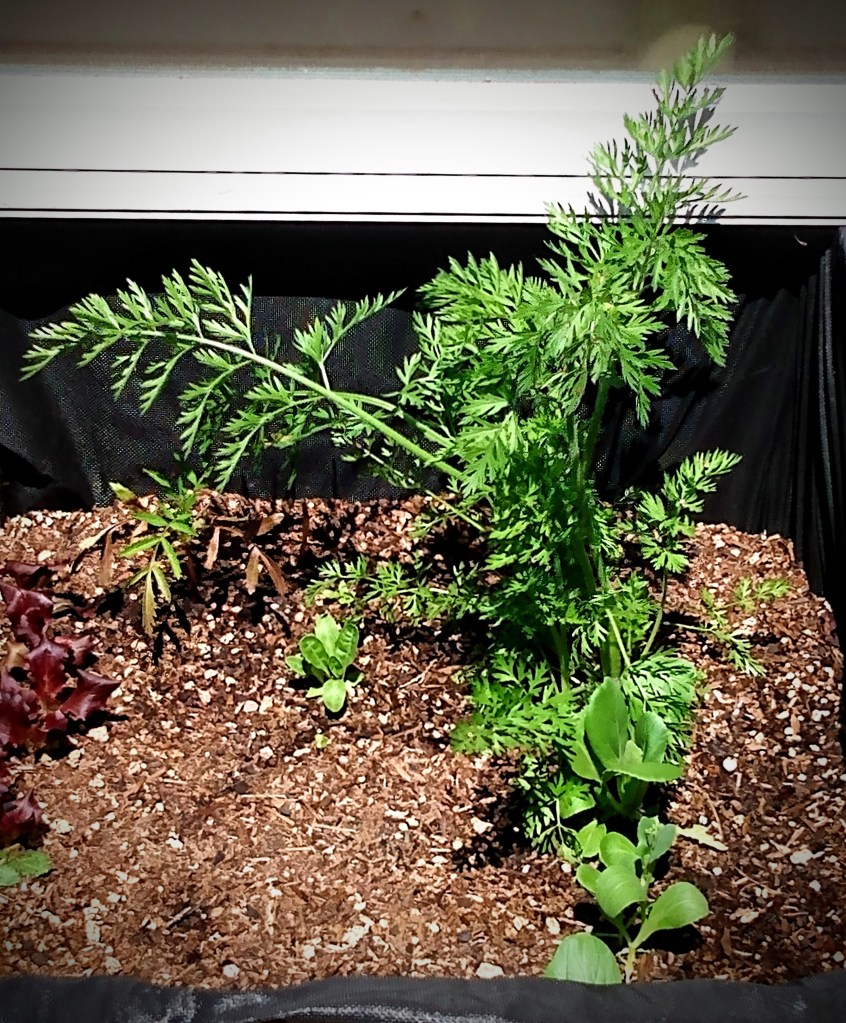
Growing salads in a container box.

One thing about moms, it seems pretty universal that sharing memories usually isn’t about the memory. It’s about reliving a moment in life that brought pleasure to them.

From this understanding, I knew that building a garden for this mom was a gift that would fill her love tank. Not only is it an opportunity for her to relive precious memories in the here and now, it also opened the opportunity to add more memories in association with these older memories. By building a garden and scheduling time to upkeep and tend to the garden, it was also guaranteeing visits and making time for her to spend time together.

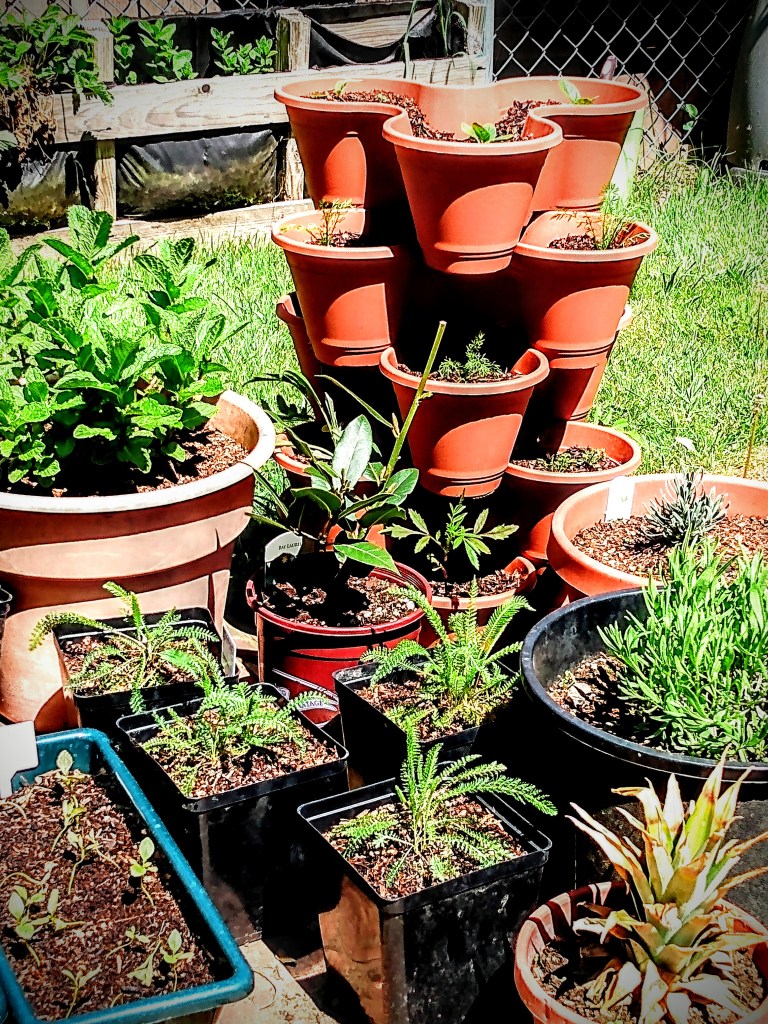
Container growing for small spaces.

For this mom, she has two love languages. Her primary love language is gift giving. Her receiving love language is quality time.

Making a deposit of part of this season’s garden was not just a simple arrive, dig holes, put in start, say good bye, and move on with the day.

Advertisements

For this Mother’s Day gift, it took in the appearance of leaving all the gardening supplies in the car and starting off with a sit down chat and getting caught up with all the news, even if it was only a day since we last saw each other. Then, I was able to go prepare the garden beds for this first plant installment.

Even before I could bring out the plants, this mom was already so filled with love that she wanted to spend some more talking. As much as I wanted to stay task driven (my personality is to knuckle down and get a project done quickly so I can move on to the next task), this day was all about showing love to this mom.

Pallet boxes for narrow spaces and hanging baskets on cyclone fence

So we had another chat session.

When I could find a polite moment to get back to the task of putting the starts back into the ground, I made that move. And with the final post plant watering, I went back and gave this mom one last extension to the gift I was giving her.

Remember, I said that this mom shows love to others by giving to them. So while I was building this garden for this mom, I know that the one thing that would bring her even more pleasure is by telling her upfront that the goal of this garden is primarily to meet her primary produce needs, I’m planting more than she will personally need so that she can give from the garden to others.

I wish I could share with you the look on her face, because she was bursting with love. Knowing that she was having a garden this year was more than enough to help her feel love, she felt seen and more loved because the gift was enabling her to show love to others without need to be reserved or anything else. It was a gift that was freely given so that she could freely give to others.

Growing herbs in repurposed gutters hung on a cyclone fence.

I know that this story may or may not show you specifically what you can give the hard to shop for person, but there is a valuable lesson here.

A good gift is designed to make a person feel loved because it speaks to how they most readily feel loved.

If you don’t know this love language, ask your person how they most feel loved. They will gladly tell you. It could be a tangible object or food that makes them feel loved. Or it can be a non-tangible activity, expression, or display.

A great gift is one that fills their love tank, but also doubles as a tool to enable them to share their love with others.

Container growing garden with DIY budget friendly or recycled components. Chicken wire trellis threaded through upright supports.

Maybe your loved one is not like this mother. Maybe they don’t show love to others by giving them things. Maybe they show love through acts of service. However their schedule is busy. By gifting them your time to do tasks for them or help them create time, this can free up time where they can show love to others by spending time with another person.

My encouragement to you today is to be inspired with a gift idea that doesn’t come from the shelf of a store. Yes, there are many store bought items that are amazing and meaningful. I want to strike the inspirational fire to give a gift out of love and seeing the other person at a core level. And also enable them to pass on love to others.

Advertisements

Right now we live in an interesting moment in history. It is an uncertain time for many families. But it is also a prime moment to celebrate others by giving to them in a way that shows them that you remember past conversations. Where you have heard and remembered things that could have easily been passed off as trivial information in the moment.

Let’s show our loved ones that we see them. And we celebrate them for who they are.

Again, Happy Mother’s Day!

publicdomainpictures.net

This post contains affiliate links to products. We may receive a commissions on products purchased through these links, but at no extra cost to you. This item link is to Amazon but may be purchased at local markets, and found at your local library.

If you are unfamiliar with Love languages, here is the book that started it all.

The Five Love Languages by Gary Chapman

Originally this was written for understanding your mate. There are several other editions available to meet other relationship needs such as children, being single, and in relationship of a military service member.

Processing…
Success! You're on the list.

Leave a comment

Advertisements
Advertisements
Advertisements
Advertisements

Transforming Memories

If you’re a sentimental person, or living with one, you know what I’m talking about when I say that it’s near impossible to get rid of those things that are just sitting there collecting dust.

Whether it’s a shirt collection, old ratty blankets, or any other fabric textile, I’m going to show you how you can transform it and reuse it in a meaningful way. And the bonus is that your sentimental loved one gets to keep their memories at the same time!

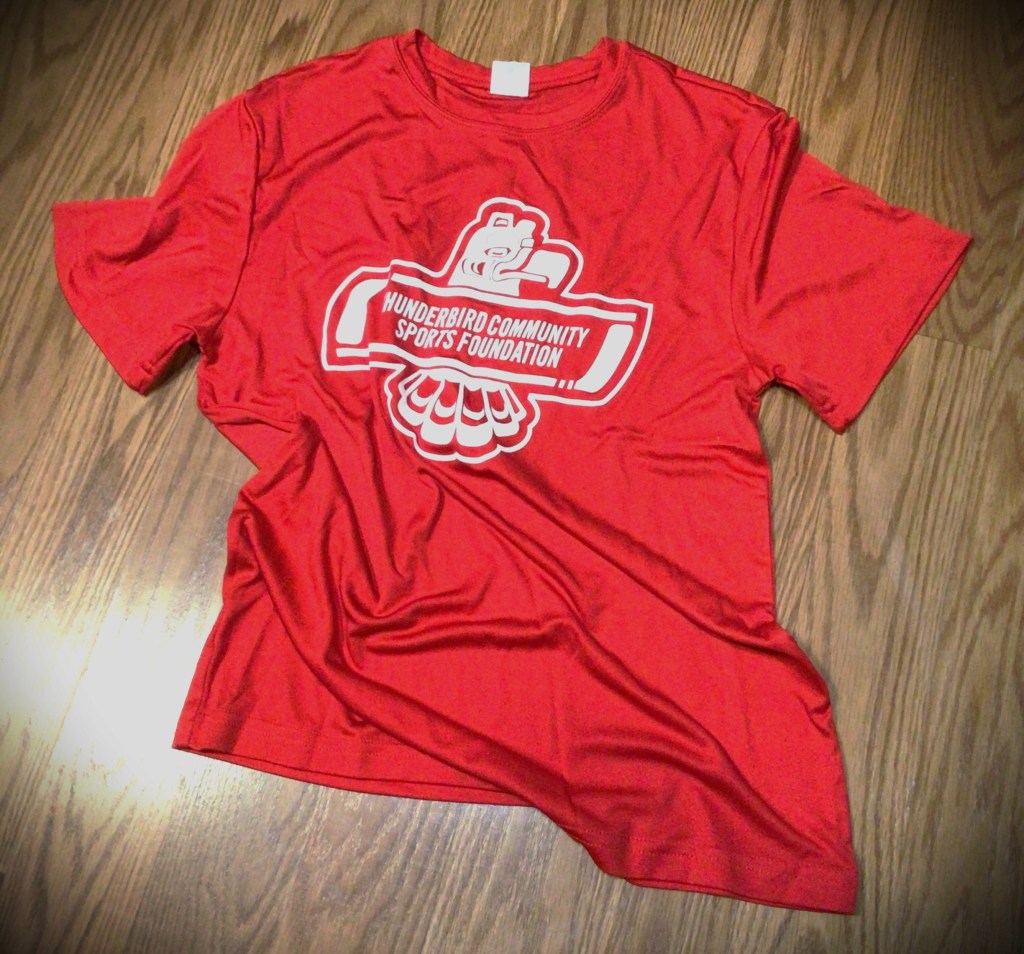
In this instance I’m using the spare jerseys that I had from coaching this past season. My office space is limited and I really couldn’t keep them for some theoretical team use. Besides, my boys have already a small collection of jerseys from different teams they have played on. I need a game plan of what to do with them, in the event that certain men in my family can’t let them go.

Breaking Shirts Down

If you’ve taken a look through Pinterest, you’ve seen how people have made pillow cases out of shirts of loved ones who have passed on. You probably have seen, many years ago, where logos and decals of shirts have been broken down into quilting squares. What do you do if you really don’t want pillow cases (especially out of stained jerseys) and the material doesn’t lend itself to quilting (or you just don’t quilt)?

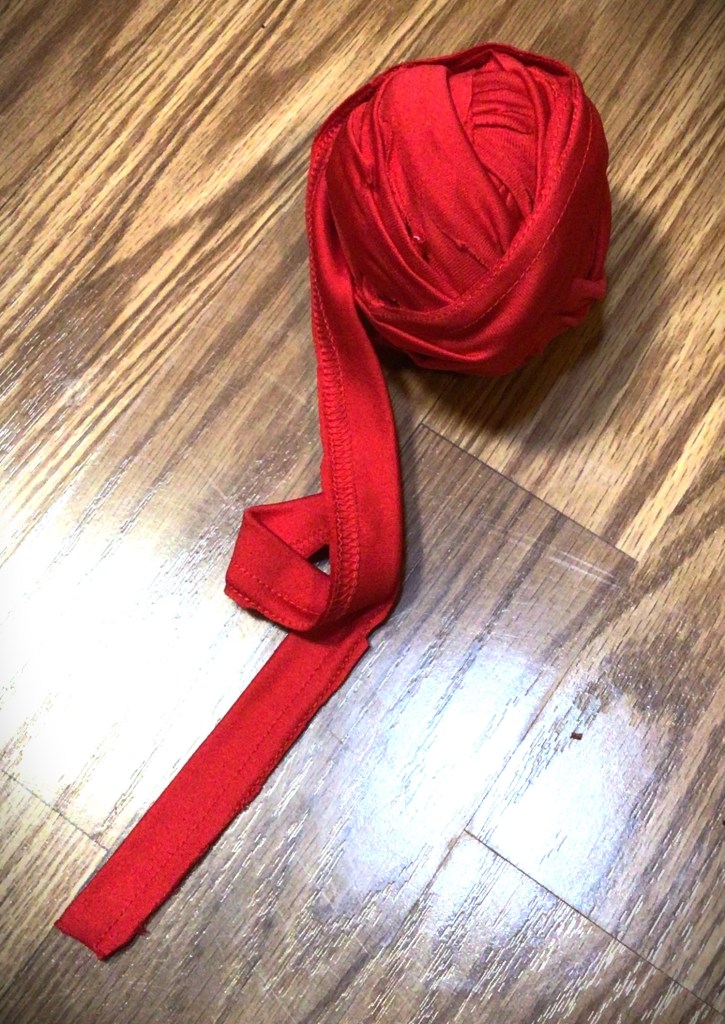
Cut the shirt down into a thin fabric strip, or yarn if you will.

The beauty of breaking shirts down into a fabric yarn is that you have so many options in front of you on how you want to use the shirts. You can crochet/knit with it, weave, braid and turn it into cordage (which then can be used in other crafting and practical projects like macramé or net making–trellis for garden, make a reusable bag, or anything your imagination takes you).

Whatever terminology you want to use for the strips of fabric, or future use, I’m going to move forward by talking about the material as yarn.

Advertisements

How to Make Your Shirt Yarn

If you haven’t washed the shirt yet, and want to, make sure it’s washed and dried. If the shirt is stained from mud, grass, or anything else, don’t worry about it. As you will see in a moment, you will not see it when you finally work your yarn. If the shirt was stained by bleach, that’s not a problem either. Depending on the size of the bleach discoloration, it either won’t be noticed or it will add variegation to your yarn similar to the color variegated acrylic skeins of yarn you see in the store.

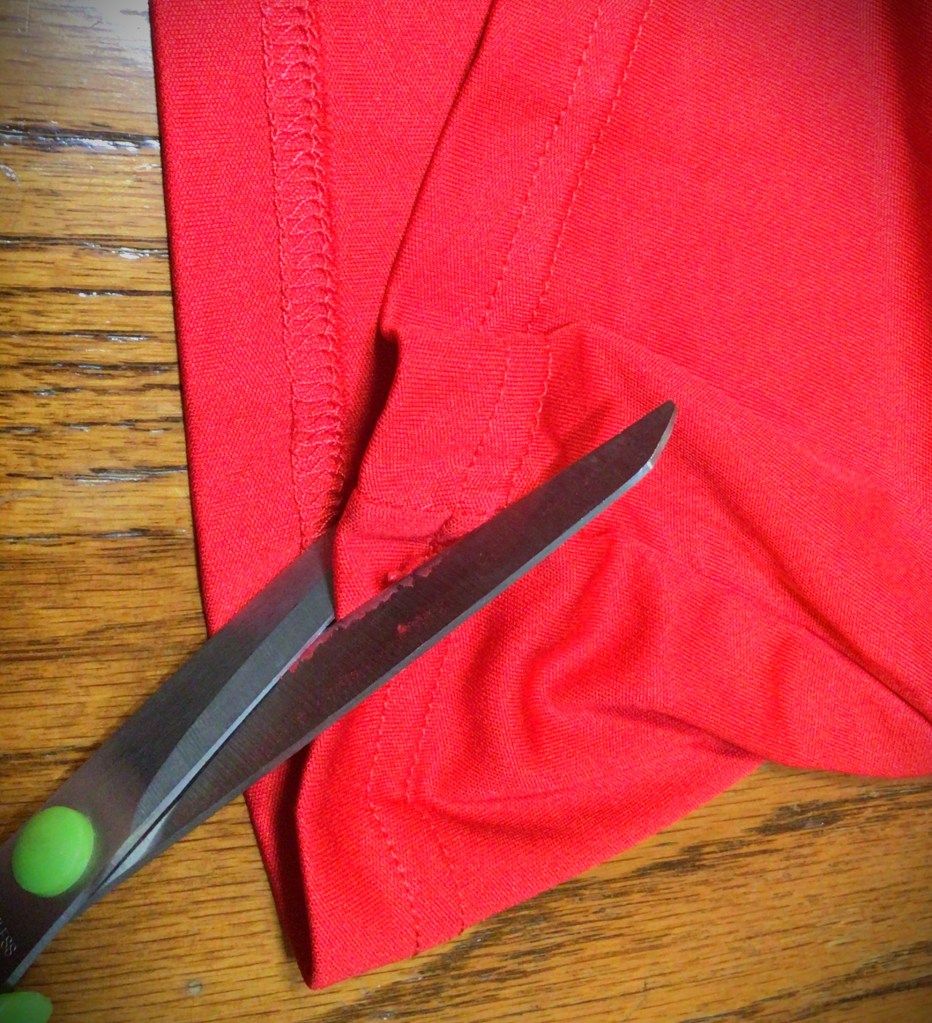
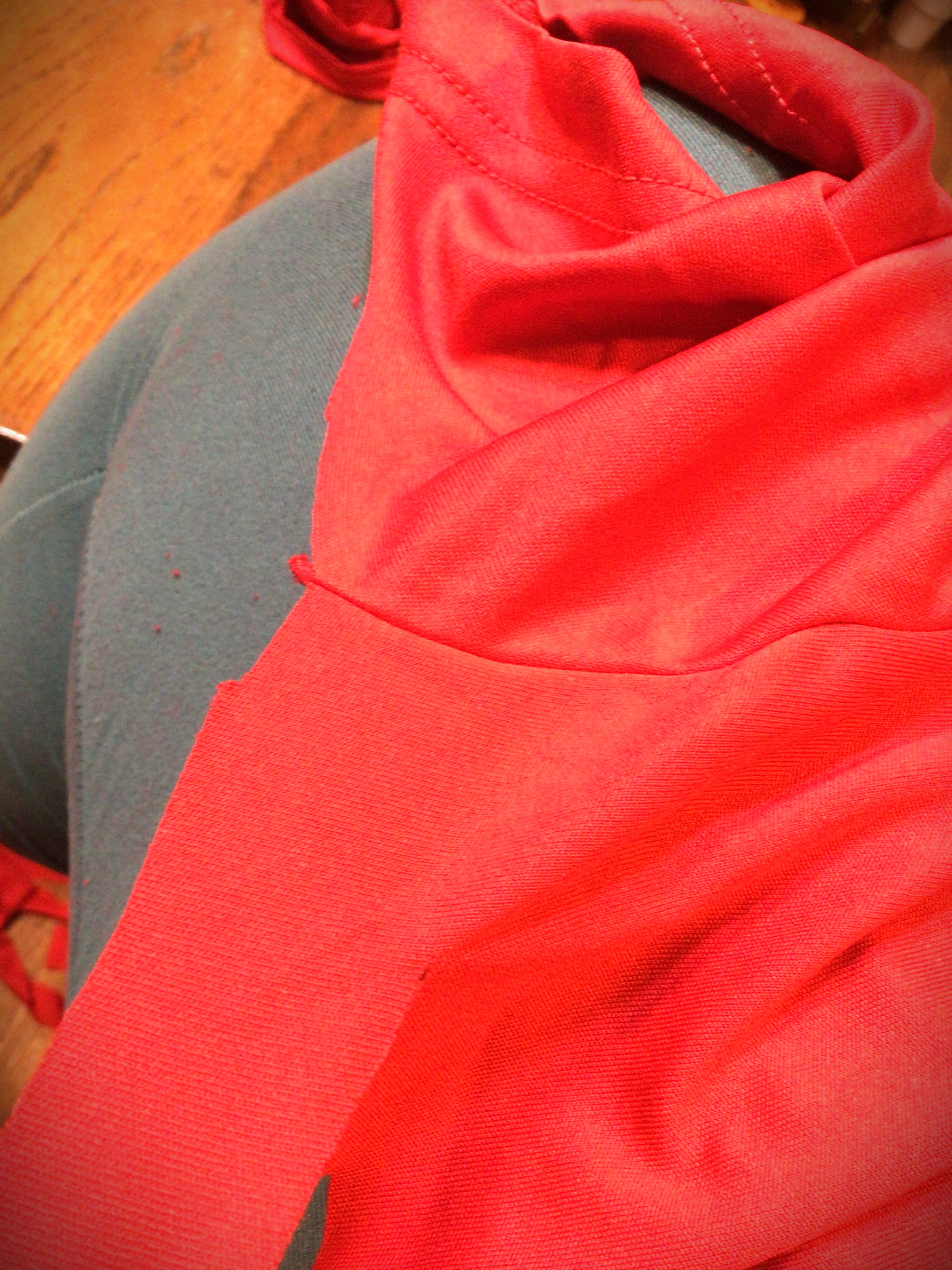
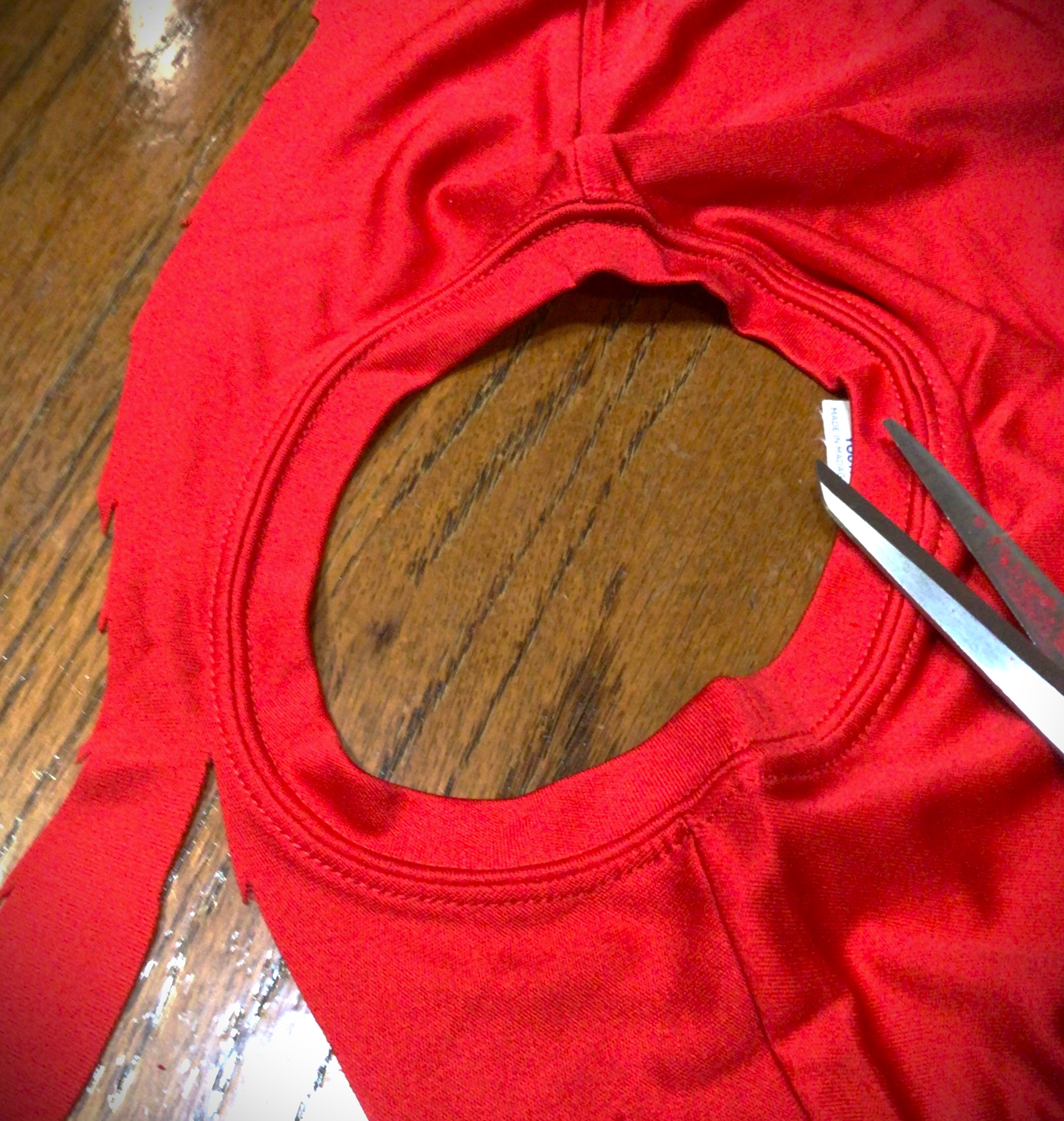
Lay your shirt out on a flat surface. The first shirt that I cut, I used my lap and the polyester stretched differently as I rotated the shirt as I cut. This made the lines uneven and rough. For the second shirt, I laid it out on my kitchen chair (you don’t have to have a crafting table to do this if you want to make yarn). My cuts were more uniform and with less jagged edges.

Don’t let your lack of cutting precision dissuade you from making yarn. If you find that you have little pennant like flags on your strips, when you crochet the yarn you will find that you have a textured look.

I started by cutting the bottom hem of the shirt. If you cut at a 90° angle, you will find that you have to cut on a slant to cut your next pass around the shirt. However, if you cut at a diagonal/45° angle, you will just circle around the shirt without noticing any change or needing to make adjustments.

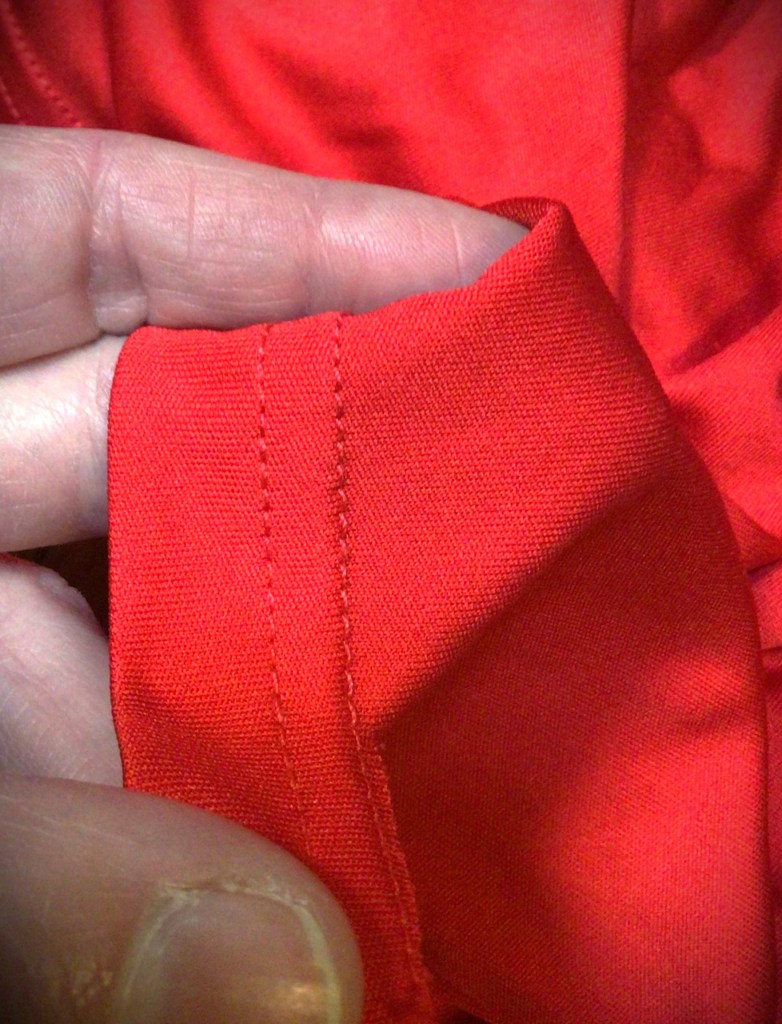
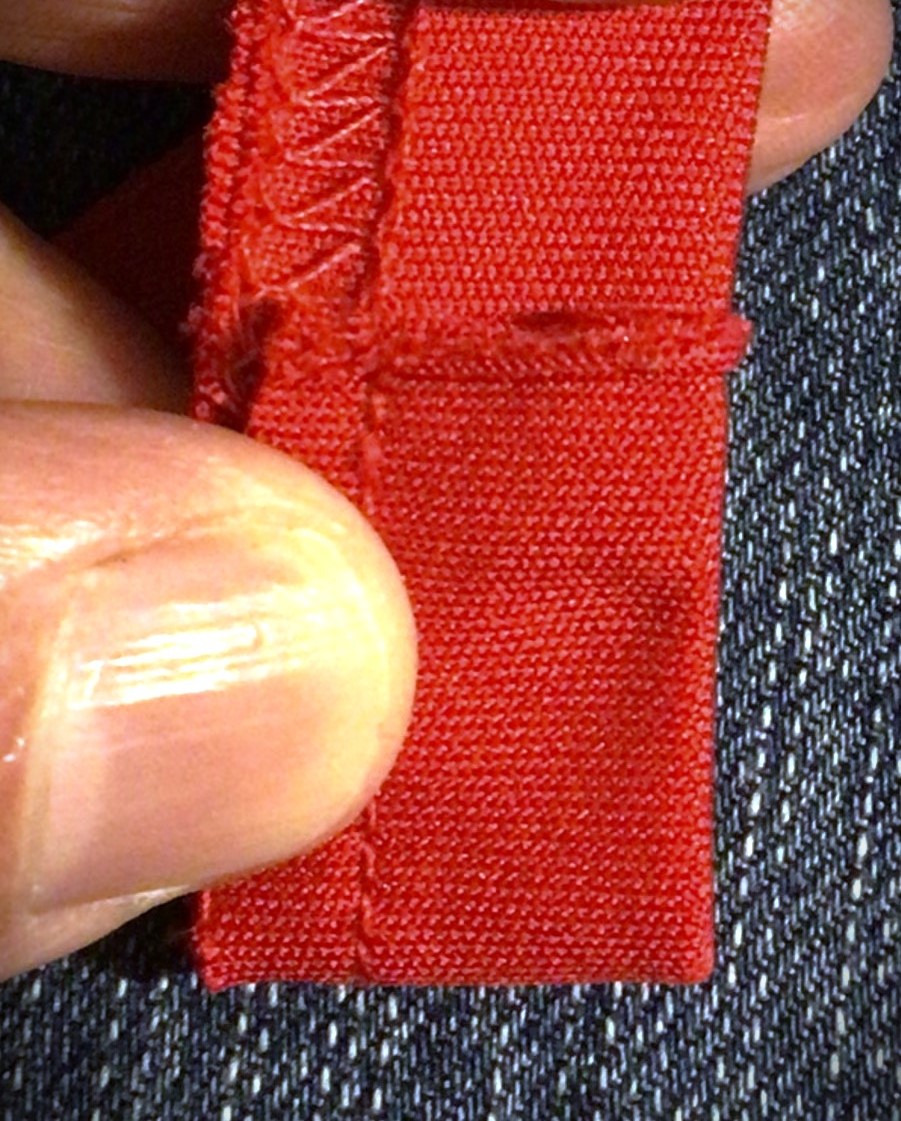
The thickness of the hem is a great way of feeling out how thick to cut your shirt into yarn. It’s about 3/4″ to 1″ wide. I wouldn’t go any wider than that, especially if you have thick vinyl lettering on your jersey/shirt.

As you cut along the hemline, look how its width is in proportion to your hand. I looked at how it fit between my first and second knuckles. With this visual cue, I could cut the rest of the shirt and keep the width pretty consistent.

I chose to start cutting my yarn from the bottom of the shirt because it allowed me to find my cutting groove without having to worry about the neck line or the sleeves.

By the time that I got up to the sleeves, I felt out how I wanted to cut the shirt.

One option was to remove the sleeves entirely. I chose to leave my sleeves intact because I wanted to maximize the length of yarn that I got from my jerseys. The beauty of jerseys is that they’re made of polyester and when you cut through the shirt/sleeve seam, the fabric remains intact. (Cotton shirts may fall apart when you cut the seam.) So all I did was focus on keeping my yarn width and keep cutting up into the sleeve and back down into the shirt.

There does come a point where the sleeve separated and opens up and you can’t go directly back into the shirt body. At this point I just turned the fabric so that I turned the rest of the sleeve into yarn before joining back up into the shirt body.

The neckline is also an odd point to cut around. What you want to do us keep thinking and focusing on keeping the width of your yarn. You can cut through the neck hem and there’s not going to be any issues. The jersey’s neckline stays intact on the seam.

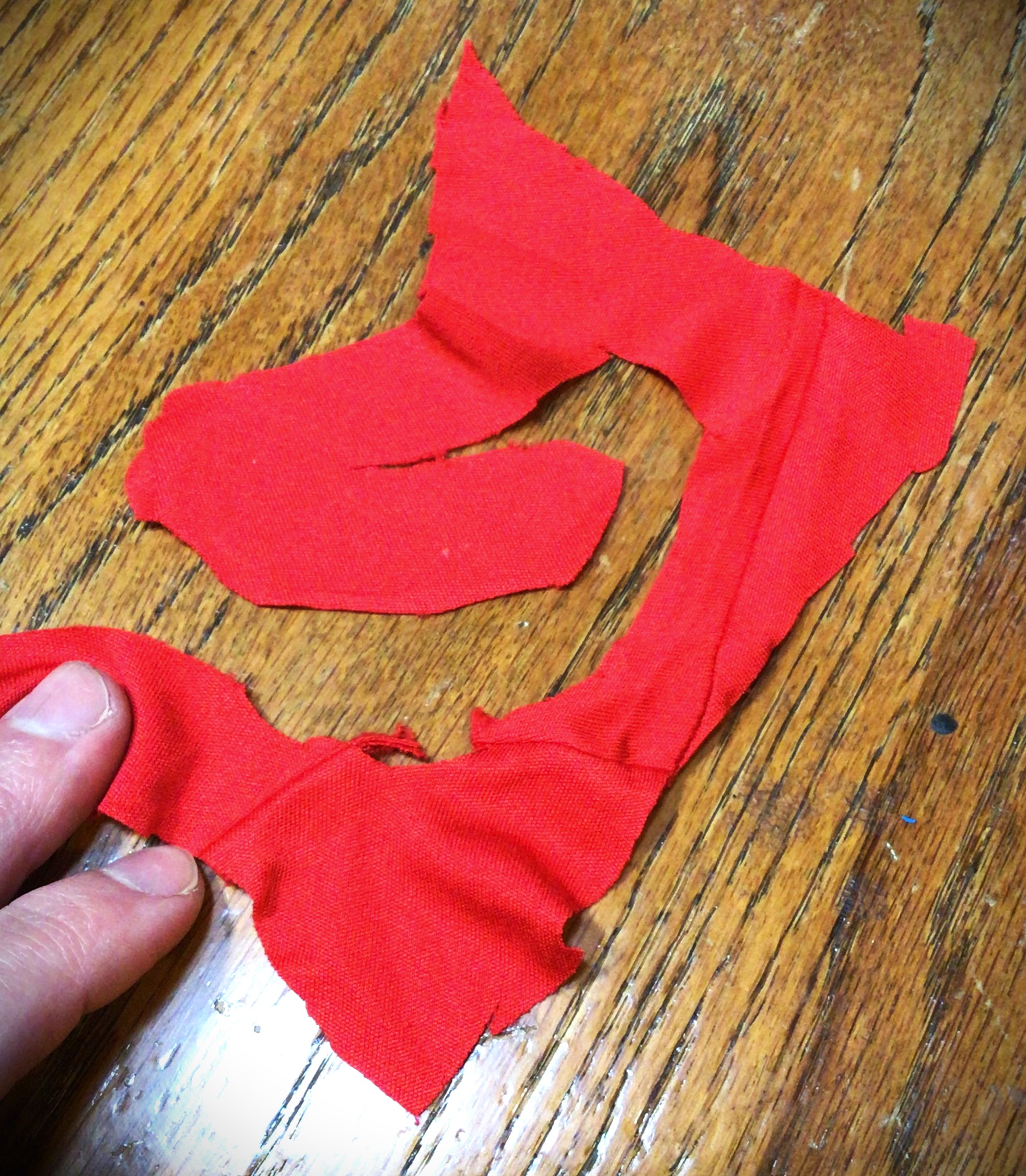
Once you get to the end, you will more than likely find a funky end. Just keep your width, cut around corners and finish off the shirt. It will look like a spiral, but it won’t affect your project at all.

With your shirt cut down into one long strand of yarn, you can trim off any large triangular flaps that you see. Or you can wait to do any trimming until after you started working with the yarn.

I chose not to do any trimming until after I crocheted my yarn. Even though I had several flags on both balls of yarn, I only ended up cutting off three triangles. And those ones were about as long as my pinky when the yarn was unworked–just as a point of reference.

For storing your yarn, or prepping to go right into a project, go ahead and roll your yarn into a ball. Each yarn ball was smaller than the whole shirt folded. So even if you’re looking to save space, and not start your project yet, it is well worth prepping your shirts ahead of time into yarn.

Starting the T-Shirt Yarn

You can choose to start the t-shirt yarn the same way as you would with acrylic yarn. If you want to avoid a large knot, you can do this.

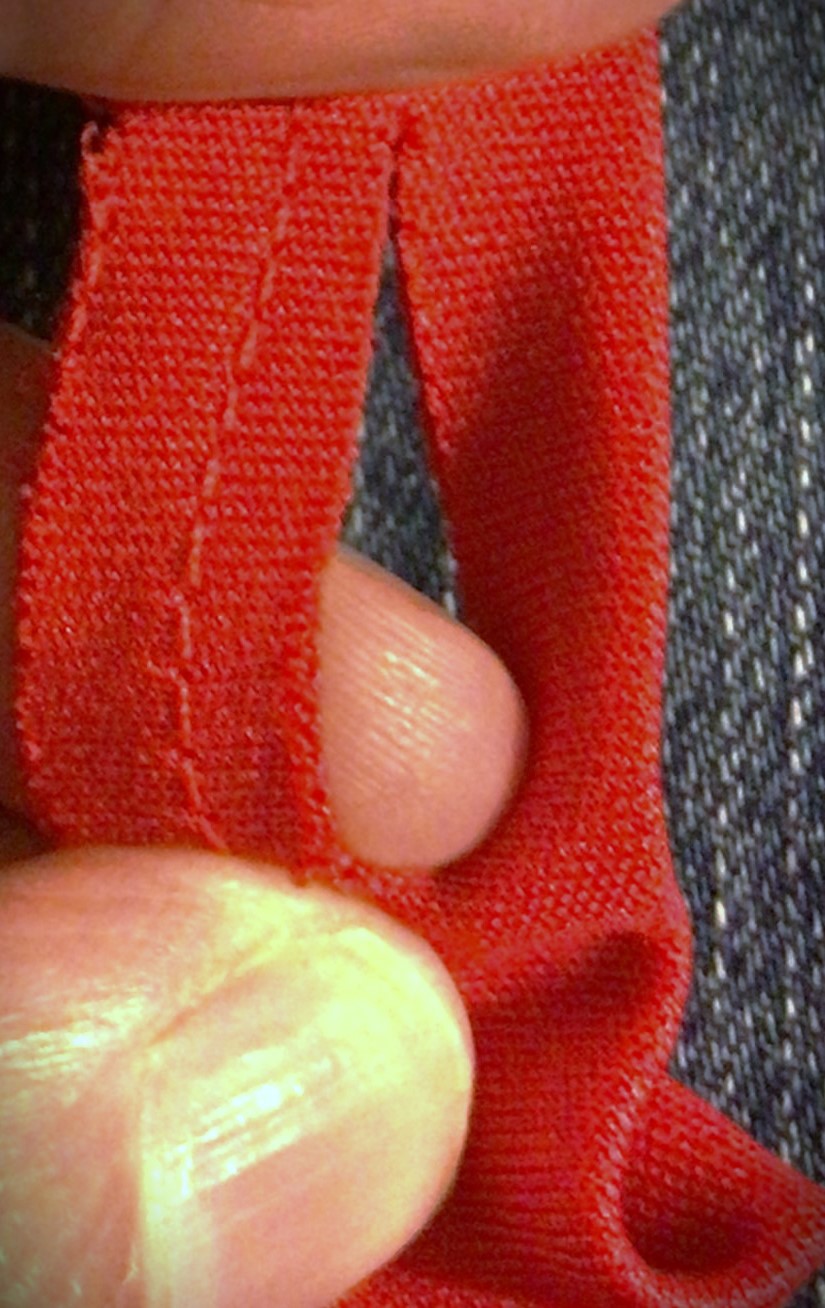
Double over the end of the yarn. Over the crease cut down the middle. When you open the yarn back up you will see that you have cut a hole in the yarn. From here you can choose to thread the yarn through the cut hole to make your first loop. Or you can treat this cut hole as your framework to start a circle or square block.

When you are finished with one ball and want to join your next one, you also have a couple options.

One option is that you cut a loop into the end of your next ball of yarn. The tail of the ball that is coming to the end, cut so you have two ends that you can tie into the loop you just cut into the next ball of yarn. (In the case of polyester, your knot is going to be small, so it will disappear as you work through the transition.)

Another option is that you cut a loop into the tail of the ball that is coming to an end. Thread the beginning end of the new ball through this loop. Make sure that you pull enough thread through so that your first couple of crochet/knit stitches are the doubled over yarn. (This minimizes the potential of a visual knot. However these stitches will be thicker than the ones on either end; from the end of the old ball and the addition of the new ball.)

Advertisements

Potential Projects

As I mentioned earlier, once you have your yarn made there are countless projects you can make. If you can crochet, knit, weave, or make cordage you can use this yarn for all those projects.

I don’t have nearly enough jerseys to make the one I want, a Christmas Tree Skirt. (I will just add to what I’ve started as jerseys become available. My kiddos are pretty fascinated by this and so I have no doubt that I’ll have their old jerseys before much longer.)

Before I leave you to start creating, I wanted to show you how this yarn works. You saw that the front of the jersey had about a third of the front covered by sponsorship decal. The back also was half covered by the jersey number and sponsorship as well.

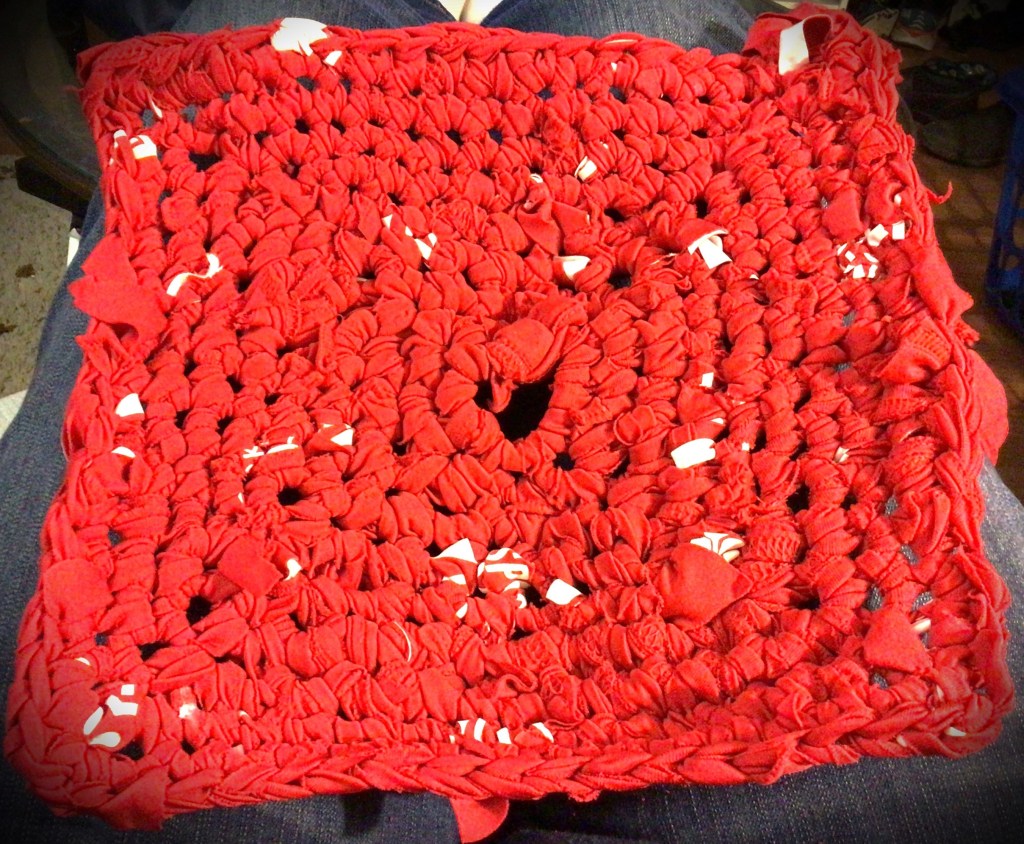
As you can see here, for as much white vinyl was on the jersey, in the end it’s just speckling. The thicker chunks of white are from the large jersey number from the back. You can even see the tips of the smaller pennant edges sticking out. Those can easily be trimmed back for a smoother appearance. Or they can be left to add texture and whimsy to your project.

Just so you’re not discouraged, the vinyl they use is difficult to work with. It did pucker as I crocheted. (You see how much it sticks out on the edges.) But as you continue to work your yarn it starts to lie more flat and incorporates itself into the piece.

Note: I didn’t use a standard crochet hook for this. I used a weeding hook (for when I cut my own vinyl) that has a handle that about as thick as my finger. Especially working with yarn that has stiff vinyl, it’s easier to manipulate when you use a thicker hook.

Hopefully this 10″ x 10″ square (made from one youth size S and one youth size M jersey) gives you an idea and even inspiration for what you might make with this kind of yarn. You could mix and match jersey colors into your project or make squares to color coordinate your project in a more analytical framework.

Be sure to comment below and post pictures of what you make using this kind of yarn!

Processing…
Success! You're on the list.

Leave a comment

Advertisements
Advertisements

What about the Shell?

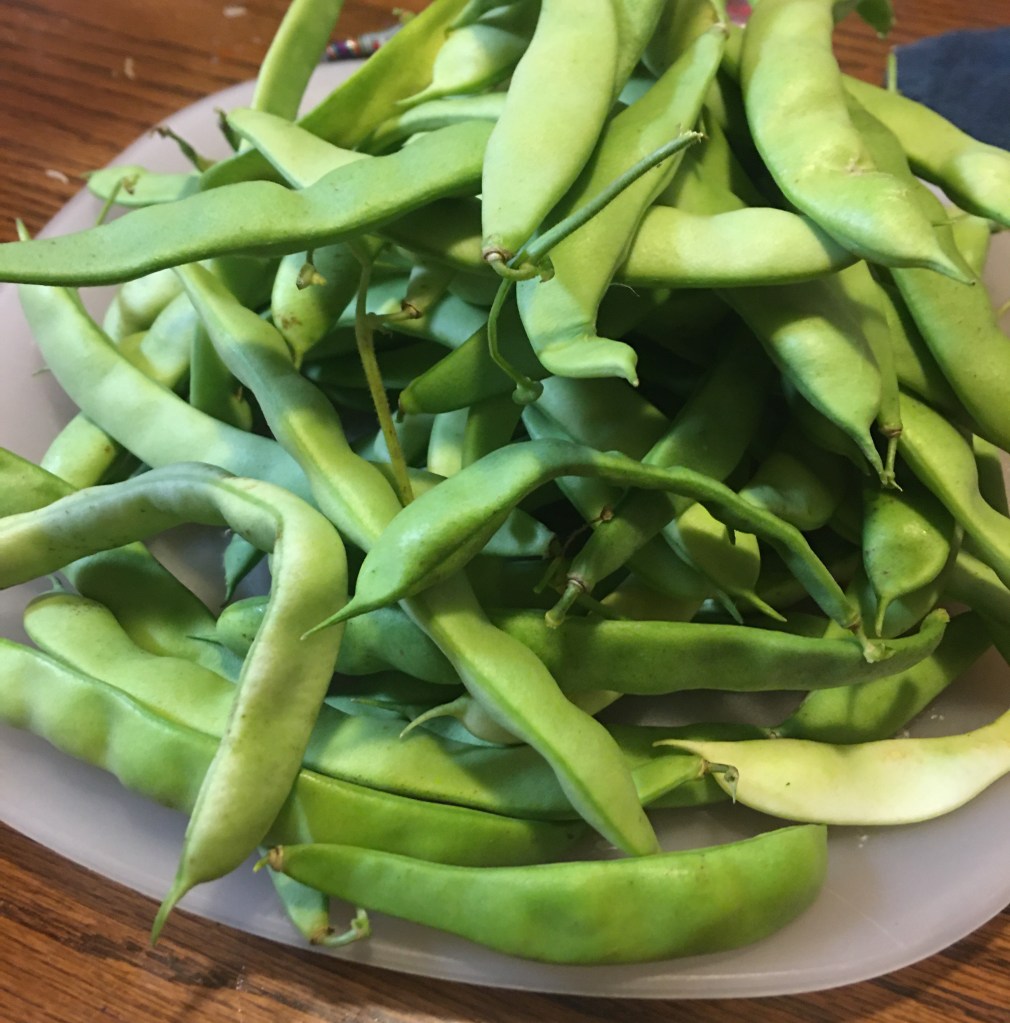
This was the first year that I grew a shell bean. I grew up with my grandparents and mom growing snap beans. In fact, snap beans were pretty much the only vegetable that I ate without issues. So I have a special place in my heart for beans.

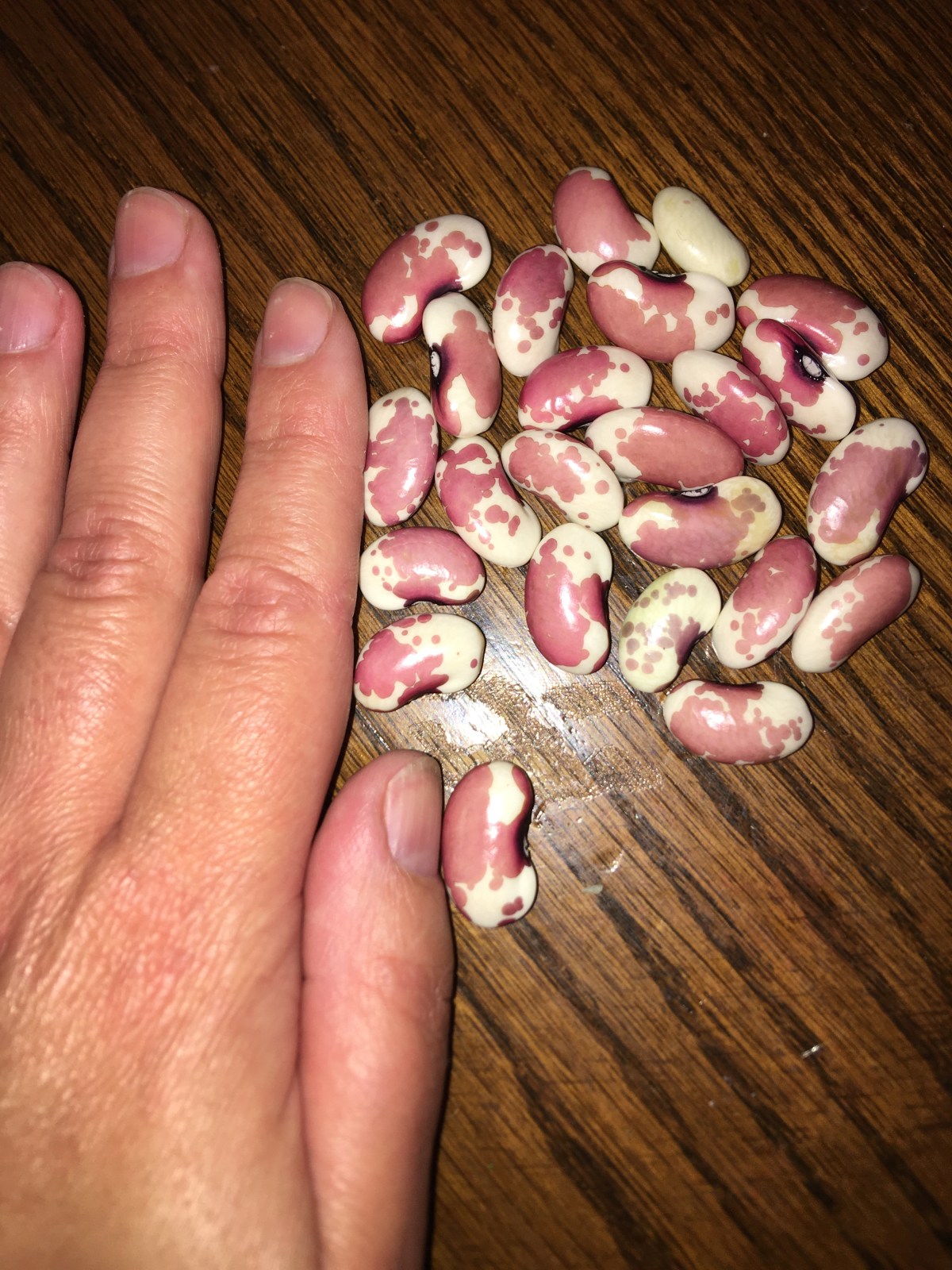
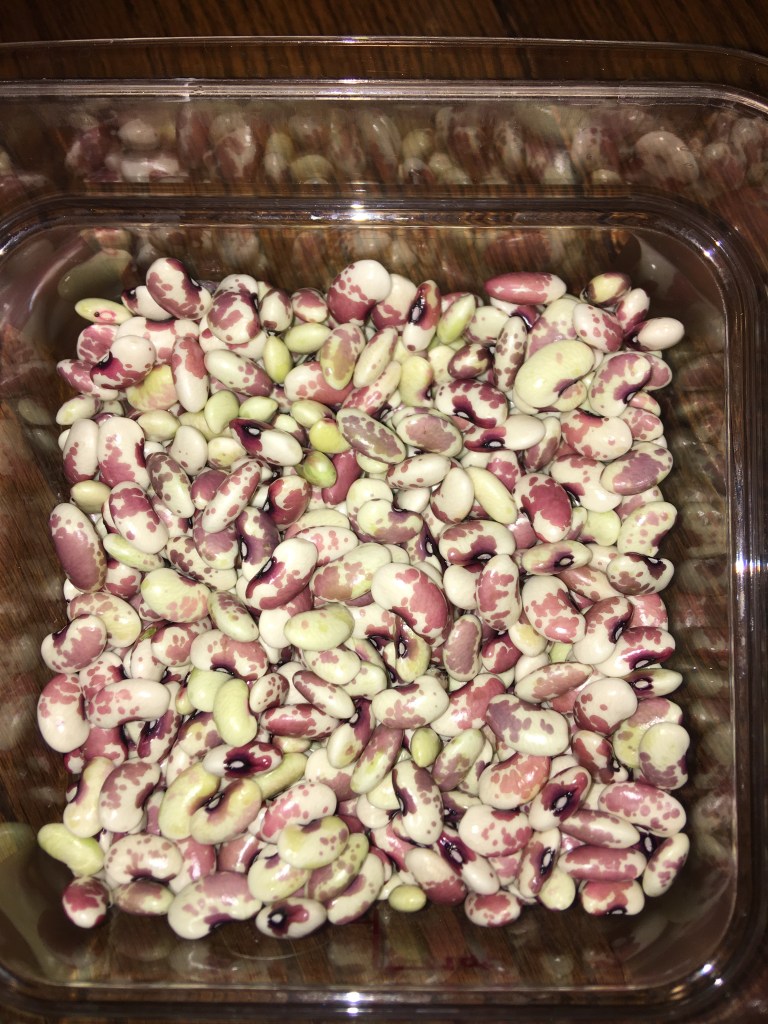
This is the shell beans that I grew this year, 1000 Year Cave Beans.
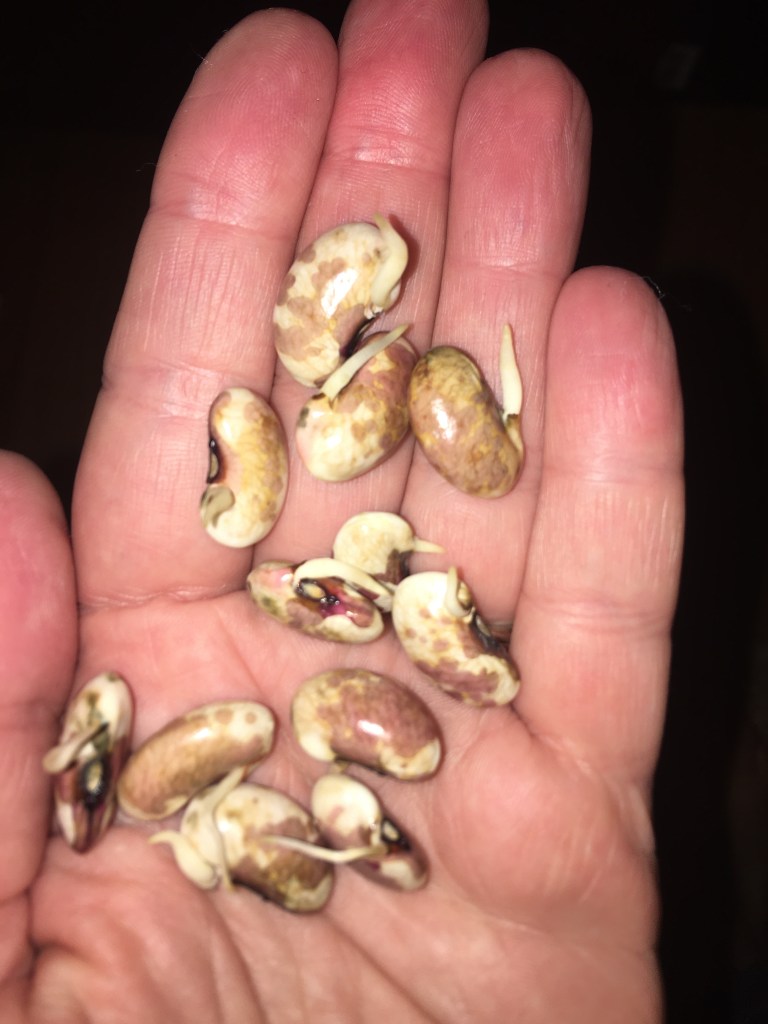
And just to show you how fresh these beans were, I didn’t anticipate them sprouting with in 3 days of me shelling them and waiting for more to mature so I could can a couple jars at once.
Advertisements

The one bit of information that I thought was prevalent was preserving beans of all kind. But with every safe recipe that I looked up every recipe was either for snap beans or dried beans.

When I teach people how to can, I always hand them safe recipes to select from, depending on what they want to can. And so these are the first sources that I turn to when I look to can a new food item that I’ve never canned before. And so I trust that what these experts say are what you are going to get. This is the one time that the extension office failed me. Here is the recipe that I used for my fresh shell beans. In full disclosure, if I were canning dried shell beans (such as the bagged beans from the dried foods aisle from the grocery store) this is absolutely the recipe that I would use.

But for fresh beans… I didn’t have canned beans. Instead I had half beans, half refried beans.

What happens when you can fresh shell beans the same as dried shell beans?

The gray in the water is the starch from the starch from this particular bean, 1000 Year Cave Bean. In fact, the starch left over in the bottom of the pan that I cooked these beans for the 30 minute stove top cook for a hot pack, was a richer version of this gray. In fact, it matched the gray on a pair of my camo pants. Next time I harvest these beans and prep them, I’ll take a picture of the bottom of my pan for you!

As you can see here, my beans started to break down due to the 75 minute processing time on top of the 30 minute hot pack cook time.

On the positive side, if you want to have canned beans that you can eat straight out of the can without needing to warm it up, the extension office recipe is perfect for it. All I added was the hot beans, hot fresh water, and 1/2 tsp salt for my pint sized jars. The beans were perfectly seasoned, soft, and very tasty. I am absolutely canning these beans again from here on out for the unforeseeable future.

The Extension Office recipe was also very pleasant for adding to my enchiladas recipe. In this instance, I really do appreciate a soft, smashable bean.

Unfortunately I need canned beans that I can toss into a soup, stew or chili where some firmness is needed.

Advertisements

Is there another safe recipe available?

I’m going to connect you to one of my favorite safe canners Melissa Norris, Pioneering Today. Please click the link to go straight to her directions. A video is also available.

If you’re on a time constraint, here’s the quick read of her directions:

  • Wash your jars.
  • Fill the clean jars with shelled beans until 1 1/2″ head space remains.
  • Add salt (1/2 tsp for pint, 1 tsp for quart).
  • Boil water and pour over the beans until you have 1″ head space.
  • (Remove air)
  • Clean the jar rims with a damp cloth, place lids, and screw down bands.
  • Place jars in your pressure canner.
  • Vent your pressure canner for 10 minutes.
  • (Once at pressure) process the beans at 10 lbs. of pressure for 50 minutes.
  • Once time is up, remove from heat and let your canner cool on its own.
  • When the lid unlocks, remove the lid but leave jars in the canner for about 10 minutes.
  • Remove the jars from the canner and set on the counter to cool for at least 12 hours and seal.
  • Store in your pantry.

If you are growing beans to supplement some of your grocery purchases, love gardening, or various other reasons… know that you can absolutely can your own beans. You can control what is used on your plants and what ingredients you add with your beans when you can them. The beans that I canned have 3 ingredients: beans, water, and salt. In comparison, the sale beans that I have in my pantry have an additional ingredient Calcium Chloride (an additive to absorb moisture which causes bacteria to thrive, “used pre- and post harvest to maintain firmness, reduce decay and prevent certain diseases… [and] as a drying agent.” (ingredi.com)

Advertisements

Store canned beans do have their benefit. I’m not going to pretend that I avoid them like a plague. For my family, we’re choosing to make a switch to lessen the additives in our diet. And with my young children, I want them to know where food actually comes from. I don’t want them to assume that food just mysteriously shows up on the store shelves. I want them to know where their vegetables come from. And where their meat comes from as well. (We love our local farmers!)

Plus I have the added bonus of not just hearing my oldest say, “Mom, can we can ____? I’m interested in that.” But it also helps establishes what we learn with our homeschooling. Math and science do matter on a daily basis. We can understand our world by working with it.

But most important of all, pressure canning beans (and other vegetables) make growing or store sale purchases a massive benefit to the family budget because we can preserve it and eliminate some of our food waste. And that is a win win for everyone!

Processing…
Success! You're on the list.

Leave a comment

Advertisements