
Last week I shared with you my process for making no waste yeast starter. And I promised you that this week I would share with you my bread recipe that hasn’t failed me and how to make tear apart rolls that are better than the ones you buy at the grocery store and bake at home.
First I want to take a moment to touch back on the subject of yeast. This last baking session I had was a perfect example of how life happens and sometimes your starter has a personality all of its own. I think mine was having a little temper tantrum for some reason.
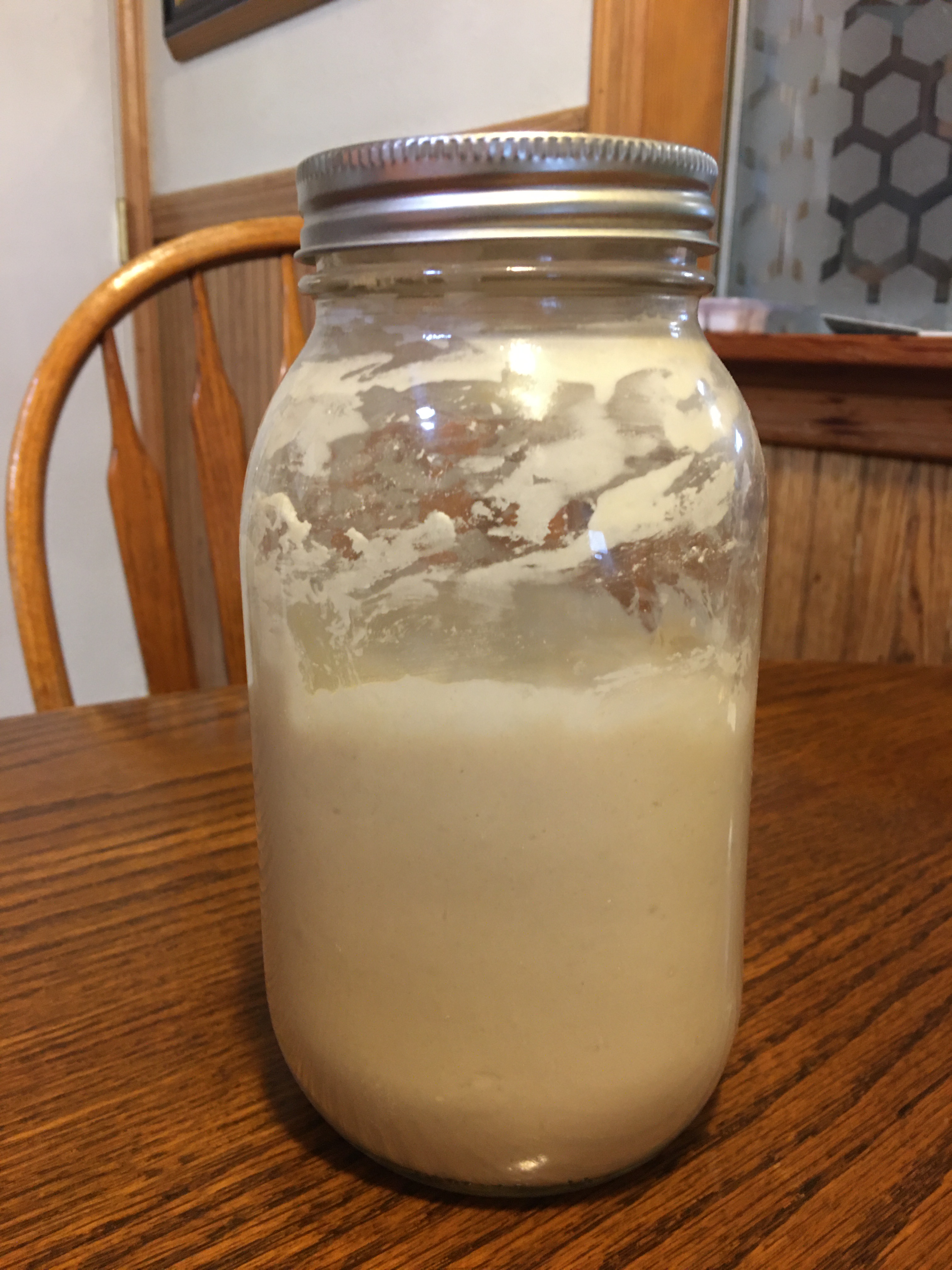
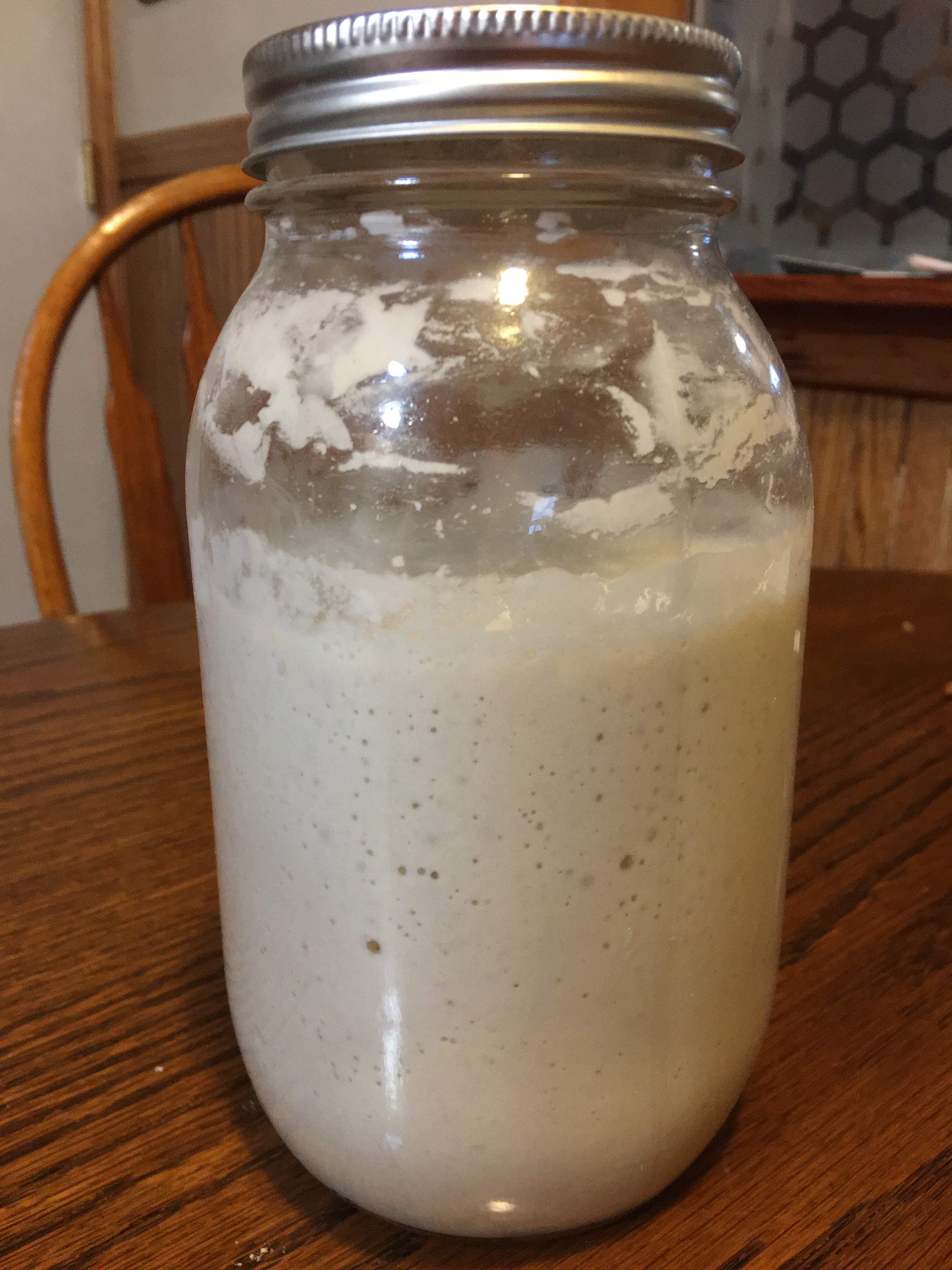
Picture 1 (below) was the moment I pulled it out of the fridge. That sucker refused to double! I left it out over night (much longer than it’s doubling time) and all I got was Picture 2. You can see the bubbles clearly, so my yeast is present and doing its job. It was just temperamental. I added 2 Tablespoons of flour, no water). 3 hours later I had picture 3.
(Side note: I keep my yeast in a quart sized mason jar because my 400 g of starter fills the jar halfway. I don’t need a marker to mark my doubling volume. I know it’s ready to go when my starter reaches the top of the jar.)

SANDWICH BREAD (2 LOAVES)
Milk 2c 480ml Butter 4 Tbsp 56g Sugar 2 Tbsp 32g Salt 3 tsp 22g Flour 5c 700g Starter 1c 224g
- Warm Milk and Butter to about 110°F
- In a stand mixer bowl, with paddle attachment, add salt, sugar, and about a cup of flour (mixer speed 3)
- Add warm Milk and Butter to mixer bowl
- Add Starter
- Add Half of remaining flour
- Once everything is well incorporated, change paddle attachment to bread hook attachment and add the remaining flour.
- Once everything is well incorporated, and you want to build up the gluten levels, let the stand mixer knead your dough (speed 3) for 20 minutes.
- Divide dough into 2 standard bread pans
- Proof dough until it doubles
- Heat oven to 350°F
- Bake bread for about 30 minutes (Bread’s Internal Temperature is 200°F)
*I did not create this recipe and didn’t make notes on who or where I got this recipe from. I have tested several dozen bread recipe over the last two years. So if this is your recipe please let me know and I will give you credit here*
Please note that depending on your country of origin, this recipe may or may not fall under the category of bread. For example, Ireland defines bread containing sugar less than 2% the content weight of flour. So by Irish standards, this recipe does not meet its standard. I have reduced the amount of sugar, to Irish standards, and still baked beautiful loaves of bread. So please do not feel like you have to use this much sugar. By all means, reduce the sugar content to meet your dietary needs. It does not change the bread.
I happen to use this amount of sugar because my house is cool and my starter requires a little helping hand to proof. And the function of sugar in a bread recipe is to facilitate the speed at which your yeast works. So if you reduce your sugar content, please allow a little extra patience for your dough to proof.
The great news about making bread from starter, there is no real time limit for you to reaching full proofing. Starter proofing can be dragged out to 48 hours in your refrigerator. This extended period of proofing builds up the sour profile of your dough.
On average, I proof my dough anywhere from 9-12 hours. In fact, I make my dough at night and proof it over night. Then when I wake up in the morning I bake my bread and it’s cooled in enough time for lunch. In this proofing window my yeast produces a very mild sour note. My mom has always hated sourdough bread, and yet she loves my sandwich bread. I know this doesn’t adequately convey a universal comparison. But it gives a general reference point based off of your preference level of sour dough bread. I would love to make mine more sour, but being a busy mom, I usually don’t make it enough time to properly prepare. It’s more of an oh-crap-I’m-out-of-sandwich-bread scenario.
Which reminds me, I need to make more bread!!!
Here are a couple pictures of the last baking session. As you can see in Picture 1, my yeast looks like it’s on the weak side. Normally it’s a thick sheet of starter that once I start pouring, it pulls itself out of my jar into my weighing bowl. I have made bread from weaker yeast than this. In fact there have been a couple of times where my starter looked like a soft milk shake. It still made bread. It took a little longer to proof (about 3 hours longer than normal), but it still proofed.
Picture 2 is my no fuss method of splitting my dough directly in my silicone bread molds. I don’t shape it. And often times the pours are uneven. (The larger weight loaf will take additional time to reach 200°F.)
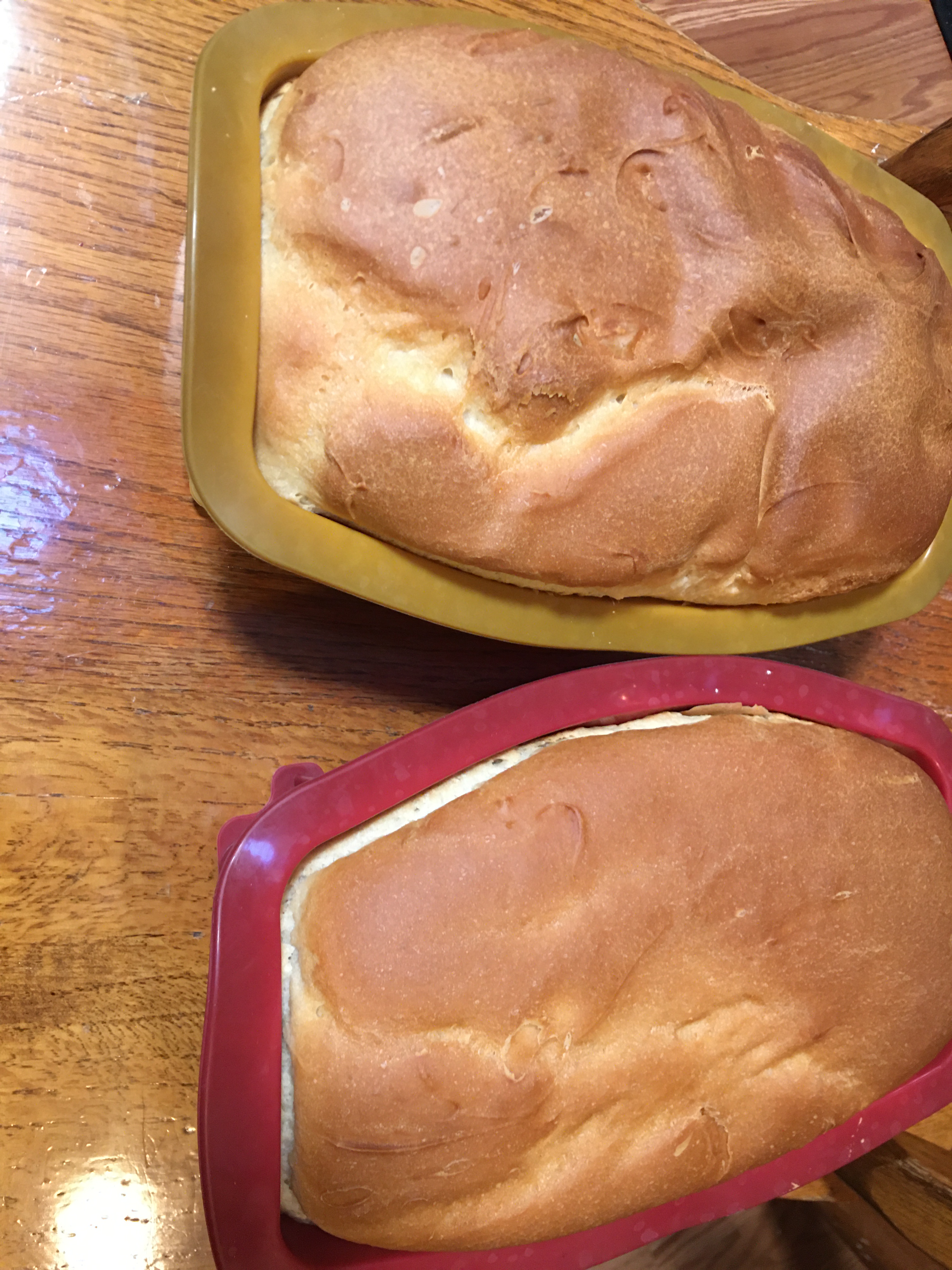
Picture 3 is finished bread. And Picture 4 is sliced so you can see how this batch turned out.



On the subject of slicing bread… Whether you are making a loaf like this, or if you make a boule loaf, if you ever find that your bread doesn’t bake as tall as you like there is a trick where you can make it look like your bread was taller. Instead of cutting your bread perpendicular to your cutting board, cut at a 45° angle. By angling your knife inward, the slice of your bread naturally looks taller. The two heels of the loaf are not usable for sandwiches, but it’s perfect for other uses; dipping in soups and stews, snacking on with some oil and vinegar, cubing for making croutons, or crumbing to make a crumb topping for a different recipe. There are plenty of other uses for these ends.
On To Making Rolls
For my rolls, I use the exact same recipe as I use for making sandwich bread. The only difference is how I form the dough.
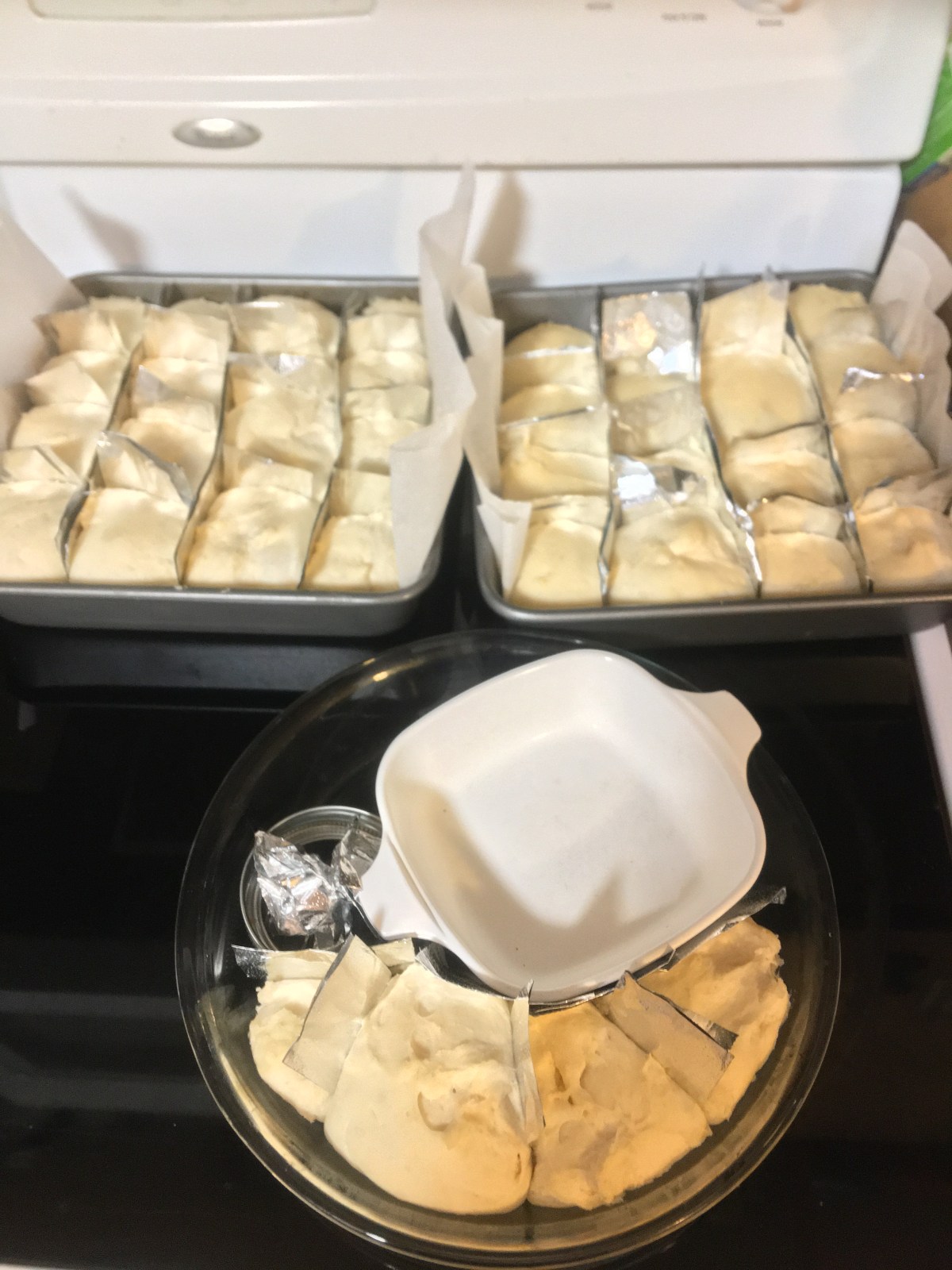
There is another method that I’ve made pull apart rolls, but this method (which you see in the picture below) is my way of making rolls that have been a hit at family holiday. In fact, these ones are eaten before the store bought rolls.

While my stand mixer is kneading my dough, I start folding foil dividers. These are just a strip of foil that I fold in half. I have long ones that fit the full length of my pans. And then I also make strips that are about 2 1/2 inches wide. If you find that the mini dividers are not wide enough, don’t worry. You will just place them in the middle and the rolls will still separate perfectly.
For portioning out the rolls, I start on one side of my pan. I make a dollop with two Tbsp worth of dough in a corner, place a mini divider up next to the dough. Then I portion out the next roll and place the next divider. I keep this pattern of dough and dividers until I complete a row. Then I place a long divider next to the row and then start the next row. I continue in this manner until the pan is filled. Then I move to the next pan.
If you finish a pan and see that you do not have enough for another pan, don’t worry. In the bottom of the picture you will notice that I kept my pattern of portioning and dividing. When I ran out of dough, I placed a long strip divider and then I put oven safe containers in the pan to hold up the divider.
Once my dough is all portioned out for rolls, I set my pans aside and proof. (The picture above was taken after the rolls had proofed and right before I put them in the oven.)
Baking temperature is the same as the sandwich bread. The cook time is less. I start checking the internal temperature at about 20 minutes. The internal temperature remains 200°F.
Once the bread is done, you can take the foil dividers out right away or wait until they cool. The effect is the same and it’s easy to pull the rolls apart either way. I have noticed that I pull the dividers out right away, they slide right out. When the rolls are cooled down, the bread tends to stick to the foil. If you find that the bread is sticking, just fold the rolls along the dividers and they will release.
Why do you check the internal temperature?
There are so many variables when it comes to baking. What is your altitude? What is your humidity level? Does your oven run hotter or cooler than the person who gives you a recipe? These three things alone will change how your bread will bake for you. A constant is the internal temperature. Bread is universally done at 200°F. If the internal temperature is less, the bread is still wet in the middle. If the temperature is higher, the bread is over cooked, dry, and crumbles. So all my baked goods, I cook to an internal temperature instead of a baking time.
Does it matter if I use a metal bread pan or a silicone mold?
I’ve baked bread for a far longer time with metal bread pans. I grew up baking before silicone baking dishes were even an idea in an inventor’s mind. Metal pans have their drawback, but I don’t even flinch when I see them or need to use them. All that I do is cut a sling out of parchment paper. That way I can pick up the sling and remove my bread from the pan the moment I take it out of the oven, and put it on a cooking rack.
For the last two years that I’ve used nothing but my silicone molds, I absolutely adore them! I don’t need to use parchment paper. Nor do I need to grease the pan to get a loaf to release. My silicone molds are a luxury, but it makes my life much easier.
So feel free to use metal pans or silicone molds. Use what you have available to you and your budget.
What is a sling?
A sling is just a strip of parchment paper that covers the entire bottom of your bread pan, comes up two opposite sides, and over hangs enough where you can grasp both ends and pull the loaf of bread out of the pan.
Be advised that parchment paper is different than wax paper. Wax paper should not be used in the oven when baking, especially when there is exposed wax paper. I know several people who will disagree with me, stating that wax paper is okay if it is completely covered. I don’t even use up my time in these discussions. Parchment paper is oven safe and has no draw backs in your baking.
Does baking bread really vary like you say?
YES! When I first immersed myself into the science of bread making, I studied a few different things. In fact, here is a picture of one of my charts that I still have in my recipe notebook.

Humidity levels were directly related to whether my dough was wet or dry. Did it matter if my dough was wet or dry? Not really. But I was able to understand why using the exact same measurements of ingredients gave me different textures on different days.
I played around with measurements of yeast, kneading times…. Everyone always says that baking is a science. That everything has to be precise. My bread has always turned out and I’ve played with measurements of flour, yeast, salt, sugar, liquid and the one constant is that my bread has NEVER failed me. If you’re heavy on yeast, you double your proof quicker than if you cut your yeast to a lower level.
In fact, IF YOU NEED TO USE LESS YEAST go with a wetter dough and knead in more flour. There’s so many tutorials out there for making bread with kneading by hand. Go that route with less yeast. The reason why is because flour is the actual food for yeast. When you knead by hand, you add more a little more flour with each time you knead. You continue to grow more yeast the longer you go with this method. Your dough is done and ready to cook when it no longer sticks to your hands when you knead it after a rest.
What is Baker’s Percentage?
This is where people say that baking is a science, you HAVE to keep everything in proportion.
BAKER’S PERCENTAGE
Flour 100%
Water 66% (of flour weight)
Salt 2% (of flour weight)
Yeast 1.2% (of flour weight)
Even if you didn’t want to use my recipe above, this Baker’s Percentage is all that you need to make bread. Everything outside of flour, water, salt, and yeast is just fluff ingredients that will change the flavor profile.
While I will play around with measurements, the Baker’s Percentage is the baseline that we measure everything against. If you do not have enough of any of these 4 mandatory ingredients, this is the method by which you change a recipe to make bread.
By all means, play with a recipe. Change it. Make bread with what you have available. Your bread can succeed when you make alterations. Just know that to make bread, you need flour, water, salt, yeast. But you can even leave yeast out if resources are that short for you. Flour, water, and salt will make flat bread for you.
If you remember from last week, I fried up my starter. That was only flour and water OR just yeast starter from your jar. Know that no matter what circumstance you find yourself in, there remains a way to provide for yourself. Do not lose hope!
This has been a full week. There are no new cut files that I made to go with this post. However, For a special surprise you have a sneak peak for what will be released on Monday!!! Click here to be the first to get Hardware Labels or Hardware before everyone else. Have a great weekend!
 How I Can Do That