

I’m coming up on the end of my first season coaching basketball and I couldn’t let this moment pass without sharing some of what I’ve learned. And also share the thoughts that I wished I could have talked with my dad about.
Before I can share what I’ve learned I have to go further back. (And we get there, I’m sharing the photos of the craft that I made for my basketball boys. Directions to make this, or an alternate, are below.)


My dad was my first coach, my most favorite one. But he didn’t become a good coach on his own. He learned from one of the best, Coach Carter. He wasn’t one of the really blessed to play directly under the amazing wisdom of Coach Carter, but he was able to attend some of the basketball clinics that Coach put on for other young men. There were only select memories that my dad shared with me from his youth, but this season of his life he was very proud to pass on.
Even without the stories, I would have seen the fingerprint of Coach Carter on my dad. It wasn’t just playing Basketball in its purest form. More importantly, Coach Carter taught my dad how to value even the weakest and overlooked player on the team. For Coach Carter and my dad, there were no bench warmers. If you were on the team, you had a role to play on the court.
The most profound thing about this way of thinking is to watch over the years about how this shaped young men’s lives.
Once I went into Junior High (Middle School by today’s terminology) my dad was no longer my coach. He tried, but there were no openings. But he was able to get position as a boy’s team coach. Fortunately for me, the boys and girls teams played in different seasons. So even though I didn’t get to play on my dad’s teams, I gave up my free time to help my dad run his practices. Yes there were looks when I tried to help out boys my age during practice. That meant I ended up being a silent assistant.
While I did feel the sting of rejection about not having my knowledge accepted because I was a girl, I pivoted away from that and just learned more from my dad. I kept going to practices. I kept chasing balls and running drills. I wasn’t going to be shut out from something that was a part of me.


It took two seasons before I got to see the difference that a coaching style can make on the health of a team. The varsity coach was good, but he never had with his boys what my dad had with his junior varsity boys. On the varsity team the weakest player saw the least amount of playing time. Often times, those players were unsatisfied and felt rejected even by their own team member because they were the weakest link.
That wasn’t the case with my dad’s team. I watched the more skilled players still groan at the weakest links. But my dad refused to give up on them. He knew that he could make them better. And he did. The whole team had to work as a team, there was no exception. He gave more one on one attention to the weaker players. It was an investment. And it paid off.
There was one young man who wanted to quit the team because he knew he was the weakest link. But dad refused to give him an out. He helped him through his head space and built him up, until he could find self value. And once that young man found his self value, the team also valued him. To be fair, the team saw the potential in him before he saw it in himself.
What made that happen?
A coach who refused to give up on one of his boys. He kept calling out all the positive. Dad could see it deep down in him. After a little time, the rest of the team saw the skills deep down in him as well. They rallied behind him, encouraged, and cheered him on. With all this encouragement from his coach and team mates, the young man saw in himself what others saw in him. And he had a breakthrough that I hope has had lifelong results.
There was one other memory, of my dad’s coaching, that has stuck with me all these years.
One of my dad’s strong players transferred to a new school and he earned a place on the varsity team! We were so excited for him. And even though he didn’t have to do it, daddy rallied the whole team together and we all went to watch this young man play in a varsity game. It meant the world to him. His basketball family was in the audience cheering him on.
The problem was that the coach had a different philosophy in coaching. I won’t go into the details of that game. But afterward, we rallied behind our family and dad spoke one more time into his life. I don’t remember the words that dad said. But I do remember watching a young man buried under the weight of shame and disappointment. When dad was finished he was able to once again smile and hold his head up.
This was my Coach.
This is the type of coach that I want to be.
Back in January I welcomed my first team, 1st and 2nd grade boys.

From my own teaching experience I know that kids always perform better when you aim for the moon and allow them the space to pick up as much skill as they can on their own. For one, there’s always at least one kid who has higher skills than the rest of the team/group. If they’re not challenged, they can cause problems or they give up. The kids with the least skill sometimes feel overwhelmed by everything presented to them, but they don’t know that they can’t learn any of this. With the right teacher, a kid can learn anything because the adult believe that they can.
My first day of coaching, I didn’t know what I wanted to teach because my knowledge is strategizing at the middle school and high school level. So I opted out with teaching basketball terms and positions. None of these things were on the list or rules for this age group. But I didn’t want to coach at this age group. I didn’t want to dummy down this beautiful sport. I wanted the boys to be challenged and love the game that I grew up loving.
What was interesting was watching the parents during that first practice. Normally parents sit on the sidelines and talk or get caught up on work or personal items on their phone. Instead, I had the parent’s attention as well. Afterward, my husband told me that the parents were commenting that they were exciting because their kids were going to actually learn something this year.
This season I exposed them to using both hands, layups, screening, positions and a few other things. The point was never to get them to be proficient. I knew they wouldn’t. My whole goal was to get them to train their bodies in what it feels like to do certain skills. And in several years time, when it’s time for them to join a team that they have to try out for, and it matters, the skills that will be demanded of them at that point will already have a seed planted in them now. I took this year to set them up for success for another coach in the future.
But what I didn’t think I would have to encounter this early is the whole issue of the boys already picking out who were the skilled players and who should be treated as bench warmers. As a Parks and Rec team, everyone is supposed to have the same amount of play time–which is how I think it should be anyway. But the boys took it in their own hands, during games, to pass to the strong players only.
And this was where I wish my dad were still here to tell me how he got his team to be unified as a team. This isn’t something that all coaches know how to navigate and do it well. But my dad did. My only clues are what I have in my memories, but it doesn’t share light on his thoughts or capitalize on what he tried that went wrong.
If anyone is wondering about the answer to this issue, so far my best results have come from just the simple foundation of having a relationship with the boys. The fact that they feel valued makes it easier for them to see the team weaknesses (we own it all together instead of singling someone out) and problem solve. And giving them the options to problem solve gives them ownership of the team.
I’m sad that I’m losing a few boys next year. But I’m excited to look forward to having the boys request to be on my team again next year.
There’s no guarantee that I’ll get them back next year. All that I have is this moment in time.

So as a parting gift, I’m passing on a tradition from my parents.
Whenever dad coached out teams, my mom always crafted something that everyone got to take home. (I grew up in a generation where trophies were given to celebrate a few players. And only everyone took a trophy home when the team had a winning season.) One year mom made a felt pennant with the team name on it. (I still have it in a memory box.)
For my boys, I made stickers through the season, marking new skills that the boys learned. On the front of the chalkboard wall hang, the boys can keep their stickers like boy scouts badges. On the back I’m leaving a final message for the boys that they can look back on and see that they have had a coach in their corner. My goal is that no matter who coaches the boys in the future, they continually have a voice in their head cheering them on.
The perfect thing about this project is that it isn’t something that is just sports related. I know some teachers who give their students and end of the year present. Also, as a parting word to their students as they move on past their class room.
If this is something you would like to make for a child in your life, here is what I did.
What you Need:
- 6″ x 6″ Square Chalk Board (I found these ones at the Dollar Store)
- Decorative Duct Tape (I found this holographic red at the Dollar Store in the Automotive aisle)
- Black Chalk Paint
- Permanent Vinyl
- White Acrylic Paint Pen
- Transfer Tape
- Scissors
- Paintbrush
- Paint the sides and back of the chalk board black (or any other color of choice).
- Apply the Decorative Duct Tape. The width of the tape covers the front, top, and top half of the back boarder. You can apply another strip of tape that I did or paint all the way up the back of the board.
- On the front of the chalk board place your decorative elements. (In this instance, I did the team name and season year.)
- On the back you can write your encouraging message. ( I also added the boy’s name so that they knew it was a message specific for them and not shared with the rest of the team.)
There are so many ways to make alternates of this.
- You can mod podge on photographs on the front or back.
- Have young children make a mother’s day painting.
- Attach miniature clothes pins.
- Attach metal strip on the top, bottom, or side to make a partial magnetic feature

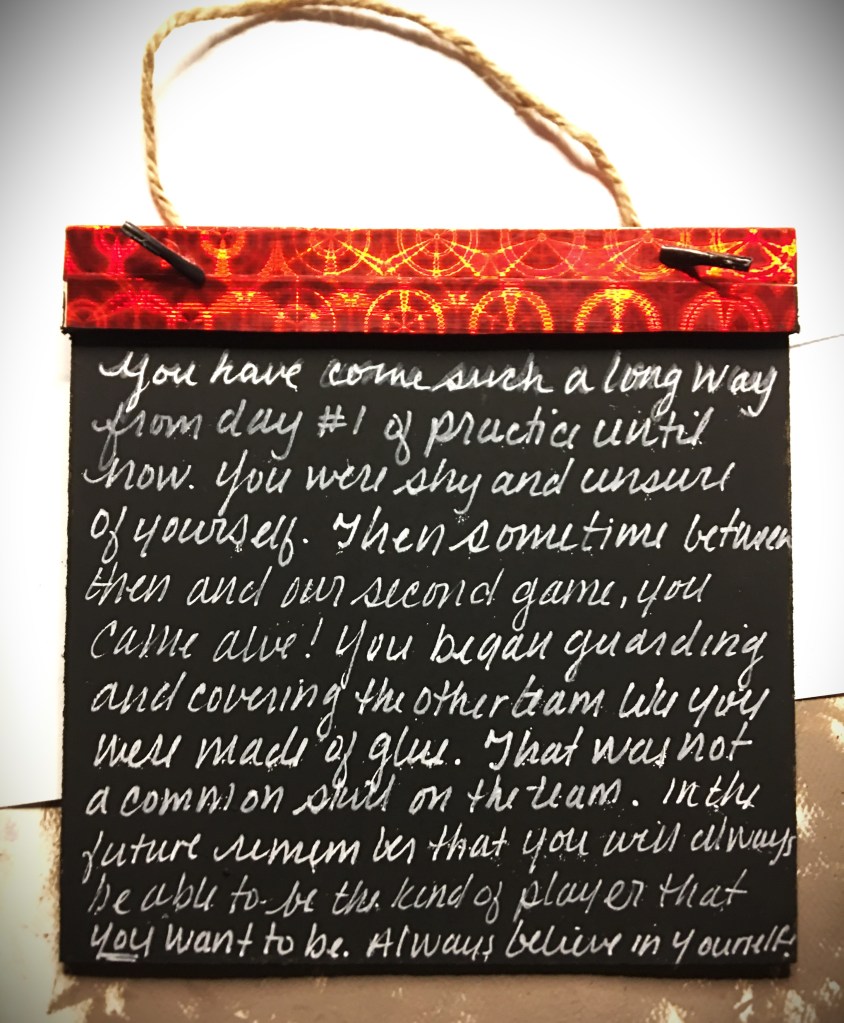
If you are privledged to have children under your influence so that you can pour life into them, I hope that you are inspired by this project. A gift with modest materials can be transformed to be uplifting for years to come!
If you are a basket ball coach and are looking for stickers that you can make and pass on to your players, check out these designs!






 How I Can Do That
Leave a comment