Finding Hardware

What are your feelings about sharing a garage/shop with someone?

I find it frustrating! I have my office/craft space organized with containers that are labeled with its contents. So even if I have containers down I know exactly what’s in it at a glance. And it’s super easy to put away and clean up.

The garage… I so wish, with every wish available I could send my family away for the weekend to organize it and find an official home for everything. And you can guess it. My problem is that my husband has a way he wants it and our two ways of organizing a work space for repairs, large projects, and keeping our hand tools are two very different ways of thinking. The funny part is that more times than not, it’s my husband who’s coming to me to find a specific tool. And yes, I keep my own stash of hammer, screw drivers, and allen wrenches that I zealously guard like my fabric scissors. If you touch them, you better put them back where they belong, LOL.

And if you’ve built anything for any length of time, you know how hard it is to find screws, nails, and washers specific for your project. God Bless my Husband, but he has that garage that we’ve all seen our grandfather’s have: screws in a coffee can, nails in jars… they may have a home but you have to dig for the style and size of hardware that you’re hunting for.

So for my husband’s birthday this year, I had my boys help me build my husband a caddy to separate all those pieces of hardware into an easy to access place that you can quickly grab without feeling like you’re sorting through that bag of unmatched socks. And Bonus for my bragging rights, is that I sourced everything for this caddy from our garage.

This caddy is perfect for a garage, craft room (of all types), office, or anywhere you need to space save and easily access anything. While you’ll see I labeled these specific for garage hardware, you can take this idea and run with it for crafting. Instead of nails, label it buttons. For a Teacher’s classroom, instead of tacks, label for push pins. Change bolts to paper clips. You can completely cater this project to anyone and their passion!

Advertisements

Here is everything that I used:

  • Wood Box
  • Hammer
  • Tack Nails
  • Hand Sander
  • Black Wood Stain
  • Acrylic Paint with Brushes
  • Glass jars
  • Electric Drill with Drill Bit
  • Nuts and Bolts (small)
  • Size Appropriate Wrenches
  • Vinyl
  • Hardware Labels
  • Weeding Tools
  • Transfer Tape

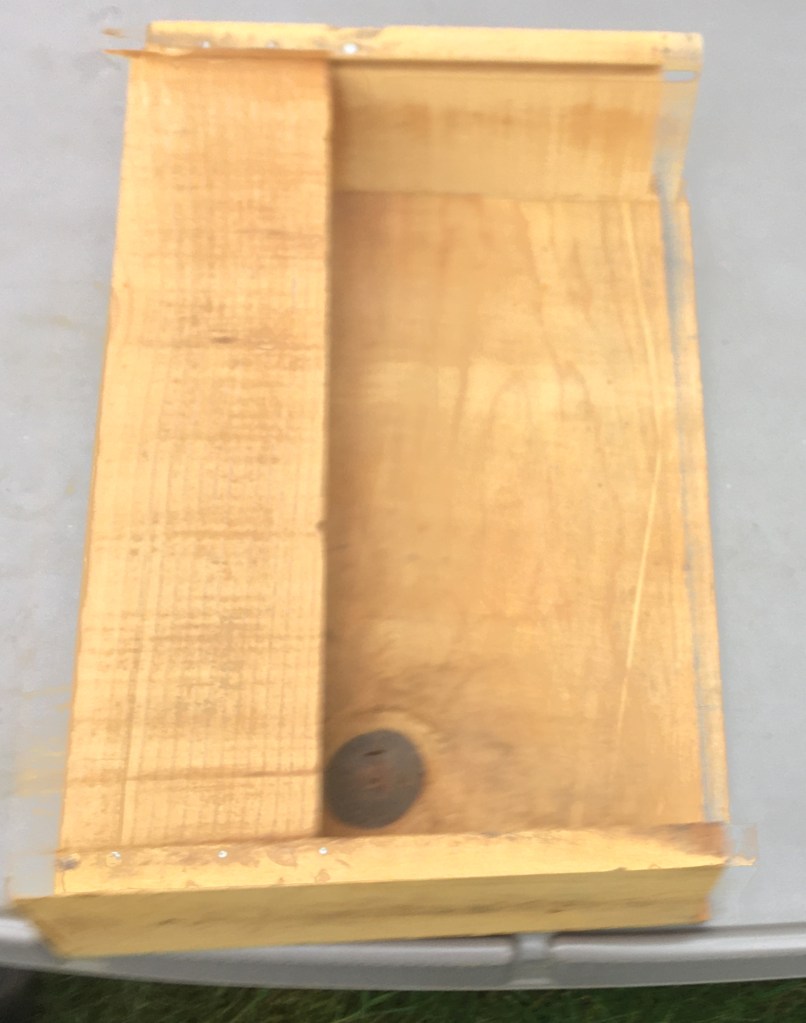
The box that I used is a wooden box (about 12″ by 8″) that’s very similar to a cigar box with sliding lid. The lid was missing and one of the long sides was about to fall off. So I just removed the lid and nailed it to the top of the box.

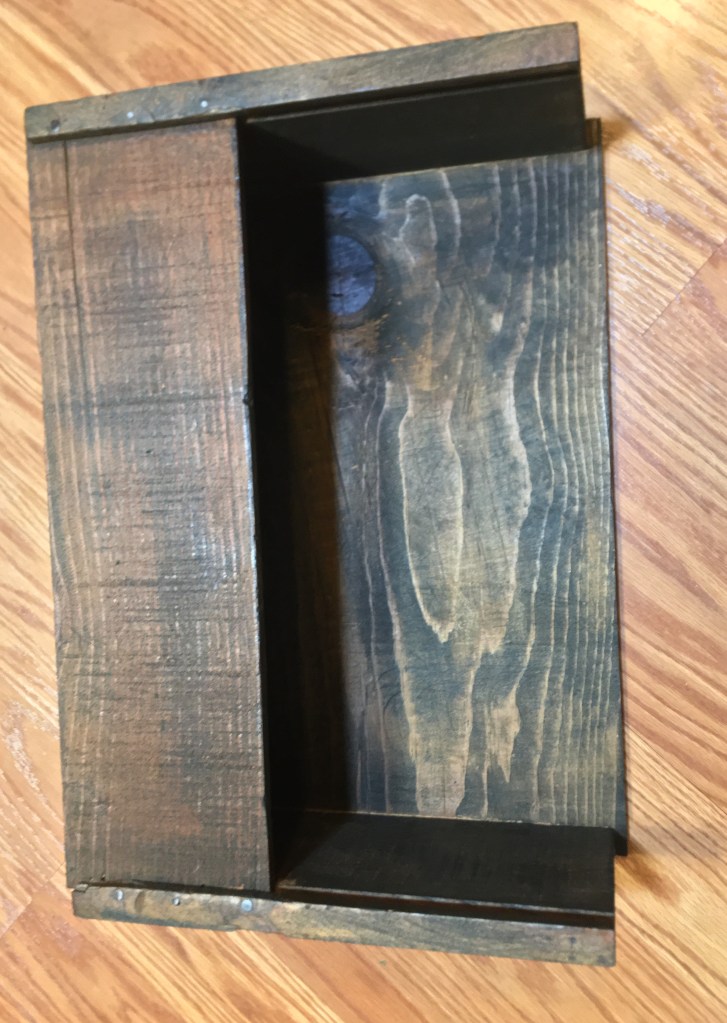
One reason why I wanted to reshape the box was to have a little hidey shelf, in case my husband wanted it. You know the little objects you want to put in a safe place, but usually any counter space is a place prime for losing the thing you want to put in a safe place. So here’s a safe place. This box was rough, because it wasn’t meant to be decorative. I sanded the box on all sided before staining it. Yes, it maintained the rough look and feel. But I also fully appreciate the rustic aesthetic.

Advertisements

While the stain dried, I cleaned out my fridge from all the jars of pickled items. I’m not a pickle eater. Nor am I a fan of pickled vegetables. BUT my husband loves them. And my fridge door is where I sourced this collection of empty jars for this project. (I was not about ready to take from my canning jars, although I’ve seen people use canning jars for their hardware holders.)
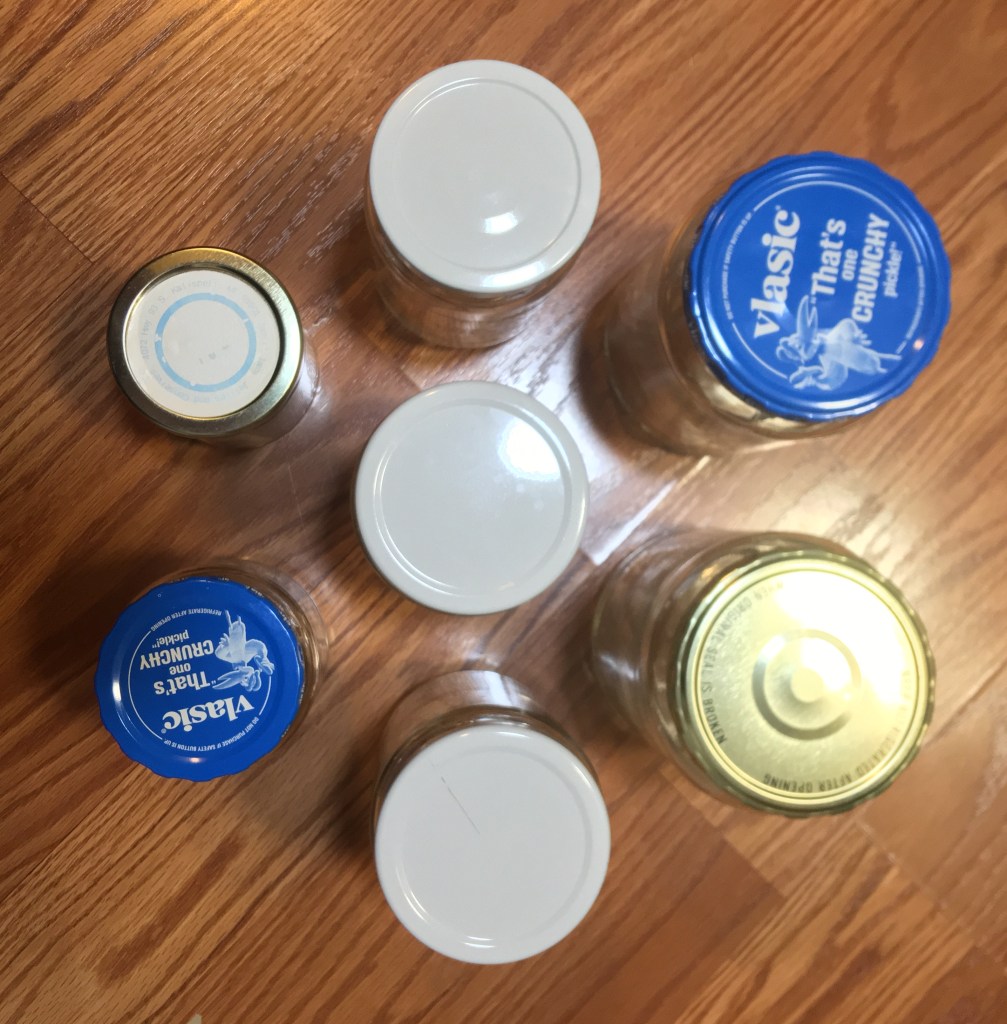
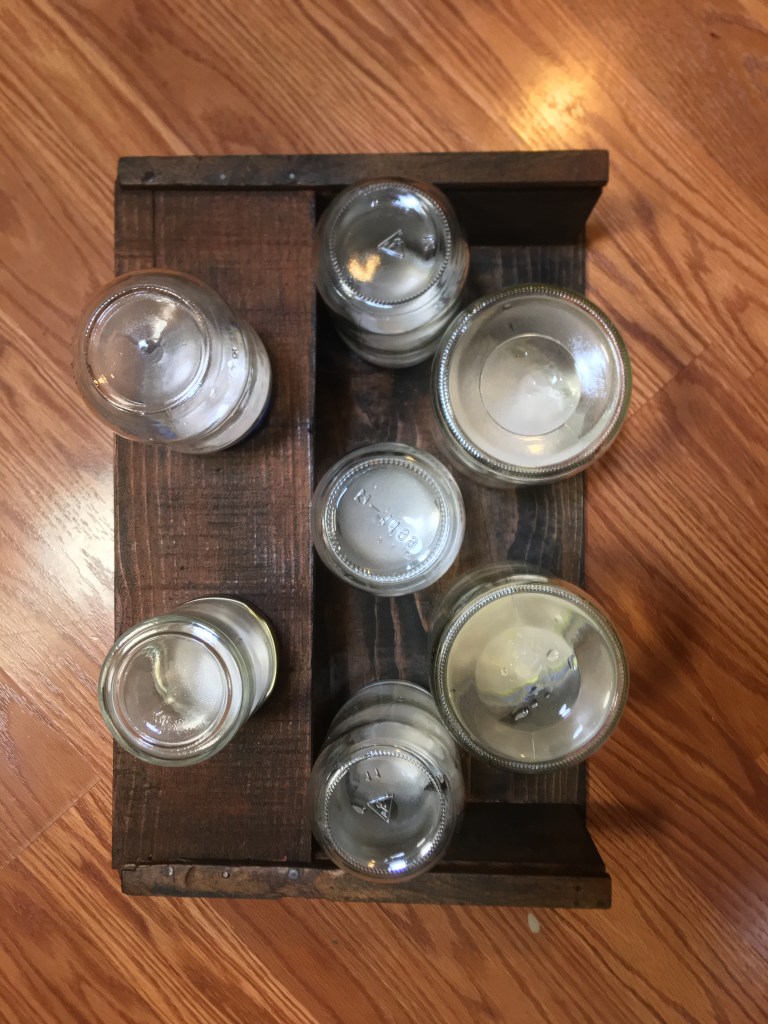
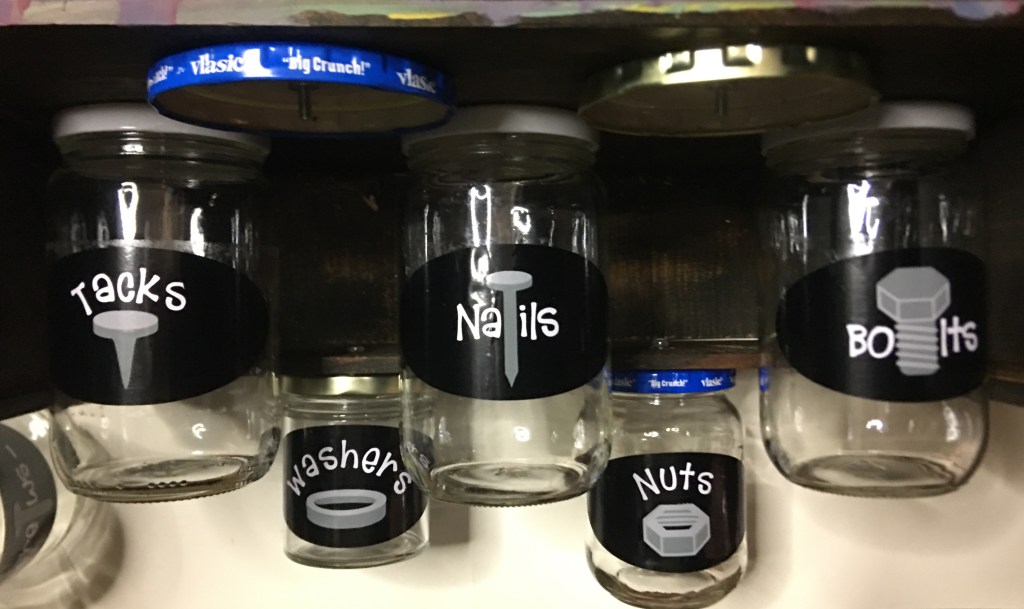
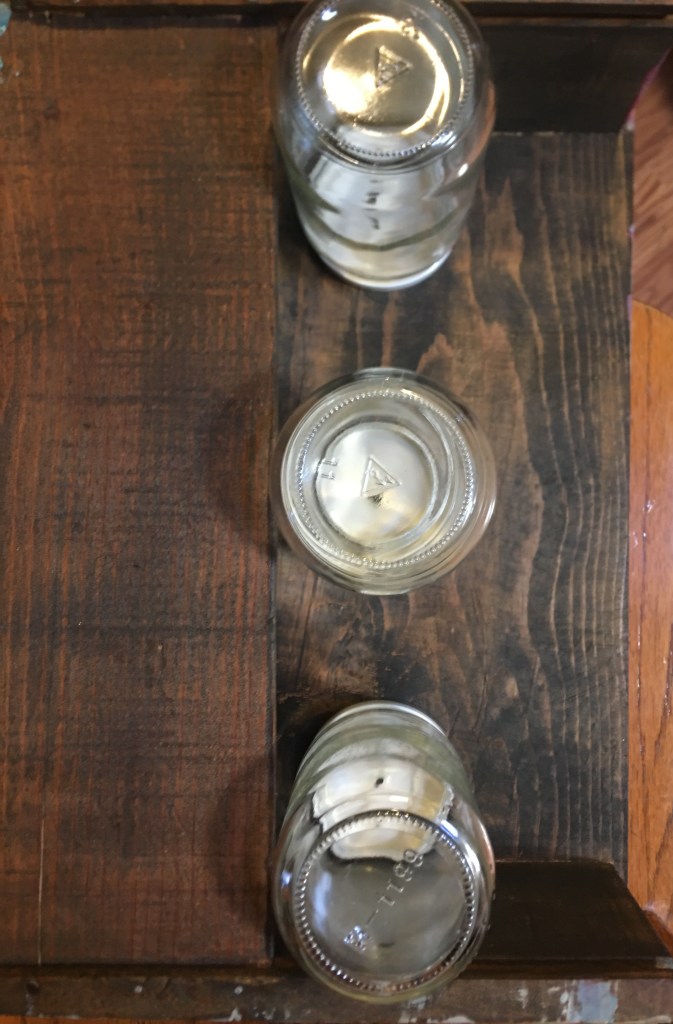
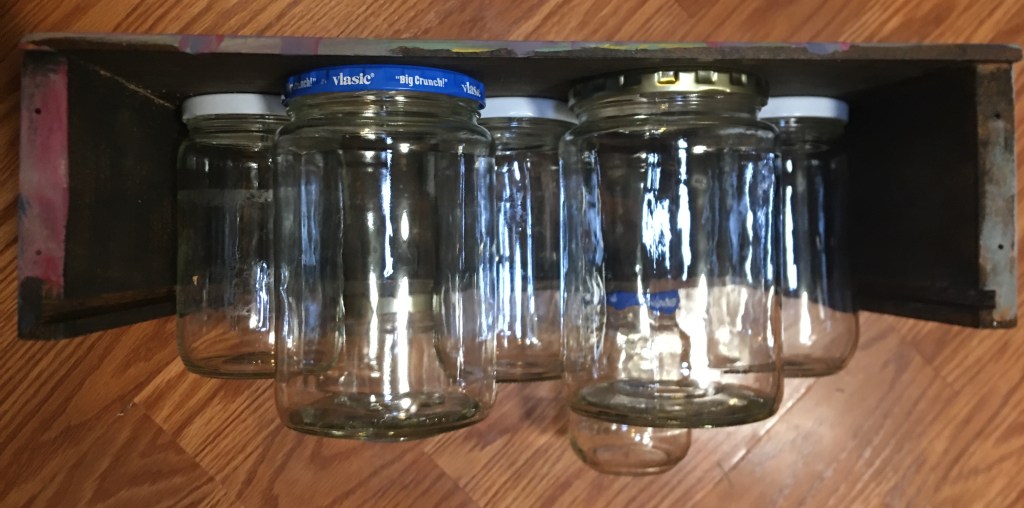
After the jars were washed and I found which ones were similar in size, I placed them on the underside of this caddy. The smallest jars I put on the shelf. And I went back and forth if I wanted the row of two or the row of three jars to be in front. I chose to put the set of three in the center just for symmetry. Plus, I knew the screws were going to go in the larger jars. And other than the nails, these are the most sought after hardware in my house. So I put those in the front to make it the most convenient to grab.

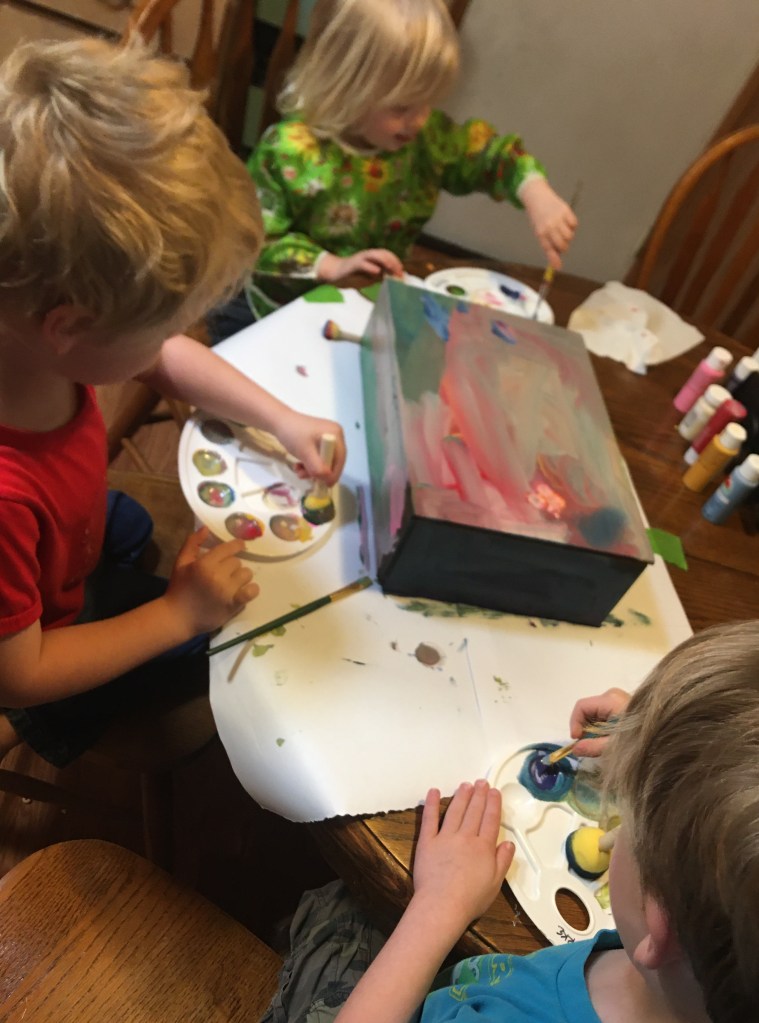
While the jars dried, from their scrubbing, I set the kiddos up for painting the caddy. They got a bit distracted and wanted to play instead of use tools, but they dropped everything to paint for their dad. And since my husband loves their art, I sacrificed my want to keep the wood stain, which was my favorite part. But I kept the underside stained so a piece of me was still there.

I’m showing you this step, because you can make your caddy however you favor it. You can keep it clean and upscale. Or you can make it very family orientated. There’s no wrong way to make this caddy.

Advertisements

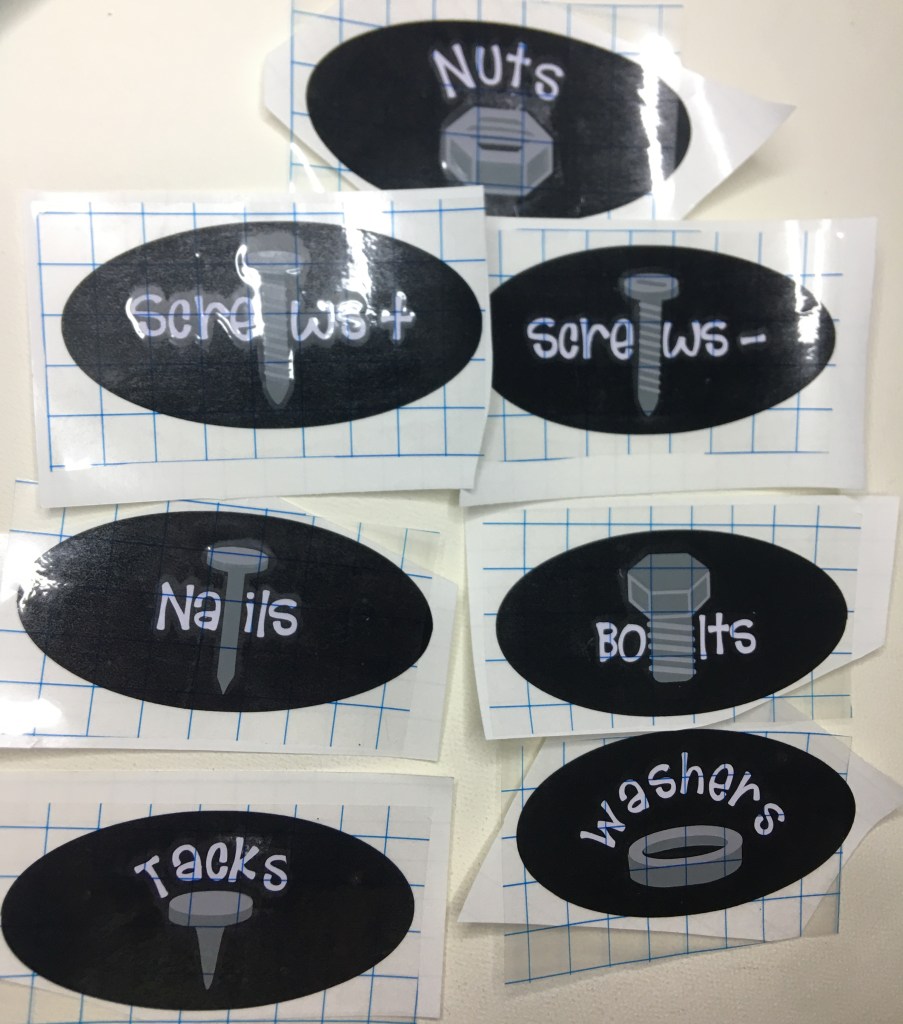
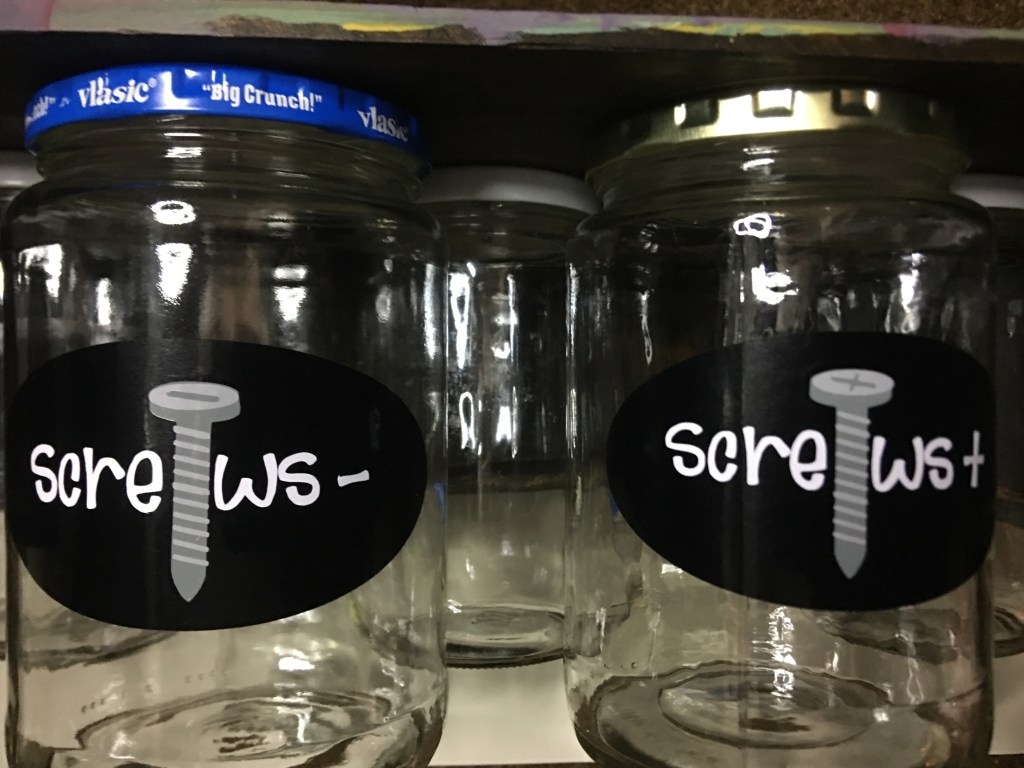
During this drying time, I cut out my labels with my cutting machine and assembled the layers ahead of time. That way when I was ready to apply theses labels, everything was lined up and ready for a simple peel and stick on the jars.
When the jars and the acrylic paint dried, I grabbed my drill, nuts, bolts, and jars. The first thing I did was drill a hole in the center of the lids. (If you are opting to use canning jars, make sure the lids you choose to use have already been used to preserve your food. That way you still have good canning lids ready to use in the future.)

After you are finished drilling, place your jars on the caddy in the exact places you want them. This pre-spacing is very important, especially when you have rows of jars next to each other like I have on the center and right side. I didn’t want the row to go over the edge, for esthetic reasons. If you have all your jars the same size and they second row comes over the edge, it’s okay. You may want to consider painting the jar lids to keep a uniform look. But the placement is also important because you will find that your jar lids are a smaller diameter than your jar sides. So by pre-spacing your lids, you will make sure you can screw your jars into your lids and not have an issue with the box sides or the shelf.

While you hold your lid in place, drill a hole through your caddy. When you hold is completed, you thread the bolt through the caddy and the lid and secure it with the nut. Hand tightening the nut and bolt will not be enough. You will want to tighten them with a wrench. This is most important if your bolts are short and if you want to be able to (un)screw your jar without holding onto the lid.
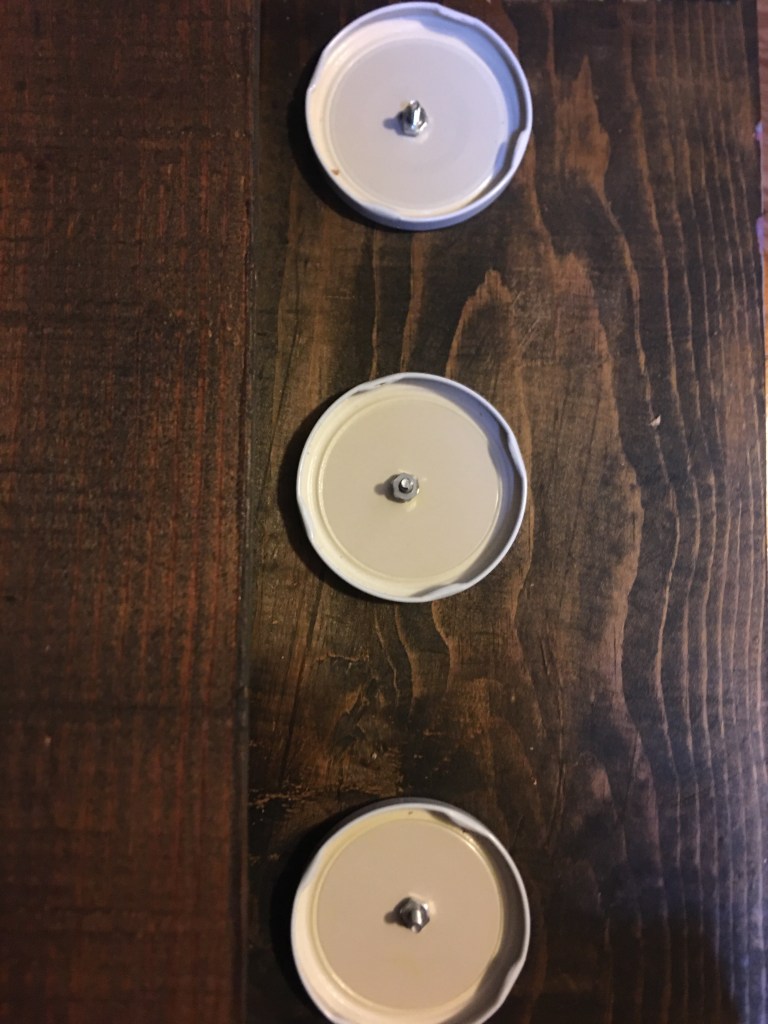
TROUBLE SHOOTING: If you find it difficult to keep your lid in the correct place for drilling, without moving, here are a couple of ideas you can use to assist in keeping your lids in place. Before drilling, use masking tape to tape your lid down to the caddy. Another option is to use a hot glue gun and place a circle of glue around the center of the lid. Be careful not to glue the center. You don’t want to drill through glue.

Advertisements

Once your jar lids are all secure, you’re ready to label!

To get labels to stick with the most success, clean your jar with a cotton ball soaked in rubbing alcohol. This will remove any oils, dust, soap, or anything else that could cause your vinyl to not secure cleanly to the jar.

It is crafter’s choice how you want to add the labels. You can place your jars on a work surface and apply them off the caddy. Or you can apply the labels while on the caddy. I chose to have all the jars attached to the caddy because the only jars that were a perfect match were the three that put in the center row. They were from the same company of pickled vegetables. All my other jars were different sizes, but very similar in measurements. However, if I applied my labels off caddy and centered them on the jars, then none of my labels would have lined up. However, with my jars on caddy, I could get the labels to line up near perfectly and give the illusion that all my jars are matching. The exceptions of course are my small jars in the back (washers and nuts). But those are tiny jars hidden in the back and completely understandable why nuts would be larger than washers.

However, if you’re the personality type that is bothered by things not absolutely, perfectly matching, then please ignore my chaos here. Work to your strengths and show us the beauty of our symmetry and perfectly lined labels. I love watching your work. But if you’re the type that can’t get things to line up perfectly, know that there are ways of lining things up even when your jars are millimeters off in their heights.
Mounting the Hardware Caddy

I’m sorry I do not have a picture of this for you today. We’re in the process of reorganizing our garage and we’re not sure yet if we’re wall mounting or rack mounting this caddy. I will update this post when we get that project finished, so you can see how you might choose to mount your caddy.

The one thing that you need to be aware of is how gravity is going to work when you have the jars filled with their hardware.

Remember, I organized my jars so that my heaviest and largest jars are on one side. If I install with screw jars forward, all the weight and pull are going to be forward. So I will need to compensate. If I install the screw jars in the back, toward a wall, there will be very little compensated needed because the center of gravity will be near the wall and negligible.

For wall mounting, I would want to have my screw jars forward and screw the back side of the box into the wall, with a screw in each corner of that board. Preferably I would want to screw the caddy into a stud, because that will carry the weight beautifully. If it’s impossible, hit at least one stud (which I would center the caddy on and put in an additional set of two screws, in additional to the corner screws). If all I have available is drywall, I will definitely put in wall anchors and drill the screws into those. That way the weight of the hardware will not weaken the dry wall and pull out of the wall under too much weight.

If we choose to go with mounting the caddy on our rack, I will do that using conduit bracket mounts. I will use at least three brackets on the screw jars side. That way, the weight of the screws will pull straight down. there will also be a bracket or two on the back just for stability purposes for when the screw jars are removed, and the center of gravity changes.

Another option for rack mounting is to use a block of wood. The caddy (jars removed for installation) I would put on the bottom side of the wire shelf, with the block of wood on the top of the shelf. Then drilling a screw through the open space of the shelf into the block of wood. This option is not the one I would personally go with, because it doesn’t work with how we use our shelves in the garage. But I did want to mention it because the caddy can be screwed into an existing shelf that you might have.

While there are many ways of installing a caddy like this, I want to put out one more idea. If none of the above work for your situation, you can add wall mounts to the back of your caddy. There are all sorts of alligator grip picture hanging mounts that you can use. With a trip to your local hardware store, you can find picture mounts that can hold portraits up to 50 pounds. That is over kill for this project, but I want to mention that this is another option that could work for you.

Please send in pictures or let me know who make this for. As I mentioned, this example of a hardware caddy I made for my husband for his birthday. But this is perfect for a Father’s Day gift, Graduation gift, something for a teacher, crafter, or even just as another option for home organization.
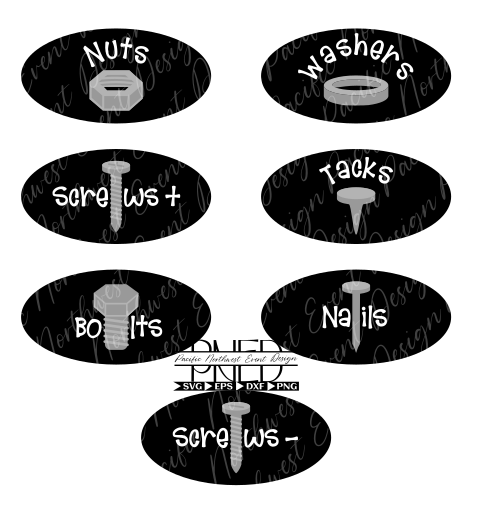
Files used for this project:

You can find Hardware Labels here.

Processing…
Success! You're on the list.

What If I Fail?

It doesn’t matter how many years you’ve been crafting and DIYing. You will fail. I fail.

What you do with failure determines what your future will look like. What your end product will look like. You can finish in a failure. Or you can take an option and end on a different note.

In fact, here is my most recent fail and how I pulled out of it.

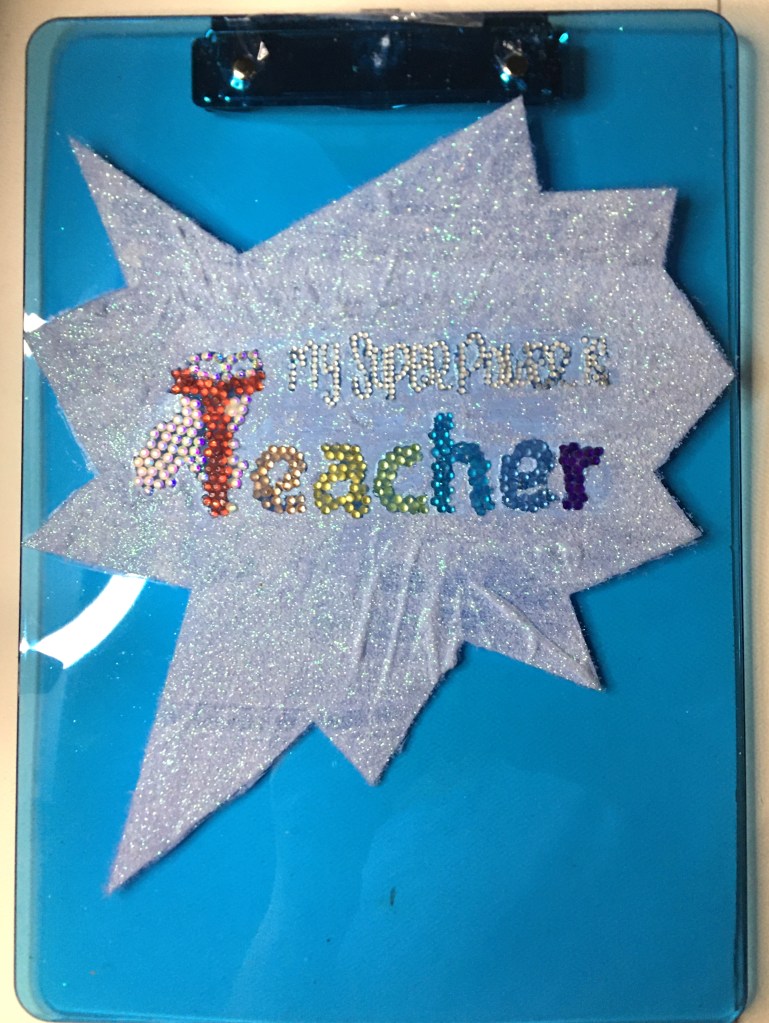
Two weeks ago I started working on a Teacher Appreciation gift for my son’s pre-school teacher. First, let me just say that it’s difficult coming up with a meaningful gift for a teacher that they don’t get a million of and you’re just one of those parents who giving a gift card just doesn’t feel personalized enough.

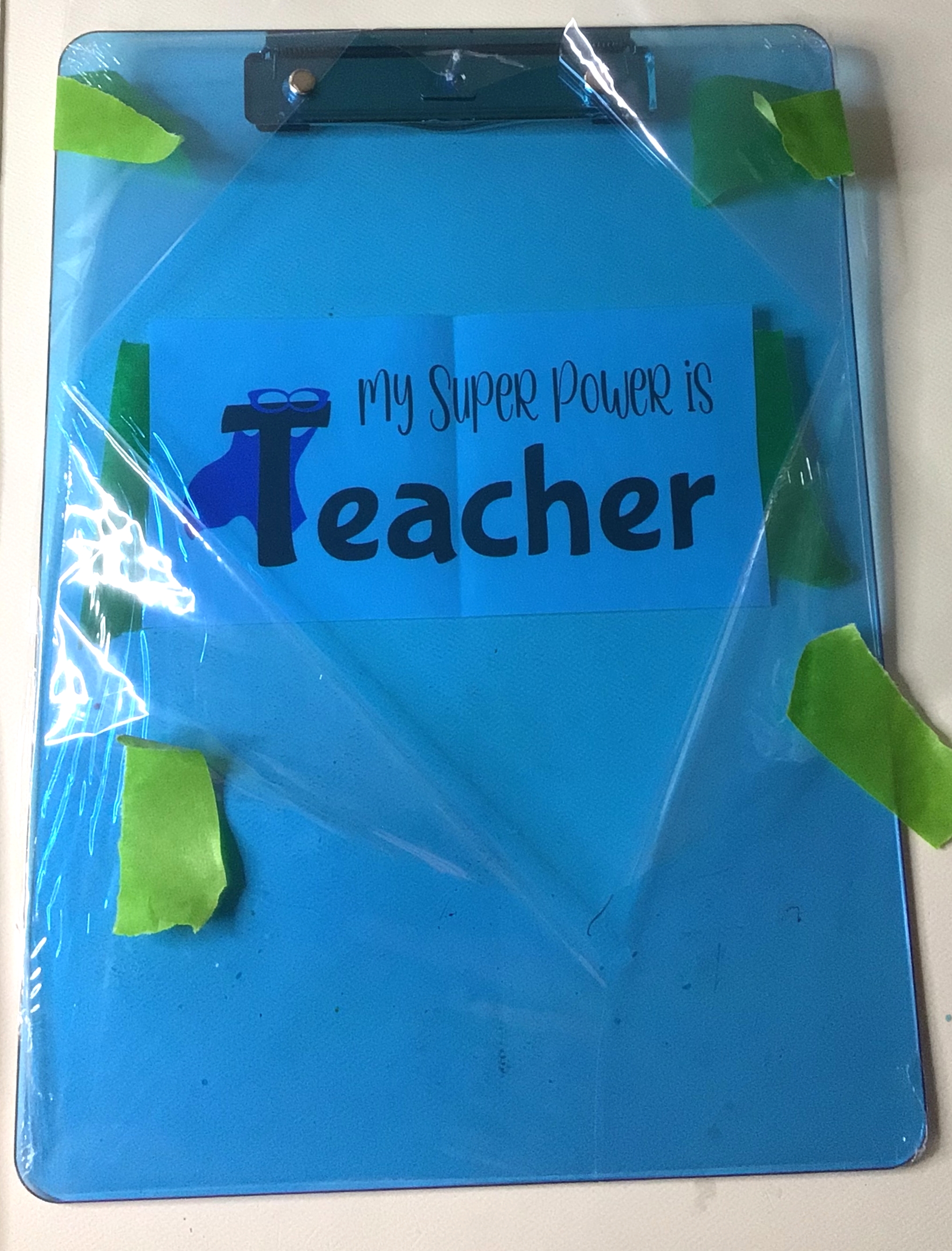
I help out in my son’s class and noticed that his teacher had one clip board. It’s pretty standard and who knows if it was on its last leg or was a work mule. But I do know that with home schooling my older son that a single clip board is not enough for me. And this was what birthed the idea of making a personalized clip board for our pre-school teacher.

Advertisements

I find the diamond painting crafts a very relaxing no thinking type of craft. With that experience, I had high hopes of having fun and relatively easy time with this. What I should have counted on is that the Jewel and Metal Glue would have had a mind of its own and gotten all over the place.

I should have set up more protection against glue betrayal. With the print out of the design on the back side of the clip board, I can see exactly what my work field was going to look like. I should have taped on protective paper (just spare crafting paper) to protect the exposed board that was not being worked on.

As it was the glue, coming out of the tube, came out at larger quantity than I needed for the small text on the top. What I needed, to control glue quantity, was a tooth pick. It provided enough glue to adhere the gems, and kept the glue of glopping up and making a further mess. However, the clear glue also found ways of transferring to other parts of my hand and got on the board. The crafter who recommended this glue to me (and other crafters) said that it dried clear. And I was under the impression that it would be relatively invisible.

Yeah, not so much.

IF you can keep the glue minimal, it hides quite nicely. IF you get impatient or frustrated, the glue does travel. It does clump up. It does not dry invisible.

I also want to mention that the gemstones were the actual frustrating part. The tweezers that came with them did not pick up well or easily. The white pencil that came with them worked maybe half the time. I actually had to pull out a spare diamond painting tool and use that. The disadvantage that comes into play is the gem glue. It acts like a super glue and builds up. It causes the gems to stick to the tool. So make sure you take the time and clean whatever tool you are using regularly. By keeping the glue buildup to a minimum, you will keep the frustration down a little.

Tips that I have for my next time:

  • Fully tape off the non-work area
  • Try to not use the tiny gemstones
  • Don’t be hasty, use a tooth pick for glue application
  • If using the side of your hand, put tape on the side of your hand (to replace every now and then to prevent hand transferring of glue)
Advertisements

Correcting the Failure

There were a few ideas that I had to redeem the glue failure of this project. Had the failure just been hand transferring of glue, I would have made other icons, “pows”, comic speech bubbles, etc to add more of a graphic design. However the glue failure was mostly an eye sore around the text with the stones, where the glue was just too thick.

I opted for acrylic paint to cover the glue. On top of the paint were glitter glue and a layer of fine glitter.

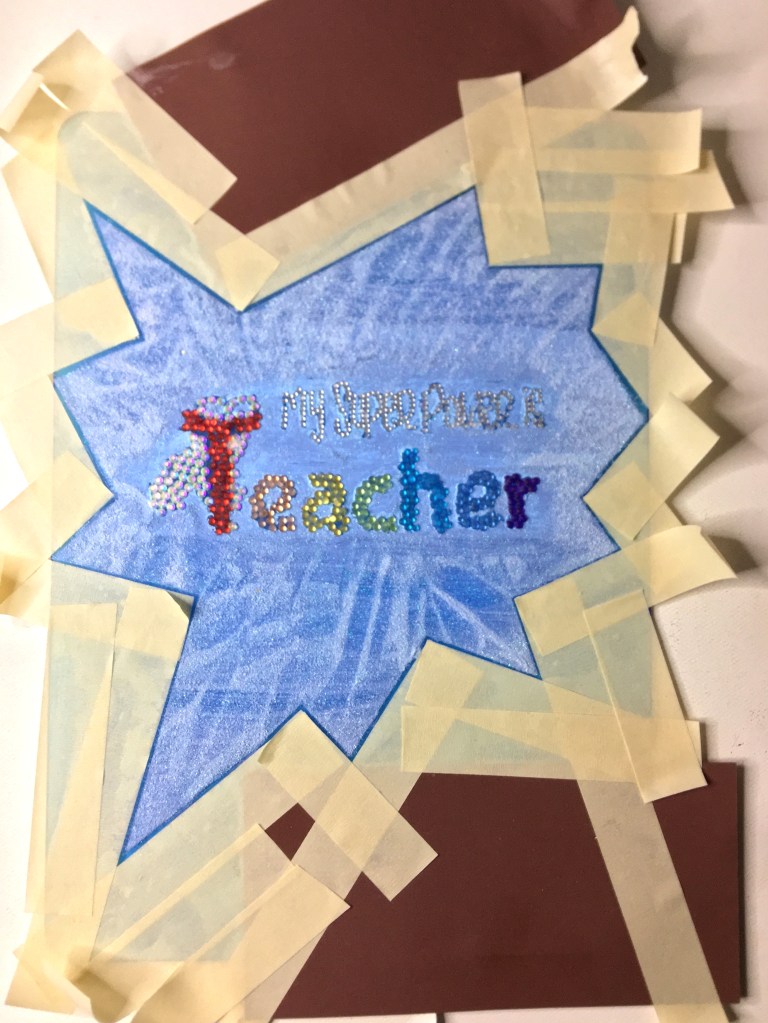
Step One: Tape off your Comic Speech Bubble. With cutting the edges, it allowed for the continuation of the lines and making the edges as varied as you want them. Just make sure that you press your edges down well so that the paint and glue don’t feather under the tape.

Step Two: Paint. Between the letters and around the gemstones, I used an acrylic paint pin. The edge of the pen is just more firm and easier to manipulate than a paint brush.

Step Three: Add glue and glitter. Once the excess glitter is shaken off, peel the tape off of the clip board.

The wrinkles that you see here is just the uneven application of the glitter glue. I was playing with texture to see if I could get a comic sunbeam pattern.

Step Four: Tape off the clip board for sealing with clear acrylic spray paint. This paint will keep the glitter from shedding. (I sprayed two coats of paint.)

There’s two ways of reapplying the tape. The tape can be put right on the glitter line. Or, as I chose, I offset the tape so that I could seal the edges of the glitter, but also add a simple edge to the design. The clear acrylic paint creates a glazed appearance.

Be sure to press down all the tape edges well. If the edges are not fully pressed, it leaves the opportunity of the clear paint to feather under the masking tape.

Once you have sprayed your last coat, you are ready to remove the tape and paper. If you choose to remove the tape with the paint still wet, there is the chance that there will be some feathering. If you wait until the spray paint is dry, there will not be that potential transference.

As you can see with this side by side, particularly around the -her of teacher, it is possible to clean up glue failure. There is a trade off of not being able to keep a minimalist design esthetic. However, there is light at the end of the failure tunnel. Sometimes you can remove errors that just can’t be erased.

No matter what you are working on, take heart. If something goes wrong, it is not the end. You can fix it. Take a deep breath. Look at your options and see what all is available. If you have more than one option, try to visualize what it will look like if you go down that route. Which route is going to get you in a better place in the fewest amounts of steps? Which route is going to eliminate the failure in what you’re working on? Not all solutions are equal. But the more options you have the more you hope you have for your end product.

Teacher Super Power was the file used today. It can be found here!

Advertisements

Processing…
Success! You're on the list.

Inspiration to Reality

Some of my favorite moments are helping make clients’ DIY moments turn into successes. And here is one of those moments.

The inspiration picture that Tina sent me was this burlap birthday banner.

I am such a fan of Pinterest and other creative social media. They provide the perfect jumping off point for communicating a clear vision.

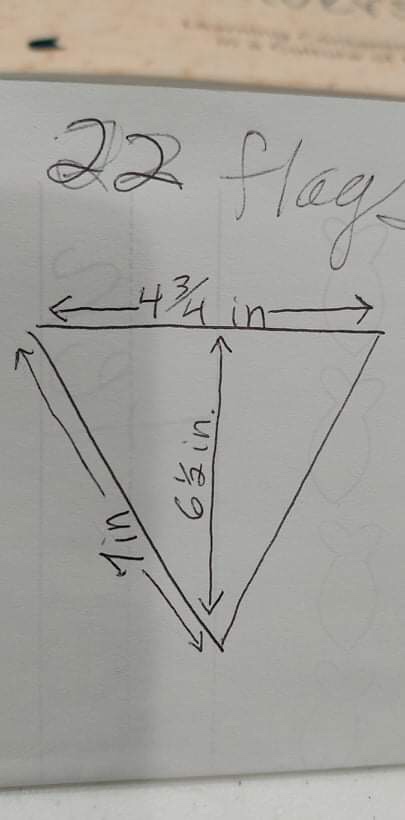
For Tina, she already had the burlap banner that she wanted to use. Because hers was triangular instead of rectangular (as in the inspiration picture) the information that was imperative was the dimensions of the triangles.

From there, I was able to put together a mock up for her with two of the closest fonts I had, to the inspiration picture, and one slightly different just for fun.

The important thing to remember when changing up a shape is understanding how to maximize the space. For triangles you are going to be limited by bottom heavy letters and numbers. So in this case H, A, and 8 are the limiting characters to the font size. When doing a mock up usually the P is the problem child because centering the letter on the triangle usually ends up with the P running off of the pennant. However this is easily overcome with an optical illusion. Keep the P in perfect line with the other characters, but you bump it off center toward the right.

So if you ever find that your characters are running off of your pennant, and they are top heavy on a triangle, you can shift your character over and keep it on your pennant.

I was so happy that Tina and her family were excited who this banner turned out for their mother’s birthday. Tina was able to use a banner that she already owned and she made something for her mom.

If you are looking to DIY a Burlap Banner and wondering wondering what is the best way to attach characters, there are two methods that I recommend. My favorite is glue dots. The dots have the right about of stick power to last through your event. Plus it has the added bonus of being easily removed from the burlap without added work.

The second method is hot glue. if your event is outside on a nice hot day or with some strong winds, the glue dots will not be strong enough. The hot glue is prefect. The drawback to this method is that sometimes the glue does not want to release from the burlap. There are a few different ways of removing hot glue from burlap. My favorite, is to place the fabric between two sheets of parchment paper and reheat the glue with a hot iron. The parchment protects your iron and table from getting glue on them. With the hot glue fluid again, you can peel the glue off the fabric. A tooth pick, or other narrow tool, is useful in reaching any glue caught in the weave.

No matter if you are a beginner at crafting or trying a new crafting skill, if there is an inspiration picture or question about how to do something, do not hesitate to reach out.

I’m here for you!

Processing…
Success! You're on the list.

Pulling Double Duty

The one thing that I love about budget and DIY weddings is that the couples, and their families, look for ways of reusing items after the wedding instead of using disposable items. And this is one thing that everyone can agree on, whether you’re a diehard Earth Day person, living Green, being Frugal, or just getting more bang for your buck.

I’m going to focus on one wedding item that tends to be wasteful or even a financial drain…wedding favors.

There are so many cute ideas out there. I really get it.

Some of them are practical. Like the paper fans on those hot summer outdoor weddings.

But if we’re being honest, how many of those items are really used by your guests after the wedding?

The problem that I see is that all those monogrammed, personalized items really don’t see a life outside of the wedding. The true exceptions are for the family and guests who are truly sentimental.

My husband is one of those sentimental people. I kid you not, he’s the one who collects the paper fans after the wedding and brings them home. His feelings are hurt if the one of the boys plays too rough with one and rips it. And 5 years later I just see a blue fan, but he remembers who wedding it was from and at least five new people he met, and a funny story or two from the reception.

So I want to challenge you to find a way to make your wedding favor do double duty. Or even triple duty!

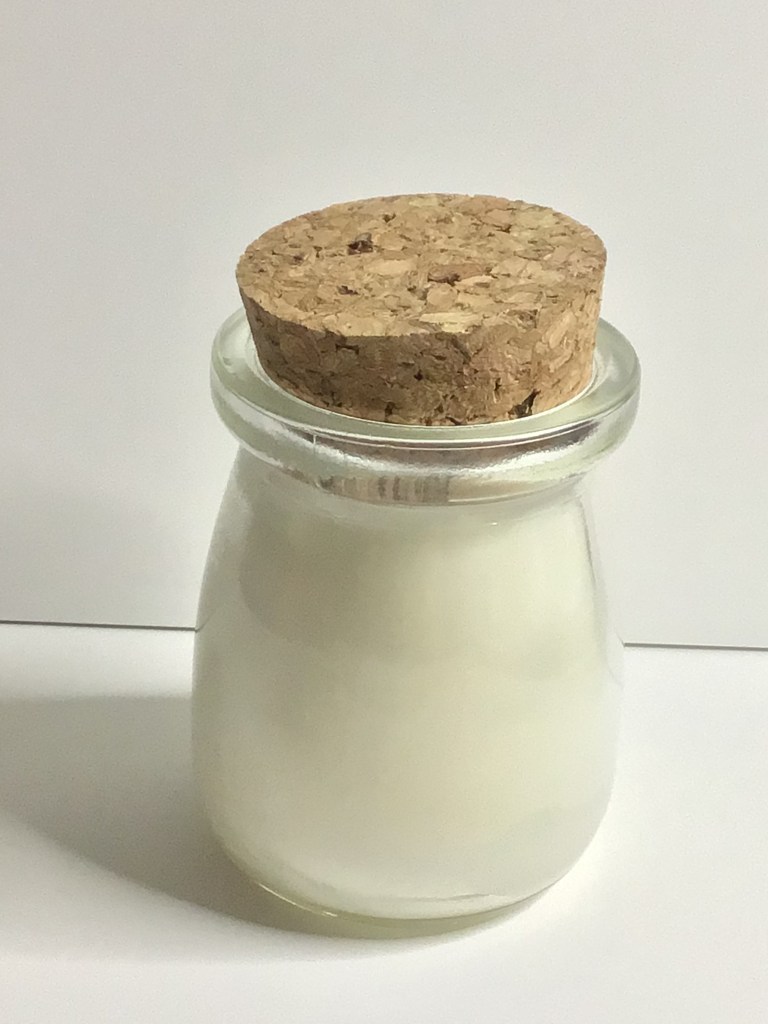
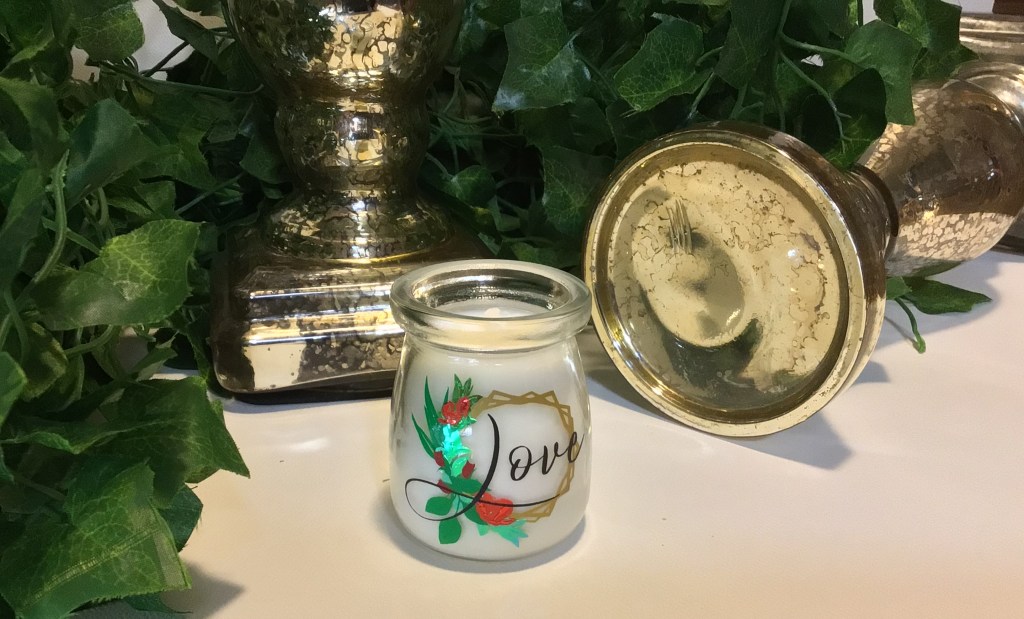
One idea I have for you are little candles that you can purchase at craft fairs and support a local vendor.

Advertisements

Use #1 Wedding Favor

Instead of personalizing these with your names, initials and wedding date, try finding phrases or words that represent your love for each other. Funny phrases work if you’re a funny or prank making couple. When you take away the obvious personalization and go with personalization that your guests can identify with, you automatically guarantee that your guests are going to want to take your favors home.

Use #2 Year Round Gifting

For example, if you’re keeping with the romantic or Boho themes, this floral wreath is absolutly perfect! It adds to your wedding decor, but it’s absolutely something that people will love to decorate their homes with when they leave our reception. Worse case scenario, you take a few home and they are still an appropriate gift to give for birthdays, Valentine’s Day, an add on trinket to another couple or bride, the possibilities are endless.

This decal is 2″ tall. Some of the details were eliminated to due to size. The rose buds you see here are about 3mm tall.

Use #3 Centerpiece Decorations

If you’re thinking about using tea light candles on your reception tables anyway, these are perfect because one purchase price for a favor is fully utilizable for your centerpiece. And if you design it just right, you can combine it with other candles. For example, here’s the same candle with gold mercury glassware.

Advertisements

Use #4 After the Candle is Gone

People love cute little things. Even more than that, they love cute little things that they can easily see using when the contents are gone.

This little jar is perfect for adding:

  • A new tea light
  • Coins
  • Q-tips
  • Toothpicks
  • Sink side jewelry holder
  • Small office supply holder (ex. tacks)
  • Tooth Fairy jar
  • Spice holder
  • And any crafty person can find a million uses for this size of a jar on a craft project

I think I bought several of these scented candles from a Christmas Craft Fair vendor for about $5 each. Yes, there are most certainly wedding favors out there that you can find cheaper per unit. BUT my big question is…

Which favor is going to be memorable for your guests? Pull double or triple duty for your decor? Will be used long after your wedding?

Another bonus to purchasing an item like this from a local vendor is that they are likely to work you a deal if you buy something in bulk from them. It’s something to talk to them about. But even at $5, it really is a great deal.

But the absolutely best thing about this favor is that it will absolutely not end up in the trash as soon as you leave for your honeymoon!

File Used Today, Love Wreath, will go live on Monday! There will also be other variations available. So be sure to check them out in my shop.

Processing…
Success! You're on the list.
Advertisements

Resizing Critters

With Easter tomorrow there is a common crafting problem that pops up with those cute egg and sucker holders…resizing.

Not all eggs are sized the same. Not all suckers are sized the same. There are even some holders for chocolate balls. Not all chocolate balls are the same size.

I’ve seen more frustrated crafters than I care to mention. Either the designer miss-sized the holes, so things don’t fit or the crafter bought a candy that was not standard size for the file they bought.

The good news is that you don’t have to throw out the files that didn’t work for you. All you need to do is resize your file in your cutting program. And I’m going to show you how.

Resizing Your Critters

Step 1: Measure the diameter of your egg, sucker, or chocolate.

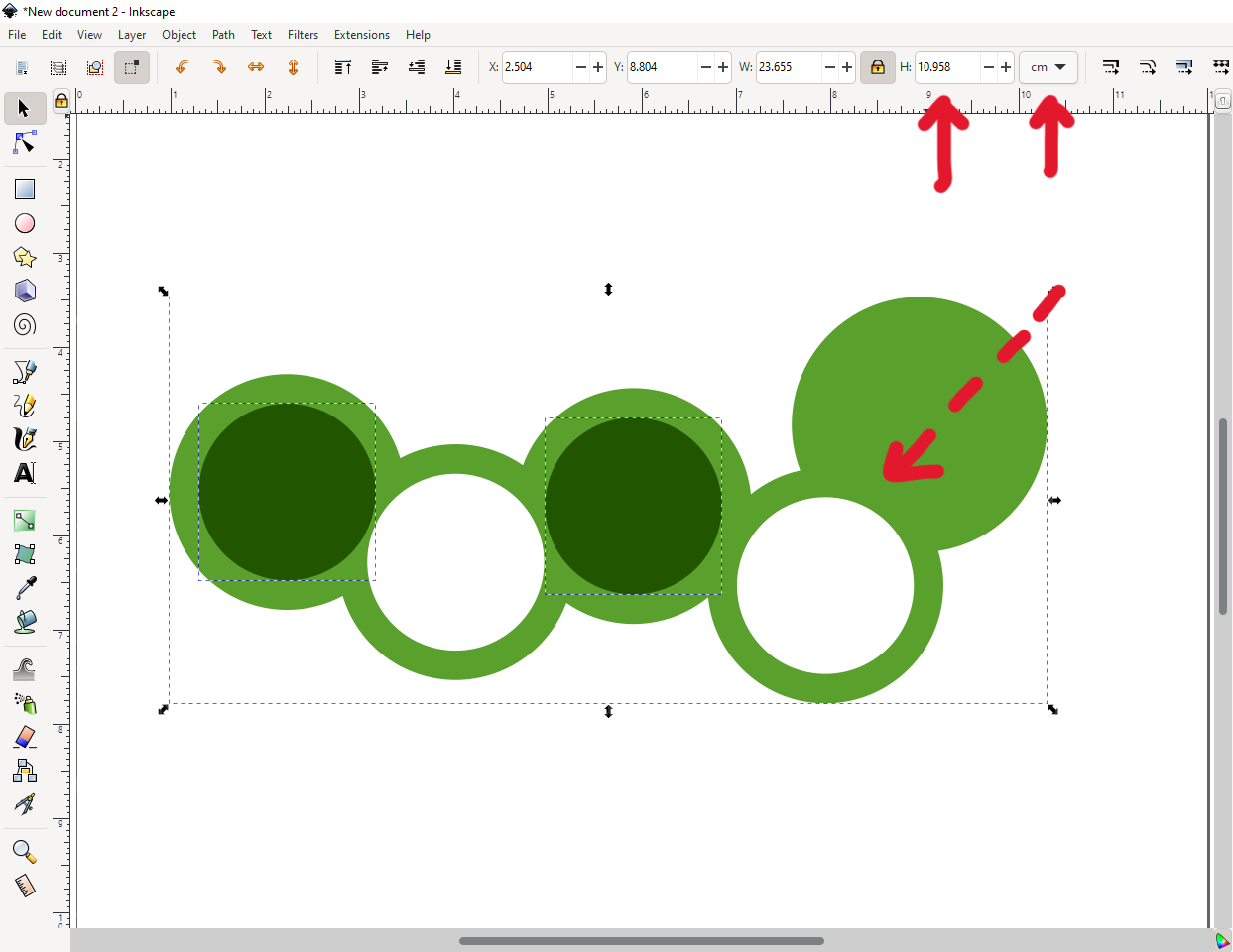
Step 2: (After checking to make sure your entire critter is grouped, to make sure you resize everything in proportion) Make a circle that fits the hole. You will use this circle to verify you have reduced or enlarged your critter to the size you need it. (See Photo 1 above)

Step 3: Check your program’s measurement type and decide if you’re going to do your measurement based off of your objects height or width. (See Photo 2 above)

You will notice in the photos that I have my measurements set to centimeters. The reason for this is because the plastic ornaments I’m using were sized in the metric system. I love designing in Inkscape because I can switch back and forth between the metric and imperial system with just a drop down menu.

The ornament I’m sizing down for is 4 cm.

Step 4: Select All: your entire critter and your sizing circle. Then increase or decrease your critter as you need.

This step will take a little time, because your entire critter is not going to be directly proportional to the hold diameter. I’m sure there’s a math equation that you could come up with to get you the answer every time. I am not a mathematician. So I use the computer program to do the work for me.

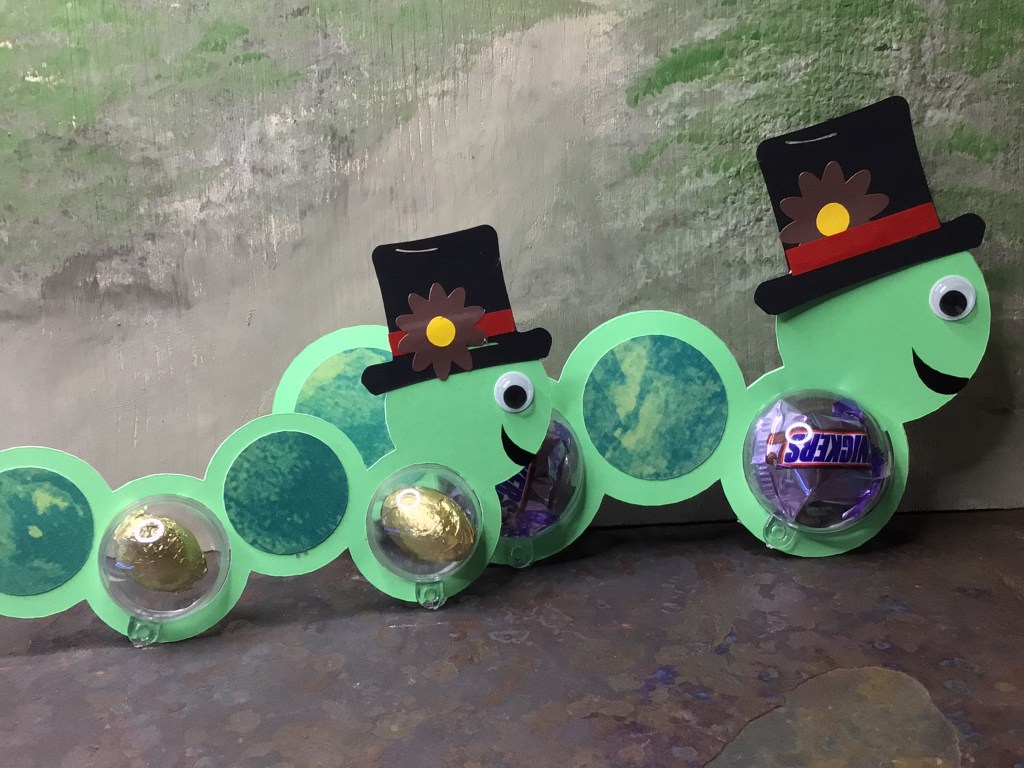
Step 5: Stop sizing in accordance to what you’re sizing for. (See Photo 4 above)

As I mentioned, I’m sizing down for a 4 cm plastic ornament. The ornament has no lip, other than the tab to string the ornament. And the caterpillar holder that I’m using does not have a base to deposit and hold the ornament.

If you’re using a cut file that holds your egg, sucker, or chocolate ball, you don’t have to be precise with your hole sizing. You just need the whole holder to be big or small enough to precisely hold your sweets.

However with a plastic ornament (I needed to use up my 3 cm and 4 cm ornaments that just are NOT standard size for any cut file on the market) I need to have a pretty precise hole size. I need to have it snug to keep the project together. So I made the hole slightly less than 4 cm so the tension of the two pieces of cardstock (glued together) was enough to hold the ornament with no other crafting tricks.

Step 6: Cut your file!

Obviously I didn’t resize in my cutting software. My software does not have a measuring system conversion tab. It’s permanently set in the Imperial measurement system.

If you find that you are also resizing outside of your cutting software, always make note of the height and width of your entire critter. This will allow you to quickly resize your entire critter in your cutting software without the guess work.

Let Me Do the Math For You

I want to make conversion easy for you, if you decide to go with my Caterpillar Ornament cut file!

Here are the measurements I used to make these Caterpillars for my boys.

Small Caterpillar3 cmHeight 2.7″ / 6.85 cm
Medium Caterpillar4cmHeight 3.6″ / 9.15 cm
Cheat Sheet for converting the Caterpillars for full ornaments.

3 cm OrnamentCircle Back Cover 3.5 cm / 1.38″
4 cm OrnamentCircle Back Cover 4.5 cm / 1.77″
Another option is to use half of an ornament and use decorative paper for the back cover.

Tootsie Pop3 cmHeight 2.7″
Dum Dum2 cmHeight 1.85″
Cheat Sheet for converting my Caterpillar Design into sucker holders!

Honestly, with converting you could go as large as you want to. You could size up even more for gifting sox, underwear, baby onsies, and baby burp clothes. Literally you can convert to package any kind of gift in a new way!!!

What do you do when it all goes wrong?

Let’s be honest. Sometimes we forget to resize something. Or we think the designer made it correctly, but our cutting software program uploads the file at non-original dimensions (which has happened!) Or there’s an entirely different reason. Maybe the item you’re crafting with is not uniform in size (which happens with cheaply made items).

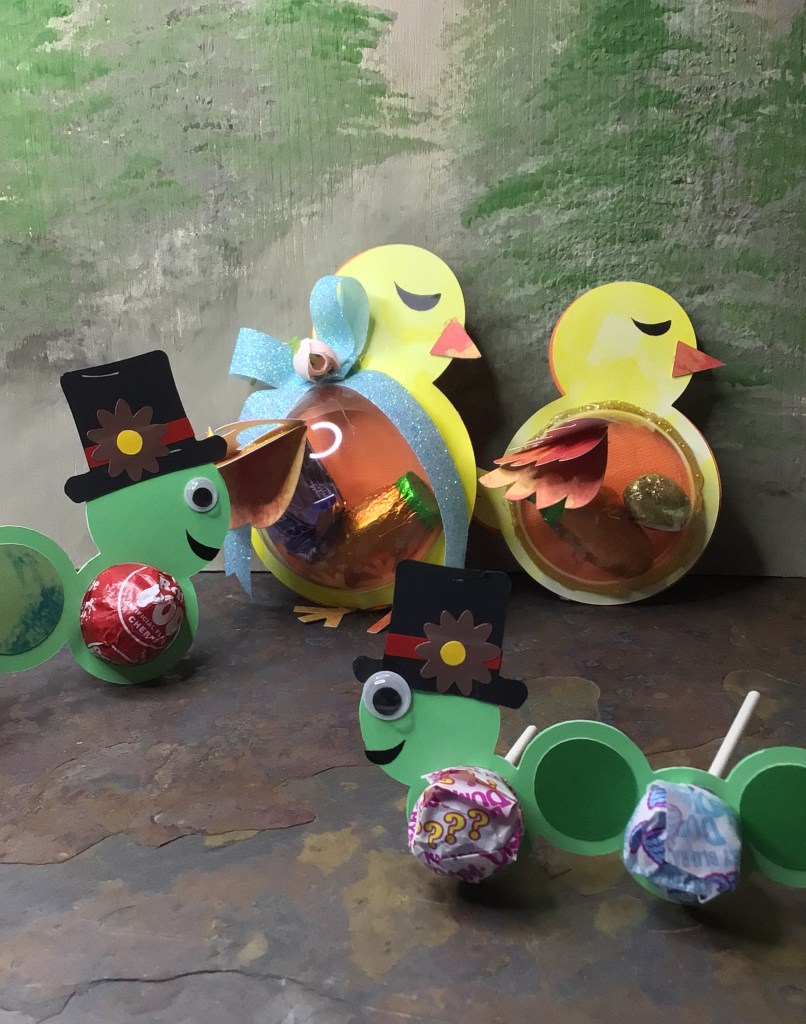
That is what I ran into with another designer’s file while I was finishing my Easter crafting for my boys. I had used this other designer’s file for Rabbits with my 5 cm and 6 cm plastic ornaments. I had also gotten her Chick file. I had to make conversions for her files because all my ornaments were smaller than hers, for which she used to design her file. The Rabbits turned out perfect. The Chicks were hit and miss. The 5 cm Chicks turned out near perfect. The 6 cm Rabbits were perfect. But the 6 cm Chicks were too small!

Now if I were making these for clients, of course I would make the adjustments and make them new. However we all know that my boys are just going to rip into the cardstock and go straight for the candy! They’re not going to notice any flaws. So I’m free to make corrections.

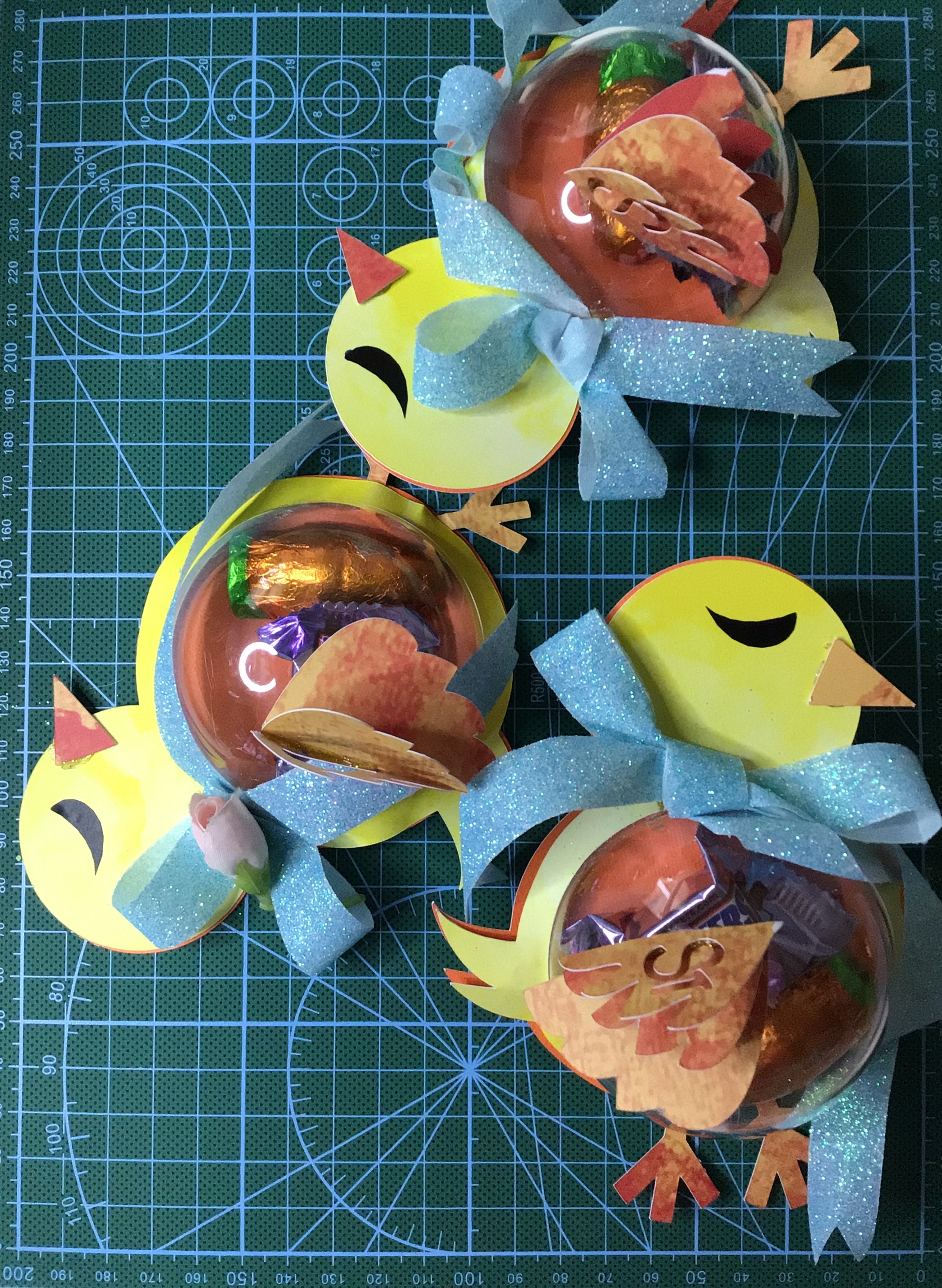
The 6 cm Chicks (on the left with ribbons) had front bellies that just would not seal to the back cover. I mean we are talking eye sore, obviously not the right size at all. So to solve this problem I took ribbon bows and curled the ribbon down over the mistakes. Hot glue is amazing for tacking ribbon down in precise locations.

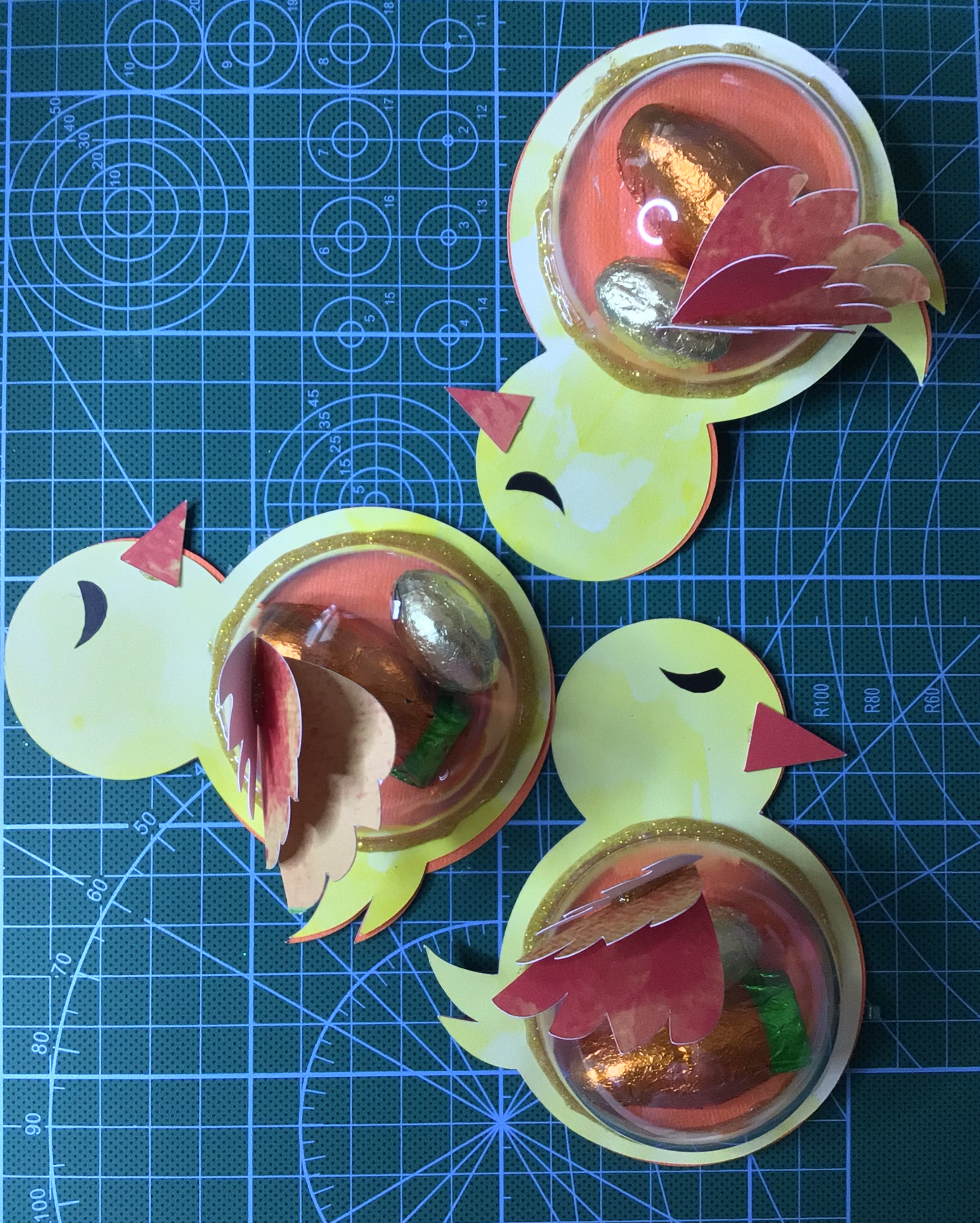
For the 5 cm Chicks (on the right), the half ornaments were having the issue of not staying in place at all. So I pulled out my glitter glue sticks and glued around the entire circular edge. I might have had smoother edges had I used Elmer’s glue and actual glitter. However, with a full weekend ahead and running out of crafting time, I opted for the glitter glue for the glue and done option.

The lesson I learned with embracing the imperfect (for a situation that doesn’t demand perfection) is to think outside the box. Cover up, fill the gaps with extra accessories, glue… it can all add to the beauty of hand crafting.

So if resizing is not exactly your cup of tea, do not fear. Don’t get anxious. Get close to being what you need and use your other skills to make it work. After all, a cut file is just a blank slate for you to make it entirely yours with the touch of your creativity.

Happy Easter!

Files Used In This Post

You can purchase Caterpillar Ornament and Floral Top Hat here.

Processing…
Success! You're on the list.