Cake Dreams

One of the memories that we are so quick to build are children’s birthday parties. So how do we make memories that last?

Make a cake!

I can’t begin to tell you all the cakes that I remember through the years. There’s the Holly Hobby cake my mom made from me (a popular baby doll from the 70’s). There was the cake that got locked in the trunk on my sister’s birthday. The cakes my sister’s and I made for our parents because finances were tight but the box cake was a big way we could show they mattered. The cake my husband made for me with marshmallow frosting. The cakes I made for my kids.

The list goes on and on….

I could tell a life story just off of the cakes I’ve made through the years.

And I want you to know that you can make cakes that make memories without going to culinary school and gaining the education of a baker!

You can make cakes!

You can make memories!
Photo by cottonbro studio on Pexels.com

Even though I have cake recipe books which put a world of recipes from scratch, I’m going to show you how you can make a memorable cake using a box cake–which is in everyone’s price range. And in this age of inflation, when you can still find boxes of cake mix for a dollar, I want that to be available to you.

Box cake mixes are great. The directions are easy enough for my kids to follow and make on their own. (In fact I just made a cake for a local mom and my boys wanted to help because they love baking cakes with me. They had to skip out on this one, but I had to promise that they could make their dad’s cake all on their own without me!)

TIP: you can test the doneness of you cake sponge by poking the cake with a toothpick in the center. When you pull the tooth pick out, and it’s dry, your cake is done. You want no moisture or batter on the tooth pick. Although you might see cooked crumb–that is still done.

Or….

TIP 2: When your timer goes off take a temperature reading in the center of your cake. When you reach an internal temperature of 200°F, your cake is done.

This particular tip is invaluable. If you’ve watched baking competitions you see people testing cakes by poking it like a chef pokes a steak. The amount of resistance tells you the internal state of being done.

The average person doesn’t know what a done cake feels like. We can easily
learn the feel of an under done cake and an overly done (and dry) cake. I’m
going to save you the head ache and just tell you that you only need to reach
200°F and your cake will be perfectly done no matter what. This works for all
elevations. AND it gives you a more accurate unit of measurement to direct you
in how much longer to cook your cake when it’s under 200°F.

Now that you know you do not have an undercooked cake, you’re halfway done.

Some people find the cake (or sponge) cooking the most intimidating. Others find the frosting to be intimidating. But frosting a cake doesn’t have to be intimidating either, because I’m going to show you a trick that I used with the Pinterest inspiration picture that was given to me for the cake I made the other day.

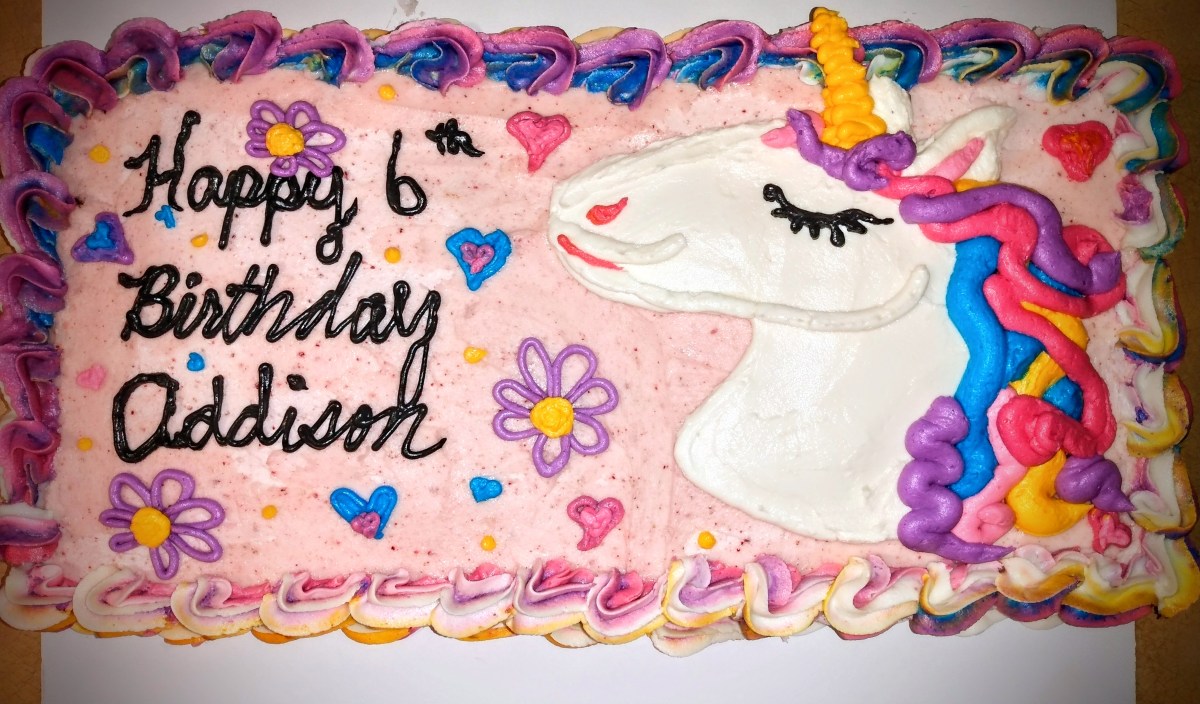
My go to frosting is formulated by Wilton. I’ve successfully modified this recipe to make it flavored. But this recipe gives you three different consistencies. I used two of these for the following Unicorn Cake that I recreated, stiff and medium. I used the medium for the filling between two layers and doe the exterior frosting. The stiff consistency I used for the decorative elements.

When it comes to coloring your frosting, the stores give you the choice of the liquid food dye or gel. The gel will give you vibrant colors for less.
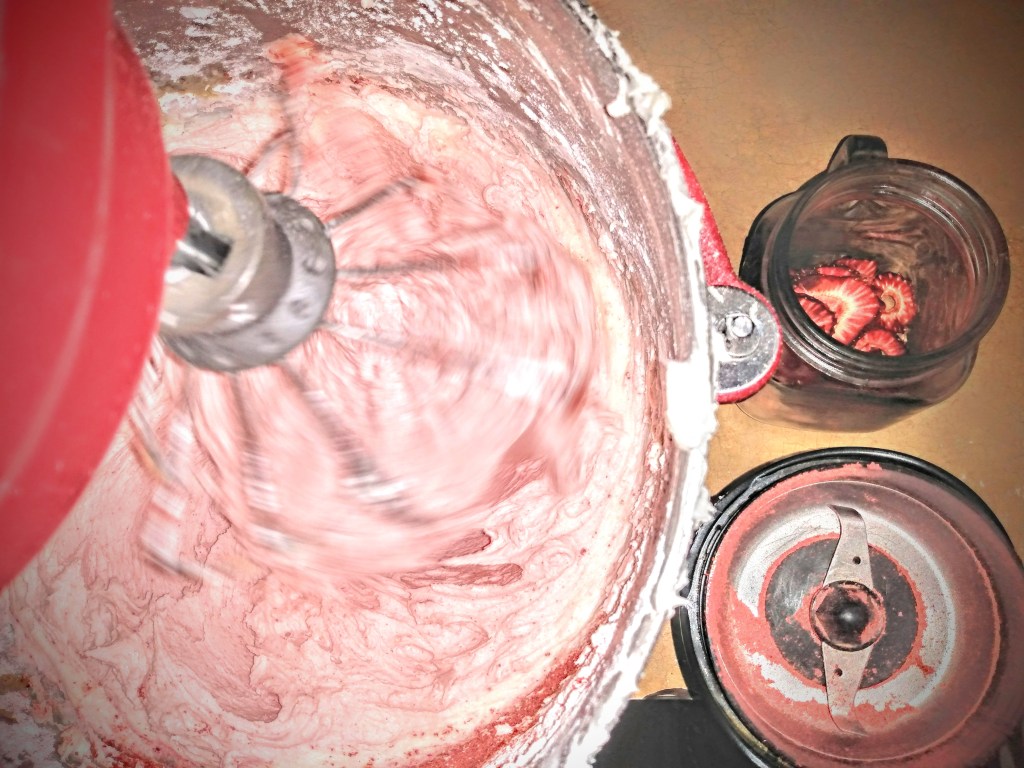
TIP: If you’re a family that is conscientious about food dyes, you can still color your frosting. What you’re going to do is plan in advance and dehydrate the fruit, vegetable, or edible flower for the colors you want. Don’t worry about the vegetables. The Wilton frosting is sweet and can overpower the vegetable flavor, if that is a concern for you.

As a point of reference, it took me about half a pound of strawberries (sliced, dehydrated, than powdered) to turn a single batch of Wilton frosting pink and mild strawberry flavor. I had the pink color to the frosting long before the strawberry flavoring that was requested by the birthday girl.

TIP: When you use a fruit with high water content, you definitely want to turn it into a powder in order to prevent your frosting from becoming watered down.

Frosting the cake is going to look a little differently depending on what kitchen tools you have available. If you can pipe the frosting onto the cake before you spread the frosting, you will be able to do a thin layer of frosting without getting crumbs of cake into your frosting.

Don’t have piping tools (pastry bag, coupler, and decorative tips), that’s okay. The trick is to take your butter knife (if that’s all you have), put dollops of frosting onto your cake, and then spread the frosting around using the flat of your knife.

The number one cause of crumbs in your frosting is your knife hitting the cake’s sponge. If you just move the frosting around, with your knife only touching your frosting, you should eliminate all crumbs.

If you still find you have crumbs, the other reason is that your frosting is too thick. This is particularly a problem with cakes that are light and fluffy. Not a problem!

If your frosting doesn’t spread easily, stop. Remove the frosting and put it back in the bowl. Add a teaspoon of water (or less) and mix it into your frosting to loosen it up. Test the consistency by trying to spread your frosting on your cake. It shouldn’t grip your cake like Velcro, but smoothly spread like mashed potatoes. Once you can easily spread your frosting, make that cake beautiful!

Want to make decorative elements, like an inspiration picture, but don’t feel confident in your piping skills? You will want this trick.

Don’t worry. You can use this trick even if you’re only comfortable using the tubes of colored frosting!

Print out your inspiration picture (with the elements blown up to the size you want them on the cake). If you have face details you want to recreate, make a copy for the body, and a second copy for the face. (The same is true for detailed that are stacked but not faces.)

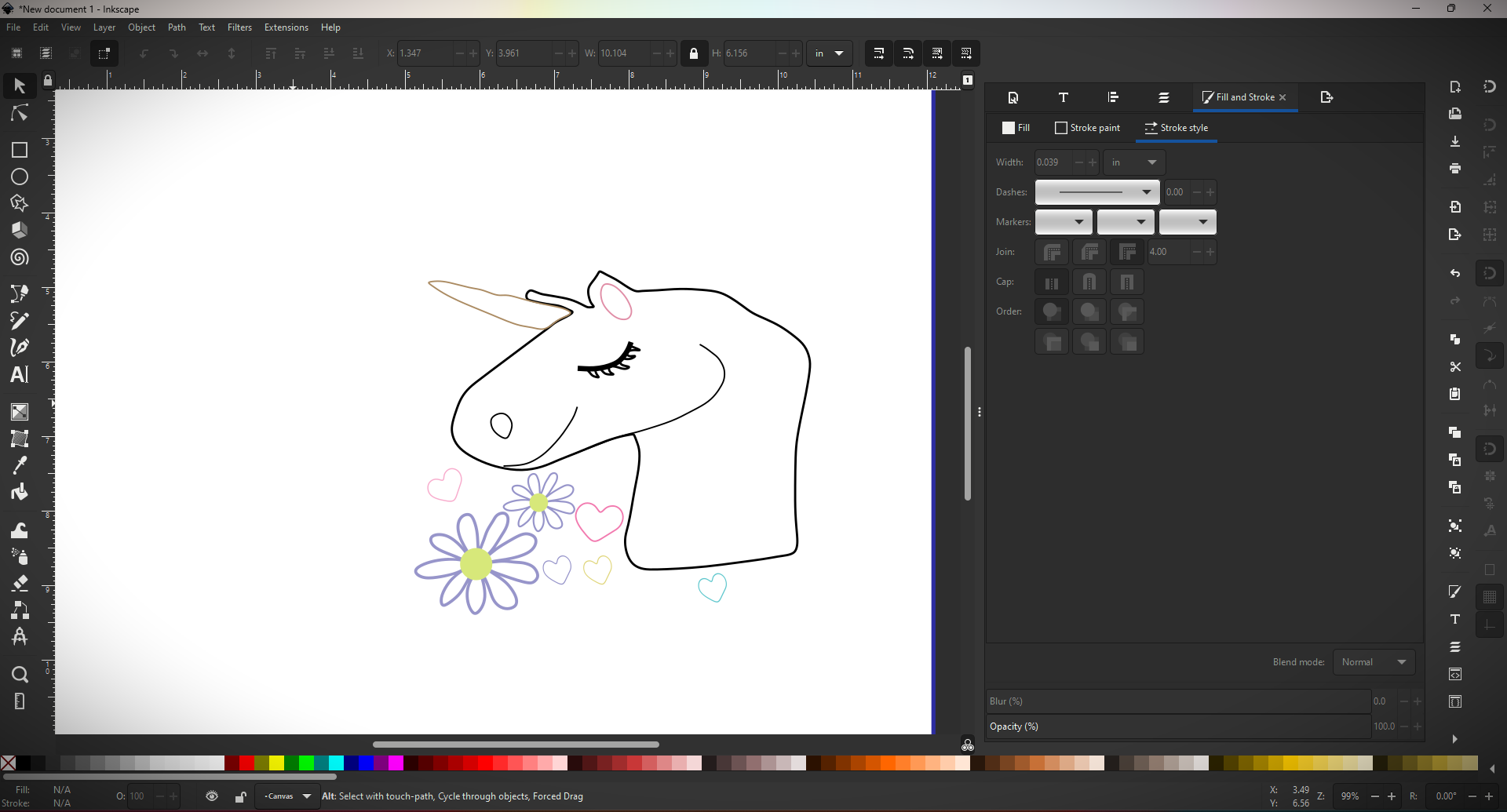
For example, here’s the inspiration that I was working with.

The original creator had freehanded the design of this cake. I’m fortunate if I can draw a horse head on paper with a pencil, so I needed this trick.

I do have skills in Inkscape where I took the picture and traced the elements and made my own stencils. After I printed out the stencils I put them on top of a metal cooking sheet. To keep them in place, I used a loop of tape. Then on top of the stencils I taped down a sheet of waxed paper.

Once my different colors of frosting were put in piping bags, I started tracing the stencil lines with the planned out colors.

In the instance with the unicorn head, I made the outline, then filled (flooded) the inside with frosting, smoothing everything out with a knife to make it look like a solid piece.

When all my decorative elements were piped out, I put the cooking sheet in the freezer.

You’ll want to plan this one ahead of time. The frosting will take time to freeze. Even with the stiff frosting, you will want this to be in the freezer for at least over night.

When the frosting is frozen, you can transfer the elements from the waxed paper to the cake.
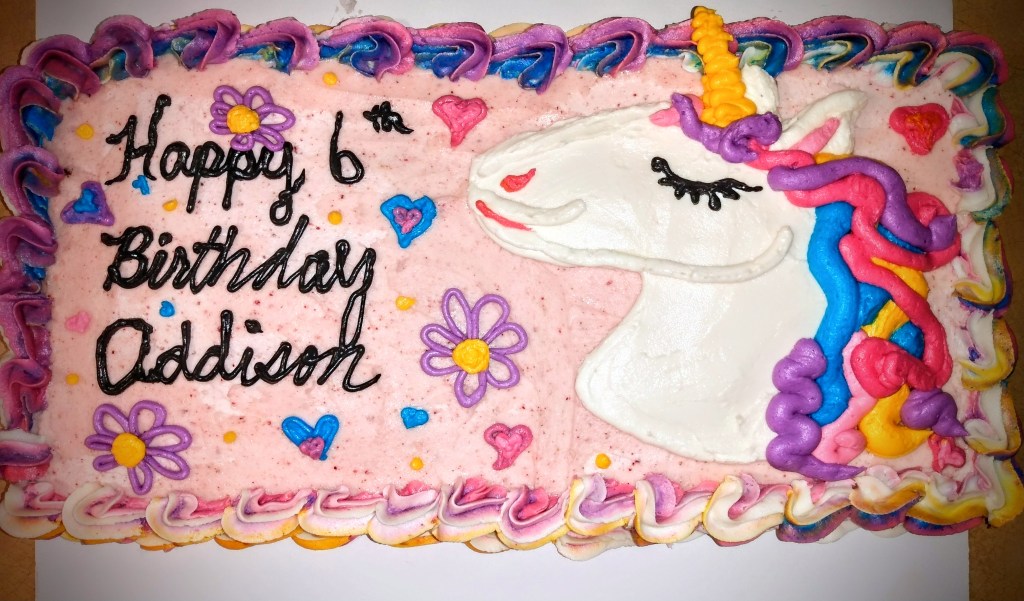
A memorable cake doesn’t have to cost a fortune. In fact, making a cake shows the person that you love them. And it doesn’t have to be perfect.

My favorite cake my husband made was the marshmallow frosting cake. And I guarantee that none of us will make that frosting again. It was not user friendly because it was a pouring frosting instead of a classic spreadable one.

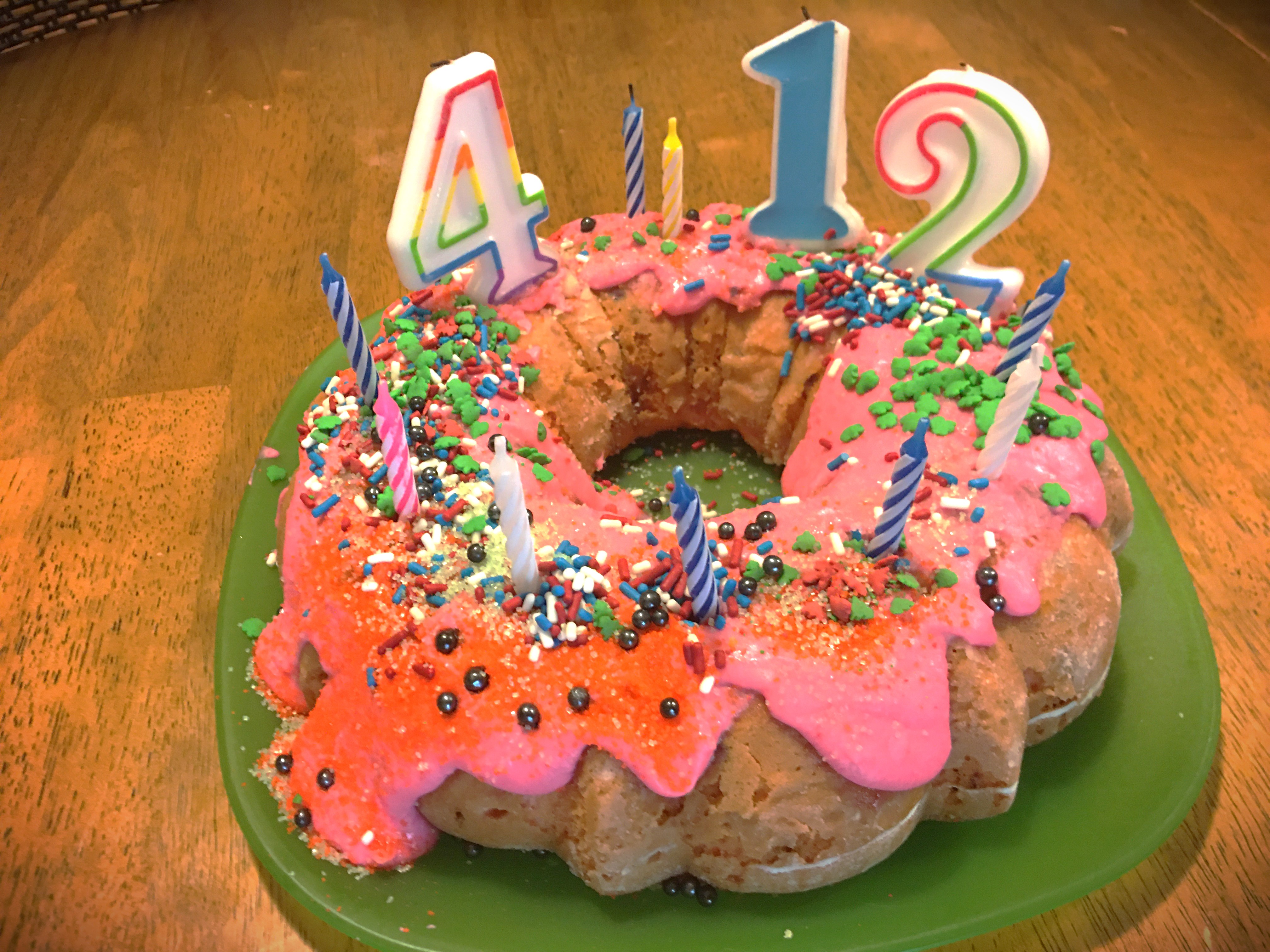
This isn’t the marshmallow frosting cake. But it is the one my boys made on their own, for me.

The most memorable cake I made was my son’s bubble cake. He wanted a bubble cake so I made a tall multi layer cake in the shape of a bottle of bubbles. That sponge would not keep shape. It wanted to disintegrate on me and there was not enough support I could put in to make it stay. Let’s just say I’m glad I made it a fondant cake, because that fondant was the only thing keeping it together. I was in tears. But my son was dancing with happiness over having a bubble cake.

I tell you these stories so that you know that sometimes the best memories come from the imperfections in our cakes. After all, my favorite childhood cake, the Holly Hobby one I mentioned at the beginning, wasn’t all perfection. I look at the pictures from that birthday and only see love. My mom looks at those pictures and sees the cramping in her hands because of all the piping that cake took. She finished that cake with tears of pain. But it meant the world to me.

So don’t be afraid to make that cake for your loved one!

It may turn out to be an imperfect but testament of love that lasts through the ages. Or it may be the cake that blows your mind because you never thought you could do it, but you did! No matter the outcome, it is always worth it to make that cake!
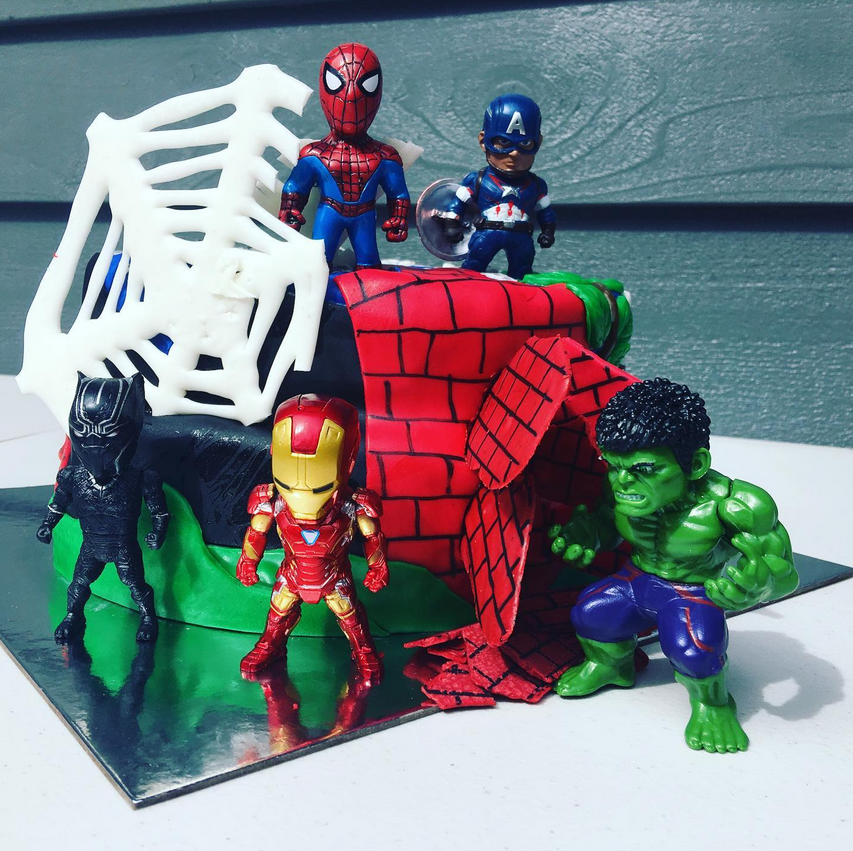
Super hero birthday
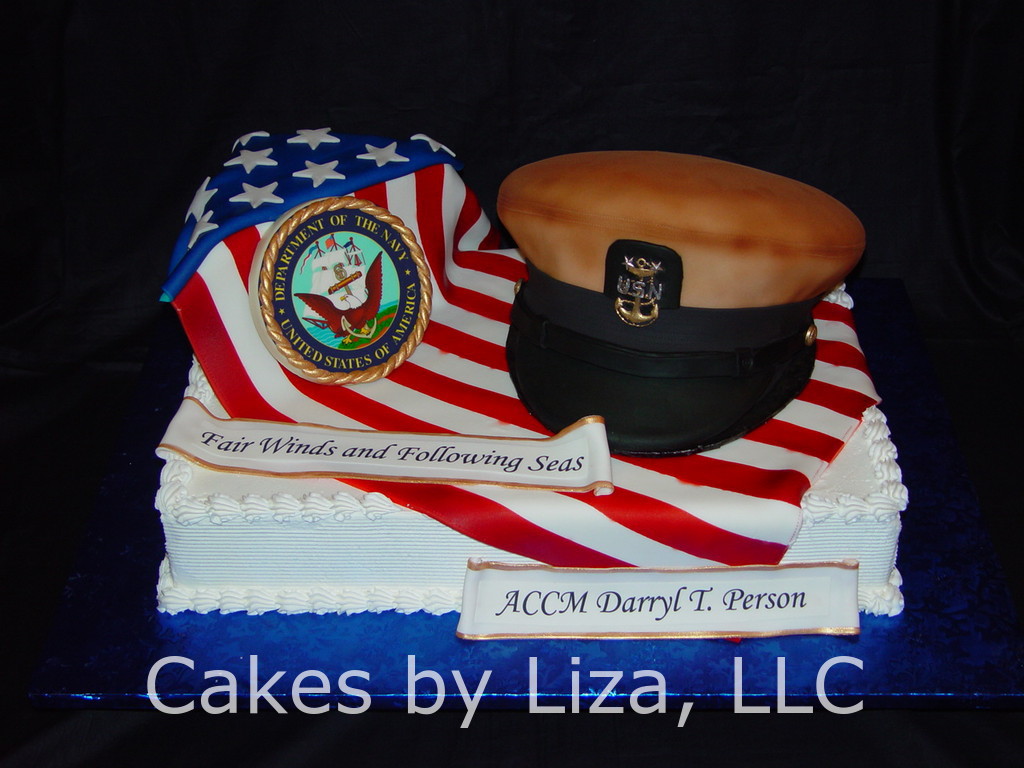
Navy Retirement Cake. Inspiration cake and my cake with the medalion that was placed against the center wave in the flag.
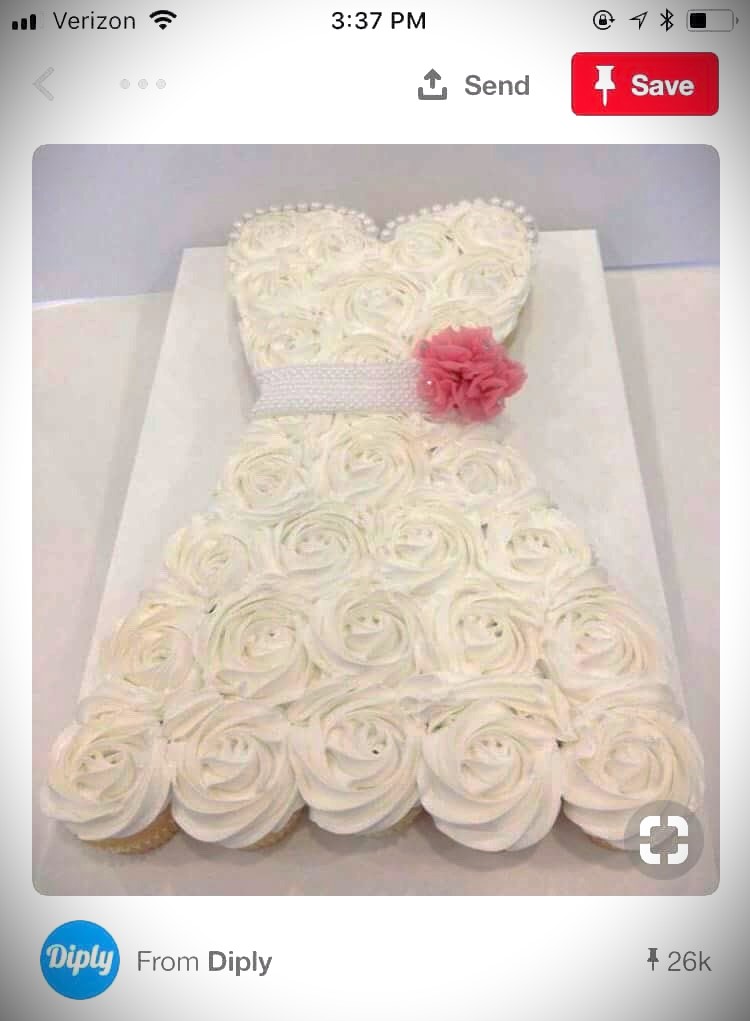
Bridal shower cupcake cake.
Taming Fly Aways!

I know these are common problems for family get-togethers. Either, your family is so large, that when you have a pot luck style meal there is always the problem of not having enough table space. Or your family is enjoying the sun with a BBQ and you spend more time than you can admit chasing down paper plates, napkins, and even silverware.

My family suffers from both of these problems. Every year.

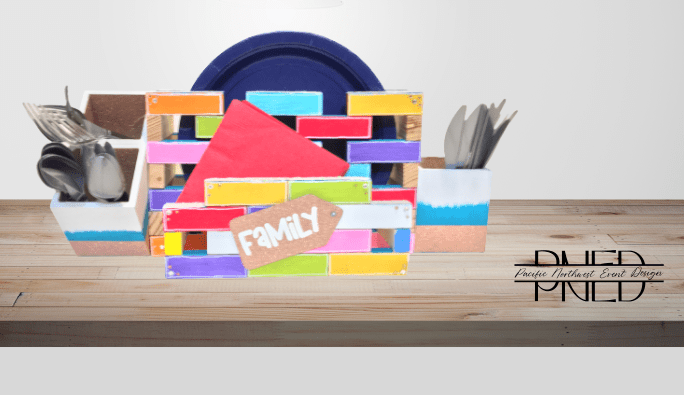
Inspiration hit when I watched this video, tutorial using dollar store Jenga Blocks, from She So CraftDee. This video was so well put together with directions, that I don’t want to recreate what this talented woman did. So I will just direct you to her video if you want to learn how to create structures using Jenga Blocks. Instead, I will proceed with the road blocks I faced while working with this tecnique and how I made this Paper Goods Caddy.

Materials

  • (54) Jenga Blocks (I used 48 of one style of blocks and 6 blocks of another style)
  • Hot Glue Gun and Glue
  • Multi-Purpose Cement 0.5 fl oz (E6200 would be the best choice)
  • Ruler (Optional)
  • Paint
  • 1.25″ Nails
  • Hammer
  • (14) 0.5″ Wood Cubes
  • (3) Square Pen Holders
  • Glitter Paper
  • Metal Gift Tag
  • Vinyl
  • Transfer Tape
  • Elmer’s Glue
  • Glitter
  • Acrylic Paint Pen (optional)
  • Flat Face Rhinestones (optional)
  • Jewelry & Metal Glue (optional)

Project Dimensions

The overall dimensions are 17″ wide by 6.5″ high by 7.5″ deep. The interior of the silverware holder squares are 2.5″. The plate holder is 9.5″ wide by 1.75″ deep. The napkin holder is 7.5″ wide by 1.75″ deep.

This accommodates 9″ paper plates and standard sized napkins. In the picture are 9″ plates and cocktail napkins (6.5″). The dimensions can be adjusted according to your family needs.

Before I jump into how to assemble this caddy, I want to start with the pitfall of gluing options.

She So CraftDee only uses hot glue. I do want to draw attention to the fact that it’s not just any hot glue stick, but wood glue. Full disclosure, I have not yet worked with hot wood glue so I cannot attest to the strength or durability. But for the crafter who does not use hot wood glue or have never heard about it, it is not going to function the same way as the standard glue stick that you have in your craft stash. So please do not expect standard hot glue to work like hot wood glue.

I have decorated in enough wedding and other events that, professionally, I would not put trust in wood glue alone to hold a vase that holds water and everything else that adds weight. An LED pillar light is only going to weigh ounces. However, the weight of a glass vase filled with water, stones, flowers, and anything else of weight is going to add up quickly. There is no telling if and when glue will fail. So I would highly recommend that you reinforce your build in the legs and the base frame so that you can rest assured that you won’t have a catastrophe on your table tops. Wood glue and standard hot glue would all be adequate for any non-weight baring sides.

Advertisements

Because this Paper Goods Caddy is a functional piece, you will definitely need to use something much more substantial, for reinforcement. I used Multi-Purpose Cement (from the dollar store) as my primary gluing option, with the use of standard hot glue to hold the blocks in place while the Cement cured. For a home craft, the Multi-Purpose Cement is a good choice if you just need a little bit of glue. You will use the full 0.5 fl oz tube for this project. However if you are a professional, I would recommend E6200 over all other glue.

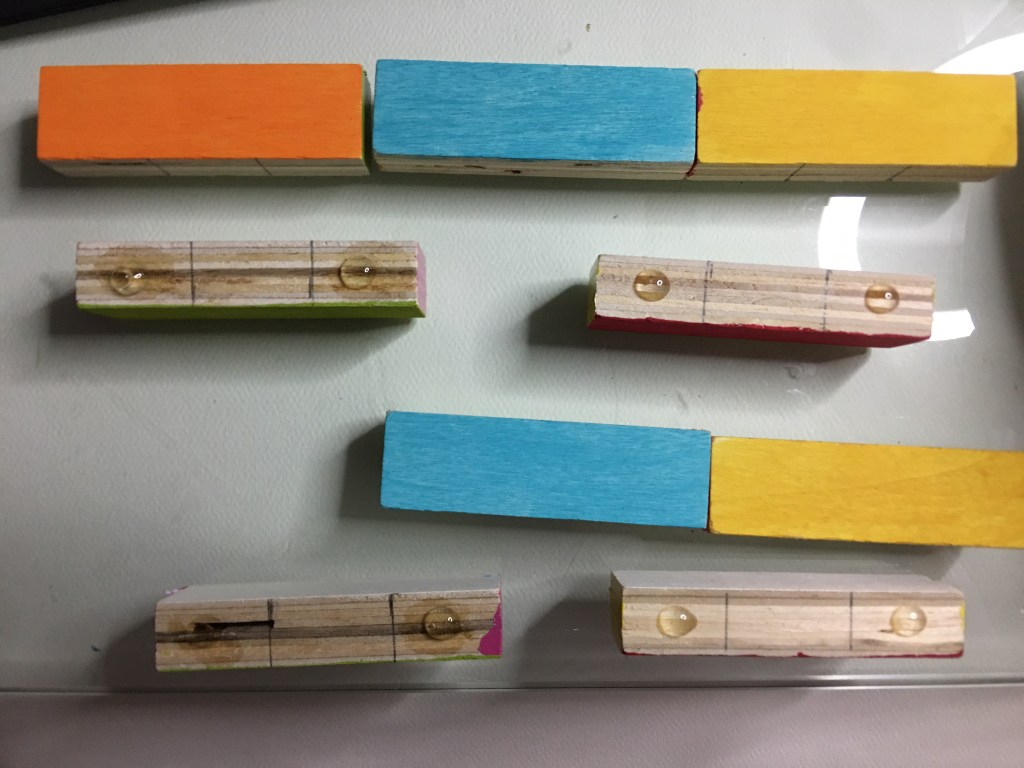
TIP #1: Examine your Jenga Blocks. You want to make sure they are solid wood with no cracks, grooves, or holes. The cheaper Jenga Blocks do not give you the easiest surfaces to work with. I had a couple of blocks that had a gaping hole where the wood was laminated together. The glue went straight down to my work surface. If sanding doesn’t give you a smooth working surface, paint your blocks. The glue actually held much better to the painted surface than the laminated wood surface. Plus, the paint fills the gapes and grooves for you. Just be sure to let your paint dry overnight.

TIP #2: If you are using colored blocks, like I did, set up the pattern that you want your bricks to be in before you start gluing. This will keep your pattern uniform in the front and the back.

Prep the Silverware Holder

Please feel free to decorate the silverware holders in your personal style. However if you want to recreate what you see in the pictures, these are the steps that I took.

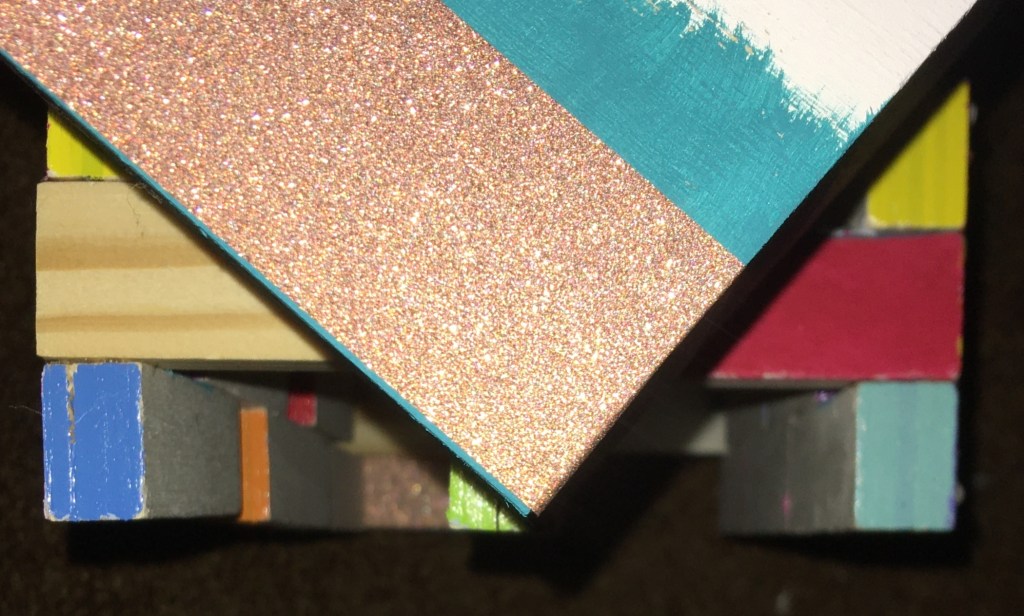
  1. Paint the top 2/3 of the pen holder with white acrylic paint. (Allow to dry.)
  2. Paint the bottom 1/2 with teal acrylic paint. (Allow to dry.)
  3. Cut Glitter Paper (or vinyl of choice) into 2.5″ strips (the number will vary depending on the length of your Glitter Paper or vinyl choice). Also cut 3 additional strips at 1″.
  4. Slide a 2.5″ strip into a box and crease the edge. (This will give you the cleanest edge and prevent you from mismeasuring the inside of the box.) Trim on the crease.
  5. Remove the backing and place on the inside face of the box.
  6. Repeat 4-5 for the remaining 11 inside faces of the three boxes.
  7. Take a 1″ strip of Glitter Paper and apply it to the bottom outside edge of the pen holder box.
  8. Tack the edge of the Glitter Paper closed with a dot of glue.
  9. Repeat steps 7-8 for the other two pen holder boxes.
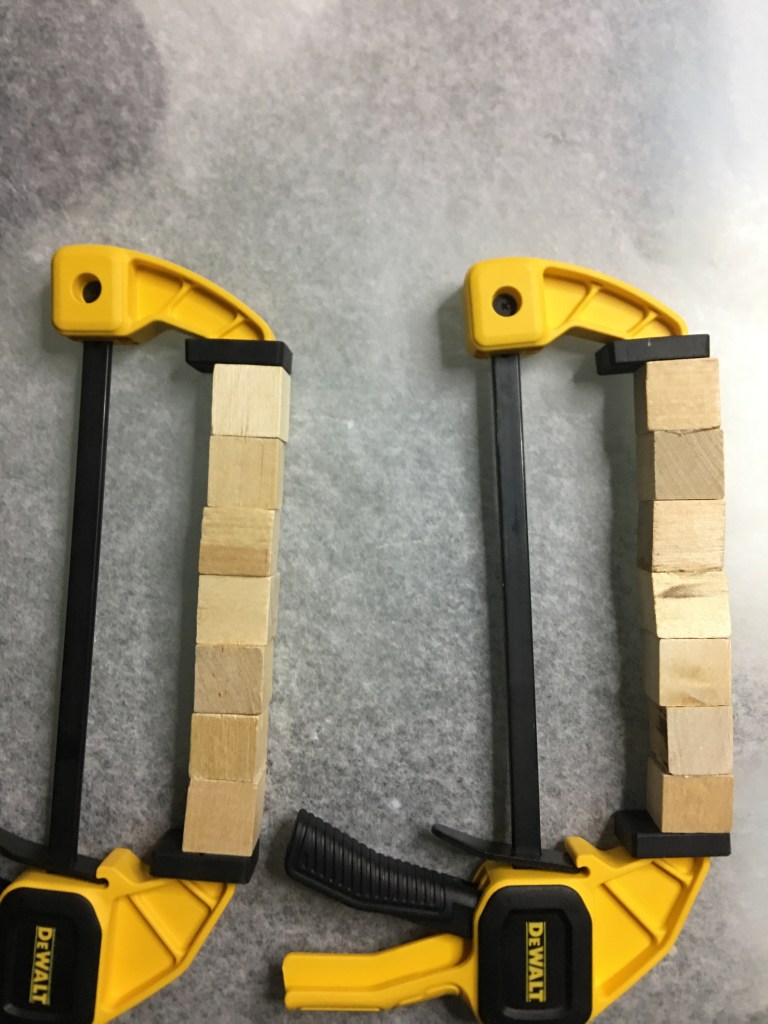
  10. Glue two of your boxes together, Glitter Paper seam sides together. Use a very liberal amount of Multi-Purpose Cement in the center, with a rectangular frame of Hot Glue. NOTE: Hot Glue does leave a gap between items glued together. So if you want zero gap please use Cement only. You will need to clamp together the boxes until the glue dries (an estimate of 1-2 hours).
  11. Set Aside for Assembly.
Advertisements

Prep Gift Tag

  1. Take a left over piece of 2.5″ strip of Glitter Paper. If it is large enough, wrap it around from top front, down, over the bottom edge, and up the back side. If it is not large enough, take two pieces that fully cover the front and back and cover each side.
  2. Trim the edges of the Glitter Paper that run over the edge of the metal gift tag.
  3. Create the hole, matching the metal gift tag, by piercing the Glitter Paper covering the hold.
  4. Using your cutting machine, cut “Family” (or any other phrase of choice). The Font I used was Chunky Confetti.
  5. After you weed your vinyl, apply “Family” with transfer tape onto your gift tag.

Prep the Paper Goods’ Feet (Optional)

My oldest son informed me that we needed to add a bottom so that the napkins and the plates could stay in the holder. He was concerned about his grandma having to put in and take out her paper goods. So I designed this so that the Caddy is not just a holder, but it’s a moveable container that can keep the goods in and be easy storage.

  1. Take 7 of the 1″ cubes and glue them end to end. This is one foot.
  2. Repeat with the other 7 cubes to make a second foot.

NOTE: you can use Hot Glue for this prep because the feet will not hold a lot of weight. I chose to the Multi-Purpose Cement because I have clamps, and I want to ensure that in the heat of the summer sun, the hot glue will not soften and become weak.

Advertisements

Paper Goods Caddy Assembly

From my stash of Jenga Blocks, I wanted to use ones with colored ends, but didn’t have enough. So this is the reason why I used 48 blocks of one style and 6 blocks of another style (which were used on the sides of the plate holder). The two different styles of blocks had different heights, which lends to the floating brick illusion. The floating bricks could be more prominent by using an even smaller set of Jenga Blocks, still using the 2 row build.

  1. Mark off your Jenga Blocks. My blocks were about 3″ wide so I drew two lines at inch increments so that I could work fast and glue all the bricks together uniformly.
  2. Glue together your two row sections, 3 bricks on top of two. In the inch section I put a large circle of Cement with two dabs of Hot Glue on either side. Once Hot Glue dries, you are free to move on to the next piece to glue.
  3. You will have 6 sets of two rows.
  4. Glue together your napkin face plate, starting with the rows. Make 2 sets of 3 blocks, glued together end to end. And make 2 sets of 2 blocks, glued end to end.
  5. Start with the base and work your way up. One top of one of the 3 blocks, center a 2 block set and also glue on the arms that will attach to the plate holder. On top of the two arms and the set of two, glue on the other set of 3. On top of that glue on the last section of 2.
  6. Set the base for your plate section, by making 2 corners. If you are using two different sized blocks for a floating brick look, your larger blocks will be used here on the sides (they are the unpainted bricks in my photos). Glue your side piece on top of your front and back corner piece. Do this for the other side. NOTE: your center bottom piece is not going to be attached to anything for a few steps, so set those off to the side for the moment.
  7. Space out your corners by setting a two row section on top, do not glue.
  8. With your corners set, remove the two row section without moving the base corners, place your napkin face plate. Once you have the napkin face plate center, you know where to add the Cement and a single dab of Hot Glue.
  9. This amount of glue is not enough to keep the napkin face plate in place, so you will need to hammer one nail into each arm of the face place, into the base corner, so that it will offer the stability to the napkin face plate.
  10. Glue the two row section, which you used to space the corner sections, onto the middle arms on the side of the plate section. Use a dab of Cement and Hot Glue.
  11. Repeat this last step with a two row section for the back of the plate section.
  12. Glue a side arm, on top of the two row sections, on each side.
  13. Repeat steps 10-12 to form the middle of the plate section.
  14. Repeat steps 10-11 to form the top of the plate section.
  15. Turn the Caddy upside down and glue in the middle sections that were set off to the side, back in step 6.
  16. To reinforce the face plate a second time, you will use 4 nails to nail both sides of the left and right Jenga Blocks above it.
  17. Where you would like to add glitter, paint on your glue and apply glitter.
  18. (Optional) Use your acrylic pen and draw on a frame around the front edge of each of your blocks, front and back.
  19. (Optional) To add gems, place a dot of Jewelry & Metal Glue where you would like to add your Rhinestones. You can glam this up as much as you want, including using only Rhinestones instead of glitter (step 17).
  20. Hot Glue your “Family” Gift Tag to the Napkin Faceplate.
  21. Glue the single silverware box, upright on the right hand side. Apply the Multi-Purpose Cement Glue and Hot Glue onto the Jenga Blocks (to the height of the silverware box). Attach the silverware box.
  22. Tip the Cady on its side so you can position the Double Silverware Box. As you look at the side of the Cady, note that the middle row is the front of the Plate Holder. Use the Jenga block to create a 45° angle. The front bottom of the Silverware Box is lined up with the bottom edge of that middle Jenga Block. The top back edge of the box will be in alignment with the front of that back row of the Plate holder.
  23. Remove the double box and apply the Multi-Purpose Glue and Hot Glue to the side of the Cady where the Double Box will sit.
  24. Attach the Double Box to the Caddy.
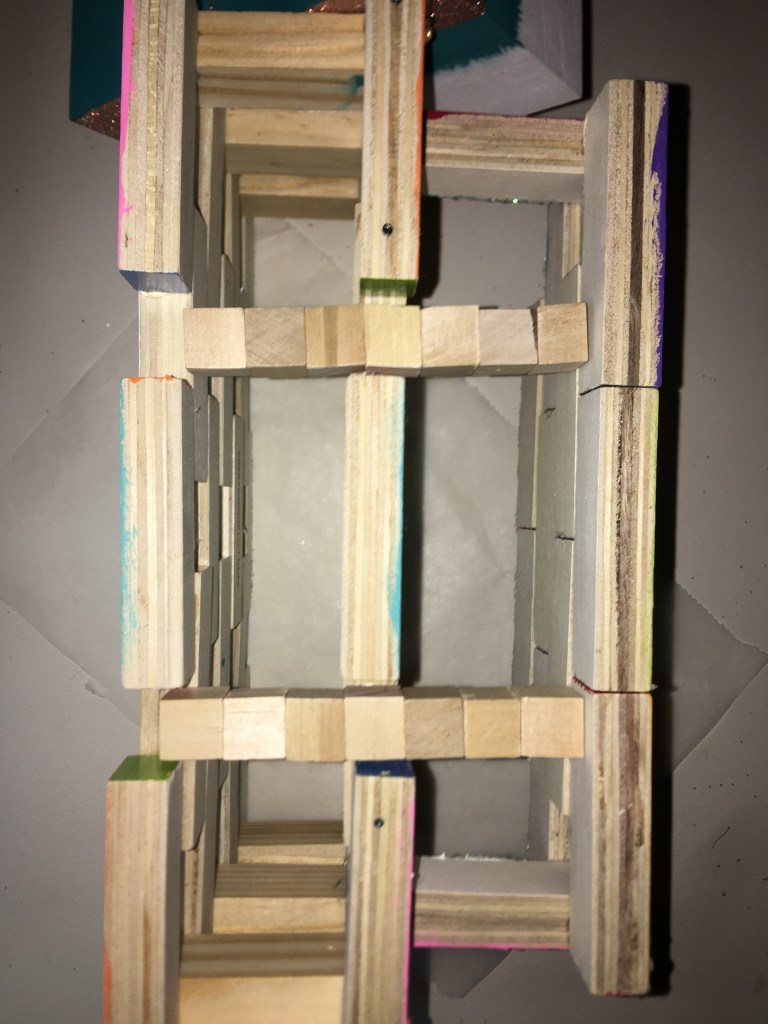
  25. Turn the bottom of the Caddy upside down and apply Multi-Purpose Glue and small dabs of Hot Glue to the two recessed sections of the middle row.
  26. Attached the two feet, centered on that middle 4th square, into those recessed sections.

Congratulations! You have completed a space saving Paper Goods’ Caddy.

Please leave a comment how this caddy turned out for you.

If you’ve seen a project that you want more information on how to make, please let me know so I can set you up for success!

Empty Tomb is now live. 100% of preceeds will go to the support of orphans in Rwanda.

Processing…
Success! You're on the list.
Advertisements