After spending almost a decade in the event decorating industry I have repetatively heard "I can do that". Instead of being dismissed by creative minded people, I want to show you how I do "that" so you can be sucessful in recreating that inspiration image. I just might have a few tricks that you haven't seen yet!
I know this isn’t talked about in early spring, because the focus is putting seeds in the focus is on planning and putting into ground right now. BUT….
Here’s my garden right now. Even before the seeds go in the ground, I still have seeds that are preparing to be ready to harvest.
Talking with others who are expanding their seed saving skills, they haven’t yet experienced saving seeds from the Brassica family (cabbage, kale, cauliflower, broccoli and others). One reason for this is most likely because we grew up being told to clear out garden beds at the end of the year. But for gathering these seeds, you need to leave the plant in the ground after you’ve harvested.
In previous years, I harvested cabbage in the spring after the pods have formed and dried. But when I let this bed go fallow, I left the cabbage in for a second year. Mainly it was to see what the life cycle of cabbage looks like after I’ve long pulled mine.
Advertisements
In the second year with cabbage, any additional heads that grow are much smaller than the original year (for growing purposely, definitely not the best use of garden space). What I hadn’t counted on was a second gathering of seeds.
Why might you consider these seeds?
The general rule of thumb is that you save the seeds from successful plants–the biggest and best. But as I said, this second year cabbage didn’t really produce heads of quality in the second year.
Seeds are the memory of the plant.
The seeds of this second year cabbage not only contain the memory of the first year head growth AND it remembers the bad growing season this past year (unseasonably cold and wet that made me question if I’d grow anything).
Originally I wasn’t going to save these second year seeds because the potential passing on of tiny cabbage heads is not what I’m looking for. However the seeds do contain the memory of surviving through an uncharacteristic cold year.
So after going back and forth on what I’m going to do, I’ve decided to keep these seeds. I’m going to perform a comparison of first and second year seeds to see what the difference in performance will be.
This will be a future post since the seeds are not ready to do the comparison this year.
Advertisements
What is the life cycle of Brassica and their seeds?
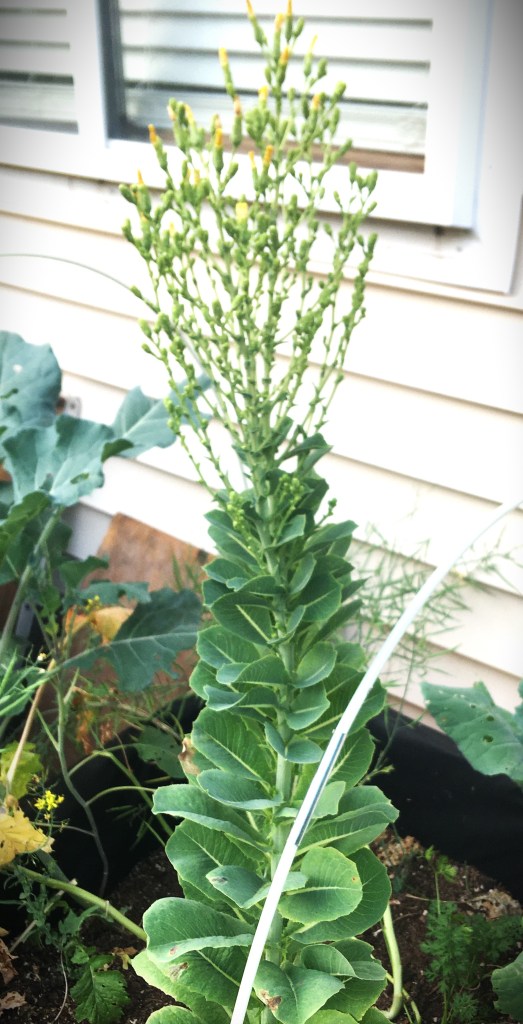
Whether you’ve allowed your Brassica family plants go to seed or they just bolted on you when the heat of summer came, you may have seen something like this:
This was one of my rapini that bolted on me. The first thing that you see is the bolt.
Next, the flowers (which form the seed pods) grow for pollination. While there are still flowers you will see some of the seed pods developing.
Out of all the plants that I’ve collected seeds from, I think the Brassica family is the one that I’m most impatient with. I don’t know if it’s just my grow zone or everyone starts tapping their toe asking their plant, “Are you done yet?”
These pods remind me so much of beans. And I honestly expected them to bulge out more than you see above. But this is what the end of the seed maturing stage looks like, immature beans. Even though these pods are fully grown, they still aren’t done yet. They will turn beige.
Everyone I’ve heard always described them to turn brown. I translated that to mean that they would darken. But the first time that I saved these seeds, they started bursting open when they were beige in color. So once you start seeing the green fade from these pods, you know it’s almost time to pull the plant and collect the seeds.
What you are waiting for is the pod to turn papery dry. If you go out each day to check on your seed pods, you will get the feel for it when you see the first one pop open. The pod will look very much like this threaded hook:
Do you see how the center of this hook has a frame and then there is negative space?
Theseed pods of Brassica have the exact same structure. There is this frame like structure with negative space in the middle.
When the pod bursts, it’s the dry skin that cracks open and falls away. The seeds live in this center portion of the frame. So when the pods open, the seeds fall out and the frame remains on the Brassica stem.
The goal is to catch your Brassica with fully mature branches, dry beige skin, before they release their seeds. Once you accomplish this, you cut the branches off or uproot the whole plant.
If you can’t open a pod by rubbing it between your fingers, you will want to hang your branches/plant upside down in a cool dry place. This can take a week or two. But the pods will crumble.
Advertisements
Removing the Seeds from the Pod
Once the seeds opened in my hand, I chose to put the branches into a pillow case and tie off the open end. Then I gave the pillow case to my kiddos and told them to hit the pillow case against the deck!
This was perfect timing for this project because my kiddos were at each other and I couldn’t keep them from hitting each other. So I gave them an alternate action of being aggressive. After each one had a turn, the pods had all broken open and the seeds were all released inside the pillow case.
To separate out the seed from the chaff (stems and pods), I just used the traditional method of winnowing. I modified this by using a little modern convenience of a box fan on high speed. Because the chaff was so thoroughly dried out, they blew away with ease. And even though the seeds are small, they really do drop back down into the pillow case that I kept at the porch in front of my box fan.
Advertisements
If you want to see how this type of winnowing process is done, there are countless videos on YouTube. There are some that do this winnowing with Brassica seeds, but the majority is in relation to wheat and other grains. The process is the same. So whether you watch how grains or Brassica are winnowed, you will understand this process. There’s no need to invest in a winnowing box or other tool unless that is the path you want to go down. All you need is your seeds on a cloth and a wind source (whether natural or manufactured).
There’s no further step that you need to take in processing your seeds. Just store
Even though now is the time to plan and plant in your garden beds, I wanted to talk about saving Brassica seeds now. Where you plant your Brassica now for a spring crop, it will stay there for the rest of the growing season. And in some locations, it will need to overwinter to give your plant enough time to make its seeds and mature them.
This is a slow process. But it so worth it when you can grow hundreds upon hundreds of seeds in a single season and not be dependent on what’s available in future market sales.
What are your tips for saving Brassica seeds?
What other seeds do you save from your garden?
Processing…
Success! You're on the list.
Whoops! There was an error and we couldn't process your subscription. Please reload the page and try again.
Now that a new planting season is about to knock on our door, I’m beginning to hear more and more from those venturing into gardening the discouragement of last year’s grow season in the Pacific Northwest.
I’ve mentioned before that last year, we didn’t have a spring. We had back to back winter that went off the deep end and nose dived right into summer. We were cold and wet and literally missed a season. My garden didn’t know what to do. Even when I direct sowed at the proper time everything stalled for 2 months and it felt like I was the only person in my community that was grateful for the 6-8 weeks of extended summer weather. I needed it to finish off some of my vegetables, like my tomatoes.
And throughout the area of 4 or so cities, a good number of people said their vegetables gardens failed to produce anything.
I get it. The vegetables that I planted in May were harvested at the same time as what I planted in July.
This year I’ve already started in on my plan of getting ready for this spring. And I’m treating it like I’m going to have another cold, non-existent spring. Everything I overwintered is indication we’re not going to have a repeat this year, but I’m not taking chances. Food prices are insane. I need to offset my grocery bill by growing more than I have in the past. So I’m going to share with you what I’m doing this year to give my garden a leg up on what may or may not happen.
The Big Leaf Parsley and Oregano that I planted last year, which did not germinate at all last year, all of a sudden decided this winter that they were going to germinate and sprout. I’m looking forward to a lovely spring this year.
Advertisements
Uneven Germination Rates
If you have a small garden that you work, one of the frustrations that you have is when you plant your seeds according to the proper measurements and seeds just don’t germinate. You start off thinking that you’re going to get a certain amount of starts of one vegetable, and in the end you find out you get a small fraction of that.
I’ve tasted that bitterness. In a normal year you can successive plant a new seed where there’s gap. But last year that didn’t work at all.
So this year I’ve started off my seeds indoors in small flats.
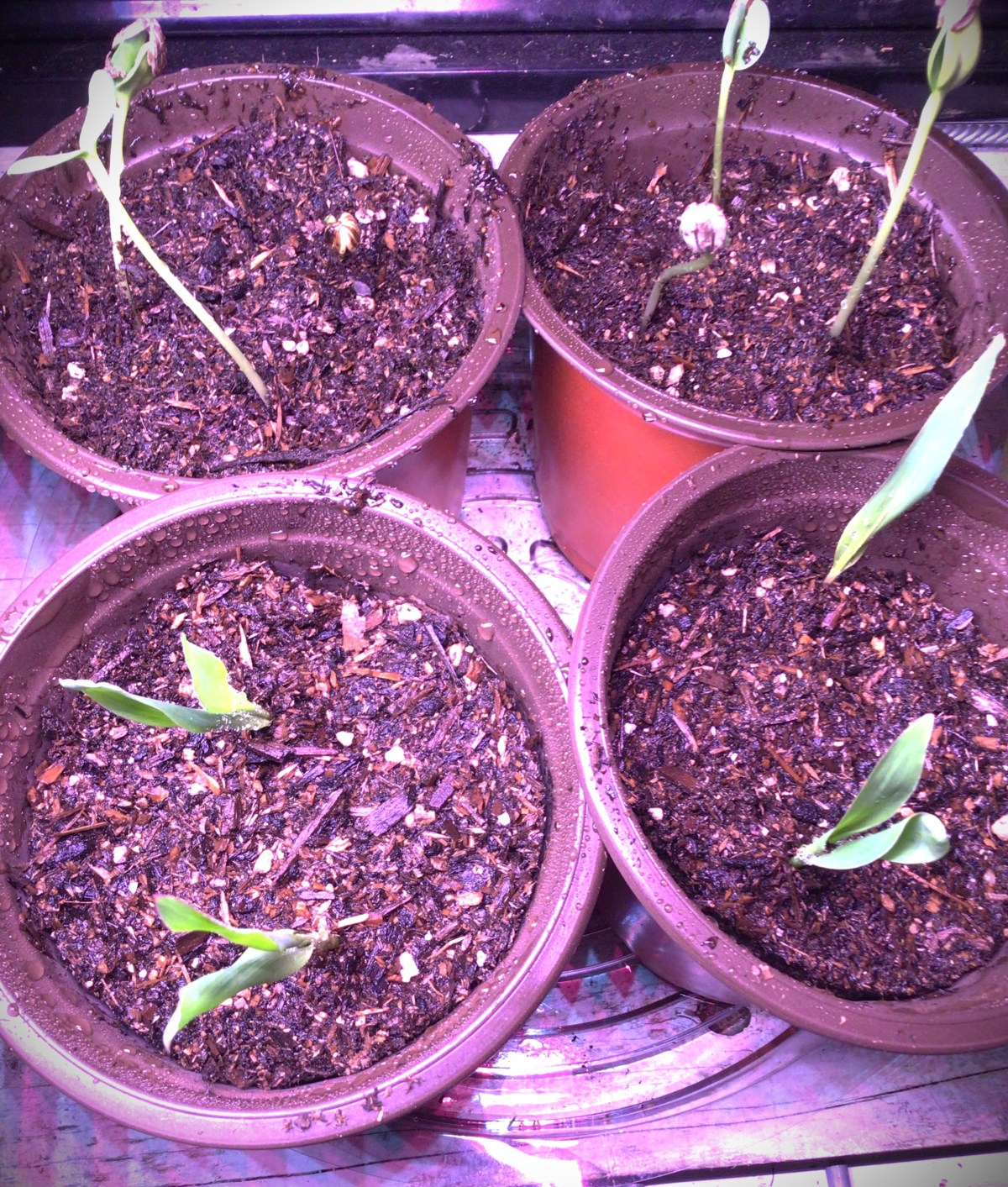
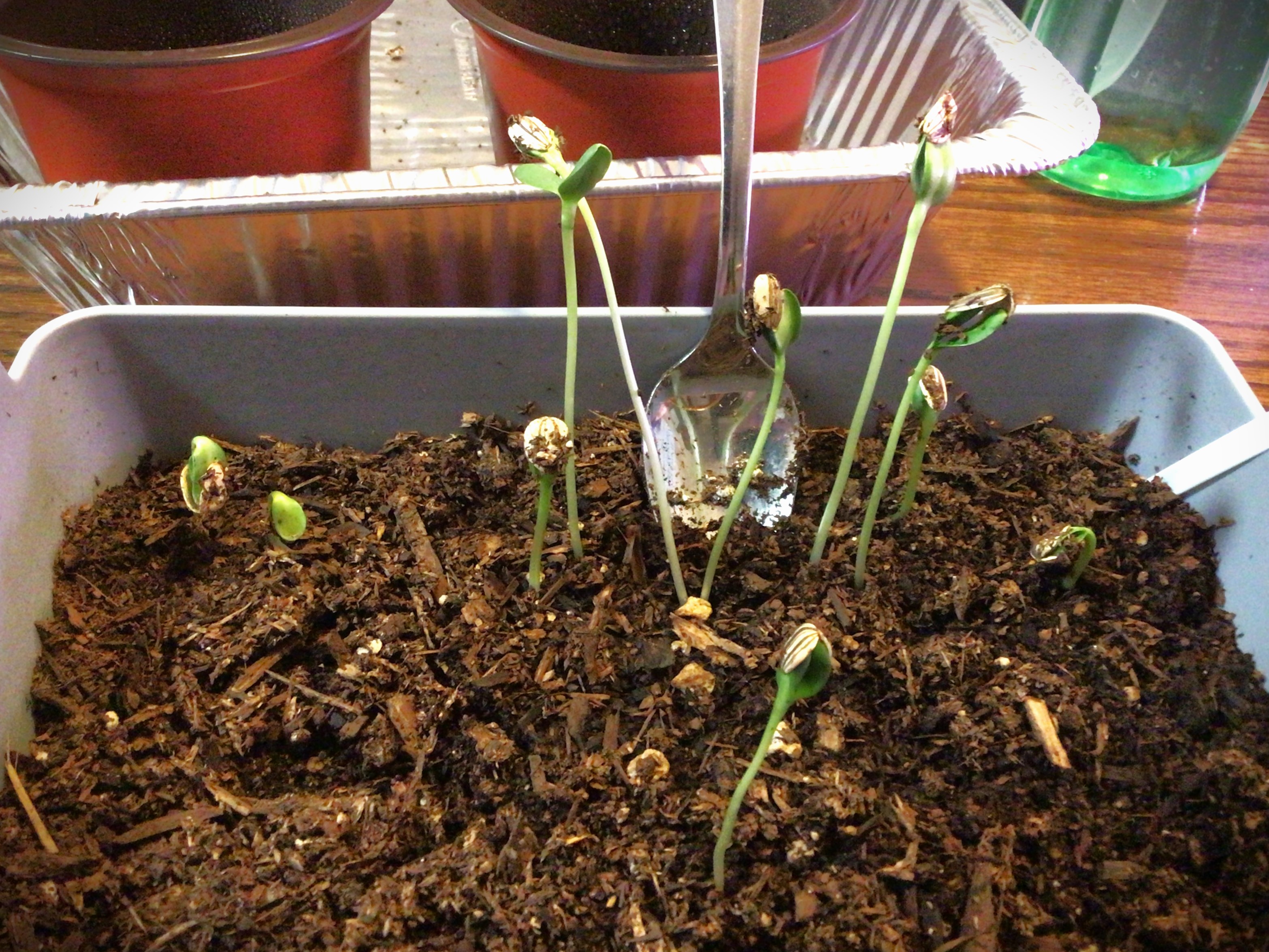
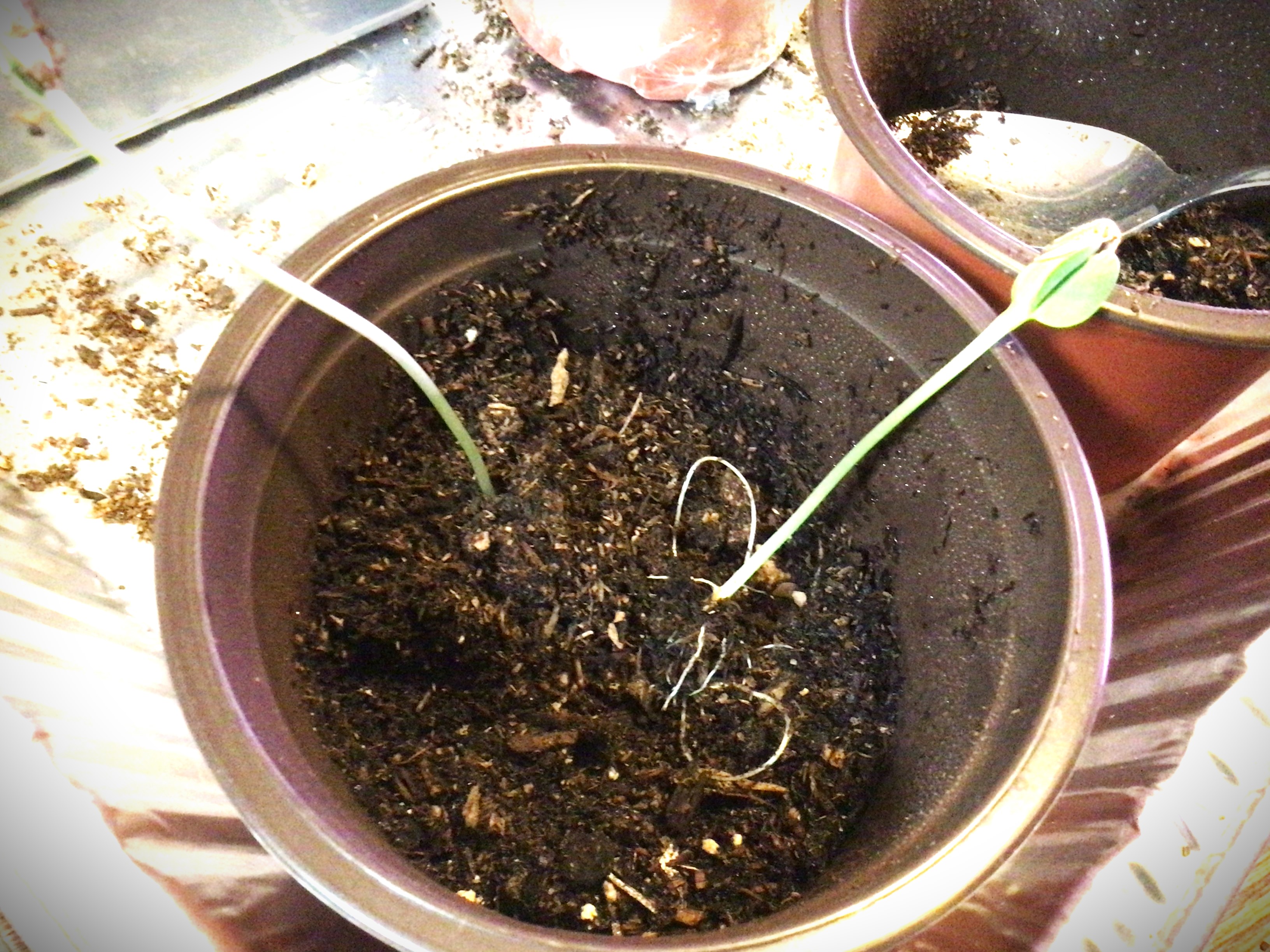
I’ve already repotted four other bunches of these sunflowers. You can see here that the seeds just didn’t want to sprout at the same time. I’m okay with that. I’m starting my seeds this way, because if none want to sprout, I won’t waste my limited garden space.
With how shallow this flat is, once these sunflowers get to a certain height, it’s time to repot them. They want to spread their roots and grow. And as much as they love this loose soil, it’s time to get these tall fellas into a pot where I can thin them out and give them more space.
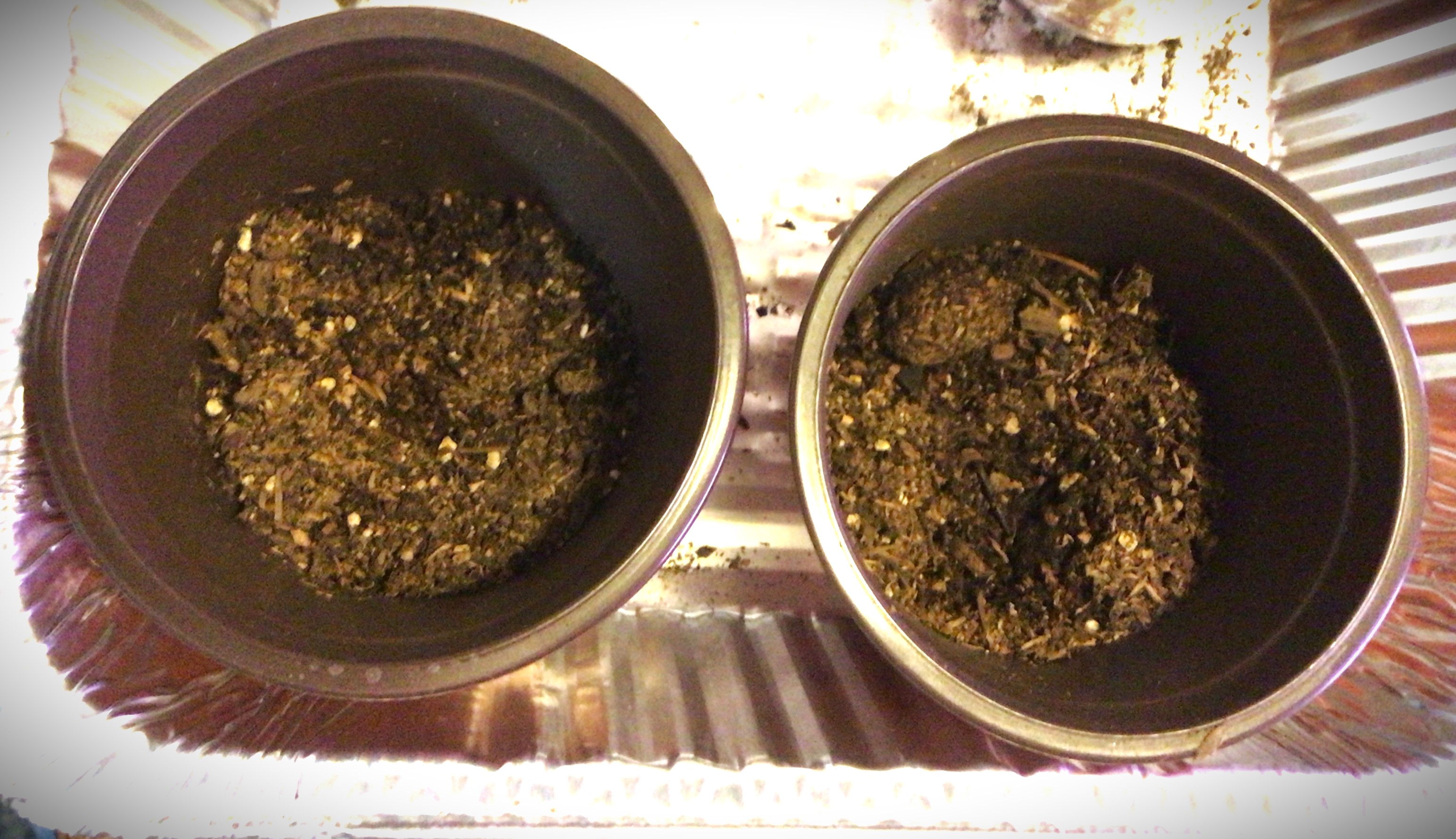
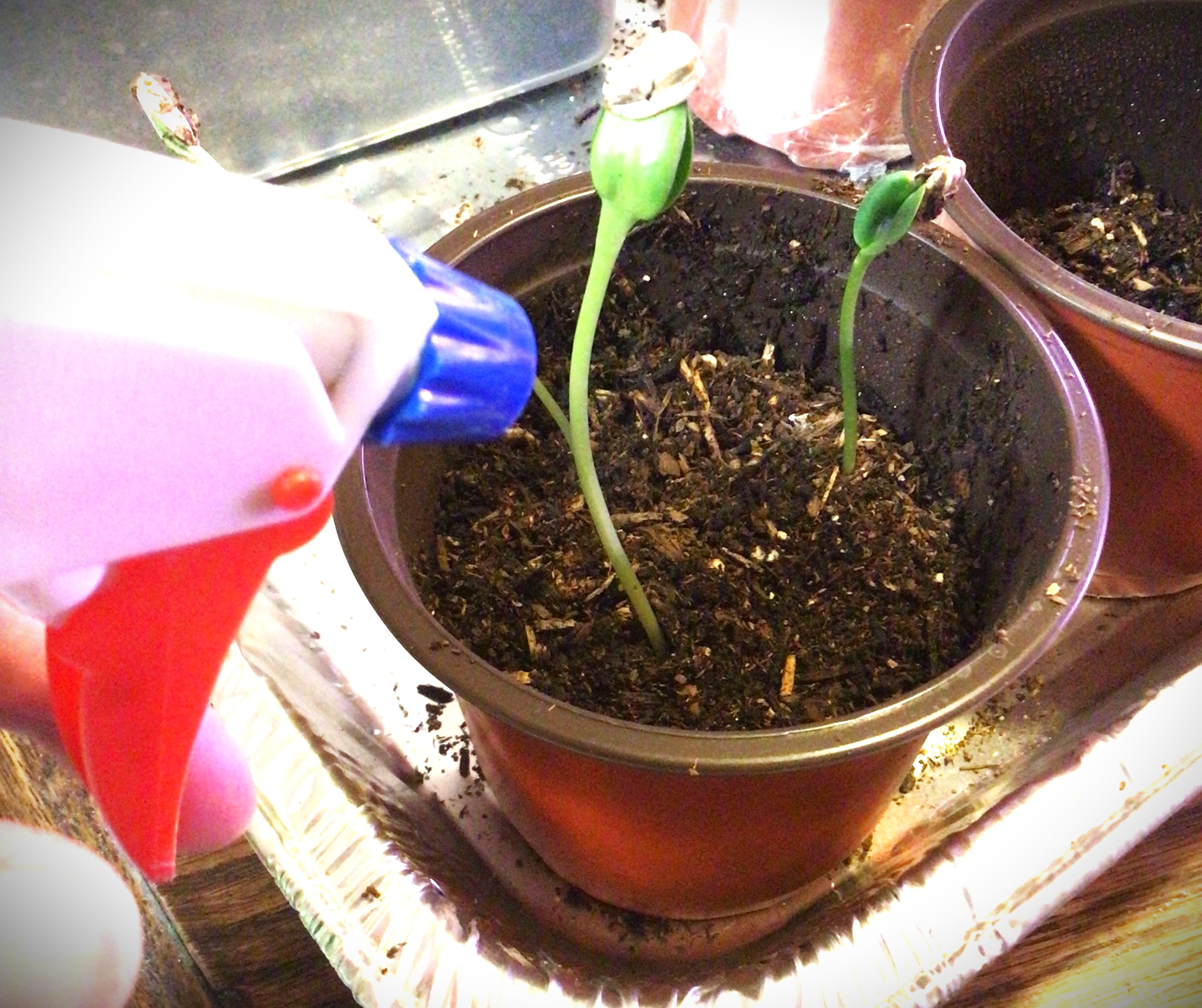
With my pots a third full I sprits the soil with some water so that it has a little moisture to start the seedling off. Next I go to my flat, with a spoon, and insert it off on the flat’s wall and gently lift up on the roots. With the roots free, I set the seedling on top and put soil around it so that it can stand on its own again. I’m putting 3 of these seedlings into this 6 inch pot.
Yes, this is not at the final spacing on the seed package. But if you’ve purchased plant starts, the majority of the time all the seedlings are crammed packed. You’ve also learned how to massage the roots apart. And you’ve also learned that you end up snapping roots. The plants do live and do grow.
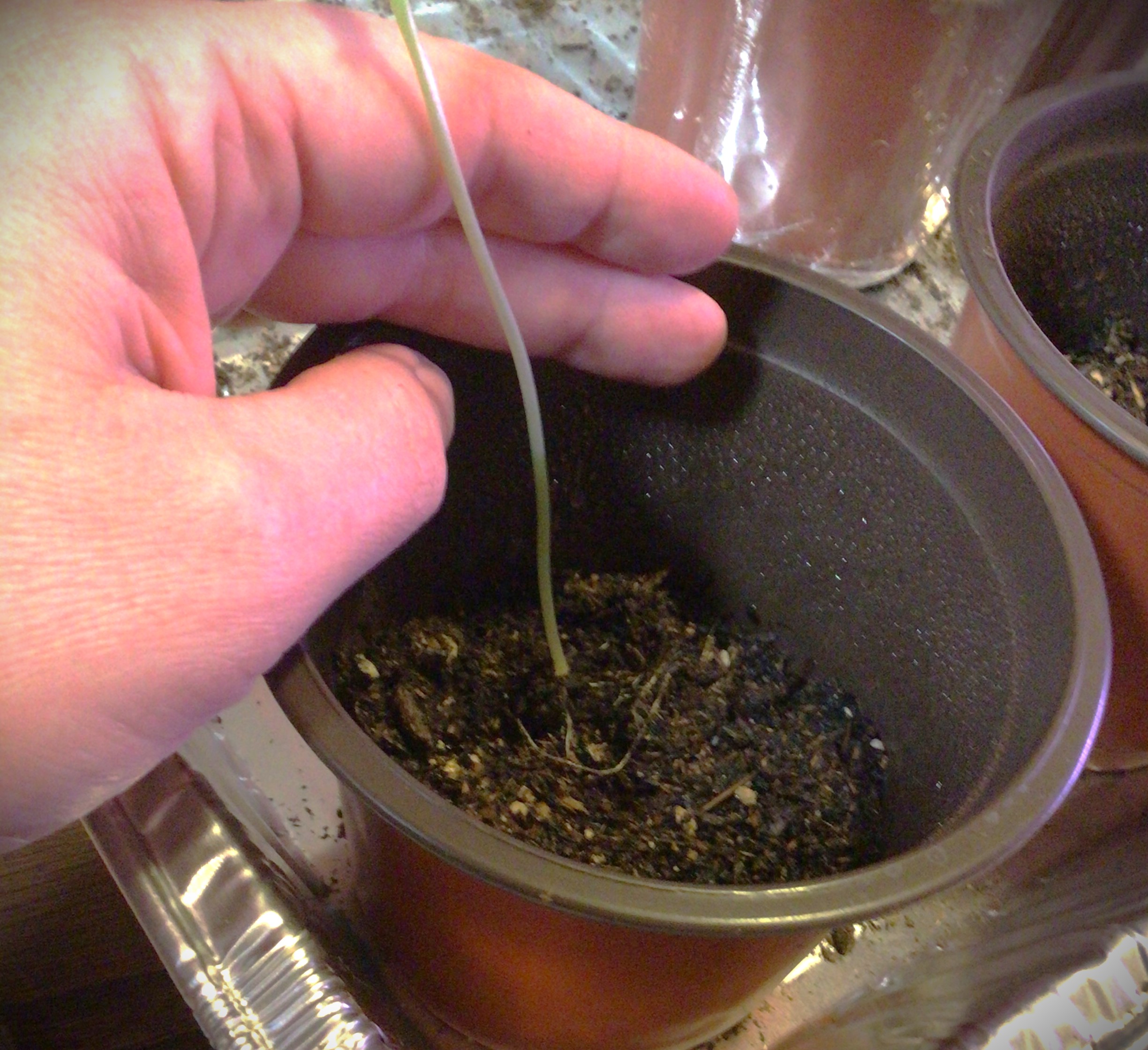
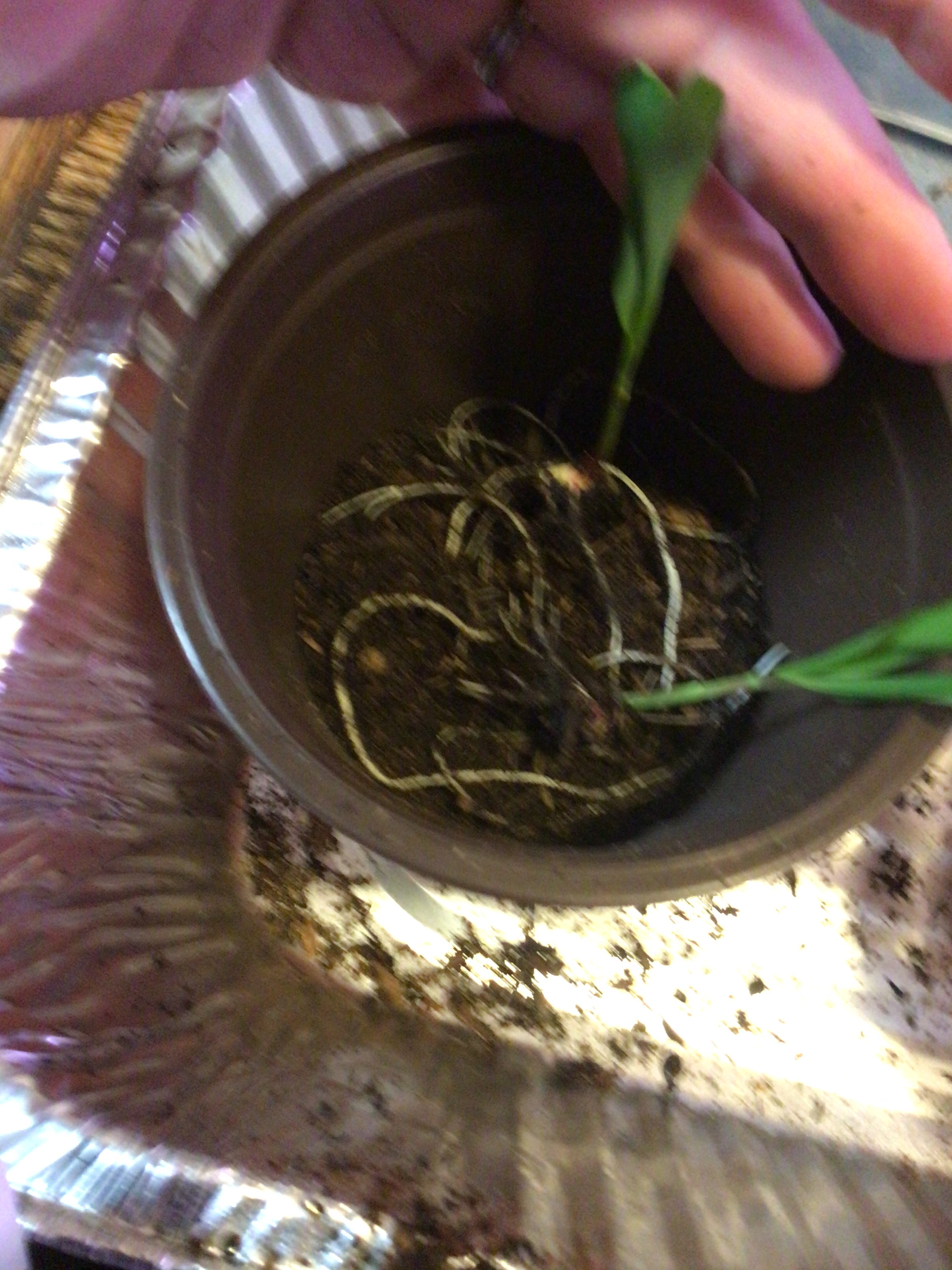
To minimize this breakage, if the primary root is long (you’ll see this shortly really well with some corn that I repotted), then I loop it on top of the soil as I get it settled into this new pot. The roots will still grow out and spread to fill this pot, but with the central heart of the roots a little more compartmentalized it should keep the greater heart portions of the roots of each of the plants more separate and easier to knead apart when it’s time to put them in the ground.
With each layer of soil I put down, I give it a spray of water.
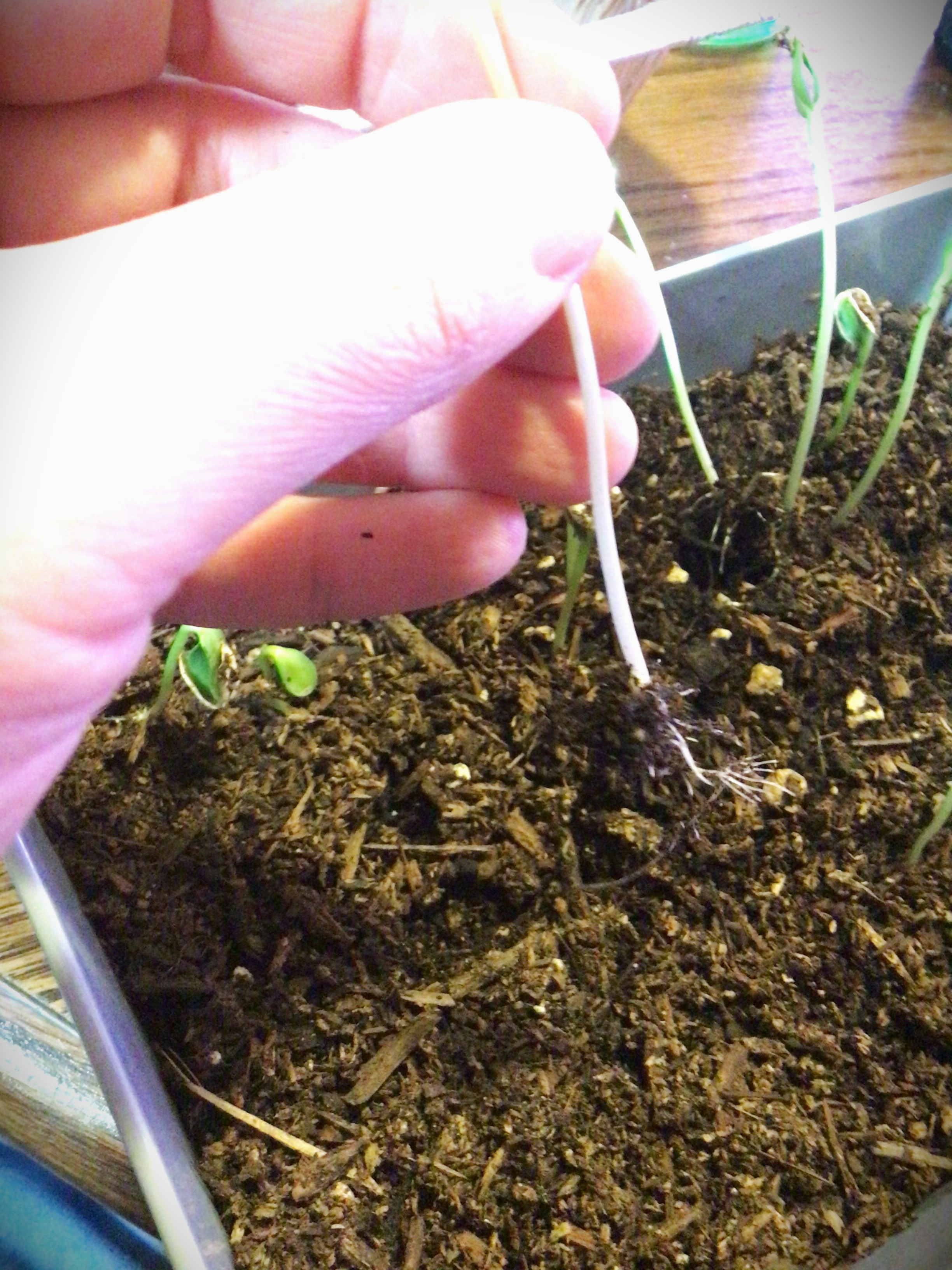
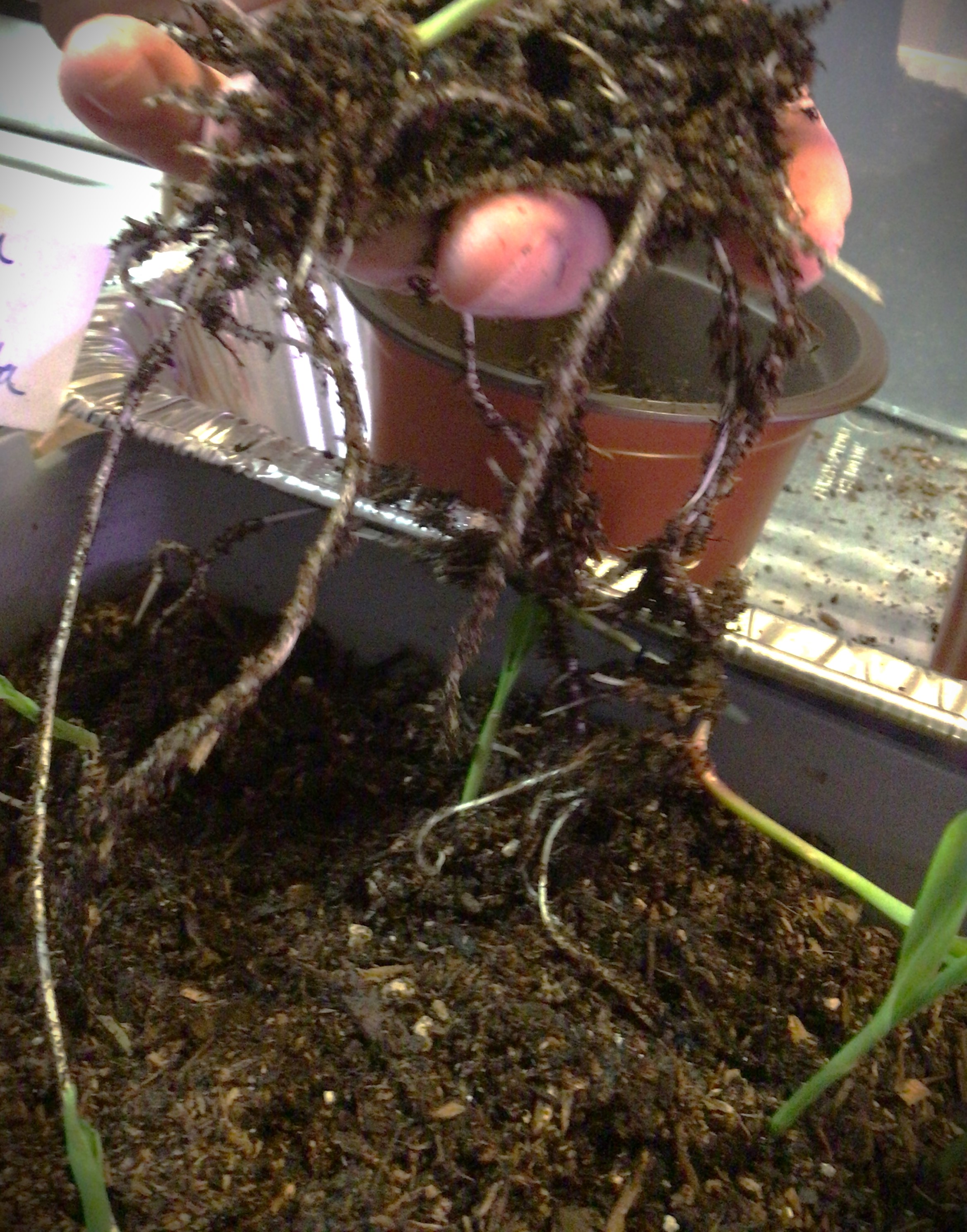
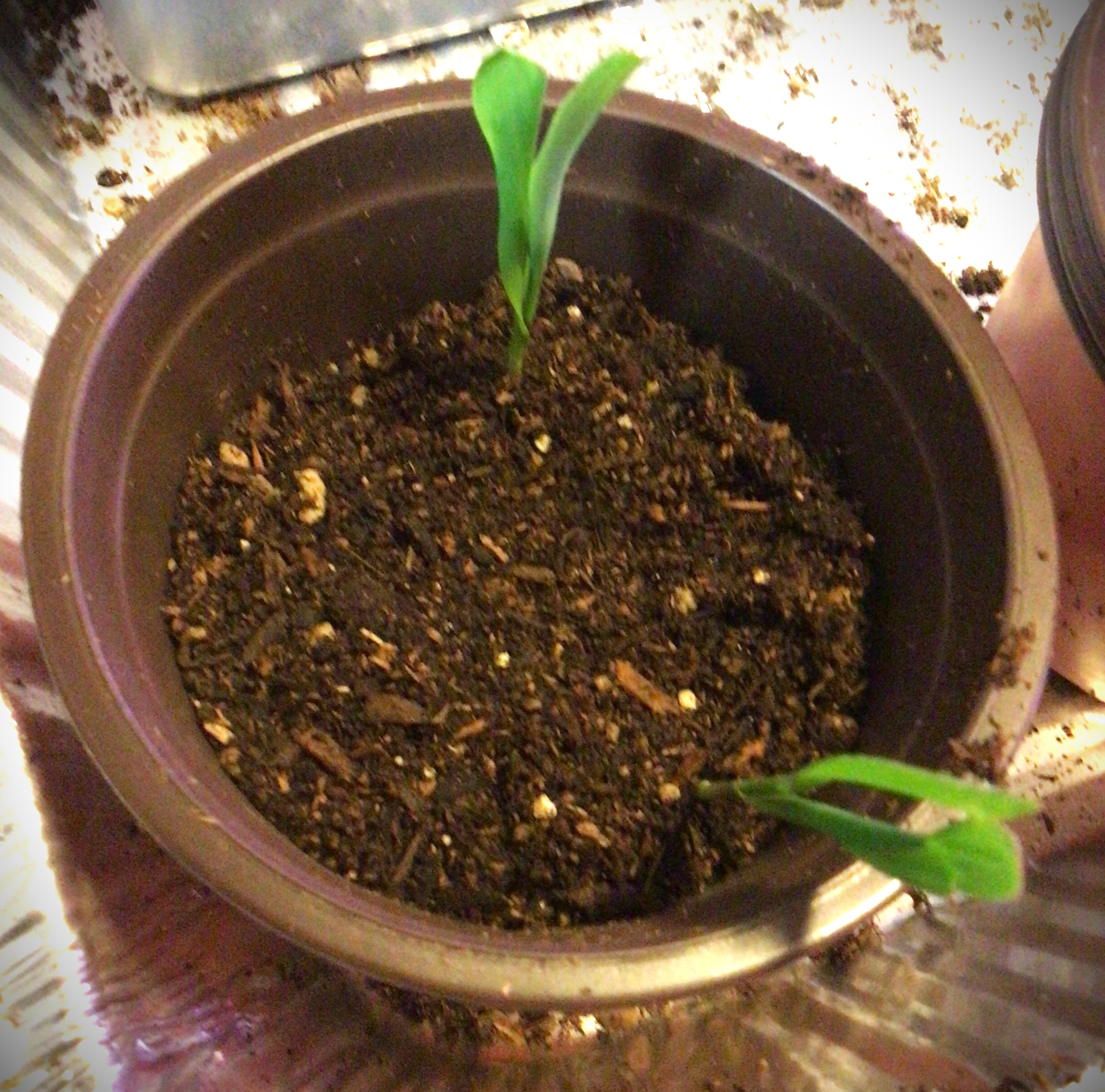
The corn on the other hand, I’m finding that their root system has vastly out performed in growth in comparison to the sunflowers.
Ok, I have to pause here and say that I was blown away with this root system growth, because I’ve uprooted my corn at the end of the seasons that I’ve grown it, and my direct sow root systems were maybe a handful at the end of a season.
So here I have three seedlings in my hand and their main roots were already trying to wrap around the smaller ones that I didn’t want to bring out yet. These ones needed massaging already to separate. Originally I was going to put three seedlings in the pot, just like the sunflowers. But I still have frost going strong and I need more time in the pots. So I’m only putting two seedlings in the pot so that I can maximize root growth now.
Even with the fact that these roots are already large, they’re definitely going to fill the pot before it’s time to plant. So a weekly diluted spray of fertilizer is going to be necessary to keep these starts healthy and not eat through all the nutrients in the soil before it’s time for the roots to get adjusted to their new home in their final resting place of my garden bed.
I’m actually looking forward to seeing how these starts perform this year, because a few years ago I always bought corn starts and so many were crammed pack together in a pot of equal size. Those corns always underperformed.
But that’s the beauty of growing your own starts. You can do things differently.
If you talk with anyone who pour their lives into perennial plants, you will always hear them talk about their success comes from healthy root system. If perennial plants grow healthy with focus on their season of root growth (during the winter), it really makes sense that annual plants really benefit from root growth as well. Yes, their life span is short. But if you’re looking to get a good return, in the form of produce, attention to root growth is necessary. If a plant has a healthy root system, their rest of the plant is going to be healthy too.
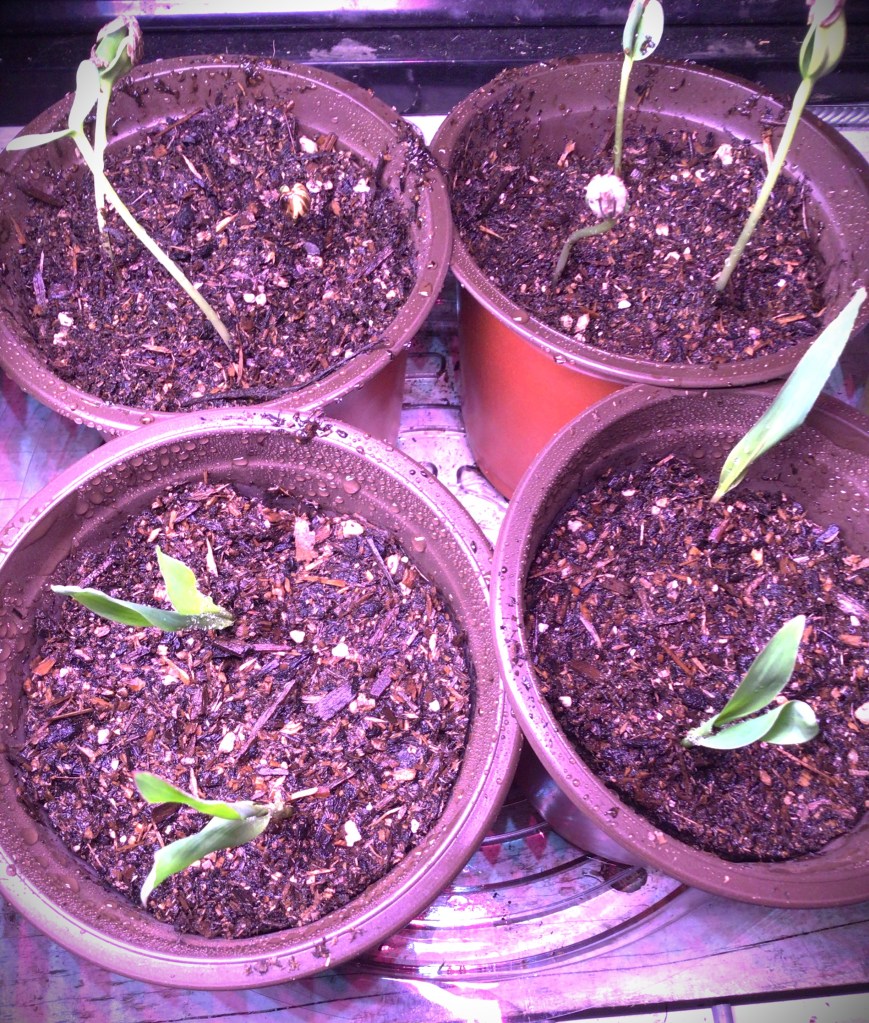
Here’s the new home of these sunflowers and corn. I have a whole lot more starts to repot. Some will be repotted into different size pots, and some in different composites. I’m currently experimenting for what’s going to work best for my garden and me. Just like not all parents share the same parenting style, neither to plant parents (or gardeners). Our soil isn’t the same. Our touch and interaction with plants aren’t either.
As I leave you today, I just want to let you know that it’s okay if your garden didn’t do well last year. It could have been the fault of the weather. It could have been the seeds, starts, or root health of the plant. It could be a combination of so many things. But I want you to know that you are empowered to do things differently. There’s not one set way of doing things successfully with your garden. You really do have your own science experiment that you perform each year, because the variables will change. Last year my changing variable was the weather. And I learned a lot. A LOT.
This year I choose to do things differently to see what happens differently. I’m pushing through more seeds than I have in the past. But I’m also growing out my long maturity plants so they have more time. I’m choosing to thin the least healthy starts even before they go into the ground and maximizing the use of my small garden.
How are you doing your garden different this year?
Advertisements
Processing…
Success! You're on the list.
Whoops! There was an error and we couldn't process your subscription. Please reload the page and try again.
Lately I’ve been very interested in the Boho style of event designing. A lot of event designers and coordinators tend to gravitate toward the fantasy of rich and fancy feeling decor. There is nothing wrong with that. I gravitate toward that. There’s just something about pretty sparkly things grabbing our attention.
Even when I worked for a decorating company, there was this huge gravitation toward bringing the Boho brides nearer to the glittery and sparkly end of design. I know why there is that nudging toward that direction. But I’m not going to speak ill of other businesses. I just want to take this moment to see and recognize those brides, and other event organizers and celebrants, who want to stay more toward the end of the spectrum of the simplistic and natural look.
This post is for you!
What I want to focus on today are a couple of floral options that are different than what might be proposed to you when you talk with a florist; succulents and preserved wild or garden flowers.
I don’t know if you’ve taken the moment to look at all different colors available in succulents. They are definitely a wide spectrum that diverges from the cactuses and green succulents that your mind naturally gravitates toward.
The best part about succulents, especially if you’re DIY as much as you can for your wedding, is that you can get these in advance and arrange your centerpieces weeks in advance. This is true, even in the middle of winter!
The one thing that you want to pay attention to is the little amount of care that you need to give them. But these are not going to wither or die on you when you look at them funny. They just need to be kept in soil designed for succulents and give them a little water every now and then.
Tip1: Succulents loved being watered from below. So when watering them, place their dish (with drain holes) in a dish of water and give them a few hours to drink as much as they want. They have enough water when you see that the soil on top has been touched by water, not dry to touch.
Tip 2: If you see the petals start to have a wrinkled appearance, they are underwater. Make sure you soak them in a dish of water. It may take a little time. But once the succulents have gotten enough hydration they will look plump again and not wrinkled.
The only other thing that you have to pay attention to is how much light they get. Here in the Pacific Northwest, succulents are not about to get too much sunlight. They can be burnt by full sun, depending on your region. But in the couple weeks that you have them before your event, this is not likely going to be an issue.
Advertisements
One issue that you might have is when you’re succulent undergoes what looks like a growth spurt.
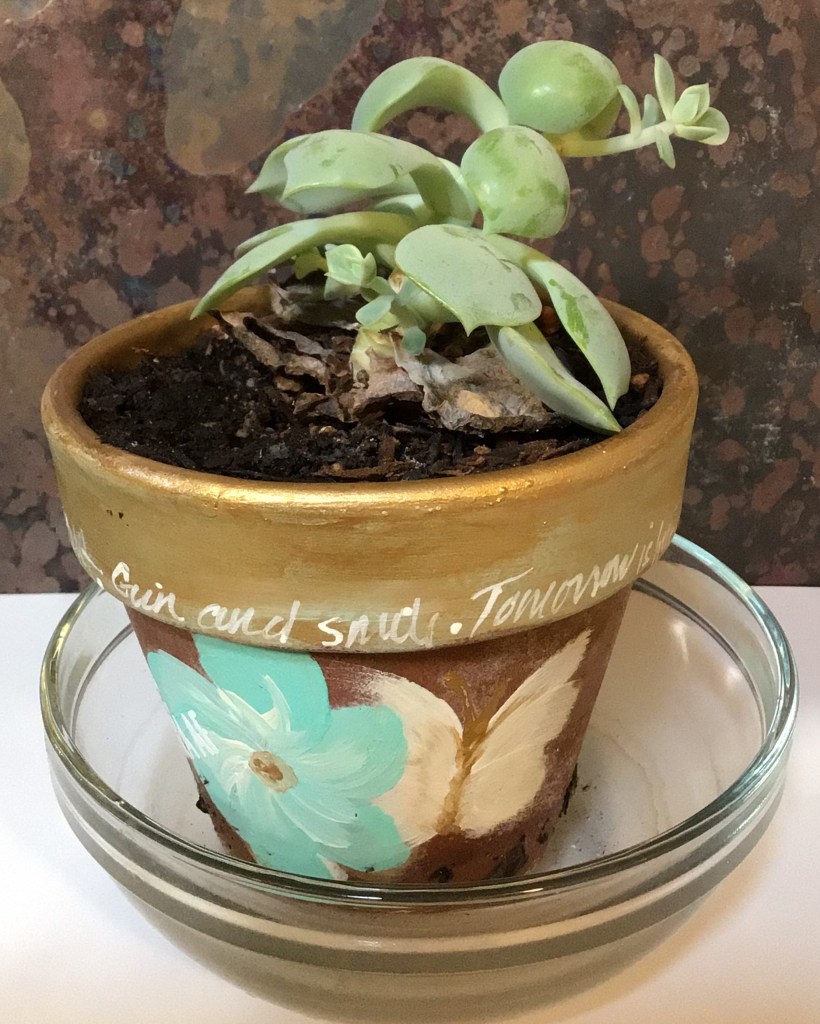
This example is definitely an exaggeration of what you will see because I’ve had this succulent for well over a year. It started to bolt like this a couple of months after I received it. What happened here is that the window sill (eastward facing) did not receive enough light. So the plant grew to reach more sunlight.
Your succulents will stay small when they have enough light. So if you see this, or you notice that there is some growth that is starting, then you want to find your succelent(s) a sunnier location.
If you catch the growth quick enough, you can trim off the growth, and return your succulent back to the smaller size.
Take a length of dental floss, wrap it around where you want to trim and pull it tight. You can use scissors, but it will apply pressure from two points to cut. If you use thread or floss, you can apply even pressure around the plant. Also if have a cluster flower of a succulent, you can fit the floss in between the petals and top the succulent without damaging the rest of the plant.
The clipping you can then put in a new container with soil and it will propagate for you.
I put the topped succulent in this cup with water with another topped clipping that I’m waiting on soil for. It’s okay to put into water, but you want to get clippings into soil as soon as possible.
If you are saving money by propagating your own succulents from bought succulents, make sure that you give yourself enough time to let new buds grow. It doesn’t happen overnight. If you don’t have enough time, your succulents will look bald and not so happy.
Here is another What-Not-To-Do
This succulent was originally small like the first picture of succulents I showed you in this section. This one also grew to reach for more light. I should have trimmed this when it first started to grow. Had I done that, it would have remained small and cute. Instead, it changed its shape and spread. But what you can learn from this is what it will look like at the spot where you clip back the top your succulent. There is a small bud that you see on the top right. That grew in about two weeks after trimming. On the bottom left you see another bud grow in where I snapped off some of the larger leaves to practice propagation techniques that I’ve seen on FB reels.
If you are interested in looking to propagate succulents for your event, make sure you give yourself enough time to do so. You will want a couple of months to do this DIY. Talk with some local greenhouses with growers who have experience with succulents. Also there are FB groups dedicated to succulents. Join a group or two and learn from those who are succulent whisperers. There is a wealth of good viable information there.
I readily admit that I am not an expert. And there is a world of information available. Just do not take your advice from clips and reels on FB, Tick Tock, or anywhere else. I tried propagating leaves in a plastic bag, through a slit in paper to suspend over water, and directly in water. None of these have worked for me and I am most certainly a novice at propagating succulents. If you’re a novice, I suspect that these reel methods are not going to lead you to success either. (With the leaves, I tried about a dozen and not a single one grew. This is reason why I have little reason to believe these techniques work. Not working the numbers paid off. If I get a success rate of 1 out of 10 attempts, I call it a viable option.)
One other walking away point I want to draw your attention to, is take notice of the terra cotta pot decorations on my pots. These were painted on with acrylic paint and have stayed on the pots over a year later. So it will not flake off anything else. And this is an excellent way of incorporating your event colors. You can create endless possibilities with your design. Whether you go with feather like swirls, dots to simulate lace, stripes, or even using a stencil from any store’s craft department. You can certainly dress up your terra cotta to fit the look you are going for.
I’ve lost count of how many events that I decorated for where I would take home flowers after an event because there was no second life for the floral arrangements after a wedding.
Don’t get me wrong. I LOVED those events because I had pretty flowers to take home and enjoy for a week or two. That is definitely an occupation perk that I’ve enjoyed.
However, at the same time, it has always saddened me a little because I have always wanted people to have more bang for their buck when they are spending good money on a wedding or other event.
So here is where we join two very important passions of mine!
I breathe creativity and decorating. But I also love working in my garden and learning all the old skills of creating home supplements, natural cleaners, and especially new ways of putting food on my table.
The very day that I learned about making a Chive Blossom Vinaigretteis the very same day that I made it.
This is Day One of my Vinaigrette:
My Four year old and I did this together for the very first time and as soon as I saw how this jar looked I immediately thought, “How Beautiful!”
And this was the first, on many ideas that I had:
You can go with sentiments or go all the way with the couple’s monogram, name and wedding date, or even line art that goes with your over all Boho decor.
What I absolutely LOVE about this inspiration is that it’s simple but has so much LIFE after the wedding or event.
For example, this Chive Blossom Vinaigrette will become a salad dressing, meat marinade, or other meal flavor provider in as little as 3 weeks. The total cost for this is just your jar, the chive blossoms, and food vinegar. When you’re looking for cost saving centerpieces, you seriously can’t beat this for bang for your buck!
To do this idea, you will definitely have this be your day of preparation, so have a few hands on deck. You will want to clip your edible flowers, rinse them, and place them in the jars before adding the vinegar.
The reason why I say do this on the day of is because of the process needed to properly turn this into a proper dressing or marinade. It is shelf stable during the whole process, but it needs to be kept in a dark cool place for the 3 weeks of processing. You could also use the jars at the end of the three weeks, when the vinegar takes on a fuchsia/purple appearance. But you want to try to limit the heat and light exposure no matter if you do it at the beginning or end of processing.
Tip 1: This needs to be shaken once a day for the entirety of the three weeks. So you will have a cleaner look at the beginning of the process. At the end of the process, you will have some floating pieces from the flowers. That just naturally happens with daily agitation.
Tip 2: At the end of the 3 weeks, you will need to filter this vinaigrette through a cheese cloth to remove all debris (and rebottle) before you use this as a dressing/marinade.
Maybe puple is not the color that goes well with your Boho design. Here is a list of some other edible flowers that can be used in making your own version of a different vinaigrette. Or you can just put the blossoms of these flowers or others into a jar filled with water.
Nasturtiums
Pansies
Violets
Hostas
Borage
Calendula
French Marigolds
Chrysanthemums
Carnations
Hollyhocks
Sunflowers
Cornflowers
Gladioli
Honeysuckle
Dianthus
Antirrhinum
Tulips
Roses
Lavender
Pea Flowers
Broad Bean Flowers
Onion/Chive Flowers
Brassica Flower Heads
Pak Choi Flowers
Squash Flowers
Dandelions
Daisies
Chamomile Flowers
Red & White Clover Flowers
Chickweed Flowers
WARNING: Make sure that you only use flowers that have NOT had pesticides or herbicides used on them. Whatever has been applied to flowers will enter your body if you eat them or any extract that you make from them.
Advertisements
Flowers as herbs and seasoning have different flavors that they impart. Some have a peppery note to them. The chives that I grow are a garlic chive, so it imparts a garlic flavor without having to fuss with cloves of garlic. I’ve also started working with Lemon Balm (a member of the mint family) which imparts a lemon flavor. So I could have added tiny Lemon Balm leaves in with the chive blossoms. Which now that I think about it, I’m definitely going to add that to my vinaigrette as soon as I post this!
Another thing to keep in mind is that for thousands of years edible flowers and plant leaves have been used for natural medicine. For example, Lemon Balm is great for combating the viruses behind the common cold. So you can give your body the things it needs to keep healthy while adding flavor to your food.
If making a vinaigrette is not something you will use after the wedding (or other event), consider looking into making your own chemical free cleaner. For example, you can still use this mason jar idea and make a kitchen cleaner with lemon or orange slices and peels.
If you’re not looking for a natural cleaner, than even using berries and mint, basil or other leaves in water, is a great of washing your produce before you eat it while borrowing it for a few hours for your event.
There is one more option for Fall and Winter Events when most of the edible flowers are not in season. You can make Pine Syrup or Spruce Tip Syrup. I found this type of syrup interesting because I have spruce widely available around where I live and real Maple Syrup is a luxury on my family’s budget. This can be a pretty centerpiece as well because you use the new growth tips on a spruce tree or pine cones for the Pine Syrup. I’m sure that you can imagine the possibilities for all your holiday parties with this one!
Decorating the Mason Jars
The simplicity of these jars is beautiful all on their own. But maybe you want to dress them up a touch. What can you do to add a little panache?
Paint the jar ring (White, Gold, or other event color)
Apply glitter to the jar ring (after finished spray with a clear coat of paint to keep from leaving a glitter trail)
Use squares of pattern, texture, or fancy cloth on top (held in place by screwing the ring down onto the jar over the fabric)
Decorate the jar itself
Use the jar as a base for a taper candle (with candle holder) to raise the level of the candle above other centerpiece elements
Put your table number on top of the jar
I hope you’re just as excited about these ideas as I am. These are definitely something fresh for existing wedding and party themes. Be free to experiment with using some of your food preparation and preserving techniques the next time you are decorating for your next event!
Files Used In This Project
As a special treat I have a surprise for you! Visit my store and check out Love. Be sure to hang around and see what else is new. Every Monday at least one new SVG is added!
Processing…
Success! You're on the list.
Whoops! There was an error and we couldn't process your subscription. Please reload the page and try again.












 How I Can Do That
Leave a comment