

Honestly, I should know better! Names have power. And the last time anything was very aptly named in my family was when my sister named her goldfish Sushi. It ate all the other fish in the tank.
I should have known that naming a starter Frankenstein was going to be a wild ride. But I’ll come back to that in a moment.
Today is the last day of this miniseries talking about yeast and bread making. I wanted to finish with my experience in making a Gluten Free alternative for in those who cannot keep a starter with flour, because of dietary restrictions. Because everyone should have the opportunity to keep a starter that meets their needs.
When I told my Mother in Law my plans for making a starter (my original flour starter), she was so excited and told me that I had to make a potato starter. She remembers having one from when she was a girl, but couldn’t find her recipe. And her memory was very limited in that process. She heard me out with my flour starter and insisted that it was just as simple and the same to make it from potato.
Of course I tried to verify everything she described with what everyone else has posted on Pinterest. And no, what my Mother in Law told me was different from what everyone else is doing. I’ll save you the search, unless you want to go down that rabbit hole. The rest of the world is making their potato starter using instant potatoes.
If you have a potato starter and use instant potatoes can you humor me and check the ingredients on the side of your box?
If you are comfortable with everything you see there, then I won’t say another word on that subject. Keep your starter healthy and keep making that glorious bread in your kitchen!
If you see anything there that you might not have been aware of or want to move toward a starter with fewer ingredients, you can transition your feed to using just a potato. I’ll show you how.
The Set Up
The little bit of information that I did receive from my Mother in Law was that the potato start from her childhood was just a boiled potato mixed with water.
Believe me I know exactly what you’re thinking! I thought the same thing.
There was not enough information to start with. What do you do with the potato? …I won’t bog you down with the list of questions that I had. Even with a degree in history, and having professors who assigned me to make food from out of circulation recipes, I had high hopes of finding some old recipe to work with. And all I had in the end was boiled potato and water.
BUT I wanted to make this experiment, with the thought in mind: How do you make yeast start with just what you can find in your pantry or garden?
It was a what-the-heck moment. Let’s do this thing!
I grabbed a potato, peeled and cubed it. Put it in a sauce pan with water and cooked that potato like I would mash potatoes. Only this time the seasoning, butter, and milk stayed where they were. Once the potatoes were soft, I removed them from the heat and reserved the water I boiled with. We all know that when you cook, all vitamins and nutrience end up in the cooking water. And I had no idea if the potato or the water has the stuff I want. (Also there’s the side objective of trying not to waste resources.)
And here is where I ended up with two potato starters. I didn’t have faith in my Mother in Law’s lack of directions. (To be fair, she hadn’t used this method in many decades and probably thought she never would.) So I chickened out and took Method Two. But the next day I decided I was doing myself a disservice by not attempting my Mother in Law’s way. If it failed, at least I had the other starter to fall back on.
METHOD ONE
- Mash the potatoes. In hind sight I didn’t mash them as smoothly as I wanted. The chunks are very obvious. But rest assured, even if your potatoes are chunky, you will still get healthy and viable starter.
- Mix in some of the cooking water. This is going to be a wet starter. So think between toothpaste and stew consistency.
I named this starter Carolyn.
METHOD TWO
- Mash the potatoes. In hind sight I didn’t mash them as smoothly as I wanted. The chunks are very obvious. But rest assured, even if your potatoes are chunky, you will still get healthy and viable starter.
- Mix in some of the cooking water. This is going to be a wet starter. So think between toothpaste and stew consistency.
- Add a couple Tbsp of starter from an established yeast.
I named this starter Frankenstein.
Why would Method Two work?
When researching about starters, you learn that you can turn a gluten based starter into a gluten free starter by slowly changing its food source away from being wheat based to your GF flour of choice.
I didn’t do the gradual change, because the food source and environment was completely different. So I just jumped all in and went at it from a science lab experiment of inoculating yeast into a new medium.
What if I’m transitioning my existing potato starter from potato flakes to potato?
The standard method of transitioning starters to a new food source is to feed on the following schedule:
Transition Day 1: Use 75% old food source + 25% new food source.
Transition Day 2: Use 50% old food source + 50% new food source.
Transition Day 3: Use 25% old food source + 75% new food source.
Transition Day 4: Use 100% new food source.
All the transitioning experts assure their audience that even with a gluten starter transitioning to gluten free, the more you feed the starter without the gluten food source, the more your starter transforms into gluten free. If you are GF by choice, you are good to start using your transitioned starter after day 3. If you are GF for medical reasons, then there comes an educated decision based off of your sensitivity. If you are very sensitive, and know your levels, you can do the math to determine what an acceptable amount for consumption is. Your bread recipe is going to have a yeast to flour ration, giving you an overall percentage. On Day 4, there is potentially a 62.5% gluten level in the yeast. Day 5, that drops down to 31.25%. Day 6, 15.63%. And so on. Now if your bread recipe keeps the baker’s ratio for bread making (2% of flour weight), Day 4 has a potential gluten amount of 1.25%. Day 5 has a potential amount of 0.63% in the bread. So you can see how this is an educated based decision of what is acceptable for your body.
Please note: I have not transitioned a yeast to a new food source other than what I did to Frankenstein. So I have no idea if Frankenstein is what’s normally expected, or just some fluke that succeeded. And Frankenstein I didn’t transitioned at all. I just dropped flour based yeast in a room temperature environment of potato and water.


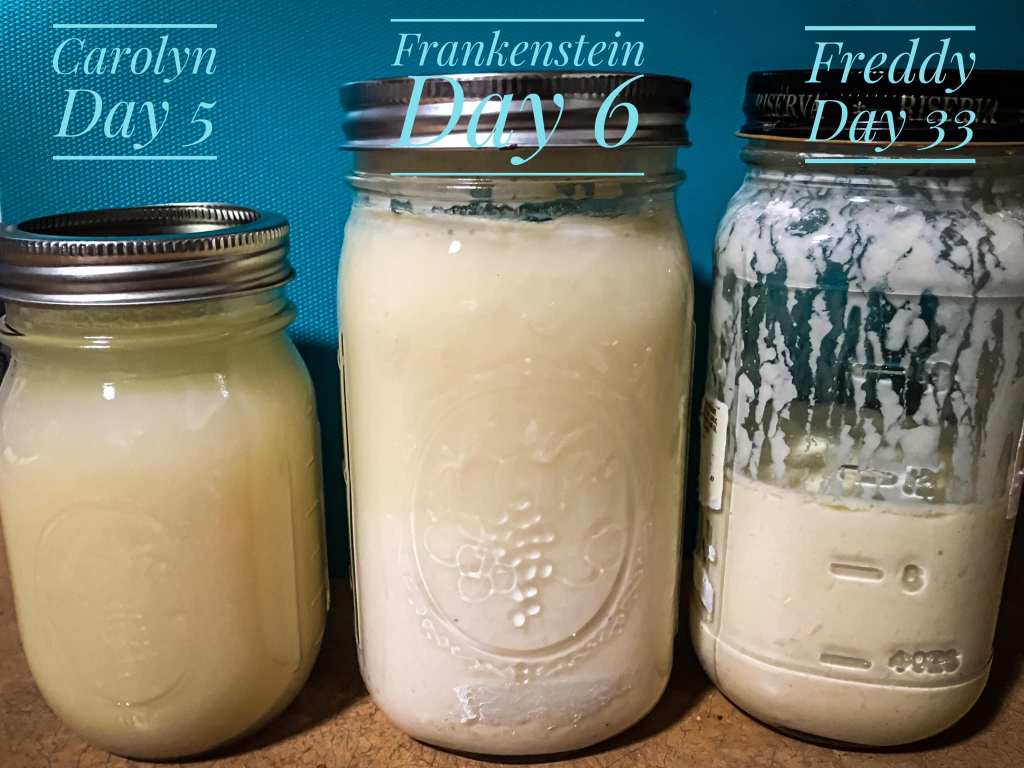
Picture 1 is Frankenstein. Picture 2 is Carolyn. These are just my starting point, pictorial references. So at least you have something to compare your potato starter with.
As a time saver for feeding, I boiled a couple of potatoes at the same time. I saved the left over mash and cooking water, and kept them in the fridge. When I was prepping for a feeding (twice a day) I took the mash and water out about an hour ahead of feeding time, so it could come to room temperature.
Day Two
I continued with a 2 time a day feeding of potato mash and the cooking water.
What I did not count on was Frankenstein (picture 2)!


Let me give you a close up on two of pictures in the set. In the above picture (picture two, top row, second from the left) you will notice that Frankenstein had clear striation between solid and liquid. When I placed a scraper in and gave to couple mixes to reincorporate the components for a feeding, I got Picture 1 (below). Frankenstein was alive!


I have never seen this kind of reaction in my life, especially in the world of yeast. This yeast, I called Frankenstein, was going crazy! In fact, Picture 2 (above) is the still of what I saw. There was movement in the jar that was very reminiscent of a lava lamp.
I mention all of this because if you decide to inoculate you potato start with another start, just to get active yeast from the get go, and you see foaming activity like this know that you are not alone. It happened to me and I have the photographic proof to prove it. The smell is standard for starter. It’s just the yeast activity that is the only difference.
What I fed Frankenstein and Carolyn were the same potato and cooking water. The only difference between the two starters is the origin of yeast. And that yeast came from my AP flour based starter, which never acted this way either.
Day 3
Continue with the 2 times a day feeding of potato mash and cooking water.
The activity with Frankenstein was still happening, but to a lesser level. Here are some pictures to show you where that starter was. I don’t seem to still have pictures for Carolyn.
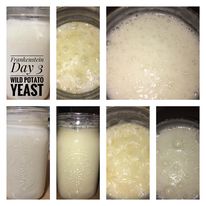
I stopped taking pictures of Carolyn on Day 3 because I had some research to do.
If you remember from Valuable Resources, I mentioned things to look out for when keeping a starter. Your starter should never have mold, spores, or color on top. Neither should it have an acetone smell. On Day 5/6, I posted on Facebook, how Carolyn started smelling like butter.
I’m going to pause here and just let my post communicate what happened to my 100% potato start.
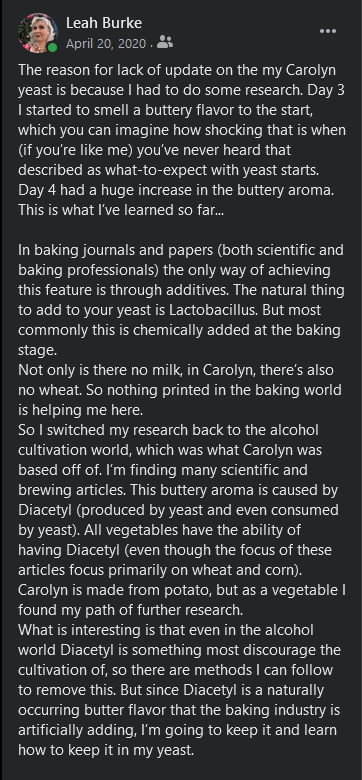
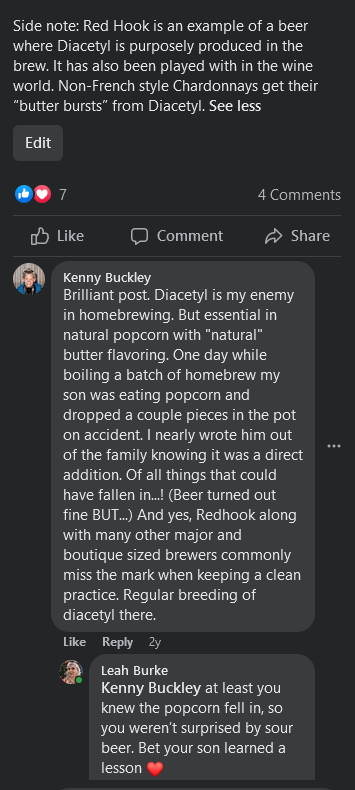
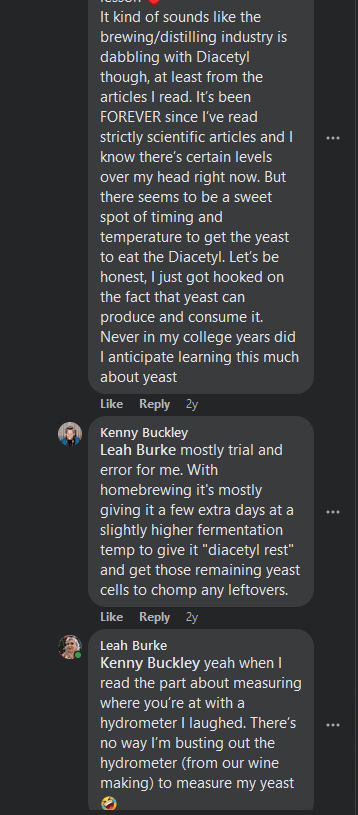
Here’s what happened, Carolyn was well on the path of turning herself into vodka. This will be a common problem, correcting Diacetyl, when you have a potato starter. This is because its potato based, not wheat based.
What I learned from Carolyn, and making a starter with next to no knowledge with what you’re doing, is that you HAVE to go back to a source that you know. Yes, I was making a starter. But this problem was not covered in anything written about sour dough starter for bread. It didn’t make much sense to look into the world of vodka making other than the fact that vodka making starts with a potato mash, which is exactly how Carolyn started. And within minutes of looking at sources in the vodka world, I found my answer.
For those curious, what caused the Diacetyl? It could have been a bacterial contamination. Or it could have been that this starter had oxidized. (Remember that yeast has anaerobic respiration.) I happen to believe that this time it was oxidation, because it happened on Day 3 which is when Diacetyl enters production of beer brewing. And all your alcohols have tools to keep oxygen out of your cultivation.
How did I heal Carolyn from Diacetyl?
There were a few options from the brewing and Vodka world. I started with adding salt into my starter (probably about 1 1/2 tsp worth. I guessed the measurement, and added a little bit more than what I thought I needed). This time, all I needed was the salt. The next day the butter smell was gone.
I cannot stress this enough. No matter what medium you use to feed your starter, yeast is a living organism. Every time you open your container to use or feed your starter, always visually check its health and smell it. Your yeast will tell you when something is wrong. And when you catch it quickly, you can tend to your yeast and keep it from going bad on you. It can turn around and come back into health.
Here is a picture of how Carolyn started showing evidence of being healthy and active.

And the Pay Out
Nothing shows the yeast is active and healthy until you produce bread from your starter. This was the potato bread that I made from Frankenstein while I was tending to Carolyn.
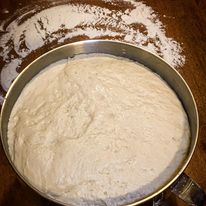
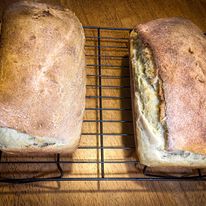
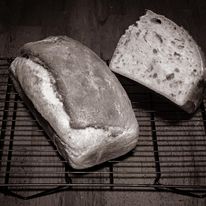
Is there a flavor difference between bread baked from Carolyn (100% potato start) vs. Frankenstein (potato started with flour fed yeast)?
I preferred the flavor from Frankenstein. Even though I followed a potato bread recipe, Frankenstein had a blend of flavor between store bought potato bread and homemade sour dough bread. Carolyn produced bread that didn’t taste anything like potato bread. The loaves turned out like they should, the flavor was just off.
To be honest, it’s hard to say if there was something deficient with Carolyn or if the difference I tasted was the true difference between the two different methods of potato starter. This was also the point in time where my life got super busy and I could not keep up with keeping 3 starters. So shortly after baking with Carolyn, I let go of the two potato starters and kept feeding my flour starter.
Final Thoughts
There are several different reasons why making a starter from potatoes is a great idea. For example, I grow potatoes in my garden but not wheat. If I ever came to a place where I could not source the amount of flour that I use (to keep my boys in bread) than a potato starter would be amazing to conserve flour and use up the potatoes I grow.
You can make potato starter from potato and water.
In fact a starter from potato and water can serve double duty by providing the yeast for bread making and for distilling vodka (for all you home brewers and wine makers looking to branch out).
Last week, in Bread Recipe that Hasn’t Failed Me, I mentioned the science behind bread making. In the case of this week’s example, caring for Carolyn required a different science. Sometimes you have to look outside the normal beaten path of bread making, to find your answers. Bakers don’t have all the answers. They are gifted with their knowledge that they’ve cultivated. But there will be times in life where bread making takes you into another field of study to find the answers to the problem(s) you are solving. So be flexible. Don’t get frustrated if you’re searching turns up as a dead end. It takes a moment to stop, breath, and take your thinking down the path that runs parallel to the one you’re on.
Thank you for going down this detour in the creative world.
Conserving resources, making something out of the barest of materials, and using what you have on hand is an art form that needs to be resuscitated in the world that we live in right now. There are options that are still at all of our finger tips.
If there is a method of making something that you want help finding a method of creation (Just like my Mother in Law’s information of taking potato and water to make potato starter) and don’t know where to start, reach out to me or leave a comment below. I want to be creative with you!

As a special bonus, here is a sneak peek to this Monday’s release, 2022 Graduate
One response to “Meet Frankenstein”
-

[…] Meet Frankenstein I talked about the gluten free starter I made and how I had to bring that one back to health. That […]
LikeLike
 How I Can Do That
Leave a comment