Fill Up On The Fillings

The holidays are all coming up. And this can bring many feelings to different feelings. When adulting, the hardest part of the holidays are when finances are tight.

To help lighten the mood and bring a little cheer with the gift of flowers.

I’m going to show a simple and easy to make arrangement that you can personalize any way you want because it’s a blank slate. The beauty of it is that I reused some items and others were given to me. I had no out of pocket expenses to share this post with you.

So let’s start with the materials.

Vase

What inspired this post was the vase that my mom had sent me some flowers in.

Fall is my season. I love pumpkin everything. In fact I grow and purchase pumpkins to have all my pumpkin goodness that I can preserve for the rest of the year. And yes, I make pumpkin scones year round because their deliciousness transcends what is in season.

Unfortunately I can’t send you a picture of what the floral arrangement was that my mom sent. Mostly because I want to keep the blank slate in your mind and spark your creativity.

What I like about this white pumpkin is that if you remove all the floral it is literally a cookie jar. So feel free to use this idea any time of year and use cookie jars, old tea pots, water pitchers, even a shoe box (hello baby shower with baby shoe boxes!) Literally, use what you have on hand that brings you inspiration.

If you’re using a cookie jar or anything else with a lid, let me show you the parts of this vase and how it works.

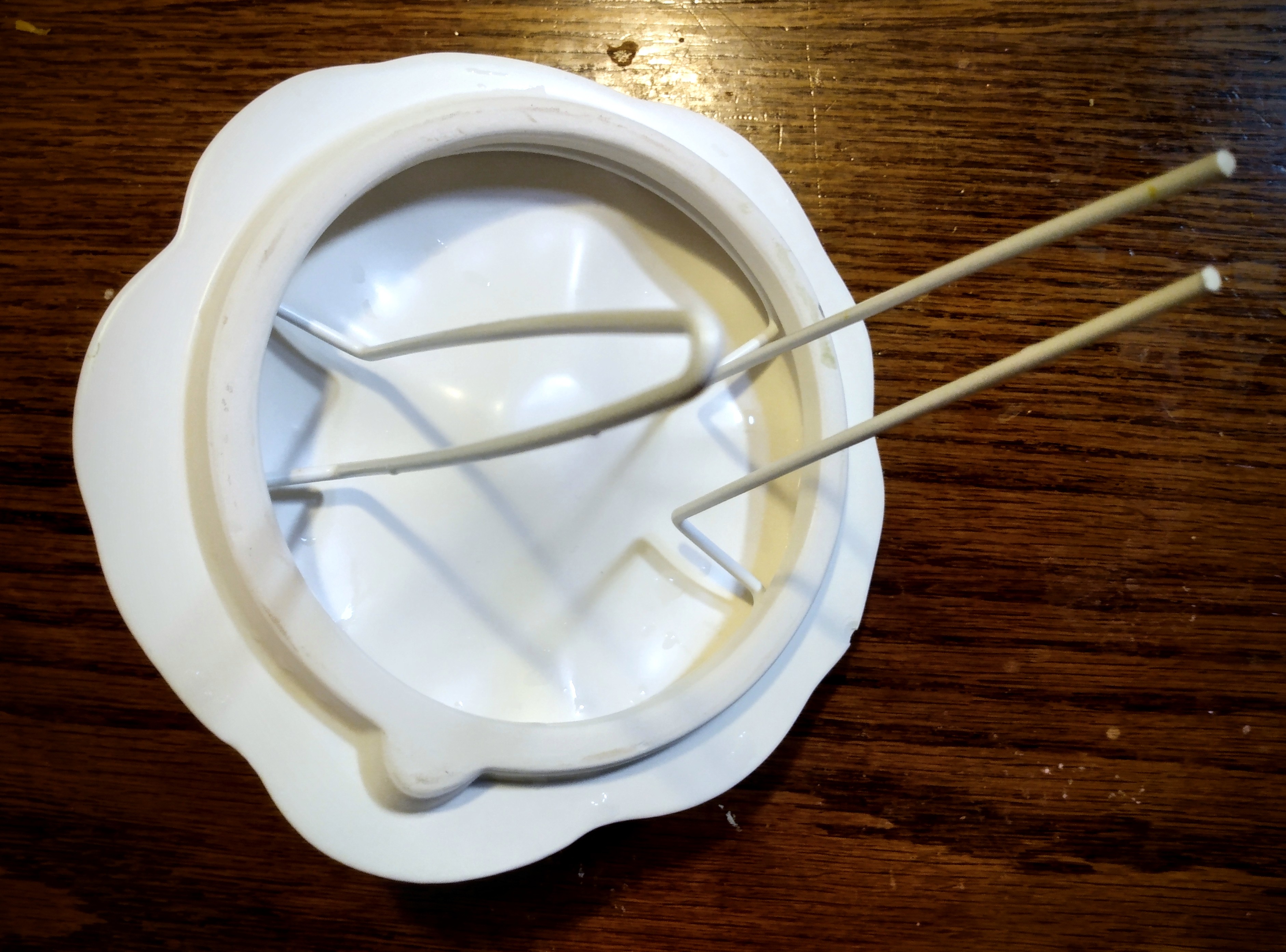
This lid stand/holder is very specific for floral. I’m sure with today’s online offerings, you could find these. But you’re going to have to know what your lid size is and go from there. I have one other cookie jar, but the lid is smaller and this stand/holder definitely will not fit in it.

However I do have two options off the top of my head that I could use from items I have in my house.

I have porcelain dolls from my childhood, and this stand/holder immediately reminded me of the doll stands I have that go around my dolls’ waist. The tension part is too small to fill the lid like in this pumpkin vase, but with two or three I could position them in the smaller lid to make the tension and platform to raise the lid.

Another option is making one from a thick gauge wire. If your local store has a DIY floral department or aisle, you will find wire thick enough to hold its shape and hold the weight of a lid. If you want to price comparison shop, go to an automotive shop or aisle. You’ll often find that you will get a better price in that department, but also walk out with a larger quantity of wire.

Once you have the wire, you can make your own custom holder/stand by leaving several inches of one leg sticking out as you then go in and create a loop of wire inside the lip of your cookie jar lid. I would make a few loops inside that lid to ensure that when you move and manipulate the legs that you don’t shrink your loop and allow your lid to fall. Once you’re confident in you loop, bring out a second leg and then use wire cutters to cut the wire. You can always add more than two legs if you feel like you need to add more stability.

Advertisements

Inner Stability

For lid placement, you will need something to anchor the stand into.

I’m choosing to reuse the oasis that came with the flowers my mom sent me. This is an amazing product because it not only allows you to place flowers like a pin in a pin cushion. It also allow absorbs and holds water, keeping your flowers in water much longer than free standing in just a vase of water.
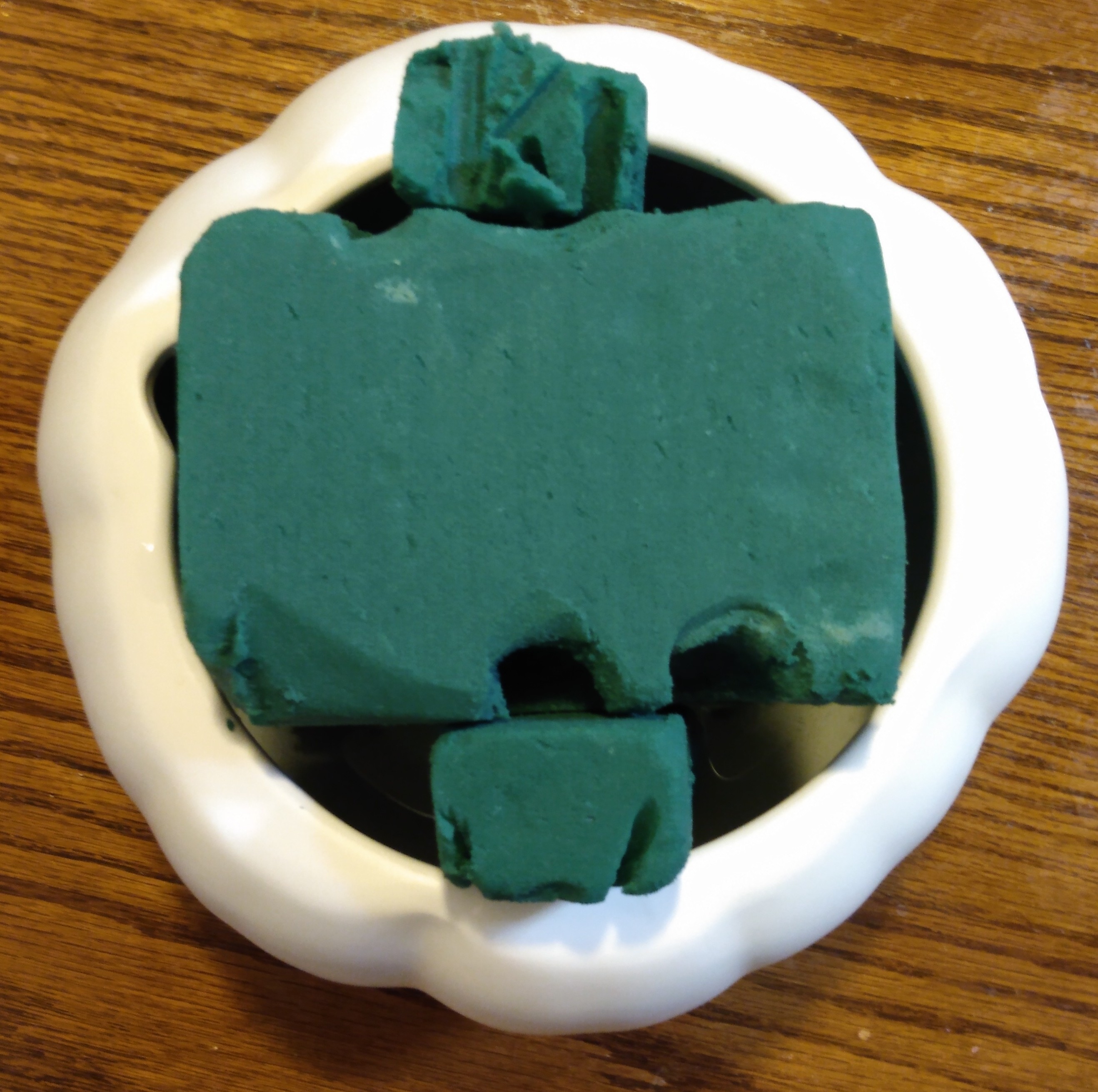
If you want to use silk flowers that you have on hand, feel free to use a Styrofoam ball or block. (I don’t recommend styrofoam for fresh flowers because the plastic will kill your flowers and won’t allow them to be properly hydrated.

Once you’ve decided what you’re using as a structure (of if you’re even using a structure), you may find that you need to piece bits together to keep them from falling into your cookie jar and becoming lost. Flower stems are enough to keep bits together. However if you need everything to be in place before you get started on your flowers, know that toothpicks or a couple inches of wire are your best friend.

As you can see here, a single toothpick is all that was needed to hold up a water logged piece of oasis.

This is a beneficial trick if you only have a small sliver of oasis that doesn’t touch the bottom of your vase. Or even if you find that your oasis fell apart on you. Or maybe some oasis you salvaged was a different size than the vase you are working with. You can certainly make your oasis fit the vessel you choose to use.

TIP: Please note that placing a toothpick or wire in a 90° angle is going to cause frustration. The weight of wet oasis and flowers are going to collapse. So instead, angle the toothpick at a 45° angle. That way when gravity starts to work against you, the toothpick will hold its place. This will be further reinforced by the flowers that you soon add.

Advertisements

Flowers

The Flowers that I was gifted after an event I attended was baby’s breath and eucalyptus. Often we look at these as just fillers to make an arrangement look larger than the more desired stems.

I wanted to use these fillers specifically because they are often overlooked for being used as flowers on their own. Maybe you have a lot of fillers left over from other arrangements that you made. Or maybe your budget is tight and these are the only flowers that are in your price range.

There are so many other fillers that you can find in your grocery store. So please keep your eyes open. And not all stores offer the same offerings. The grocery stores don’t supply very many filling options. However, stores like Trader Joe’s offer the best selection of filler flowers in my area. And their prices are quite affordable.

TIP: If your local store doesn’t offer many choices for filler flowers take a look at what is available for discounted flowers. They’re the ones that have the more delicate flowers that are wilted. These discounted bouquets are often cheaper than just fillers flowers, but the fillers used in these bouquets still have a long life to them. There are a huge number of flowers that will last weeks without even having water available to them. So know that even all that you can afford is a heavily discounted, on its last leg bouquet, if there’s a decent amount of fillers included, you can make a decent arrangement even if you have to throw out the wilted roses, lilies, and other delicate petal flowers.

Advertisements

Arranging

When looking at using long stems of filler, like eucalyptus, you will be happier in how these stems lie when you hold them up and see which direction they are naturally bending. (See the right picture below.) If you want the stem to cascade down, angle the bend down and also put it in the oasis by entering from the bottom and putting the stem upward. This can be seen in the picture on the left.

See the difference between placing firm eucalyptus stems. Using the left picture (above) the stems you see in the bottom right corner are the stems that I angled from the bottom of the oasis and pushed upward. The one stem that is in the upper left corner is the one that I pushed from the top and downward. But this stem I also used a second trick. Even with the curve of this stem, it had the tendency to stand upright. So I curved the stem in a C shape and kind of hooked the stem in the oasis. Then I put the pumpkin lid over this stem to weigh it down. Even with this trick, the stem never gave a cascading down effect like you see with the bottom right corner stems.

How you place the stems is everything about how it stands up or lays down.
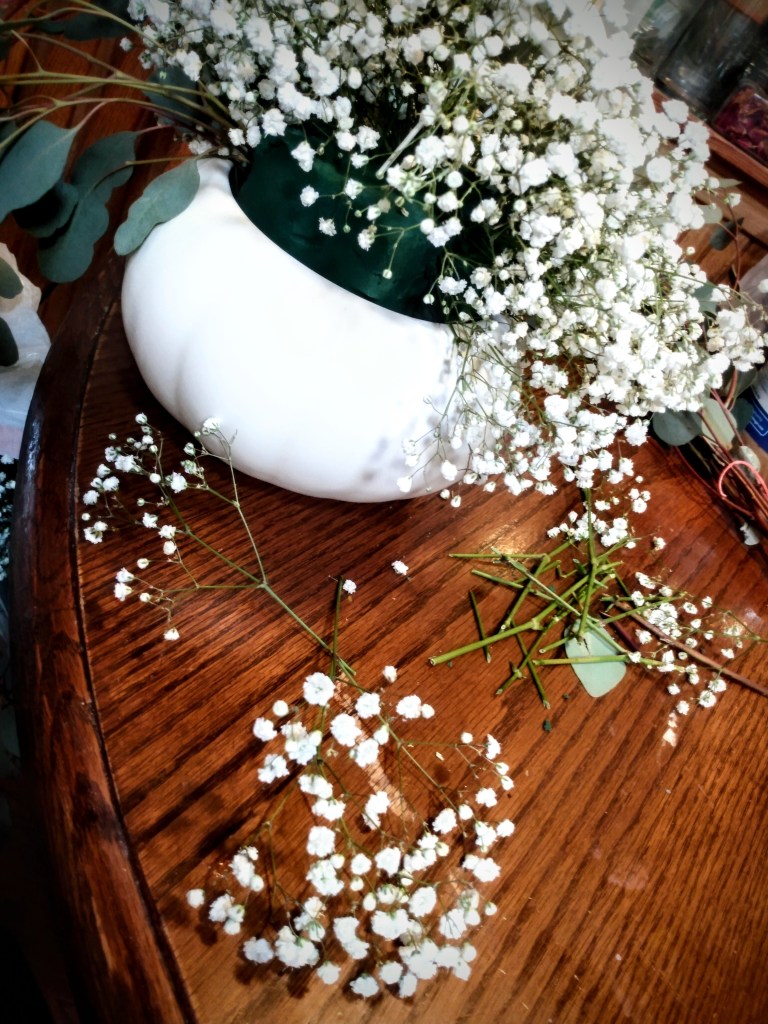
The baby’s breath is much easier to shape the way that you want. For this cookie jar I used about four stems of baby’s breath and snipped them down into smaller branches. And with an arrangement like this, there’s no need for long pieces. All you need are the “scrap” pieces or bits that are the size of your hand or smaller.

If you “scrap” pieces or the bits that you cut down are too small, it just means that you need more of them to fill larger spaces.

One work around for filling empty spaces quicker is to take larger pieces like this. In the below picture on the left is a stem that is about the length of my elbow to my wrist. It could have been trimmed down into four smaller stems, but I wanted to fill a large hole with just this one piece.

To close up the gap spacing between these branches, slide your fingers up the main stem, gathering all the stems up the main stem. That gathering bunches all the stems up to achieve what you see in the right picture. You will have to hold you stem in this position until you push it into the oasis. At that point, the foam holds bunching in place.

Before you place your first gathered stem, I want to draw your attention to a stem feature that has the potential of causing you some up front frustration.

The weakest part of the baby’s breath stem is the joint where all the branches merge. The times that stems snap, when placing them in oasis, is when I try to push these joints in without giving them assistance.

If you have an arrow tip like you see above, it’s easiest if you just snip that off. It causes resistance, when pushed in the oasis, that you don’t need, because those stem numbs have no flowers.

Look further up on the stem and you see what it looks like when you have attached flowering stems. When I don’t need the height from the stem, I snip it right there at the base of where all the stems merge. Then I slide my fingers down to make more of an arrow point instead of a tear drop. That fat end of the tear drop is difficult to push into oasis. However, if you make a sharper point, or a smaller surface area to push in, the stem slides right into the oasis.

If there are any other merges in the stem, it’s easiest if you pinch it smaller to get it to go into the foam. Depending on how large of a cluster you have, there may be a few of these joints that you have to manipulate into the foam.

Advertisements

Final Adjustments

Once you’ve filled in all your empty space, there’s a few decisions to make.

  • Do you add more of one filler or the other?
  • Was there too much and some needs to be removed?
  • Does placement need to be adjusted?
  • Is something missing?

I looked at the final arrangement here and went through these same questions. All the holes I filled with baby’s breath as that’s what I chose to be primary flower out of these two fillers.

The thought crossed my mind to add more eucalyptus. But I opted with the creative decision of having less leaves on my pumpkin “vines”. So that meant instead of removing branches of eucalyptus I chose to weave the branches through the clusters of baby’s breath.

As far as “am I missing anything?” that is the question that is always there when you have a blank canvas for an arrangement.

Right now this is how my pumpkin sits in my living room. But it also allows me to keep this long lasting arrangement in season through the rest of the year. For Thanksgiving, I could add fall leaves or any other fall accent pieces. For December all the fall accent pieces can be pulled out of the oasis and winter pieces added. For example, I would put in snowflakes or mini presents. In fact, I’m eye balling some mini glitter snowflakes while writing this. The question is if I want to keep with the white color and add silver glitter snowflakes. Or do I want to add a splash of color and put in gold snowflakes?

But that’s the beauty of making a simple arrangement like this. I can dress it up and change it.

In fact, I could keep this up for the New Year and put in foil clusters that look like fireworks.

For now I’m just going to have to contain myself and not entertain my kids. It’s so easy to grab their small stuffies and other toys and use them as props to make little scenes. We don’t do Elf on the Self in our house, but just like there’s millions of Pinterest posts on Elf on the Shelf ideas, there’s just as many possibilities for arrangements like this. It doesn’t matter if you have a pumpkin cookie jar like vase (like I used here) or a teapot or coffee cup. No matter what you are using as a unique vase, you have just as many options to accessorize and decorate without limits.
How would you dress up a pumpkin arrangement like this?


Leave a comment

Processing…
Success! You're on the list.
Advertisements
Advertisements
Advertisements
Advertisements

Saving My Freezer!

Now that Fall weather has set in, there’s one concern that comes up every year. What do we do when the power goes out this year?

You would think that with the frequency that my surrounding area loses power due to snow fall, that there would be changes in the electrical system. Or even something as simple as taking preventative measures to eliminate more outages. But instead the average number of outages remains the same. And the outage time remains the same, 24-72 hours. Some areas have outages for longer.

But none of them have hit the fame as the President Day’s Storm of ’92. Roads were thick sheets of ice. Trees were breaking from an obscene amount of cumulative ice. And the power lines were down just from the weight of the ice on the lines. That’s not even taking into consideration the transformers that were blown.

I remember that my family had no power, with snow and ice, for longer than a week. I wish I could remember how much snow we had that year. And I wish I could remember how long we were really without power. My family did quite well in that storm because we had a wood fireplace, where we could keep one room sufficiently warm, with a flat top that we could cook on.

Even with all the power outage skills that my husband and I have, it only mildly prepared us for the day that an Otter Pop propped our freezer open this past summer.

Fortunately for us, the freezer had only been ajar for a couple hours and we caught it before we had a complete loss of our frozen foods.

And for as much as working in campus dining wasn’t exactly my job of choice, I do value the information that I learned getting my food handler’s permit. In this particular instance, I had the information to easily recall safe temperatures to prevent food borne illnesses.

A couple of my meats were between 38-39°F. Most were further away from the danger zone. And the majority was still frozen solid. My defrosted meat was still safe so I cooked that all up and prepped my pressure cooker for canning hot packed meat. The rest of the compromised meat, that could safely sit in my fridge and defrost the rest of the way, was saved to process the next day.

So with storm season quickly approaching, what plans does your family have for saving food for when the power goes out? Or even your freezer gets accidently propped open? Or your fridge fails you for one of a handful of reasons?

If your fridge or freezer contents can be handled in a timely and food safe manner, there is absolutely no reason why you can have zero food waste when the unforeseen happens.

Pressure Canning

Just about everyone I talk with, who are familiar with food preservation have the skills of water bath canning (the process of canning in glass jars acidic foods). I’m sure you’ve seen people’s canned jams, jellies, tomato sauces, and fruits. Foods that are under the pH value of 4.6 can all be water bath canned, be shelf stable for 18 months, using current lids (when stored properly in a cool dark place, like your pantry or storage closet).

What about the rest of your food that is not acidic; vegetables, milk,
butter, and meat?

That’s where a pressure canner comes in.

Before moving on, I want to acknowledge those who say that they mama, grandma, or auntie still water bath can everything (even the food above a pH 4.6). I’m not going to argue with your mama, grandma, or auntie. Food is one area where I prefer to not take my chances. The risks I make in life, I prefer to make elsewhere. Pressure canners can be purchased for less than an Instant Pot. So I choose to use the pressure canner and encourage everyone else to use a pressure canner as well. It also has the least processing time. Those who claim to water bath meat do so with a processing time of over 3 hours. With the pressure canner, processing time runs from 75-90 minutes (for elevation 1,000 feet above sea level and lower) depending on the size of your jar and type of meat you’re canning. So from the money and time perspectives, the pressure canner is still the best way of processing (all other food risk issues put aside).

Another bonus to investing in a pressure canner is that it’s two canners in one. You can pressure can with it as well as water bath.

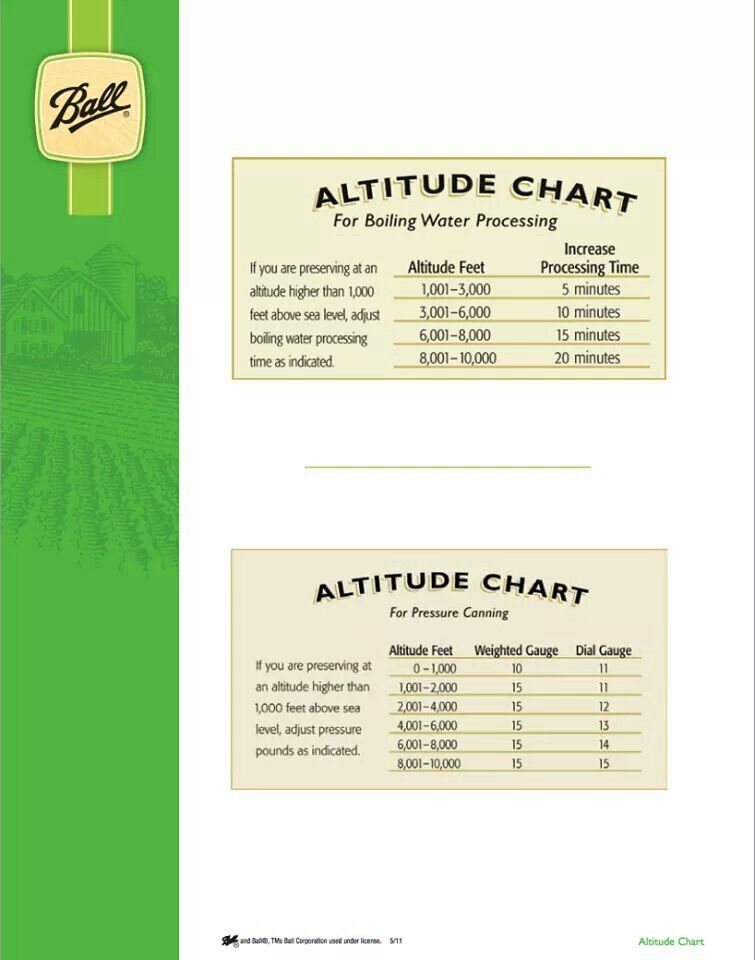
Pressure canning weights and processing times vary dependent on the elevation at which you are cooking.

Another subject that can bring some heated conversations is cold pack vs. hot pack pressure canning meats. What you need to know is that cold pack means that you put raw meat into your jar and the processing time cooks your meat. Hot packing means that you cook your meat until a little pink is left and then you pack it in your jar with a stock or water. There are safe ways of processing both ways, when you look at the cuts of meat, how it’s packed, and what proven canning recipes state.

A bit of it comes down to common sense decision making as well. For example, the meat that I took out of our compromised freezer (38-39°F) was safer to hot pack. The reason is that once you come to 40°F bacteria start to grow and cause problems. So I immediately cooked the ground beef, even a little longer than until only slight pink remains, because I didn’t want to start the canning processes with a possibility of the meat being compromised. When canning, the meat nearest the center of the jar doesn’t reach the high temperature to kill off bacteria as quickly as the meat nearest the edge of the jar. So by making sure the meat would all be thoroughly cooked (between pan and canning), I make the chance of food borne illness less. Of course, this meat I’m going to use before the other meat I have canned, but this is all about making the choices that make sense with the science behind food preserving.

Something worth noting, that in the ideal situation where there is no compromise to your meat, how you can it is going to determine how it turns out. In the instance of ground beef, if you hot pack it, you will end up with canned beef that is small crumble in shape and texture. If you cold pack ground beef you will end up with a product that is solid–comparable to a meatloaf or a pressed meat like SPAM. So if you’re canning meat in a non-emergency setting, think about how you would like to use your canned meat. Because that is going to help you decide how you preserve your meat.

Things to Watch Out For

Obviously, the first signs of failed seal are if your lid buckles or the lid never seals to begin with.

When you remove your jars from the canner you can immediately spot the first failure type, a buckled lid. It’s any type of warping that you see on the lid. Even if the seal feels sound, it could be a false seal that will break on your shelf after you let it sit for a week or two.

Think of this issue as soundness of a structure. When you build a house, you don’t use warped wood or a broken foundation because it can cause problems to the soundness of the house in the future. Everything could be fine for a few years, but the time comes where the house gives way to other problems because of unsound structural sources of the house. A buckled lid may have a sound seal, but it’s only a matter of time before it fails.

In this instance, it’s just best to remove the lid and reprocess the jar. Your food is not going be harmed by processing it a second time. But, giving it a new lid with a proper seal is going to give it the sound structure your food needs to be safely preserved on your shelf.

Now the failed lid seal, that problem is the one that sneaks up on you. And it’s the number one reason why for good practices you never store your jars with the rings on.

Once your jars have cooled over night it’s time to remove the rings and test the seal. Pick the jar up by the edge of the lid alone. If sealed properly the jar will suspend off the lid. (I still brace myself for my jar to crash to my counter or floor, even though I haven’t ever had one do that.) If a jar is not properly sealed, you’ll hear the lid pop and it comes right off. No big deal, clean the rim of the jar off with vinegar and apply a brand new lid before processing it again.

Now the reason why we don’t store jars with rings on them is because when you go to check your jars (ideally every week), you can immediately see if a lid’s seal is broken. The couple of times it’s happened to me, I opened my pantry door, barely touch the jar and the lid clatters to the floor. Usually this happens before anything starts growing or smelling off. So, early detection of a failed seals is great.

I’ve seen many pictures and heard stories of people who left their rings on their jars. More times than not, they smell something off in their panty and have to figure out where the smell is coming from. They never say it, but I can guess the process of elimination they have to go through in removing rings. Sometimes they don’t have to touch the rings because they see a science experiment going on in a jar. A regular inspection of lids, with rings off, prevents spoiled jars from going this far.

Siphoning

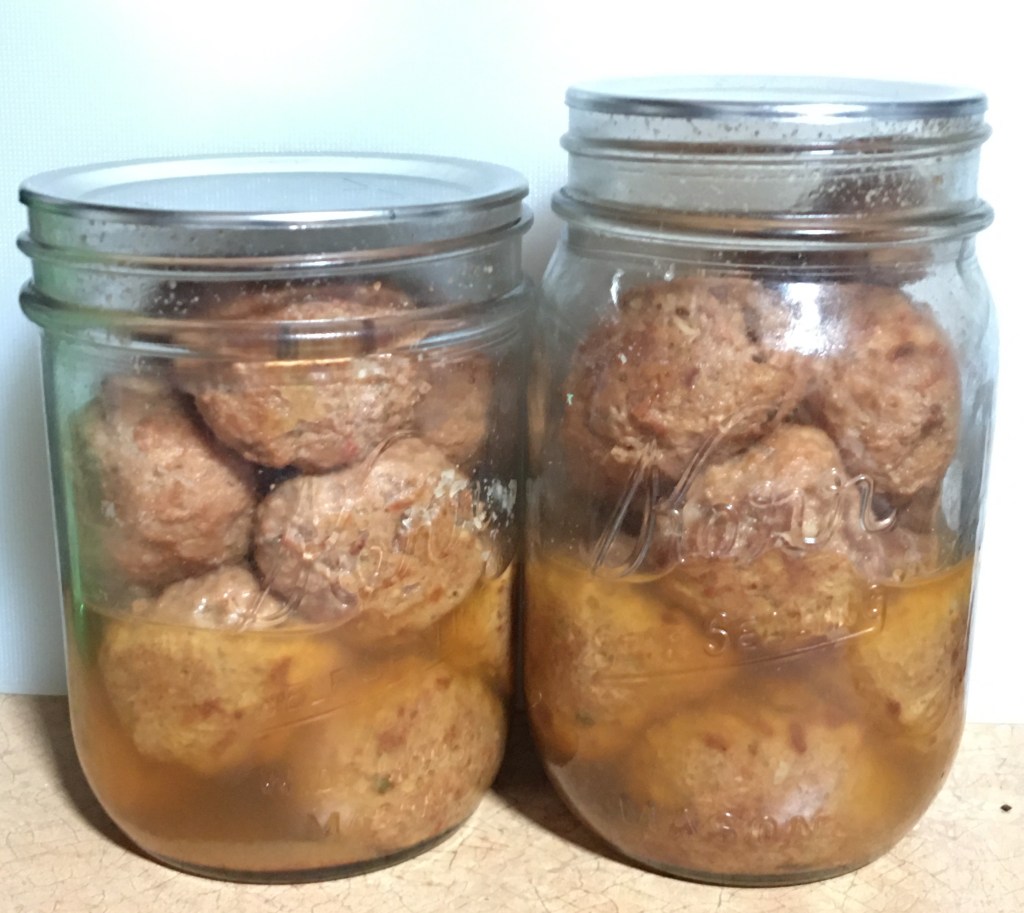
There are a few reasons why your jar siphons (loses liquid). This is a great article in covering all the possible reasons. I want to point out what it looks like.

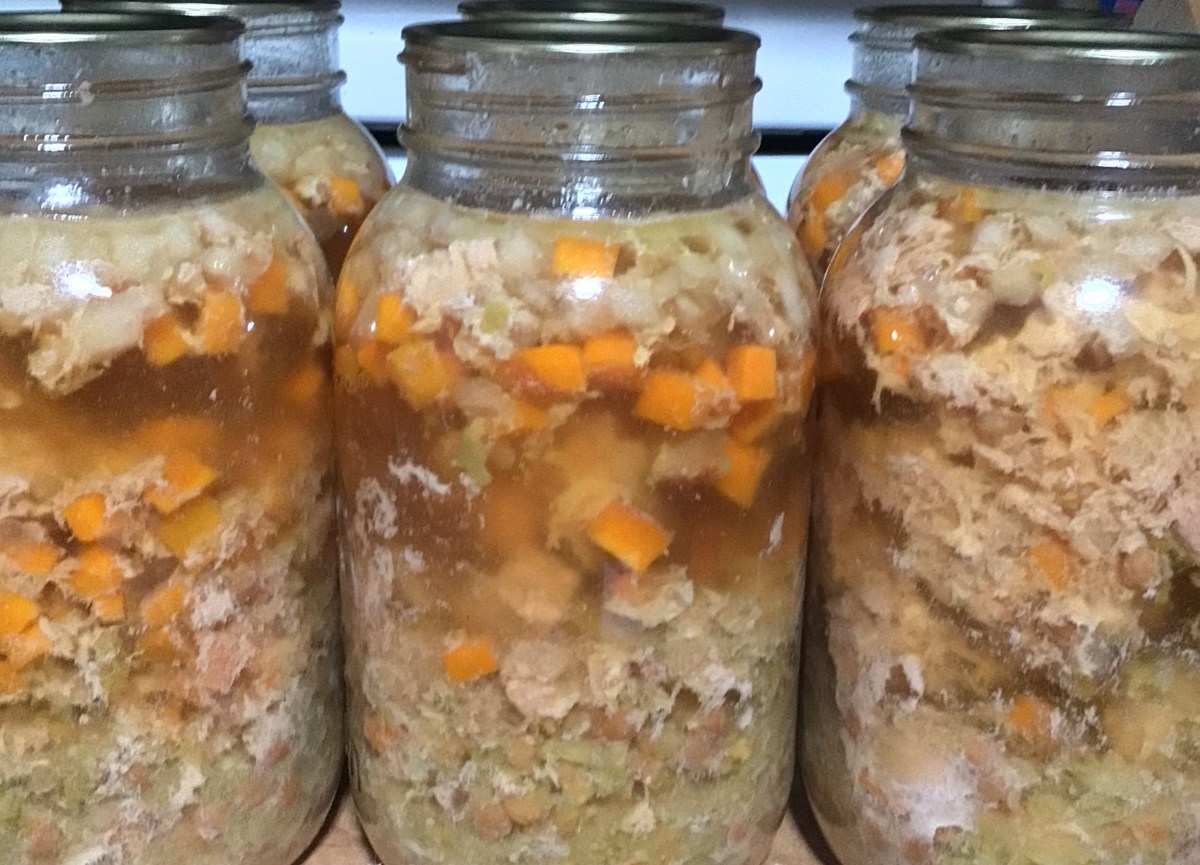
This is one of my canning sessions. These two were the only two jars that siphoned, out of the 7 in my canner. Both lost over half their liquid before sealing. Truth be told, I have no idea why these two failed (losing half a can of liquid or more is a failed seal). But with this much liquid missing, there was no way I could put these on my shelves. I could have put these in my fridge to eat the next day. Instead I chose to put in more beef stock and re-can them with a fresh lid. (They didn’t lose any liquid the second time.)

Siphoning is only a problem when you lose a drastic amount of liquid like this. Otherwise, siphoning is a common occurrence in canning and generally not a problem. Any meat (or other canned product) above liquid line will be discolored over time. It’s still good, just not visually appealing.

An interesting story is that I never learned how to pressure can from my mom or grandma, because my grandma tried pressure canning and could not figure out why she kept siphoning like this. After a few fails she just called it quits. Mom was pretty impressed when I had this conversation with her. The bottom line is that technology is pretty amazing in this day and age, where we can teach ourselves new skills and problem solve with a little research.

So please know that if siphoning was a problem with your previous attempts at pressure canning, know that making one or a couple adjustments can solve this problem for you and you can prevent it in the future.

Back to the Meat Save

As I mentioned earlier, I was so glad to have the skills to can the meat from my freezer. At first my husband was freaking out because he thought it was all lost. (And the freak out would have been rightful had I not been able to save our meat.) But his reaction is what most people have. Especially with food prices so high.

I cannot tell you the value of the calm of pulling out the pressure canner and setting up for an unplanned canning session. The best feeling of all was knowing that the whole incident was not a lost moment. My husband learned how to can meat. Up until this moment, it was something that I did and he just popped into the kitchen to find out how I was doing. But now, if we have a moment where we have to marathon can again, we can take shifts and not lose out on sleep or meat.

What are your plans for the coming storm season?

Are you prepared for a moment where your fridge is not working for you?

What cooking sources do you have for a no power situation?

Some ideas I would like open for consideration is pressure canning soups, meats, and vegetables. In a worst case situation, these are safe for you to crack the lid and eat straight out of the mason jar. Or you can warm them in the matter of minutes over your grill.

Another option is freeze dried foods. All you need alternate fuel for is to boil water. The water can then rehydrate full meals for you that are warm.

I know power outages are hard on the whole family. But by thinking in advance, it is possible to turn it into more of an adventure instead of worrying about food loss (by opening and closing the fridge) or getting burnt out by cold food.

If you’re interested in new recipes that require nothing more than a camp stove, this is the first site that I go to search, Trail Cooking. Under her tab, Trail Cooking, Sarah has an amazing list of recipes. Usually I find a handful of interesting recipes on most sites. Here, I have a list that rivals the lists I have for my cookbooks on my shelf at home. So please be sure to check out her menu offerings!


If you’re not yet into canning but still would like to prepare for no power meal options, check out The Good Steward.