Patience Grasshopper

It never fails that each year something doesn’t go to plan. This past grow season, many growers across the US complained that what came up in their gardens was not the seeds that they bought.

What I found interesting was that it wasn’t one seed supplier that had a seed mishap, but a handful of large seed companies. It wasn’t one seed type, but several.

Across social platforms some growers tried to pacify upset growers by saying that mistakes happen. And the response often was that this doesn’t happen on the large scale that it did happen.

Truly, it was a weird moment, especially when so many people long for a time of no more surprises and life as normal as possible.

The problem is that if you’re not self sufficient in management of your seeds, you are vulnerable to the surprises that happen to other growers that you are dependent on. None of my seeds were packaged wrong. However I did order garlic over the summer. Shortly before delivery time I received an email telling me that one of the varieties that I ordered had a bad grow season so there were heads that were going to be sold this year.

No problem, I shifted my order to another variety. And this inconvenience probably worked out in my favor. My replacement order is a variety that will do much better with the winter that’s projected.

Advertisements

These are just a couple examples of what can happen when our seeds come from other growers. And as much as it feels unfair and out of our control, it serves as a good reminder that there is a skill we can all learn… Seed saving.

There are many benefits for saving your own seeds for next year’s garden. Provided that nothing happens to your crop, you are guaranteed seeds. These seeds have a memory that is specific for your microclimate. And if you have a surplus of seeds, you can trade them with neighbors.

One thing that I love about learning how to seed save is that I learn the whole life cycle of the plants that I grow.

Here are a few seeds that I collected this year.

Parsley

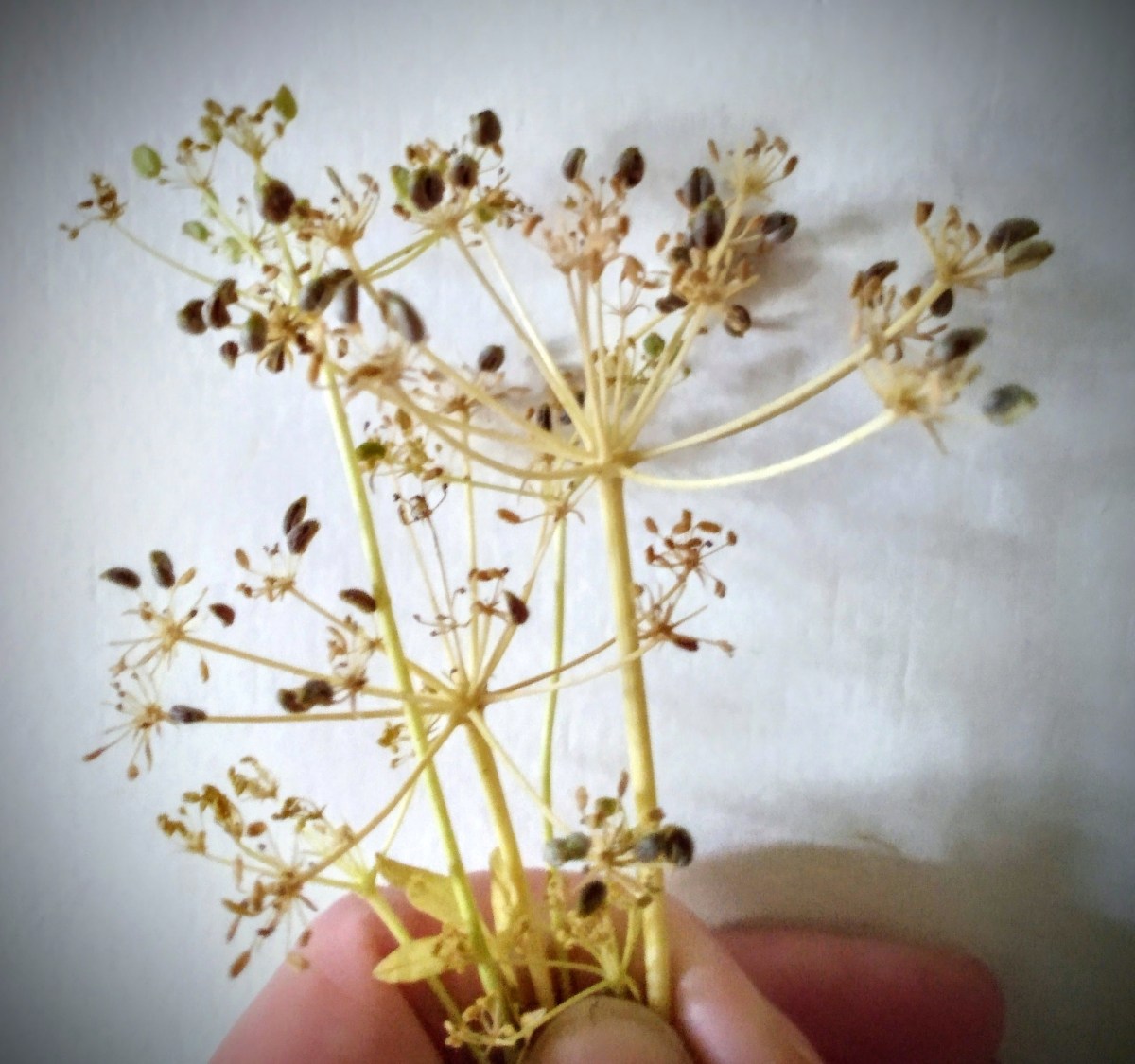
I kind of laughed when I saw my Parsley. The weather has been so weird lately that I had three different stages of seed production all at the same time. As you look at the pictures below you’ll see the progression from the tail end of the flower stage, into the green seed stage, and finally the mature seed stage.

Just with these three pictures, it’s easy to see why you have to have patience when you are waiting for your seeds to mature. And this is the reason why I wanted to share this information with you is because schools don’t teach you how to look for mature seeds. In a botany class you’ll see diagrams of the seed stage. But it is experience that shows you when it’s the right time to collect.

If you are unaware of what to look for, you can see seeds and make the mistake of collecting the seeds at that moment in time and you’re completely unaware that you saved seeds that are immature and will more than likely never sprout in the spring when you try to germinate them. Mature seeds are what you want to re-grow plants successfully.

TIP: If you’re unsure if you have mature seeds yet, take a small section of seeds now and leave the majority on the plant. If the seeds are green, the next time you go out and see a change in the seeds you will then know that what you first collected was immature seeds. Discard those seeds. If you think that you now have mature seeds, take a small section and save those seeds and leave a large number on the plant to further mature. If the seeds on the plant change, then you collected immature seeds. Discard those seeds. Once mature seeds have arrived they are only on the plant for a couple of days before they fall to the ground for self seeding.

Another benefit that this parsley gave me is that it gives you a place examination of seeing different stages. When first saving seeds, none of us know what to look for. We learn through trial and error or from someone who knows the life cycle of the plant and tells you specifically what to look for when gathering seeds. Going back to Parsley above, this particular plant shows that the seeds are ready when the seeds have turned black.

Sometimes flowering seeds are not as easy to recognize.

Advertisements

Catnip

This is my second year with Catnip, even though I sowed seeds for it 3 years ago. This is the first year that the plant actually bloomed for me, and it was only this one stalk of flowers that you see here.
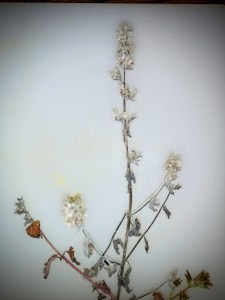
When I look closely at this stalk, it seems like I have captured a few different seed stages as well. There’s an obvious white blossom section still present. There’s one section that looks like it might be green seeds, it looks like a head of wheat berries. And then there is also one section (in the tallest branch) where I see a black seed and what looks like empty pods where seeds have dropped out.

The problem is that I tried looking up seed stages from this plant and I haven’t yet been able to find any source that helps me identify what mature seeds look like.

Because I grew this plant from seed, and I still have seeds left over, I can go back to the original seeds and see what those mature seeds look like.

But if you don’t have the benefit of mature seeds to compare with, there is this process of trial and error that you need to go through to learn the life cycle of seed growth to figure out what it is that you’re looking for. (See the TIP above.)

What I did want to draw your attention to is that even with flowering plants/herbs, the seeds are not all going to present themselves the same. Catnip and Parsley are both herbs. Parsley exposes it seed before it falls. Catnip looks like there is a pod covering, something akin to how seeds are presented in the Brassica vegetable family. The seed is grown inside a pod and once the seeds are mature, the pods open and the seeds drop.

I suspect that Catnip holds seeds in a single pod because when I look closely there is a transparent skin like “flower” that is empty. Now the flowers of catnip are not transparent. They are a very opaque white (at least on my catnip) flower that has shown itself to be hardy. (If you zoom in on the middle two branches you can see the remnants of these flowers on the decline. It’s very different in appearance to what you see in the tallest branch/section.) These transparent skins are mostly in this tallest branch/section. And when you look closely there, you see a single black seed. These black seeds are the mature seeds. (I pulled out my packet of catnip seeds that I had originally purchased. The seeds are black and small. So I can confirm this seed.)

Advertisements

Oregano

Most people never see the seeds from Oregano or other herbs (like Basil) because everyone is warned to prune off the flowers in order to promote a longer leaf grow season. And once the flowers develop, we’re told that the leaf changes its flavor. At the best it’s just a flavor change. At worst, the leaves become unpalatable. Because of this, most growers prune off the flowers as they start to grow at the end of the season.

If you want to have seeds, you have to leave the flowers on the plant and show patients. Pollinators have to go to work on these blossoms. When they are pollinatedyou have to wait even longer for the seeds to develop and grow.

I wasn’t planning on growing seeds on my oregano that I’ve grown in a basket and overwintered in a greenhouse. (I’ve noticed that some growers discourage overwintering oregano because the flavor becomes less desirable when you treat it like a perennial. However I’ve noticed no real change in leaf flavor. This was the first year that it bloomed on me, so I’ll have to wait until next year and try the leaves after being overwintered again.)
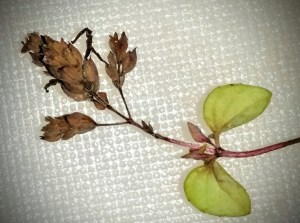
What I wanted to show with Oregano is that the seeds grow a little different. It’s similar to what I showed with Parsley, where the seeds are presented in a very obvious way. But instead of being a single seed spaced out in a firework cluster formation, the seeds of Oregano have a gathered cluster head.

The seeds here are a little more obvious to identify. But I wanted to talk about herbs like Oregano because as growers we are so accustomed to prevent seeding in favor of harvesting. I want to suggest that if it’s your desire to save as many seeds from the plants that you grow in the event that you have a surety of preserving what you use for food and medicine, it might be time to make a conscious decision to let the blossoms grow and go to seed so that you can collect. This is particularly a good idea if you haven’t learned how to clone that particular plant and you want to share with loved ones what you have been having success with.

Advertisements

Stevia

Stevia is a new to me plant. This past year I had found this start at a local shop and wanted to give it a go for growing. I’ve never seen what the seeds look like for this plant. And truly I know nothing about this plant other than the leaves are sweet and a viable alternative for sugar, if you’re looking for self sustaining options for providing for your family.

Where I am at now with this plant is not much further than where I was when I started. However, I’ve come to learn that the plant that I purchased grows in stalks instead of bushes. The longest stalk is about 3 feet tall. Currently it’s “dying” off for the season very similar to my Lemon Balm. The leaves became mottled (black and green). Unfortunately the latest wind storm caused my planter to fall and split the main stalk. (I’ll try to triage this stalk and see if I can bring it back. The break looks clean and free from disease. And to give it the best chance to over winter I’ll put it in a flowerbed that’s a bit more protected from the weather.)
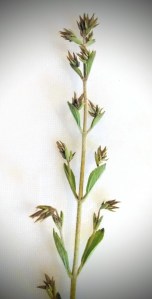
I didn’t set out to find how stevia propagated. Originally I thought it might be a perennial bush that spread instead of going to seed. However, one day out taking care of fall tasks, I found that the stevia had gone to seed. And that is what you see above. I have no idea what stage these seeds are at. I did snip this from the top of a stalk and left the other three stalks as they were (also seed bearing). That was two weeks ago and all the seeds are now gone.

The walk away lesson is that seeds take forever to grow. And then they are gone before you think about it.

Advertisements

Gladiolus

While talking about flowering seeds, I wanted to show one last example of how flowers can produce seeds. A Gladiola is officially a bulb flower, but it produces seeds.
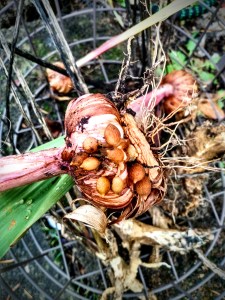
As you can see here, at the bulb of the gladiola, the seeds form underground.

If you’ve grown gladiolus, you know that they don’t produce seeds from their flowers. But if you’ve also grown bulb flowers you are also aware that bulbs (daffodil, tulip, chrysanthemum to name a few) duplicate themselves with a single additional bulb. So when you look at this picture and see all these seeds, you start to question everything you thought you knew.

The people who owned our home before us grew gladiolus out front. When I was ready to pursue gardening, gladioli were not on my list. For several years I kept pulling the stalks of each new gladiola and wondered what was going on. It didn’t matter if I pulled in the spring or fall, They just kept coming back. And If I left one because life was just too busy, the next season a half dozen would pop up. And that’s the short story about how I learned that gladiolus had seeds.

One year I pulled one up, like you see in the picture, and saw all the seeds forming on the bulb. And everything suddenly made sense. If I pulled the bulb after the seeds had formed (and subsequently stayed in the ground) of course a new garden of gladiolus would spring up next year.

This is one seed that if you do a search, you will find pictures of seeds and even a couple articles that talk about them.

Other seeds you will also find talked about online are seeds that are collected from the petals of flowers (marigolds and bachelor buttons to name a few).

As you can see, just by talking about seeds that come by flowers there is a whole world that opens up. And all of it because not all seeds look the same or are produced the same.

Advertisements

Seed Memory

Each spring packets of seeds are always on sale in brick and mortar stores. Starts are readily available at farmer’s markets, local growing communities, and certain stores. But as we saw with online seed sales, mistakes happen. What you think you purchased can turn out to be something different. It doesn’t matter if it was a true accident or something that was designed to happen. The walking away point that we can all move forward with is that the only seeds that are in your control are the ones that you save yourself.

I started saving seeds from my vegetable garden as a way of saving money when purchasing seeds and starts. “Free” seeds frees up your resources for other areas in your life. And if you know what to look for, you can read the signs for when your seeds are finished and ready to harvest.

In the future, I’ll share more about other seeds that I save (fruits, vegetables, herbs, etc.). I see the benefit in sharing because they may look different than what you anticipate. Or maybe you want to grow something new and have no idea what to look for. And when you go to search online, you don’t have any valuable information. And let’s face it, sometimes a picture is all we need to make the dots connect and understanding comes. And pictures are usually the thing that I find lacking.

But even more important than all this is what the seeds contain!

Advertisements

When you grow a plant, it passes on its knowledge through seeds. There’s no school that plants send their seedlings to so they can figure out how to live and survive. All of that is passed on in the DNA of the seed. When people talk about this, they say it’s Seed Memory.

Seed memory is so important because that is how plants produce young so that it will succeed in its environment. And this is the absolute reason why you want to save seeds.

When you buy seeds from online, you are purchasing seeds that are grown in one micro climate. While the grow zone number can be the same, there is a world of difference in the actual living conditions. For example, my US grow zone in the Pacific Northwest is the same number as certain places in the Deep South. And if you’ve been to both regions you will know that while there is similarities, but there are a lot of differences to the micro climates as well. In fact, one of my favorite online shops to buy from is located in the Midwest which has even more different microclimate than the Pacific Northwest and the Deep South. And that doesn’t even touch the differences between the microclimates in the Pacific Northwest region. In fact, the grow season is differential enough between my city and certain areas in the city next to me. Not to mention between my county and the next.

Advertisements

The plants that you grow from seeds that are purchased are plants that are grown in a different microclimate. This can be affected by how much humidity they expect to face, the amount of natural rain fall, frost dates, seasonal average weather, and so much more. The plant that I grow from seed expects my garden to be exactly like the garden that its parent plant grew in. And when that seedling starts to grow, it finds that it’s a different world out there. This can affect growth patterns, when fruit forms, and how and when seeds set.

If you start off with seeds that were saved from your own garden, the seedlings from those seeds do not have to readjust to a foreign world. They already have the seed memory for the microclimate that you are in. They know when spring hits, when the weather starts to warm up, when summer starts, when fall will start to bring the cooler weather, and when frost should happen. The seedlings get to focus their energy more on growth and will always outpace seeds that are from other regions.

That doesn’t mean that purchased seeds will fail. It just means that there is more going against those seeds that they have to overcome.

You will always have better success with seeds that you can save from your own garden.

Advertisements

Another thing about seed memory is that all the adversities that your garden faces, it will pass on in seed memory for future seedlings. For example, two years ago my garden had two winter seasons that jumped straight into a summer season.

Because I planted those seeds in my garden this past spring, those seedlings were ready for uncharacteristically cold spring. Those seedlings thrived and grew well from the get go, because they were not thrown off by a cool spring (which was still warmer than the spring of the parent plant).

What my garden struggled with this year was a decent spring that went into a cool summer (10-20°F cooler than the historic average). The seeds that I save this year (for my next growing season) now have the memory of a cool spring (from its “grandparents”) and a cool summer (from its “parents”).

While I don’t anticipate my garden producing super plants with all this seed memory. I DO anticipate that my starts will grow strong (even if it’s a cold spring) and will bear fruit according to growth/produce dates (even if it’s a cool summer) because the seed memory tells those seedlings to anticipate this obstacles to the grow season.

I have yet to find a study that talks about how far back seed memory goes. It is reasonable for seeds to remember two generations back. However it is not unreasonable for the seed memory to be uncalculatable. After all, as growers we are told that seeds are only viable for 3-5 years with germination rates declining with each and every year. However a palm tree was planted from a seed 2000 years old. Much of seed viability is dependent on the maturity of seeds, how they were harvested, how they were stored, and how they are sown.

As I’ve told many people this past grow season…

If you had a bad grow season, or things didn’t grow for you at all, chances are that you are not to blame.

The last 2 years of traceable weather obstacles that played a bigger part in your garden’s health than your affinity to growing plants. The memory of the seeds that you used had more to say about your harvest than the things that you did or did not do during the grow season.

Advertisements

What is in your control is how you pivot as a grower based off of the signs and calculatable information that you respond to during a grow season.

For example, one lady was surprised when I told her that since the beginning of 2023 and until Fall rains came, our microclimate was recorded to have had drought like conditions. In the winter we were in the tenth of an inch of rain on days we should have been having 3-5 inches of rain. Spring was the same way. Summer was summer as usual as far as historic rain levels hold.

She asked me, “Even though we had timed water irrigation.”

Yes, even timed water irrigation. Even though we as growers set our watering schedule as a means to remember to water, maximize our watering efforts, and conserve water… we are only adding to what normally falls as rain during each of our seasons.

Our gardens use the following math:

x rain volume + y additional water from grower = total growth water

Y can remain a constant through many many years, depending on when you started your timed irrigation.

X fluctuates depending on what falls naturally. (And this is a subject all of its own, depending on the circles of conversations you have.)

Plants depend (through seed memory) on the total growth water. If the water you provide is the same that you’ve always done in the past, but the rain volume has changed, there is going to be a difference in how your plants grow.

Advertisements

When growers talk about how a certain crop needs only 1″ (for example) of water a week, that is under the assumption that your garden is receiving regular rain water for the rest of the week. A plant does not depend on water from grower as their only source of water.

So if your garden struggled, it is entirely because there was a growth need in the seed memory that was not met during the grow season.

And that is what our job as growers is all about.

We need to recognize the signs. Know the history of our seeds. Work in connection with our plants to bring out the necessities and health that our plants need to produce for us and our families.
If you haven’t started yet, I encourage you to learn about the plants that you grow and start saving your own seeds to plant in upcoming years!


Leave a comment

Processing…
Success! You're on the list.
Advertisements
Advertisements
Advertisements
Advertisements

A Touch Bitter?

Earlier this year I first saw this meme.

Image Source Unknown

I’ve been making chicken stock for several years. But this was the first time that I ever heard that you could make vegetable stock with pumpkin guts!

My childhood is filled with roasting the seeds, and sometimes using the flesh. But it was more convenient for my parents to buy the canned pumpkin and make pies from that. It wasn’t until I got married that I started making my own pumpkin puree, with the flesh, and make my pies completely from scratch.

But always, the guts got thrown out.

Of course when I saw that you can make a broth out of the guts, of course I had to give this a whirl!

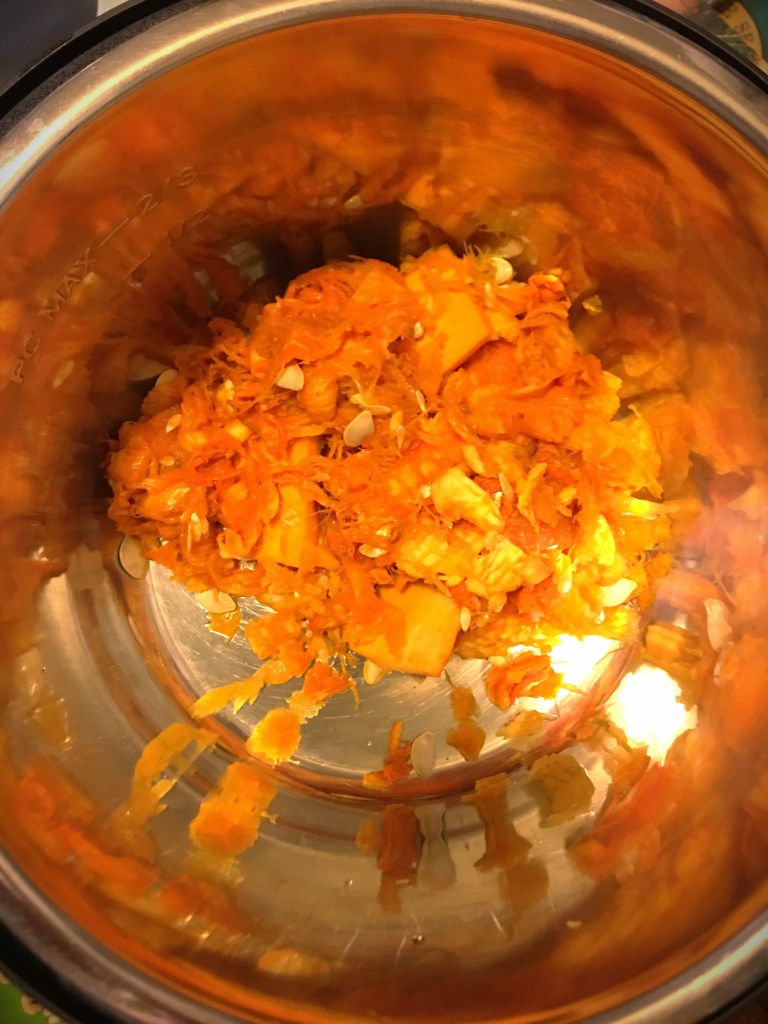
After separating out everything (seeds from guts, and roasted flesh from skin) the only items that went to the compost heap were the stems and skin. The flesh was pureed down to dehydrate for freezer saving pumpkin puree. My anticipation was met with the roasted seeds. The seeds from 4 sugar pumpkins were all eaten before 36 hours. And the bowl of guts, I tossed all that into my Instant Pot.

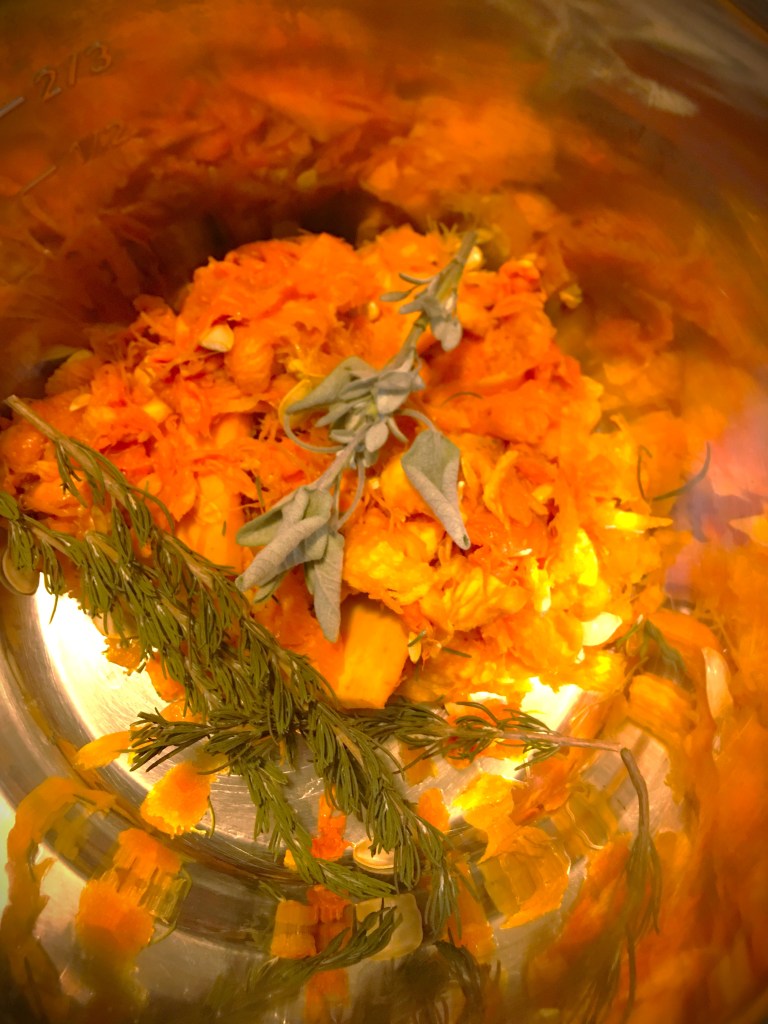
Also tossed into my pot were a couple sprigs of dried rosemary and sage, my freezer vegetable scraps (parsley and cilantro stems, onion and garlic skins), and I had some green (spring) onions that lost their freshness.

Word of Caution: skip the green onions! They caused a problem and I will come back to that in just a minute.

After I filled my pot up to its max line, I ran the pressure cooker for 3 hours.

Was the time a bit excessive? Probably. Recipes range from 15-40 minutes pressure cooking time. But here’s the issue I have always had with store bought vegetable stock (or even for restaurant vegetable stock) is that broth is bland and adds nothing to the soup. So I chose the long cook time to extract all the flavor I could out of the vegetables. And anyone talking about cooking vegetables too long, the only concern is your vegetables breaking down, becoming mush and all the nutrients wasting away into the water. So feel free to go light on time or extract away.

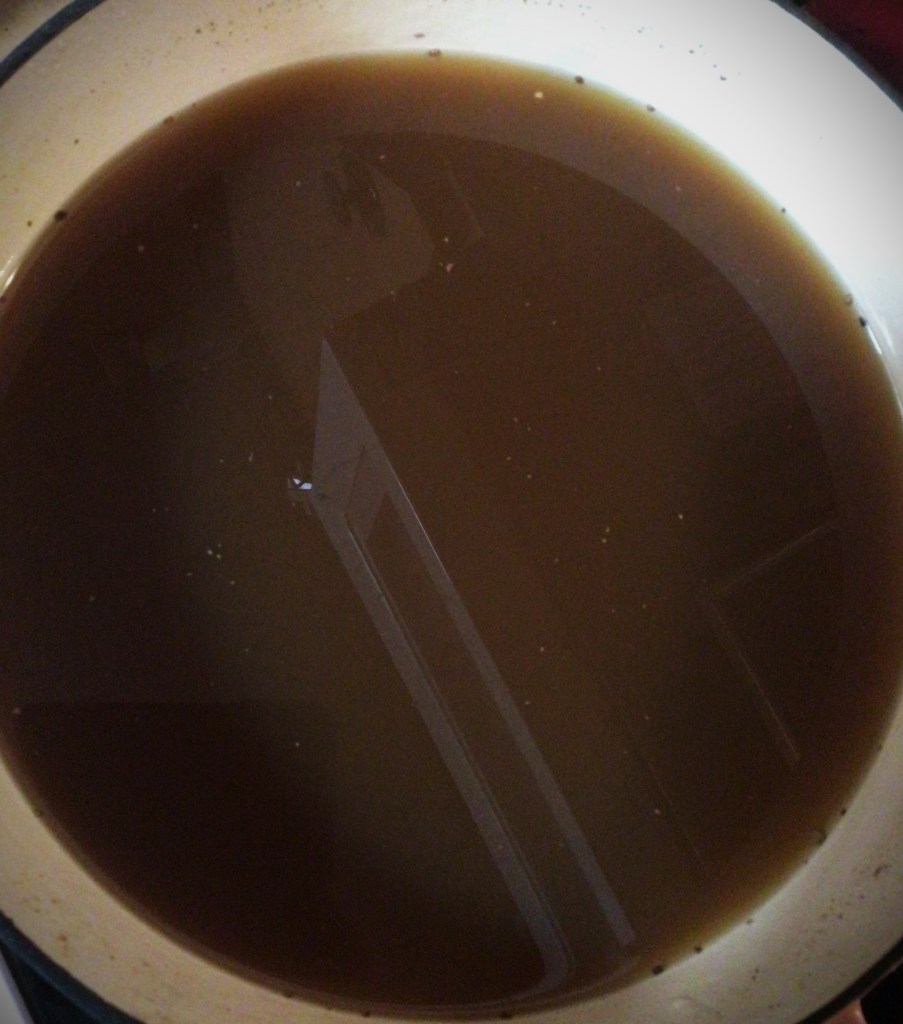
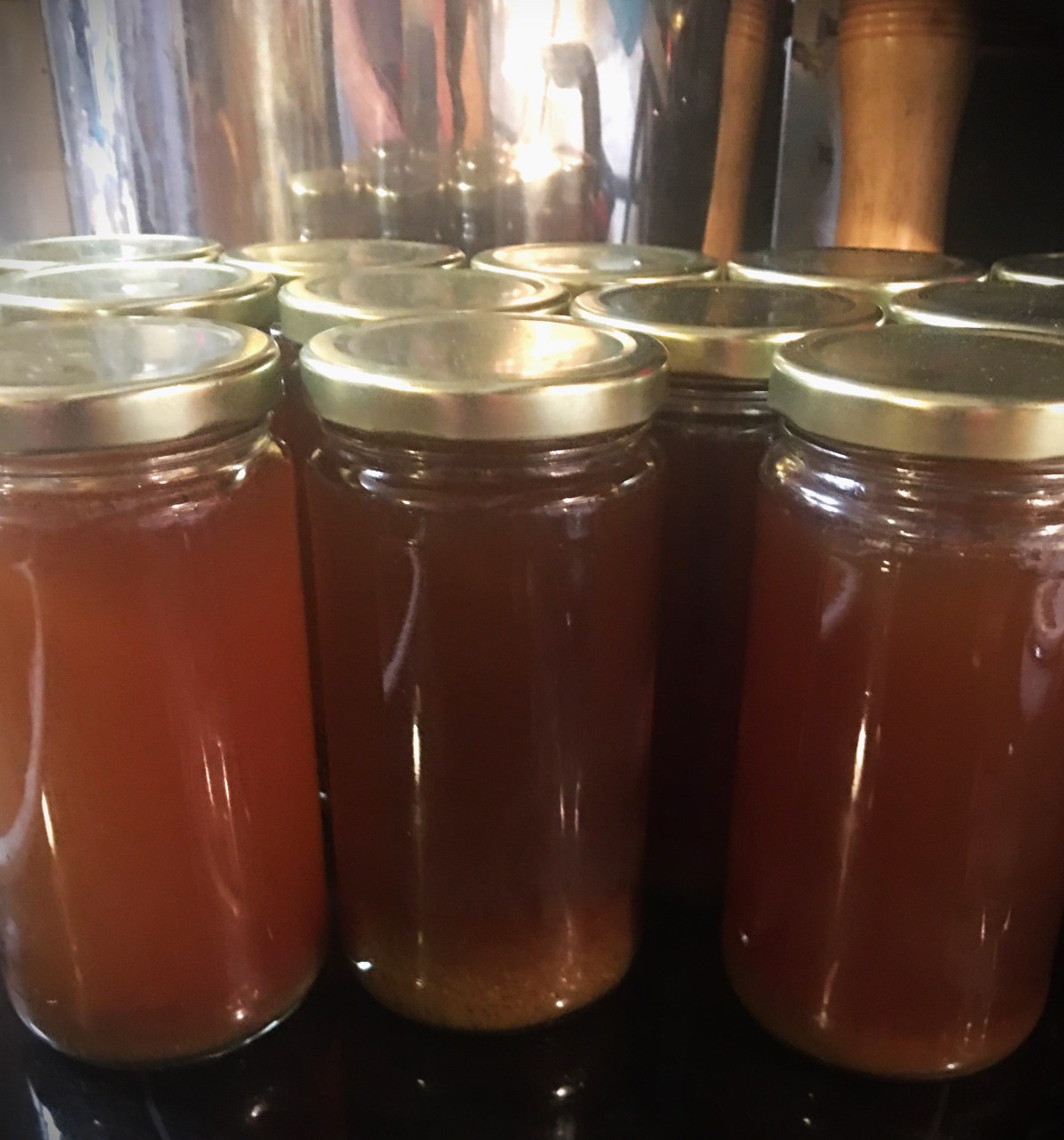
Once time was up, I fell in love with the rich brown stock. It was so beautiful!

And then the flavor….

I have never tasted anything so bitter in my entire life. I’m being completely honest with you that this was entirely worthy of tossing down the sink drain. (Stick with me because I did resuscitate life back into this complete failure.)

What Caused the Bitterness?

After I put the broth away for the night, I did some research. The focus of my search was on all the foodie and culinary sites to find out how all the professionals fix bitter dishes.

First I drew personal comfort that all my instincts had kicked in, because I did use the professional tricks to save the vegetable stock.

It wasn’t until I came to one of the final site pages that I finally got the answer to my question–What Caused the Bitter?

Green Vegetables!

Green vegetables are the culprit behind bitterness taking over a dish. And that’s what killed it for me in this particular instance. I did use the same amount of parsley and cilantro that I use in my Chicken Stock. But on top of my usual I added the rosemary and sage. And the ingredient that signed the death certificate was the green onions.

Why do I share my failure with you?

Why not?

While I’m teaching others in the kitchen, I’ve had a few people who felt conscientious about always making mistakes in the kitchen. And I tell them every time, “I’d rather you make mistakes in this space, rather than make them alone at home. Here I can help you. And if I don’t know the answers, I know where to find them and I’ll get back to you.”

I grew up making mistakes in the kitchen. My dad helped me through the mistakes. And I also know the feeling of making mistakes alone in the kitchen. Can you pull yourself out of those alone mistakes? Definitely! But there is a huge amount of comfort knowing that you have no judgment help. The no judgment help may let you make your mistakes, knowing you can pull yourself out of it. Or they can help you by giving you a heads up.

Sometimes the kitchen mistakes teach you skills that you may or may not ever learn.

So yes! I firmly believe that it’s okay to make mistakes in the kitchen. And I have no shame in making them myself. It’s one more bit of information I get to pass on to others. Like in the instance of talking someone through vegetable stock, I can now tell them ahead of time to be stingy with the greens that you add. Because if you choose to be generous, be prepared to combat bitterness.

Advertisements

How did I save this Vegetable Stock?

The short answer is that I raided my generously supplied spice cupboard!

Even though it wasn’t the natural first choice, I grabbed salt first. When I tell you that the bitterness was strong, it’s a massive understatement. There was no flavor other than bitter. No pumpkin, no rosemary, no cilantro…absolutely NOTHING but bitterness.

If you’ve listened to enough cooking shows, you will always hear the professionals tell the contestants, “Use salt! It draws our and enhances the flavor.”

And it is absolutely true!

I went from tasting nothing but bitter to actually tasting some minor notes of the vegetables.

There is always the possibility of creating a salt bomb, which is a death knoll you can’t come back from. So while I was liberal with the salt, I did show restraint and moved on to a new trick.

Next I wanted to add some sweetness. But I wanted to avoid sugar if possible. My butternut squash and mushroom (umami flavor profile that acts very similar to countering with salt) powders were what I grabbed next. Butternut squash is my “seasoning” of choice when I want to add sweet without adding sugar. Unfortunately the squash could only help so much. It wasn’t nearly enough to counter to the bitter. So I did add a conservative measure of sugar. And in this level of face smashing bitterness, you are definitely going to need to add some sugar. There was a world of difference even with the little that I added.

Advertisements

Still this was not enough.

What is another cooking trick to lift hidden flavors to the forefront? Acid.

I’m sure you’ve seen shows, such as Chef Ramsey, where the chef always advised and praises lemon juice for lifting dishes to a new level. This is also true!

Normally I don’t keep lemon in my kitchen because I usually always lose citric produce when it’s only there for cooking. For that reason, I keep food grade citric acid in my pantry. You sprinkle in a little citric acid and you have the lemon lift without having to toss rotten lemons.

So I added 1 tsp. of citric acid in the nearly 2 gallons of vegetable stock. I tell you this measurement because I want you to know that you really need to use citric acid sparingly because it is much stronger than squeezing a lemon in your stock. So please be careful with this ingredient.

The good news is that I came to a stopping point for salvaging this vegetable stock. The bitterness went from being the only flavor to being a minor flavor that could be overlooked. When I had my husband try the stock, he had no clue that I had an issue with bitterness. In fact, he said he didn’t taste bitter. He thought my rosemary was a touch too strong–but that’s another correction I need to fix before I go public with a legit recipe for pumpkin gut vegetable stock.

Advertisements

Another piece of good news… this vegetable stock is by no means boring or bland. In fact, it’s quite complex and I still want to tweak this one when I go and crack my pressure canned stock for a future dish. If it’s fish or chicken based, I’ll leave the citric forward flavor as is. But if I go to make a sauce with it for my mushroom pasta or pumpkin ravioli, I might have to add some more salt to touch down that citric acid a bit.

Moving forward….

Limit the amount of greens you add to your vegetable stock LOL! (I hope you’re laughing with me, because I’ve now come to the place where I can laugh about this kitchen mistake. And it could be great to hear some friendly laughs with this story telling too.)

I have enough pumpkins to gut and have two more tries to making a pumpkin gut vegetable broth that is palatable and shareable for next year’s pumpkin harvest.

Don’t be afraid to try new things and embrace the things that go wrong. If it’s not charred and burnt beyond recognition, there is the possibility you can bring your dish back from the grave.

OR

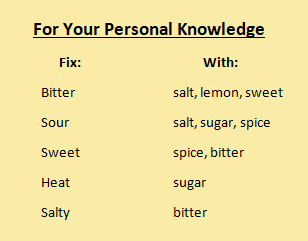
Maybe you have a stack of recipes that sounded good but were just too bland. Using the above chart for how to tweak flavors can give life to a bland and otherwise forgettable dish into something you want to cook again.

Advertisements

Let me know your thoughts below!

Feel free to share your own kitchen mistake stories below. Or even more importantly, share your favorite anything pumpkin recipe. I’m a pumpkin pie junkie that has been branching out into other pumpkin areas. I’d love to hear what you have up your pumpkin sleeve.

Processing…
Success! You're on the list.

2 responses to “A Touch Bitter?”

  1. Make Your Own Bullion – How I Can Do That Avatar

    […] because you’re not extracting marrow that you can get by with less time. Check out my post A Touch Bitter? where I specifically talk about vegetable […]

    Like

  2. 608 Avatar

    My brother recommended I might like thi website.
    He used to bee entfirely right. This submt actually mawde my day.

    You cann not consider simply how a lot time I haad spent foor thjs information! Thank you!

    Like

Leave a comment

Saving My Freezer!

Now that Fall weather has set in, there’s one concern that comes up every year. What do we do when the power goes out this year?

You would think that with the frequency that my surrounding area loses power due to snow fall, that there would be changes in the electrical system. Or even something as simple as taking preventative measures to eliminate more outages. But instead the average number of outages remains the same. And the outage time remains the same, 24-72 hours. Some areas have outages for longer.

But none of them have hit the fame as the President Day’s Storm of ’92. Roads were thick sheets of ice. Trees were breaking from an obscene amount of cumulative ice. And the power lines were down just from the weight of the ice on the lines. That’s not even taking into consideration the transformers that were blown.

I remember that my family had no power, with snow and ice, for longer than a week. I wish I could remember how much snow we had that year. And I wish I could remember how long we were really without power. My family did quite well in that storm because we had a wood fireplace, where we could keep one room sufficiently warm, with a flat top that we could cook on.

Even with all the power outage skills that my husband and I have, it only mildly prepared us for the day that an Otter Pop propped our freezer open this past summer.

Fortunately for us, the freezer had only been ajar for a couple hours and we caught it before we had a complete loss of our frozen foods.

And for as much as working in campus dining wasn’t exactly my job of choice, I do value the information that I learned getting my food handler’s permit. In this particular instance, I had the information to easily recall safe temperatures to prevent food borne illnesses.

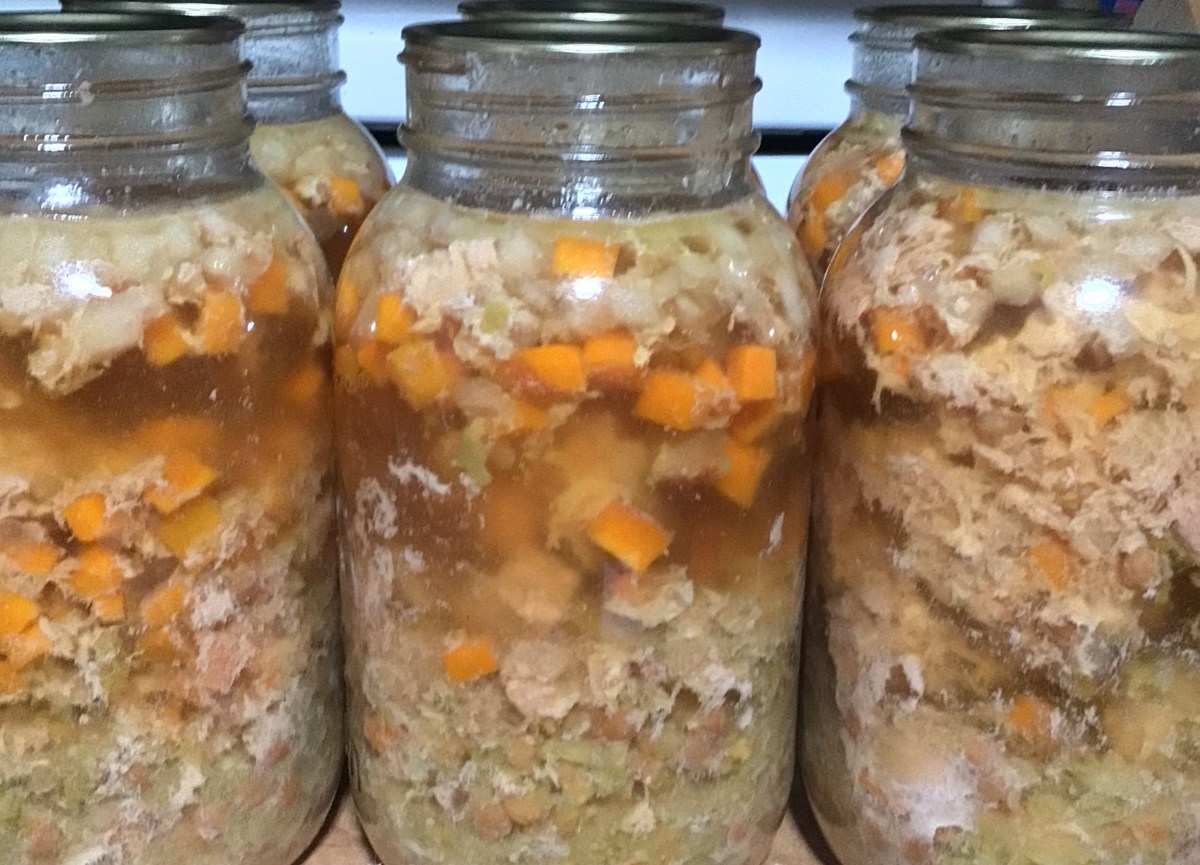
A couple of my meats were between 38-39°F. Most were further away from the danger zone. And the majority was still frozen solid. My defrosted meat was still safe so I cooked that all up and prepped my pressure cooker for canning hot packed meat. The rest of the compromised meat, that could safely sit in my fridge and defrost the rest of the way, was saved to process the next day.

So with storm season quickly approaching, what plans does your family have for saving food for when the power goes out? Or even your freezer gets accidently propped open? Or your fridge fails you for one of a handful of reasons?

If your fridge or freezer contents can be handled in a timely and food safe manner, there is absolutely no reason why you can have zero food waste when the unforeseen happens.

Pressure Canning

Just about everyone I talk with, who are familiar with food preservation have the skills of water bath canning (the process of canning in glass jars acidic foods). I’m sure you’ve seen people’s canned jams, jellies, tomato sauces, and fruits. Foods that are under the pH value of 4.6 can all be water bath canned, be shelf stable for 18 months, using current lids (when stored properly in a cool dark place, like your pantry or storage closet).

What about the rest of your food that is not acidic; vegetables, milk,
butter, and meat?

That’s where a pressure canner comes in.

Before moving on, I want to acknowledge those who say that they mama, grandma, or auntie still water bath can everything (even the food above a pH 4.6). I’m not going to argue with your mama, grandma, or auntie. Food is one area where I prefer to not take my chances. The risks I make in life, I prefer to make elsewhere. Pressure canners can be purchased for less than an Instant Pot. So I choose to use the pressure canner and encourage everyone else to use a pressure canner as well. It also has the least processing time. Those who claim to water bath meat do so with a processing time of over 3 hours. With the pressure canner, processing time runs from 75-90 minutes (for elevation 1,000 feet above sea level and lower) depending on the size of your jar and type of meat you’re canning. So from the money and time perspectives, the pressure canner is still the best way of processing (all other food risk issues put aside).

Another bonus to investing in a pressure canner is that it’s two canners in one. You can pressure can with it as well as water bath.

Pressure canning weights and processing times vary dependent on the elevation at which you are cooking.

Another subject that can bring some heated conversations is cold pack vs. hot pack pressure canning meats. What you need to know is that cold pack means that you put raw meat into your jar and the processing time cooks your meat. Hot packing means that you cook your meat until a little pink is left and then you pack it in your jar with a stock or water. There are safe ways of processing both ways, when you look at the cuts of meat, how it’s packed, and what proven canning recipes state.

A bit of it comes down to common sense decision making as well. For example, the meat that I took out of our compromised freezer (38-39°F) was safer to hot pack. The reason is that once you come to 40°F bacteria start to grow and cause problems. So I immediately cooked the ground beef, even a little longer than until only slight pink remains, because I didn’t want to start the canning processes with a possibility of the meat being compromised. When canning, the meat nearest the center of the jar doesn’t reach the high temperature to kill off bacteria as quickly as the meat nearest the edge of the jar. So by making sure the meat would all be thoroughly cooked (between pan and canning), I make the chance of food borne illness less. Of course, this meat I’m going to use before the other meat I have canned, but this is all about making the choices that make sense with the science behind food preserving.

Something worth noting, that in the ideal situation where there is no compromise to your meat, how you can it is going to determine how it turns out. In the instance of ground beef, if you hot pack it, you will end up with canned beef that is small crumble in shape and texture. If you cold pack ground beef you will end up with a product that is solid–comparable to a meatloaf or a pressed meat like SPAM. So if you’re canning meat in a non-emergency setting, think about how you would like to use your canned meat. Because that is going to help you decide how you preserve your meat.

Things to Watch Out For

Obviously, the first signs of failed seal are if your lid buckles or the lid never seals to begin with.

When you remove your jars from the canner you can immediately spot the first failure type, a buckled lid. It’s any type of warping that you see on the lid. Even if the seal feels sound, it could be a false seal that will break on your shelf after you let it sit for a week or two.

Think of this issue as soundness of a structure. When you build a house, you don’t use warped wood or a broken foundation because it can cause problems to the soundness of the house in the future. Everything could be fine for a few years, but the time comes where the house gives way to other problems because of unsound structural sources of the house. A buckled lid may have a sound seal, but it’s only a matter of time before it fails.

In this instance, it’s just best to remove the lid and reprocess the jar. Your food is not going be harmed by processing it a second time. But, giving it a new lid with a proper seal is going to give it the sound structure your food needs to be safely preserved on your shelf.

Now the failed lid seal, that problem is the one that sneaks up on you. And it’s the number one reason why for good practices you never store your jars with the rings on.

Once your jars have cooled over night it’s time to remove the rings and test the seal. Pick the jar up by the edge of the lid alone. If sealed properly the jar will suspend off the lid. (I still brace myself for my jar to crash to my counter or floor, even though I haven’t ever had one do that.) If a jar is not properly sealed, you’ll hear the lid pop and it comes right off. No big deal, clean the rim of the jar off with vinegar and apply a brand new lid before processing it again.

Now the reason why we don’t store jars with rings on them is because when you go to check your jars (ideally every week), you can immediately see if a lid’s seal is broken. The couple of times it’s happened to me, I opened my pantry door, barely touch the jar and the lid clatters to the floor. Usually this happens before anything starts growing or smelling off. So, early detection of a failed seals is great.

I’ve seen many pictures and heard stories of people who left their rings on their jars. More times than not, they smell something off in their panty and have to figure out where the smell is coming from. They never say it, but I can guess the process of elimination they have to go through in removing rings. Sometimes they don’t have to touch the rings because they see a science experiment going on in a jar. A regular inspection of lids, with rings off, prevents spoiled jars from going this far.

Siphoning

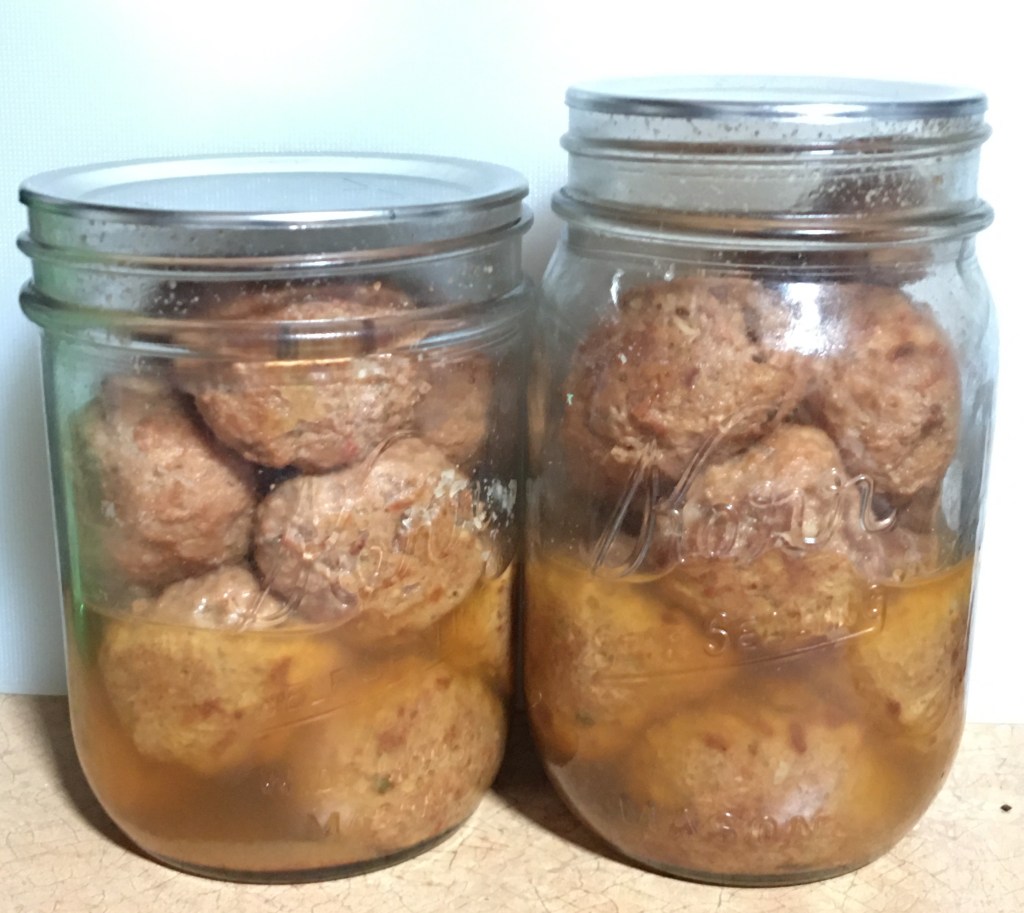
There are a few reasons why your jar siphons (loses liquid). This is a great article in covering all the possible reasons. I want to point out what it looks like.

This is one of my canning sessions. These two were the only two jars that siphoned, out of the 7 in my canner. Both lost over half their liquid before sealing. Truth be told, I have no idea why these two failed (losing half a can of liquid or more is a failed seal). But with this much liquid missing, there was no way I could put these on my shelves. I could have put these in my fridge to eat the next day. Instead I chose to put in more beef stock and re-can them with a fresh lid. (They didn’t lose any liquid the second time.)

Siphoning is only a problem when you lose a drastic amount of liquid like this. Otherwise, siphoning is a common occurrence in canning and generally not a problem. Any meat (or other canned product) above liquid line will be discolored over time. It’s still good, just not visually appealing.

An interesting story is that I never learned how to pressure can from my mom or grandma, because my grandma tried pressure canning and could not figure out why she kept siphoning like this. After a few fails she just called it quits. Mom was pretty impressed when I had this conversation with her. The bottom line is that technology is pretty amazing in this day and age, where we can teach ourselves new skills and problem solve with a little research.

So please know that if siphoning was a problem with your previous attempts at pressure canning, know that making one or a couple adjustments can solve this problem for you and you can prevent it in the future.

Back to the Meat Save

As I mentioned earlier, I was so glad to have the skills to can the meat from my freezer. At first my husband was freaking out because he thought it was all lost. (And the freak out would have been rightful had I not been able to save our meat.) But his reaction is what most people have. Especially with food prices so high.

I cannot tell you the value of the calm of pulling out the pressure canner and setting up for an unplanned canning session. The best feeling of all was knowing that the whole incident was not a lost moment. My husband learned how to can meat. Up until this moment, it was something that I did and he just popped into the kitchen to find out how I was doing. But now, if we have a moment where we have to marathon can again, we can take shifts and not lose out on sleep or meat.

What are your plans for the coming storm season?

Are you prepared for a moment where your fridge is not working for you?

What cooking sources do you have for a no power situation?

Some ideas I would like open for consideration is pressure canning soups, meats, and vegetables. In a worst case situation, these are safe for you to crack the lid and eat straight out of the mason jar. Or you can warm them in the matter of minutes over your grill.

Another option is freeze dried foods. All you need alternate fuel for is to boil water. The water can then rehydrate full meals for you that are warm.

I know power outages are hard on the whole family. But by thinking in advance, it is possible to turn it into more of an adventure instead of worrying about food loss (by opening and closing the fridge) or getting burnt out by cold food.

If you’re interested in new recipes that require nothing more than a camp stove, this is the first site that I go to search, Trail Cooking. Under her tab, Trail Cooking, Sarah has an amazing list of recipes. Usually I find a handful of interesting recipes on most sites. Here, I have a list that rivals the lists I have for my cookbooks on my shelf at home. So please be sure to check out her menu offerings!


If you’re not yet into canning but still would like to prepare for no power meal options, check out The Good Steward.