

With inflation of food prices and rumors of food shortages, it’s really been on my heart about how and where my family sources its food. My heart especially breaks because if not in my own communities, there are most definitely places in this world where people will die from lack of food. I have connections with people outside of the US and it breaks my heart with just how food vulnerable people are.
My choices in food sourcing are not going to help people in different countries. Although I love my dream world where people in first world countries make individual choices, where as a collective all the extra food we don’t claim for ourselves gets reallocated to countries, places, and communities that are in more of a dire need of. That is my naive side that I hang on to, because I know full well that this is not how the world works.
So I focus on my local community. I have neighbors who are more food vulnerable than I am. So in being sensitive to my neighbors, who I can help, I have been changing how I shop to produce the foods from scratch that I have the knowledge to make. At various times I’ve seen the bread and dry pasta shelves bare. Even with stock at a good sale price, I still I don’t buy those items because these are two commodities I can make for myself. By not making those purchases, it frees up those resources for the families who don’t yet have the skills to make those products for themselves.
But I’m not content with just providing for my family. Not when I have the ability to help other families to provide for themselves.
Today I am focusing on helping anyone who wants to learn how to make their own bread.

I don’t know about your local market prices, but a loaf of bread runs for about $5. This does not mean that there isn’t cheaper bread to be had. But this is the average price if you look at all the shelf labels. Before my boys were born the average price was $1 a loaf, no matter what the brand name. So if for no other reason, now is a good time to learn how to make bread so you very easily can see how you can save a couple dollars every shopping trip, where you can use elsewhere in your family budget.
I want to teach you how I made No Waste Starter.
Why is this important?
When I made my Covid-Starter I researched the heck out of making a starter and the different schools of thought for bread making. Every starter tutorial out there always starts with a rather large quantity of flour and each day you throw out or discard cook half your starter. Even two years ago my thoughts were about how much of a waste of precious resource this method is. At the time flour was very plentiful, but my head went to where I can make bread when I don’t have flour to waste. And now we are most certainly in a time where many people are now finding themselves in a place where flour cannot be wasted.
I present to you my photo journal from two years ago where I made starter without discarding.
Being a historian, by education, I was fascinated with how bread has been made through the history of mankind. The feature that took over my creativity is the bread trough/bowl. Before mason jars, that we all use today, or starter crocks families used a wood trough or bowl to keep their starter.
Please note that you need to pay attention to your starter if you are using wood products to make your starter. Make sure the wood dish is clean and free of chemicals. Also note that wood holding liquid can bread bacteria. When making starter, there should be no colors or scents coming from your starter. New starter will not begin to have a sour smell until the end of a week. So if you find mold, spores of color, or any scent that does not smell like sourdough bread, throw out the starter and begin again. Wood products are viable vessels. But note that all of these potential contaminations can be found using any vessel, not just wood. So make sure your vessel is clean and you keep a clean work space while you cultivate your starter.
The vessel that you in the following pictures is an unfinished teak wood tray. The sides are raised, making it ideal of containing the starter as it grew through the feeding cycles.
DAY 1
For DAY 1 I cleaned my teak wood tray and my hands well, making sure that all soap was thoroughly rinsed off. Once ready, I mixed 2 Tablespoons of flour with equal amounts of water and mixed it together by hand on the tray. When finished mixing the pancake like batter I covered the tray with a clean tea towel to keep any foreign materials from falling into my starter and contaminating it. And then I just leave the tray out on my countertop. (My fridge was already covered with things confiscated from my boys. All my parents out there know what I’m talking about. But your countertop is just fine for your starter. It needs to be warm but in a place left alone.)
The science behind making your own starter yeast is that the water flour mixture becomes home to the natural yeast that floats in the air and lives on your hands.
DAY 2
I fed the yeast once in the morning and once in the evening. Each feeding was 2 more Tablespoons of flour and water, mixing/kneading it with clean hands. (I added the flour first and then add water to loosen it up and facilitate better incorporation. After each feeding I covered the tray with my tea towel.
As you see in the pictures, at the beginning of each feeding there was a crust on the tray and on the starter. This crust was easily dissolvable and reincorporated into the starter.
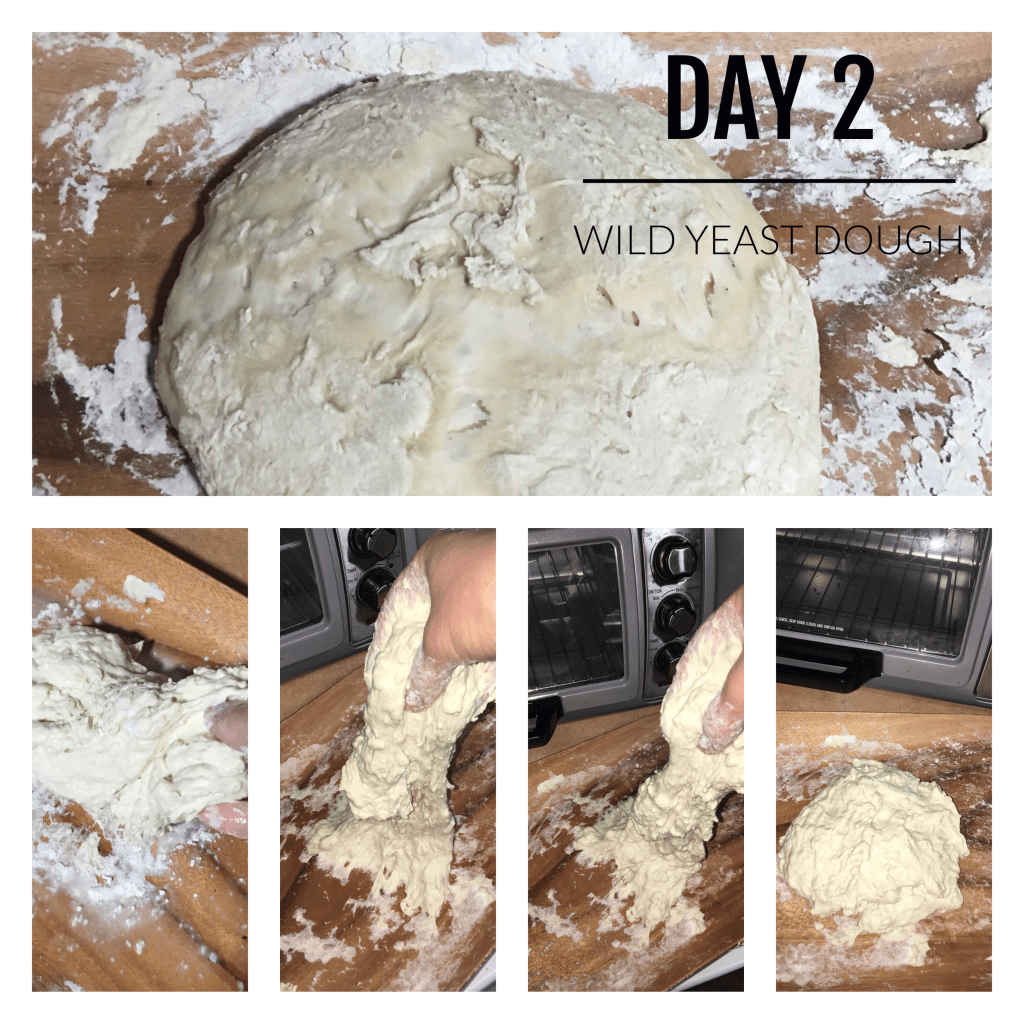
The bottom four pictures show you what I was looking at once I started working water and flour into the starter. I also show you the window test (how you tell in bread making that gluten is being formed in the bread–pull a portion up and watch how gravity pulls your dough). There is no uniformity here. So I wasn’t looking to see very much yeast activity. However, I know there is some yeast already active. Look in the first picture and you will see a couple of air bubbles (the visible presence of yeast respiration), with a very large one just off center on the bottom.
DAY 3
I continued with the morning and evening feeding of flour and water. After rehydration and incorporation of the crust and feeding, I covered the started back up.
I was excited today because there was more of a visible change that was taking place. There’s the increase in mass, but more importantly there was an increase in yeast activity. The bubbles were more prominent. (The bottom left picture is the best one for showing how much the yeast activity increased.) The middle right picture is the size of my starter, right before its feeding. The middle left and center pictures show you the change that has happened in just one day with a window test. The bottom center picture shows you the gluten structure that has formed, how sticky my starter became.

Why was I focusing on the gluten structure?
Gluten is not needed for yeast production. But I made a focus on capturing this information because gluten is what keeps the air bubbles in your bread. Gluten is an elastic structure. Without it you don’t have a way of seeing the amount of anaerobic respiration that is being produced. You can tell the health of your yeast by the size and amount of bubbles produced.
So while all the other starter methods you can read about don’t talk about gluten or keep this dry of a starter, this was an amazing process for me. I was able to see what was going on in yeast production. I could see that I was on a right track. And if you want to talk more about the science of yeast making, I can guarantee you that I have more to talk about than what is presented here. In fact, if you’re a homeschooling parent and want to have an AMAZING practical experiment for your student to see and understand respiration, this is most definitely for you!!!
The bottom right picture is my picture of impatience. I literally couldn’t wait to fry up some of the starter after a feeding. It didn’t taste great, but it didn’t taste bad. It has a sour flavor to it, but not in the classical sourdough sour. It was more like a citrus sour. It was not palatable. In fact, I took a nibble and just decided not to finish it. So when they say you can’t eat from a starter this early, it’s because it’s just not palatable.
Now if I was hard up for something to eat… I might be tempted to eat my sample here. However, I know I have enough food reserves where I’m not pressed to make this an eat vs. go hungry situation. If you are in an eat or go hungry situation try to get your yeast established before getting to this point. I would not recommend it at this point.
Side Note: I changed up my method a little bit here.
I didn’t want to keep having to deal with this crust, so after the second feeding I opted to get rid of the tea towel and switch to laying a piece of plastic wrap on top. I wanted to prevent the dehydration (which formed the crust) and retain the water content. I did not seal off the plastic wrap on the sides, just placed it on top so the starter was still somewhat exposed to the yeast in the air. I wasn’t afraid of not having yeast exposure because I was still kneading the starter with my hand for a few minutes each feeding. Plus I have the evidence that yeast is already present.
DAY 4
OMG I was literally doing a happy dance! Look at all those bubbles!!!!
Plastic wrap was most definitely NOT the material to use. Yes it did not inhibit yeast production. It’s the fact that the starter heavily clung to the plastic. There was no way I could pull or scrape starter off of the plastic wrap. There was also no way that I could reuse it. So if I’m trying to not throw any resource out, plastic wrap has better uses elsewhere. Here it’s a onetime use and a waste. (See below for what I switched to using.)
By having a less permeable cover, there was less dehydration, which I felt better about. It made the feeding quicker. And today I kept up with the morning and evening feeding.

As you can see, here in these bottom three pictures, there is more structure and less stickiness of the starter. When I pan fried this up, it was palatable fry bread. Thinking back now, after two years, I should have put a pinch of salt into the dough–bread is made up of flour, water, yeast, and salt. That is all you really need. The salt would have been something other than no flavor. Think of a salt free cracker, that is where this starter is at. If you are in dire need for food, you’re now at a point of having viable food.
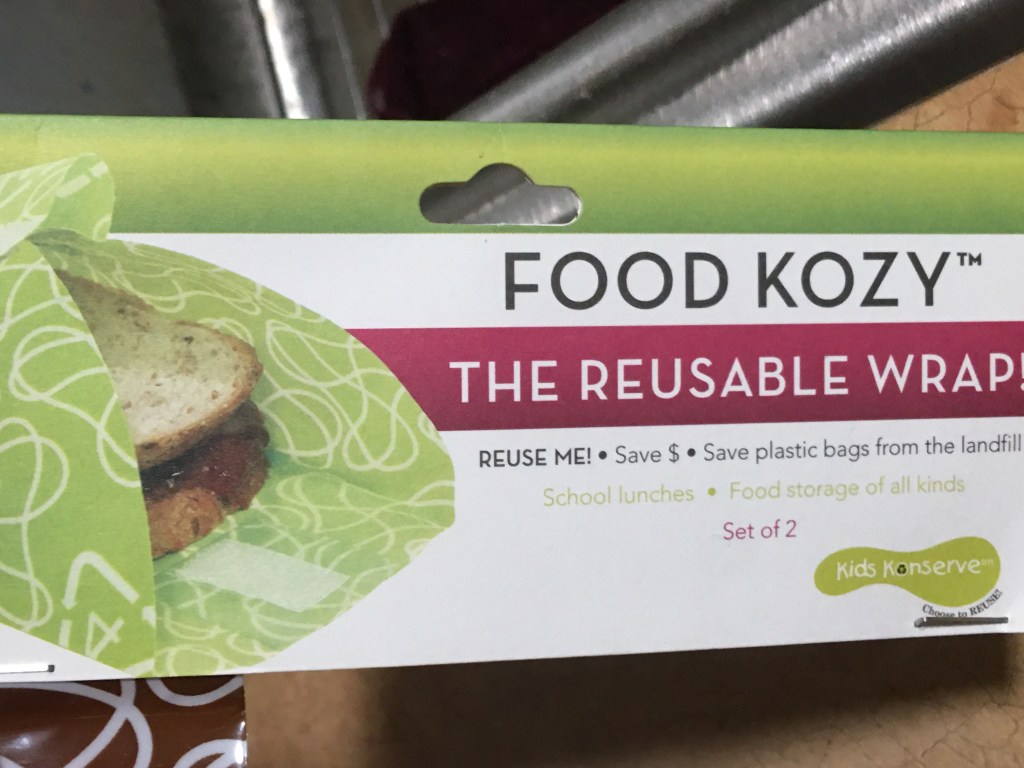
I had these reusable sandwich wraps in my drawer. It’s a thicker plastic with velcro closures. I had to position the velcro on the sides so I didn’t have to clean them with every feeding. This plastic covering was a dream for yeast production because it didn’t fold in on itself and allowed me to scrape the starter off. The starter didn’t stick as much to it either. (See bottom left picture of Day 5 to see how little starter clung to the covering.
DAY 5
This was another day of morning and evening feeding. The reusable sandwich wrap still allowed a crust to form, but it was much more manageable and something I could live with for a balance between sustainability of resources and maintaining hydration. My goal is still to literally be hands on with my starter. So I still opted for the use of the tray instead of switching to a different vessel.
I was very pleased with the yeast production. And when I fried up a bit of the starter, there was now a very faint sourdough flavor to it. So that was evidence enough for me that my starter was ready for bread production.
Everyone else that I had read with about making a starter, none of them told me what it that you’re looking for is. They all just state 7 days like it’s some magical marker or transformation that happens at that point in time. I’m open to hear from anyone as to why you insist on waiting 7 days before a starter is ready for bread production. However, with years of baking bread with conventional dry fast acting yeast, and with scientific understanding of what the function of yeast is in bread, here are my indicators that your yeast is ready:

- You can see evidence of yeast production: your starter has the same amount of bubbles as you would see in a slice of bread.
- When you fry up starter, it produces palatable flat bread.
Okay, everyone who talks about starter says that you can’t make bread until your starter has doubled after a feeding. My yeast was already doubling before Day 5. So this indicator was not relevant for me. The two important things, hands down, are evidence of yeast being present and flavor. You won’t eat bread (whether in loaf form or flat bread) if it doesn’t taste good.
I should also note that the starter does by now have a very faint sourdough smell.
DAY 6
This was my first day of baking my own bread from my starter. I chose to make boule bread. One, the amount of yeast wasn’t as much as I keep now, but I had enough for the first recipe I tried with enough left over to feed and store. So the pictures you see here for Day 6 were the bread making process of the different kneading times and the transformation that you see with the dough as you go through the process. It went from rough lumpy looking to that beautiful smooth ball.

I’m not going to focus on this recipe or the process because it’s labor intensive. I haven’t even made a boule in several months. This is not my go to and not exactly practical for today’s busy schedule. I love boules and can probably get better height out of them, but I have a recipe and process that is much more mom friendly and something I can make every night for bread the next day. But I will talk more about that next week. I’ll give you my every day recipe next week with also my process of making rolls. Again that’s next week.
After I made this recipe, I fed the remainder of my starter and I actually transferred it into a quart size mason jar. One, my boys were starting to reach onto the counter and I didn’t want to have my work wasted because a curious boy decided to tip the tray over and knock my yeast on the floor. Two, I wasn’t (and still am not) in a position where I need to make bread every day. So for flour conservation, I put my starter in my fridge. The fridge slows the anaerobic respiration of the yeast so that you are able to feed your yeast and it is perfectly happy until you make your bread in a week.
What is the longest I’ve left my yeast untouched in the fridge?
I think it was 17 days. And boy was my yeast sad and weak. BUT even with weak yeast, I was still able to use that yeast without using a single discard and wasting precious resources. It took a little longer for my bread to proof, but the yeast pulled back in the dough and in my jar.
When do you pull your starter out of the fridge to use?
My best results have been when I take the starter out 1-3 hours before I want to use it. It warms the yeast up to an active state. But more importantly, more times than not, my yeast hasn’t finished its cycle and doubled in the fridge. But allowing it to finish it’s doubling in volume on the counter, it gets the yeast into its strongest and happiest state.
Have you used your starter while it was still cold and not yet doubled?
Yes! The yeast is still good. It’s just dormant and hasn’t used its entire food source. Here’s the drawback to using cold yeast. Your bread recipe liquid is warmed to an optimum temperature to really get your yeast excited, happy, and ready to eat. When it’s cold and put into a warm liquid, the temperature change can be a shock. And it does take longer for your yeast to get happy and get busy proofing your bread. So it’s not ideal using your yeast cold, but it’s not a deal breaker.
Remember, yeast is a living organism. It has certain conditions that make it happy and productive. It’s so easy to think of yeast as a non-living organism, but that’s not the truth. Yeast lives. It has an environment that is ideal. And when you recognize that, you can set your yeast up for great success in making bread.
When do you feed your starter?
I take my starter out of the fridge. Get it to room temperature and double in volume. Once the starter has doubled, I measure out the portion I need for my bread recipe. What remains in my mason jar, I clean up my jar by scraping down the remaining yeast with a silicone scraper. Then I add the flour and water, mix it well and put the lid back on. Then back to the fridge it goes until I cook another batch of bread.
How much do you feed your starter?
I always keep 400 grams of starter on hand. It fills a quart size mason jar about half way. This makes it easy to tell when my yeast has doubled without needing to do the rubber band trick that I saw all the time in tutorial videos.
Whatever weight of starter I take out for a recipe is what I replace with weight of flour and water for feeding. For example, if I take out 300 grams of starter, I put back in 170 grams of flour and 130 grams of water. The appearance of my starter is a little bit looser than you see in the pictures above, but I do keep my starter thicker than what I see everyone else keeping theirs at.
The most important reason for this is that this is what makes my yeast the most happy. My yeast remains strong and healthy and I have only had hooch in my mason jar one time in 2 years. The hooch formed because my water content was too high for the flour content. The yeast ate through all the flour and couldn’t use all the water. So it’s my opinion that if you have a problem with hooch, try feeding your starter less water.
Besides hooch production, excess water is going to add to the odds that you will through your starter environment off and make it ripe for other things to grow in your starter like bacteria and mold–which you will have to throw your starter out.
Another problem happens with too much water, the smell of acetone. I haven’t had this problem with my flour based starter, but it did happen with my potato starter. I’ll talk more about this is the post for the potato starter. But it happened because there was too much water. And this problem you can solve by adding salt into your starter. The salt balances out the starter’s environment and makes it inhospitable for the presence of bacteria that has started to set up shop in your starter. So know that the moment you smell your starter having an off scent, don’t wait to see if it goes away. Add a teaspoon or two of salt and be preventative. If you wait, you run the chance of losing your starter.
Is All Purpose Flour okay, or do I need bread flour?
I prefer All Purpose Flour. One time I bought a 25 pound bag of bread flour and immediately regretted it with the first batch of bread I made. Bread flour is supposed to only have a higher content of wheat protein in it to create more gluten. However it threw the salt content off on my bread. Even after I lowered the salt content in my recipe (by half), the flavor of the bread was still off. You may or may not notice the change in flavor, but I did. My boys did. So do not feel pressured into needing specialty flour to be able to make bread at home. In fact, I’ve received comments (from friends and family that I’ve gifted bread to) that what I made them tasted like high quality restaurant bread. And all I used was All Purpose Flour.
Side note: I’ve tried working with other flours to make gluten free bread. I’ve not yet found success in that experimental process. I have found success in making gluten free starter from potato–which will be featured in an upcoming post (it should be in two weeks). If I finally find gluten free flour (mixture) that I love in bread, I will quickly and excitedly share that because I have great love for bread. But I’m not going to share anything that I’m not passionate about.
Is there a difference between bleached and unbleached flour?
As far as quality of bread, I haven’t noticed a difference that makes me have a preference one way or another. I personally like using unbleached flour over all for everything. So that’s generally what I have in my pantry. However, you should use the flour that you have available to you and don’t have stress over it. And don’t let people pressure you one way or another.
If you have flour that just isn’t working for you, there are ways to alter a recipe to make it more palatable for you. I had to change recipes all the time when I was using dry active yeast, because I hated the flavor that yeast produced. My easiest and quickest way of altering it without changing the results of my bread crumb was simply by adding herbs. My go to herbs were always adding about 1 teaspoon of each: garlic powder, onion powder, and oregano. The salt content never changed. The dry/wet ratio never changed. And there was just enough flavor adjustment that I could eat the bread and it didn’t change it enough to ruin the overall sandwich flavor whether grilled cheese, peanut butter and jelly, or any combination of meat sandwiches.
Every master bread maker will tell you that you have to respect the ratios of the ingredients: flour, water, salt, yeast. Anything you add to that for flavoring is just a bonus. But I’ll talk more about that next week.
If there are any questions that you have, please leave them in the comments. I want to make sure you have all the information you need.
While this week’s post is on the outlying area of being creative I did want to share with you some new Cut Files that are related in subject. Be sure to visit my store to see what all is available for sale!

You can find Rollin In Dough here. And Kneading In Dough here.
 How I Can Do That