First Year With Grow Bags

For a few years now I have heard many of my growing friends sing the praises of grow bags and how wonderful they are. Not to mention that if anyone does not have land to grow a garden, this is a great substitute for growing on decks and patios. So I put it to the test.

My 2023 potato growing season, I put my raised bed (which I’ve grown potatoes in for the last four years) vs. 10 gallon black grow bags to see how they stacked up against each other. And this was great timing for this challenge because I wanted to up my potato crops to see if I could get that produce off of my shopping list and on my self sufficiency list.

Below I will tell you the results and my thoughts on the process. But first I wanted to start off by showing how I set up my grow bags. A lot of people set them up with just putting in potting or raised bed soil. I wanted to go a different route because with my family we try to go with natural fertilizers that fall into the organic farm spectrum of growing.

Setting up the Grow Bags

I set up these grow bags like I do with my brand new raised beds. But I structured it differently, aligning with how I’ve seen other people use their grow bags for growing potatoes. Those people layer their bags with soil on the bottom and top and hay in the center. The rumor is that this hay section allows the potatoes to grow large because they have less resistance from soil, which can compact down around the tubers. Keeping this in mind, here is how I layered my grow bags (from bottom of the bag working up):

  • Raised Bed Soil
  • Compost
  • Pine fronds
  • Small Pine branches
  • Pine Fronds
  • Compost
  • Raised Bed Soil

This spring we had pruned back our pine trees. Normally these go into our compost pile. But as you can see below, these fronds had new growth tips on them, which have the most vitamins available. I didn’t want those nutrients to go to waste. So I separated out the softer fronds from the more rigid branches. As you see below.

These branches were then cut down to fit inside the grow bags without puncturing the sides.

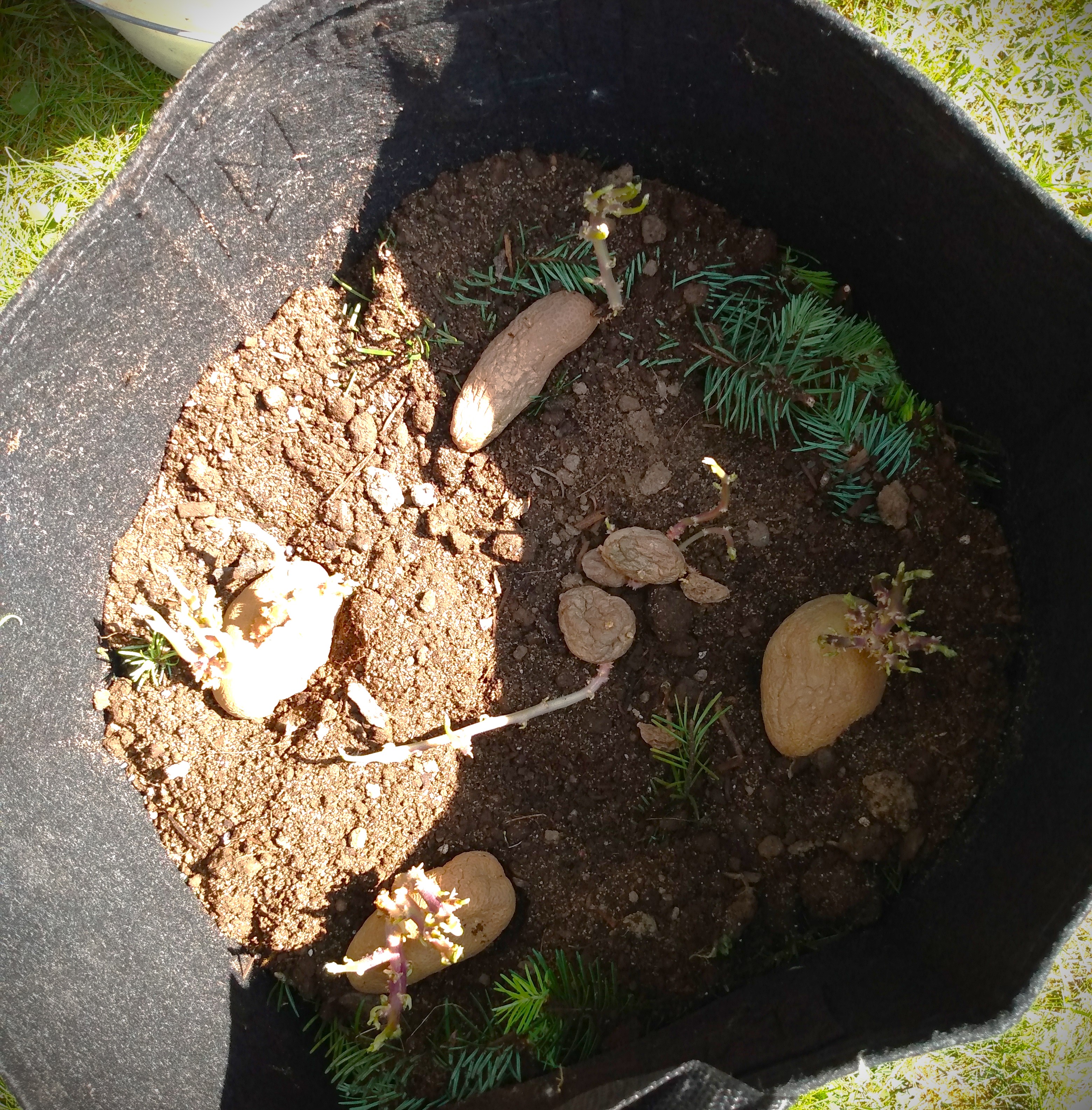
With all my components prepped for work, I built up my grow bags. Right after I laid down my pine layers, I put down a fine layer of compost to set my potatoes down on. Once I placed my potato seeds down, then I covered them with the layer of compost and final layer of raised bed soil.

The pine branches and fronds were added primarily for slow release nutrition for my potato plants. But I placed them in the grow bags, like other growers place hay, because the thick layer of fronds (theoretically) gives them the tubers the ease of growth without the soil compounding around them from watering and rains.

To finish this experiment, I placed the grow bags near the same area that my raised bed potatoes were growing so they could receive the same amount of heat and light.

Advertisements

Sweet Potato Side Note

I haven’t yet harvested my sweet potatoes. But I prepared their grow bag the same way as my potatoes. I’m trying to give them the most time to grow and the vines haven’t died back yet.

That being said, the sweet potatoes are a first time experiment because I haven’t grown them before. So I may post about what happened this year, or I may wait to talk about them until I gain a few more seasons of growing them. But I did want to post this picture of my rooted slips before I planted them.

Out of everyone I watched in videos to learn about growing sweet potatoes the one bit of information I wasn’t able to see was what a good rooted structure looked like. This was mostly because those growers cut from harvesting slips to already having them in the ground.

So if you’re like me and you want to bench mark to compare what you’re growing next to, here is a picture of my slips before I put them in the grow bag.

The method of growing slips that worked best for me, was sitting the bottom (fat) end of the sweet potato in a glass of water. This method gave me strong slips about a month before the method of laying the sweet potato on its side in a container of soil. Everyone I watched swore by the soil method, but I honestly found the water method better for me.

The lesson for this side note: when first starting to grow something for the first time, try a few different methods at the same time to see which one provides better for you. What works for one grower may not work for you. And vice versa.

Advertisements

End of Season Results

It took a while for me to get to this point because even though the potatoes were started at the same time they didn’t finish as the same time.

Starting from left to right, the first container I grew purple potatoes. The middle and right were my russets that had sprouted on me over the winter.

My purple potatoes grew seed flowers. I allowed the flowers to grow to see what that process was like and if I could collect the seeds. However my blossoms kept falling off. So I don’t know if the flowers were being trimmed by little garden helpers or if the flowers were falling on their own. Needless to say that I didn’t see how the seeds grow or if the plants even grew them. As soon as I learn that process, I will share that information with you. But for now I have nothing more to say other than flowers grew on the plant portion of the purple potatoes.

And true from those I watched from those who did have information on the flowers, when your potato plants grow flowers, it does delay the whole growth cycle. My two russet bags never grew flowers and the plants started dying back maybe 6 weeks before the purple potatoes did.
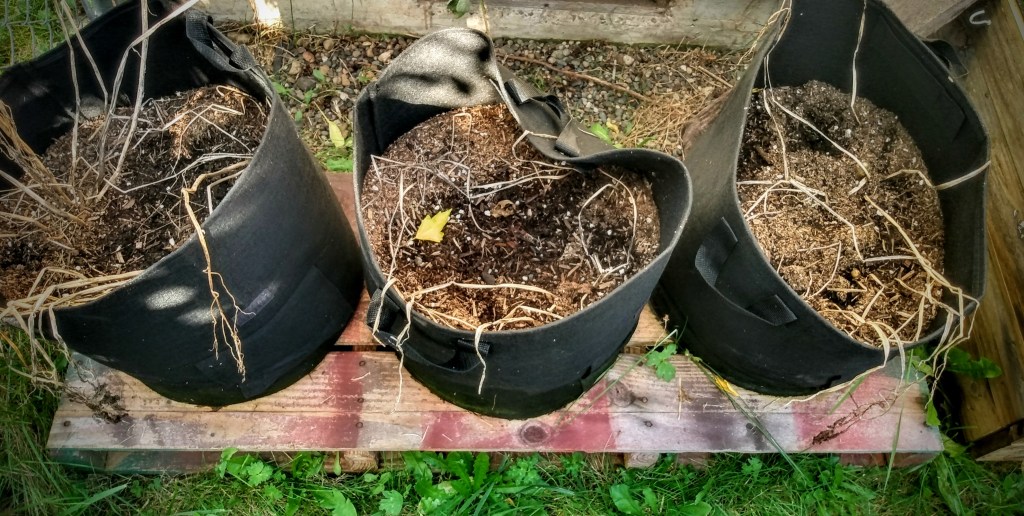
I wanted to keep these grow bags to use in the future. And since I didn’t want to lose the velcro integrity on the bottom, I didn’t use that “door” at all. Instead I brought over my wheelbarrow and dumped my bags in one at a time.
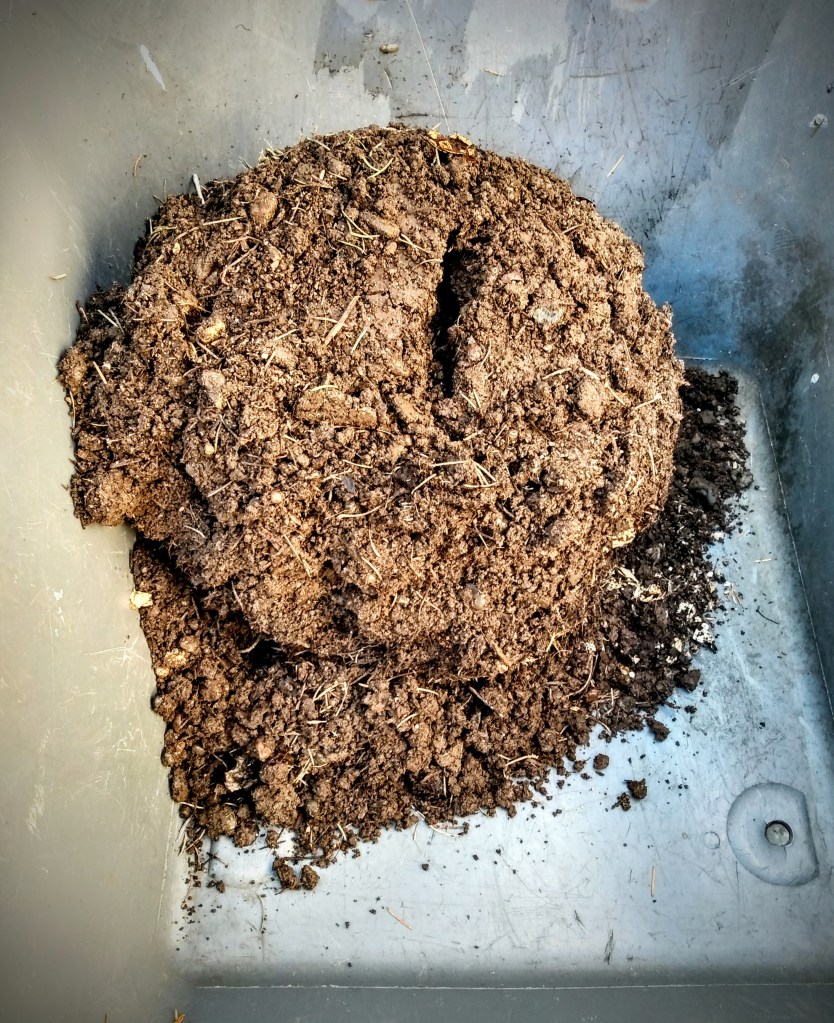
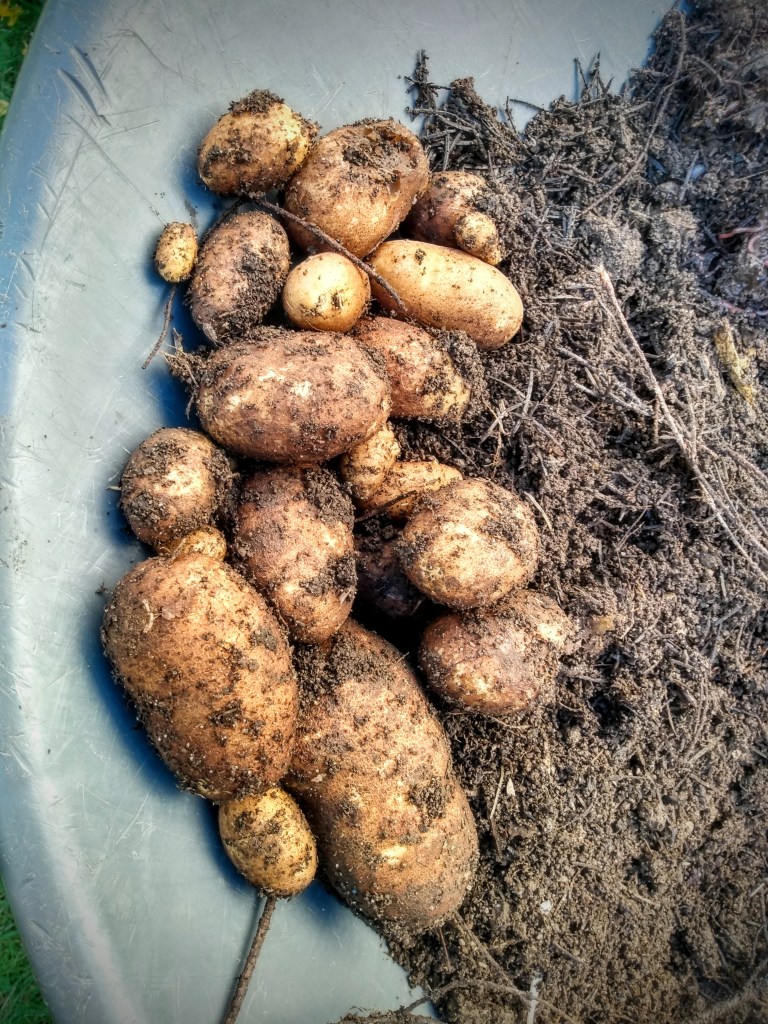
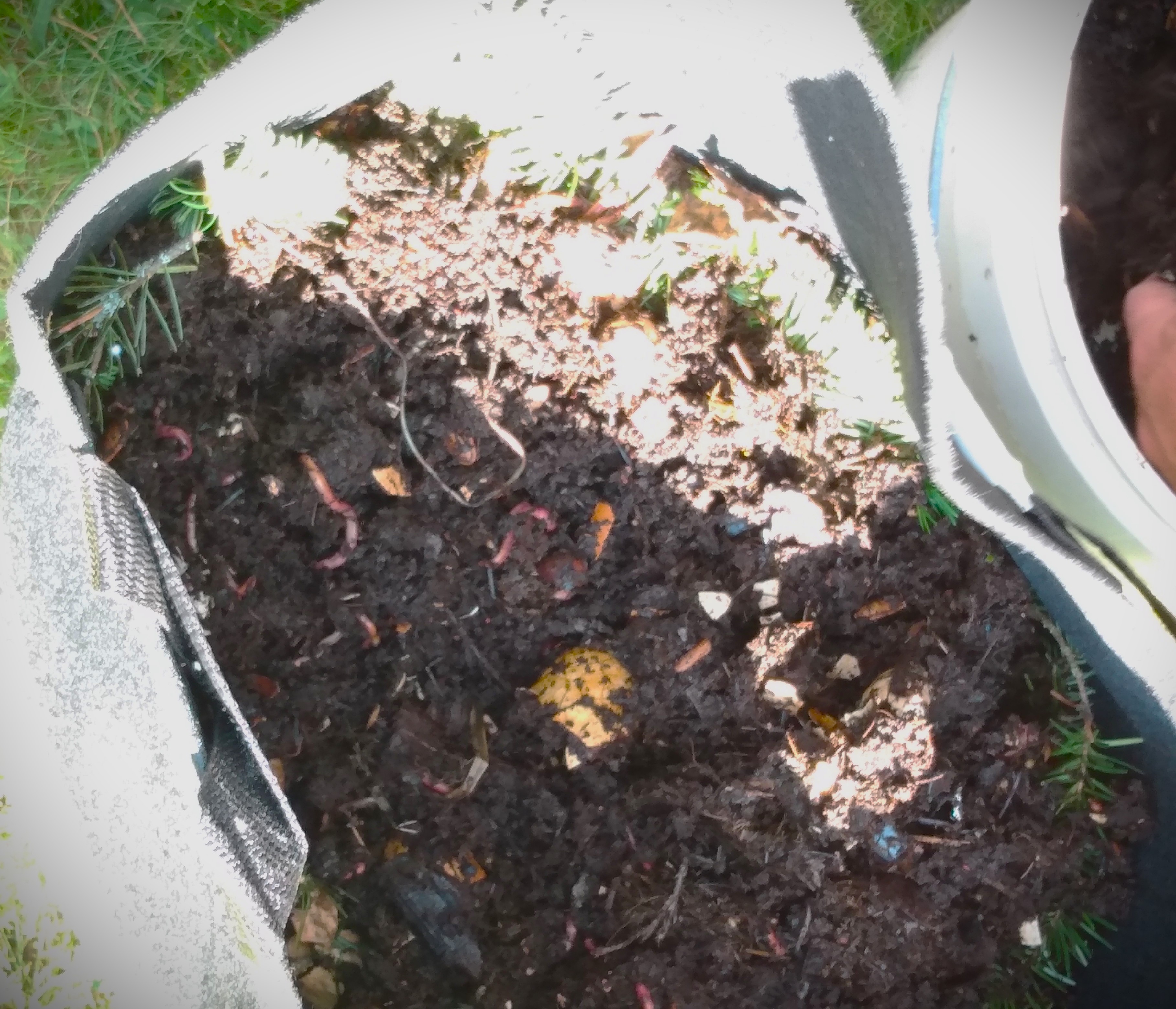
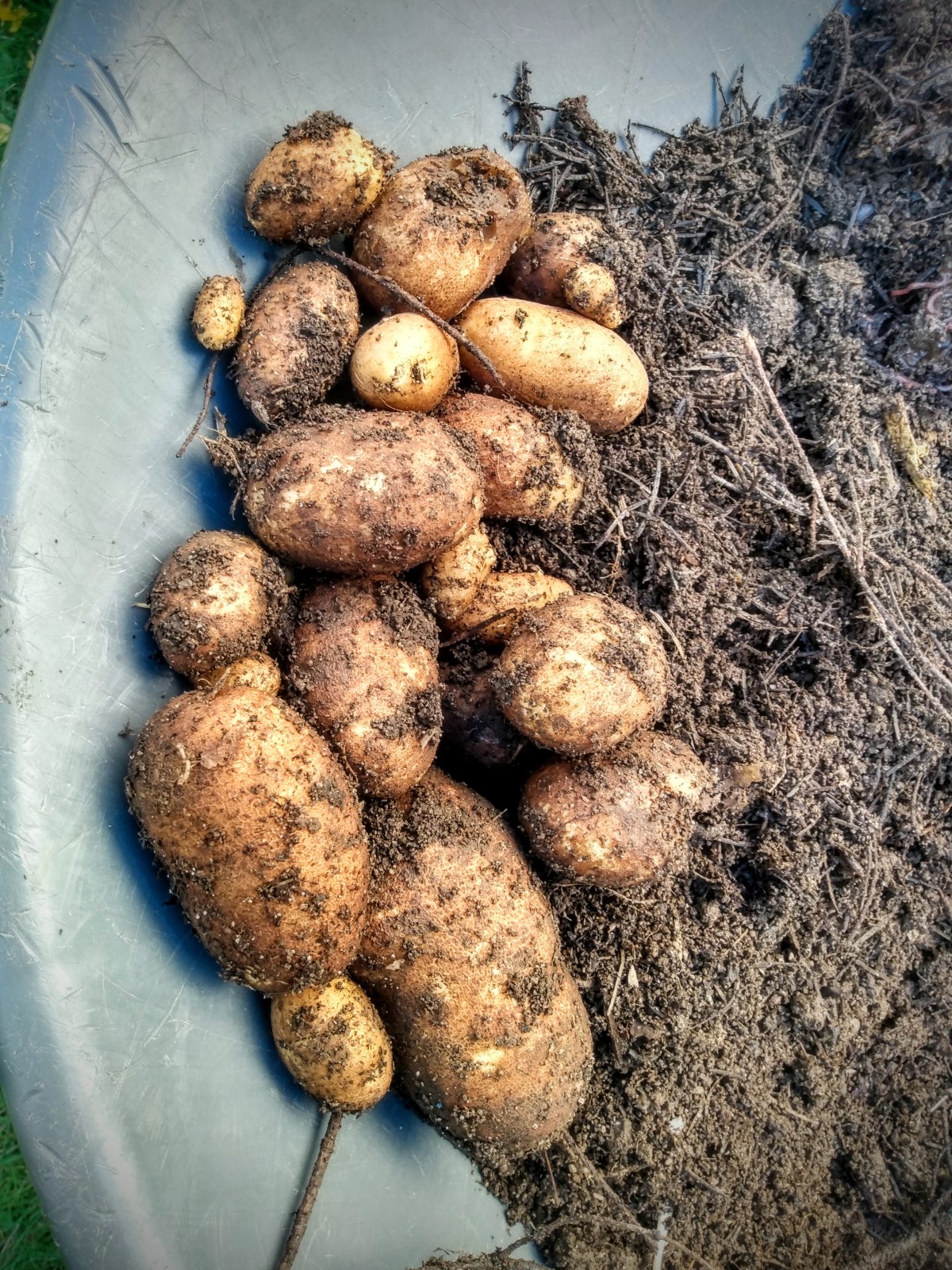
As you can see here, the soil still compacted. So even when you do take measures to prevent compacting, gravity is still going to work. This was the bag from the right side. I didn’t add any sand into this bag and that might have what made this one compact more than my other two bags.

Originally we had added sand to our compost for bags two, three, and sweet potatoes, in order to make the compost stretch between all the bags. The sand did keep the “soil” of the grow backs more loamy than the one that was straight compost.

Having seen what sand did for me in these grow bags, I will more than likely continue to add some soil with the fresh compost to prevent a clay like clumping from beginning to end of season.

That being said, if you look at the picture with the potatoes that I harvested from the first bag, you will see what didn’t compost down during the grow season. So if you’re worried about adding sticks into your grow bags, you can see that they will break down over the course of the season.

This was my first time growing purple potatoes. I chose them for some fun colors to make dinner with. And there’s the fact that dark purple fruits and vegetables have a higher antioxidant property and more vitamins and minerals than same fruit/veg families that are lighter in flesh color.

I wanted to make a quick mention on them, because as soon as I upturned the grow bag and started troweling through the soil I was asking myself, “Where are the potatoes?!”

As you can see above, these beauties hide with the soil. The way that I identified them was that they had an opal like sheen to them. So I pushed the soil to the side looking for anything that didn’t have the same matte finish as the soil.

I’m super excited for these potatoes to cure so that I can see my kids’ reactions to having purple potatoes for dinner. That and even more to the point, I want to eat something colorful that I haven’t eaten before!

Advertisements

Grow Results

Back this spring, I wasn’t too sure what I expected. Obviously I expected potatoes, but I didn’t know how these grow bags were going to work out.

Here are the results of what each bag grew, in the same orientation as the bags were placed in the above picture; purples on the left and the ones that grew in compost/sand mixture on the right and middle.
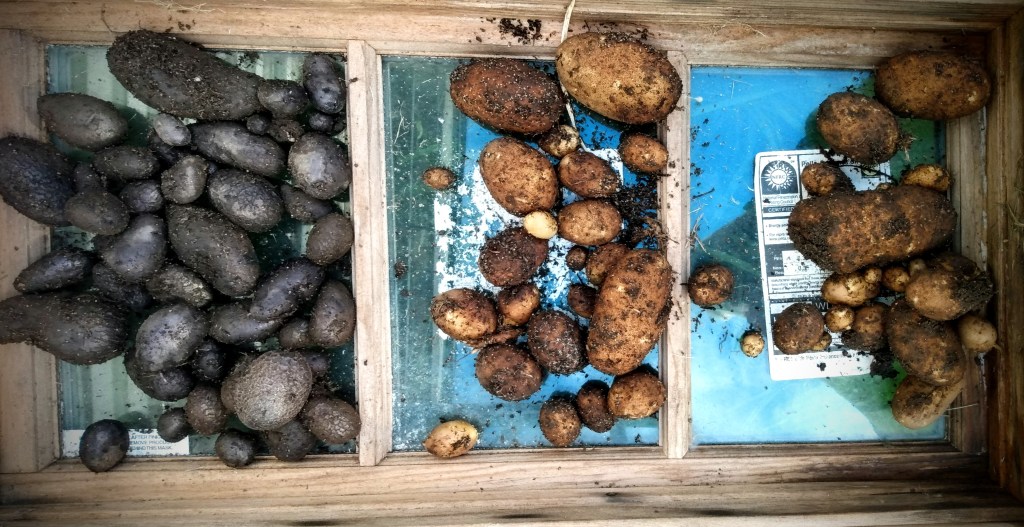
For the russet potatoes it looks like the number of potatoes were not limited by sand or no sand added. Even though I did get larger russets that grew in both bags, it seems like I got a better return on size by adding some sand to the compost. (Both had the pine branches and fronds, the only difference was sand in the compost.)

The purple potatoes outperformed the russet potatoes in quantity and overall size. This surprised me the most.

What I learned between the different varieties of potatoes is that I need to get some more different varieties and try them out to see if there are other potatoes that will grow better for me, like the purple ones grew better for me.

Side Note: red potatoes don’t grow well for me. Below you’ll see a single red. Not everything has to grow well for you. Half the fun with growing your own food is seeing which varieties grow well for you and which ones don’t. As it is, even when my neighbors grow the same vegetables as me, there’s often times variations in performance even when we have the same microclimate. But when you select and grow what grows best for you, you not only put food on your table, you have something to exchange with your neighbors who grow something else better than you.

Advertisements

One Final Comparison

As I mentioned at the beginning, I grew potatoes in a raised bed and the grow bags. I wanted to see the comparison on how things grew for me. Before I give the results, I did want to mention that I couldn’t go through my entire raised bed because I had a lone tomato plant that I couldn’t find any other home for, so I planted it in the corner of my raised bed that had a gaping hole. Once my potato plants started to die off, my cherry tomato plant took off and outperformed all of my other tomato plants. So out of respect for that super grower, I tried not to disturb its roots too much. That means that there could potentially be some potatoes under the tomato plant, but I couldn’t thoroughly check there. As it is that tomato plant is still producing even though I had already harvested and uprooted all my other tomato plants.

Here are the pictures of my grow bag (box on the left) and my raised bed (box on the right), taken side by side.
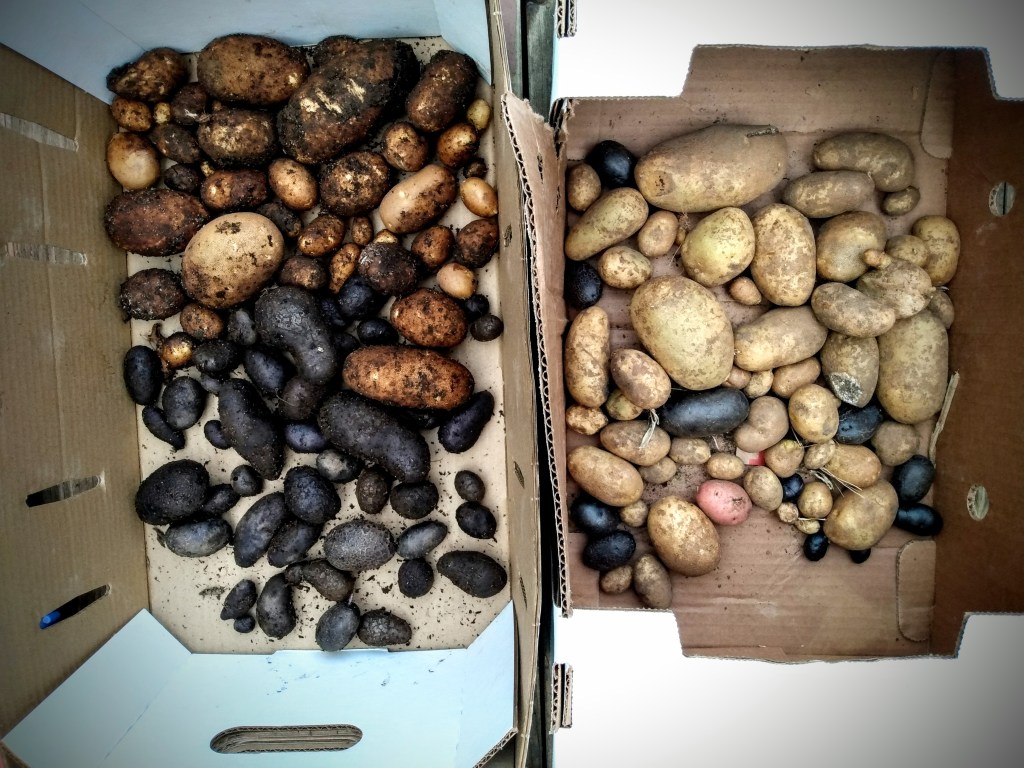
The raised bed might have had a couple less seed potatoes than I used in the grow bags, but we’re only talking about somewhere around a 2 plant difference if that is the case. So as far as quantity of potatoes go, the grow bags seemed to have done better. This result could be because the bags had the extra compost and pine trimmings that the raised bed didn’t have. But to be fair, the raised bed had seed potatoes planted about two months before I planted the grow bags, so the pine trimmings weren’t available for those plants. (The raised bed was harvested about two months before also.)

The sizes of potatoes seem to be about the same. But my largest potatoes did come from the raised bed.

I’m actually glad that I took the chance on the grow bags for my potatoes. I definitely think that it is a viable option for people to use if growing crops for your family is a challenge or not possible because you don’t have land to use to grow. I’ll post an affiliate link for the grow bags that I used below. And if you’re interested in using grow bags next year, but space is limited, if you can find a space to fit a 5 gallon bucket, you have the space to use a 10 gallon grow bag (which is slightly bigger, but you have a general idea of how much space you need.)

Things to remember when growing in a grow bag is that you will need to have a way of feeding your plants. Soil will have nutrients in it. But it won’t last forever. Compost is always a great option for feeding your plants because you’re putting nutrients back into your ground or plants that would normally just be sitting in a landfill, it’s an inexpensive way of feeding your plants, and you know or have more control with what is going into feeding the food you’re going to eat. If compost isn’t an option for your family, choose a fertilizer and/or compost product that works for you. The fewer chemicals that you choose to feed your plants means the fewer chemicals that enter the food that you eat. Take the time to read the ingredients label. If you can’t pronounce what you are reading, you probably don’t know what that ingredient is, and the chances are high that it’s something that you don’t want in your body.


Hopefully seeing this little adventure of mine has helped fill your curiosity of grow bags or give you another option that you might not have had before when it comes to you growing food for your family in a very limited space. And whatever you can grow means that you’ve saved that much money to apply elsewhere in your family budget.

Products I Use

This post contains affiliate links to products. We may receive a commissions on products purchased through these links, but at no extra cost to you. These items listed here are from Amazon but may be purchased at local markets.

In case you need to grow inside, LED Grow Light Strips for Indoor Plants, the red light gives you an option for growing plants that bloom.
Leave a comment

Processing…
Success! You're on the list.

Make Your Own Bullion

With the growing list of food ingredients that people become sensitive to, it’s easy for families to kind of go numb reading ingredient lists. Not only is it difficult to read the chemical name of some of the ingredients (let alone answer the questions, “Why is this in here?”), but some families are now asking, “What isn’t listed?”

For example, natural flavoring is listed as a single ingredient but can actually incorporate up to 200 different ingredients. It’s a shady practice, because it could be something as simple as a proprietary blend of herbs. Although it’s more likely the summation of chemicals used for extractions of certain elements for flavoring. But how is a family to know what chemicals or processes were used and make the educated decision if this is something that is harming the health of a loved one?

So whether you’re looking to cut some corners in your grocery budget, trying to eliminate ingredients in your diet, or simply wanting to eat more simply (knowing exactly what you’re cooking with, able to say the ingredients, and other reasons) you can make basic kitchen ingredients from scratch. Bullion is one of those ingredients that you can make in advance and have it in your pantry waiting for you to use!

Advertisements

First Make Your Stock

I’m going to move forward here with making chicken stock and turning it into chicken bouillon. However you can do this by making your own beef stock or vegetable stock. (And I just want to say that when you make your own vegetable stock, it actually has more flavor and tastes a thousand times better than what you will buy in your local grocery store!)

There are also a few different ways that you can cook your stock. You can make stock on stovetop, in a slow cooker in your oven, in a crock pot, or a pressure cooker. The only difference is going to be the amount of time you commit to. With the exception of the pressure cooker, you will want to cook low and slow to release all the nutritional benefits of your ingredients. A lot of influencers, bloggers and You Tubers will encourage you to make a stock in a short amount of time. Of course it is possible, but I want to encourage you to take the time and cook your stock ingredients out.

If you’re making a bone broth, cook it so that you extract the marrow from the bones. If you’re cooking vegetables, don’t assume that because you’re not extracting marrow that you can get by with less time. Check out my post A Touch Bitter? where I specifically talk about vegetable stock.

You know that you have a good and flavorful stock when it has rich and dark colors. The color comes from all the nutrients that you cook out from your original ingredients.

Advertisements

My Chicken Stock

I’m going to be honest with you here, daddy taught me how to cook by following a recipe. But I inherited a wild cooking hair from mom, where we improvise. I cook by smell, then by flavor, all over what a recipe says. I’m working hard to make notes on my recipes to find a strong base that is pretty average for how my recipes go. Just know that when I have chicken bones to use, I literally use the ingredients that I have on hand. And just like your kitchen, there are ingredients that I run out of. I don’t go to the store for missing ingredients. I run with what I have.

Here’s what I have standard in my kitchen:

  • onion skins (kept in a vegetable food scrap bag in the freezer)
  • garlic skins (vegetable food scrap bag)
  • stems of herbs that dehydrate to make my own dried herbs (vegetable food scrap bag)
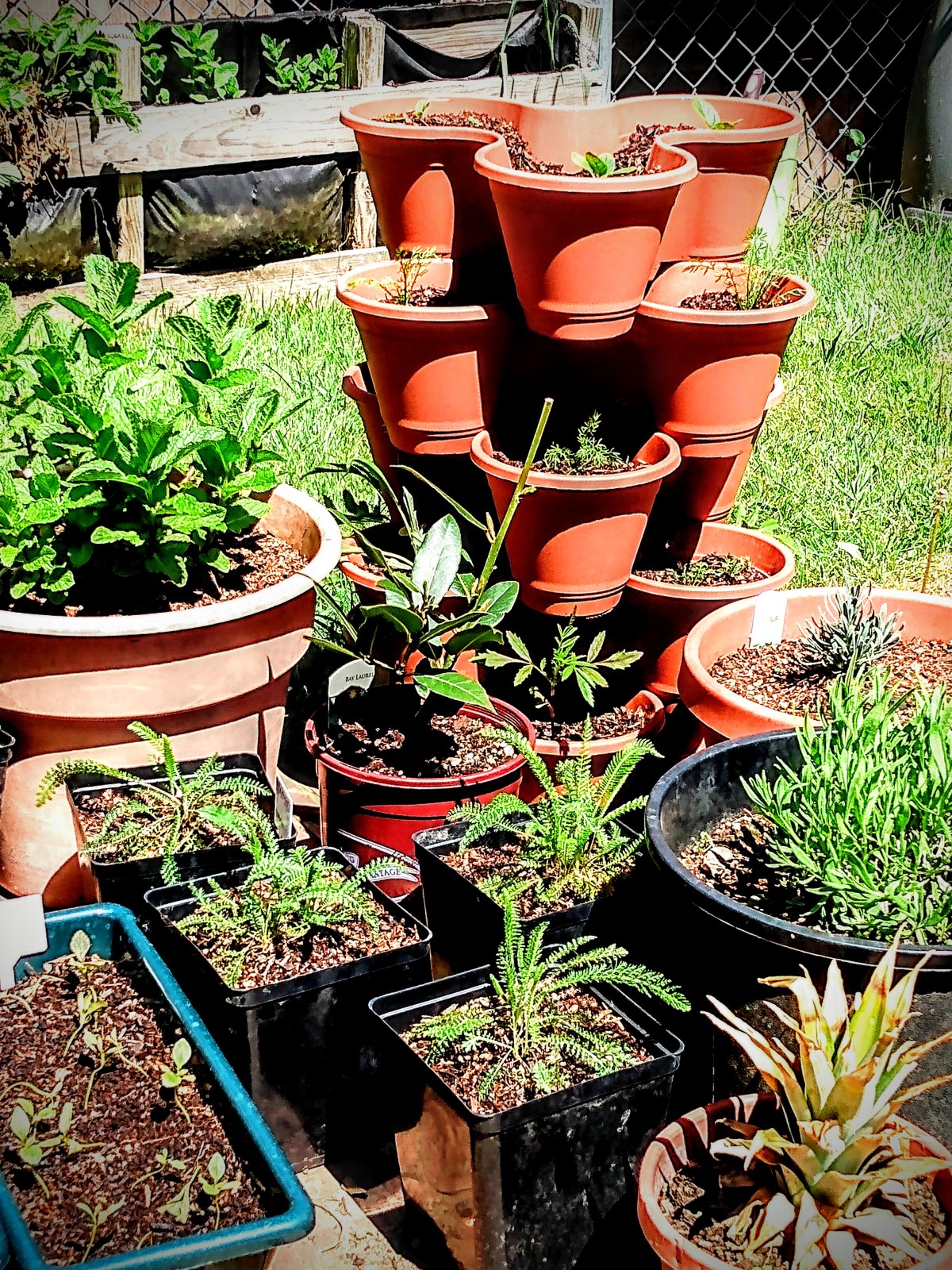
  • dehydrated herbs from my garden (oregano, basil, lemon balm, sage, parsley, chives and others)
  • dehydrated herbs that I have yet to successfully produce in my garden (ginger, tumeric and others)

General Recipe

In my 8 quart instant pot I add:

  • the bones of one whole chicken fryer
  • if the chicken came with gizzards, I cook the gizzards here in my stock.
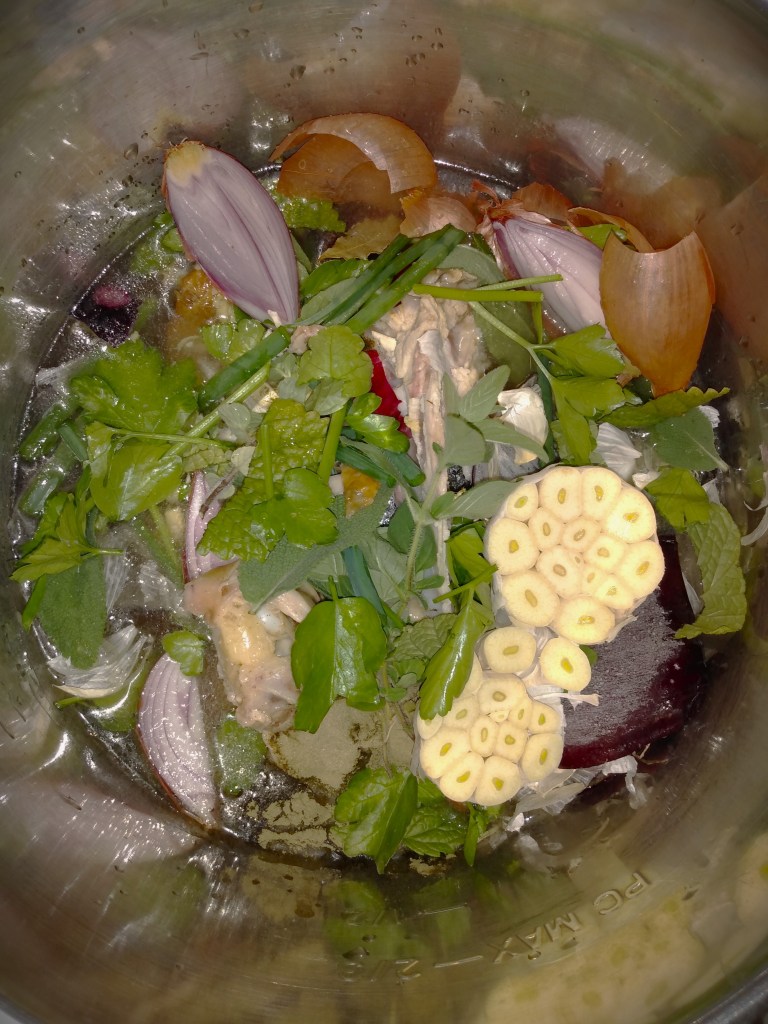
  • the vegetable food scraps from my freezer (ideally I aim for the skins of about 4 onions, the skins of 2-4 garlic heads, half a bunch of leafy herbs)
  • herbs from my seasoning shelves (including salt and pepper)
  • filtered water that fills my pot up to it’s Max line.

The herbs are generally where I run out of supply and have to improvise. If I have everything the herbs that I like to add are:

  • Ginger
  • Bay leaves
  • Lemon balm (fresh will give you more of a lemon flavor, dehydrated will have more of a green tea lemon flavor, use according to which type you’re using. I like going heavier on the fresh lemon balm)
  • Rosemary
  • Oregano

These herbs I go heavy on. If I’m out of any of these, I improvise using other herbs. Sage I use sparingly because it’s such a potent herb. Cilantro I use sparingly because I have family members who dislike the flavor of this herb. So I keep this one low in quantity to still get the nutritional value, but the flavor is not prominent at all. Fresh cracked pepper I use in varying levels depending on what my stock is currently at. Salt, I try to remember to add, but half the time I forget. Because the flavor of salt is not extracted, like herbs, I have no problem seasoning with salt once my pressure cooking is done.

I set my instant pot to pressure cooking, on high, for 3 hours. (No matter which stock type I’m making, I don’t ever go less than 3 hours.) This is what gives you full extraction.

Making Bullion

Once your broth has finished processing, you strain out all the ingredients. With a vegetable stock, I go ahead and compost the vegetable bits that I strain out. With bone stock I strain out all the bones and vegetables and they are thrown out.

If you’re making vegetable bullion, you can cool your stock down to room temperature and then move forward with the next step. If you make a bone broth (chick, beef, venison, goat, sheep, etc.) you will need to cool your broth off over night in your refrigerator. The exception is if you have a fat skimmer that can separate the fat out from hot broth. I do not. So I refrigerate my stock over night.

Once the fat layer has formed on your chilled broth, you skim the fat off of the broth.

You have to skim off of the fat, because when you make bullion you want to have a long shelf life. Fat is the limiting factor in shelf stable food. It will go rancid before anything else goes bad. So by removing the fat, you ensure that you have a long shelf life for your bullion.

When my chicken broth is been skimmed from fat, I grab my jelly roll trays for my dehydrator and set my dehydrator up where it’s going to process the broth. The reason why I set my dehydrator up in location and fill the jelly roll trays on the stacked racks is because the broth is going to run to lowest point. There is not going to be an even layer of broth. So I fill in place and pour the stock until I reach the lip at one point on my tray. This will maximize the amount of broth I can process at a single time.

Dehydrating liquid hack: before placing your liquid on the jelly roll trays put it in a sauce pan and reduce the stock. By evaporating the liquid down, you will cut down on your dehydrating time and save space in your dehydrator.

I run my dehydration temperature at 140-145°F until the broth is crispy like this. Dehydration time is going to vary depending on if you reduced your broth first, the temperature you dehydrate out, and most importantly the thickness of where your broth pools. The thicker sections will be gummy to touch until it’s properly dehydrated. The thinner bits you can leave as is. Or when you check on your progress, you can used a silicone spatula to push the thinner bits in closer to the thicker bits (this makes it easier to remove the thinner sections when you’re finished dehydrating).

In the center of my jelly roll try, you’ll see that I put my coffee/herb grinder in the center. It makes it easy to brush the chunks and bullion dust into the grinder. When the container reaches its limit I remove the tray, cap the grinder and run it for about 10 seconds. Just long enough for the broth to turn into a powder. The bullion powder I put directly into my mason jar that I’m going to store it in.

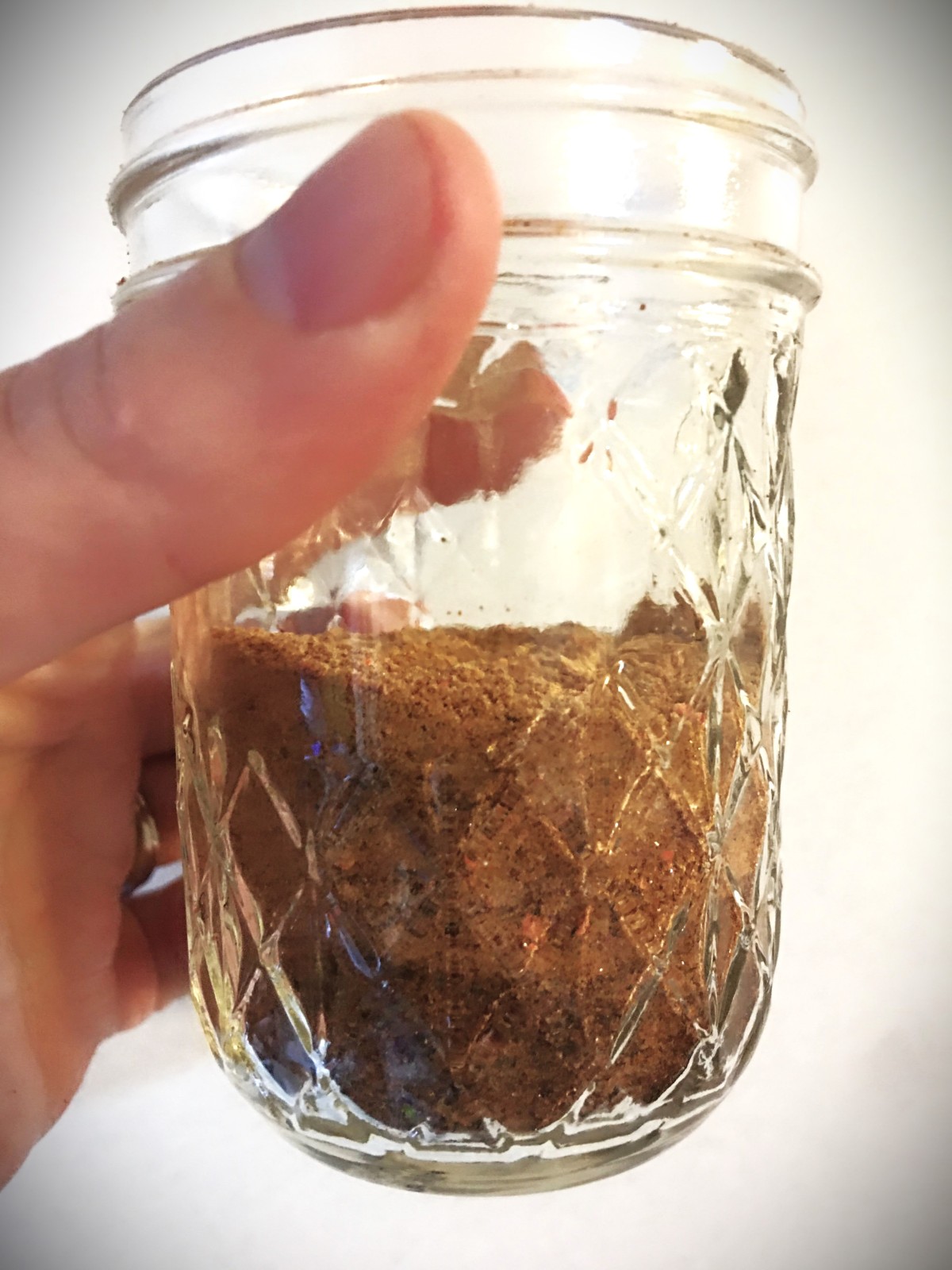
Just so you won’t be alarmed, what you see in this 1/2 pint size jar is what my 8 quart size instant pot produces. My first time making my own bullion, I was disappointed that it didn’t make more. But that disappointment disappeared when I tasted the bullion. You will not be disappointed with the intense flavor!

This is perfectly save to keep in your pantry or in your spice cupboard.

Personally I have a tiny kitchen, so I keep my bullion on the top shelf of my fridge. The bullion usually doesn’t last my family a year. Although there was a time where I needed to free up some jars and use my canned chicken stock, so I had one batch of bullion powder in my fridge for about 2 years. It was still fresh and flavorful when I went back to finish this bullion off.

Comment below and tell me how you like this space saving flavorful bullion.

How does it compare to what you’ve previous bought from the store?


This post contains affiliate links to products. We may receive a commissions on products purchased through these links, but at no extra cost to you. These items listed here are from Amazon but may be purchased at local markets.

If you don’t have a current dehydrator and are looking for one, I have been very pleased with this dehydrator. This was an upgrade from my very first dehydrator, but still on a budget. If you’re in a tight financial place, with today’s economy, this is the one that I highly recommend. Not only was it a great price, but it also included jelly roll trays for each rack (something that can’t be said with other budget units)

Herb Grinder Elictric has been great for keeping all the ground herbs/boullion contained in the grinding bowl.

Processing…
Success! You're on the list.

Leave a comment

Advertisements
Advertisements
Advertisements
Advertisements

Meaningful Gifts

Happy Mother’s Day to all the moms who are celebrating today with their children, the moms who are missing their children, the moms who have lost their babies far too early, those who shared an all too brief moment with their babies, the mothers who are in the middle of a season of making the dream of motherhood a reality, and those who love on the children from other mothers who lean on you to be the loving assurance in this season of their life. No matter what motherhood looks like to you, Happy Mother’s Day!

Photo by Secret Garden on Pexels.com

Depending on who you talk to, some people feel that holidays are too commercialized. Others find it difficult to find the perfect gift. And others find it difficult to gift a loved one while feeling the financial pressures of this season of world history. No matter where you personally find yourself on this spectrum, I want to help you find inspiration on how you can find a meaningful gift for someone. Whether it’s a belated mother’s day present, a birthday, anniversary, father’s day, grandparents’ day, teacher appreciation, graduation, or any other occasion, know that you can gift in a meaningful way.

I’m going to use the example of the mother’s day gift that I gave one of the mothers in my life. While this may not apply to the person in your life, the same principle can be applied in finding what you can gift that special person in your life.

This mom loves talking about her memories. For many years she’s shared her precious memories of when she operated a daycare. And one of those fond memories is when she grew gardens with the children under her care.

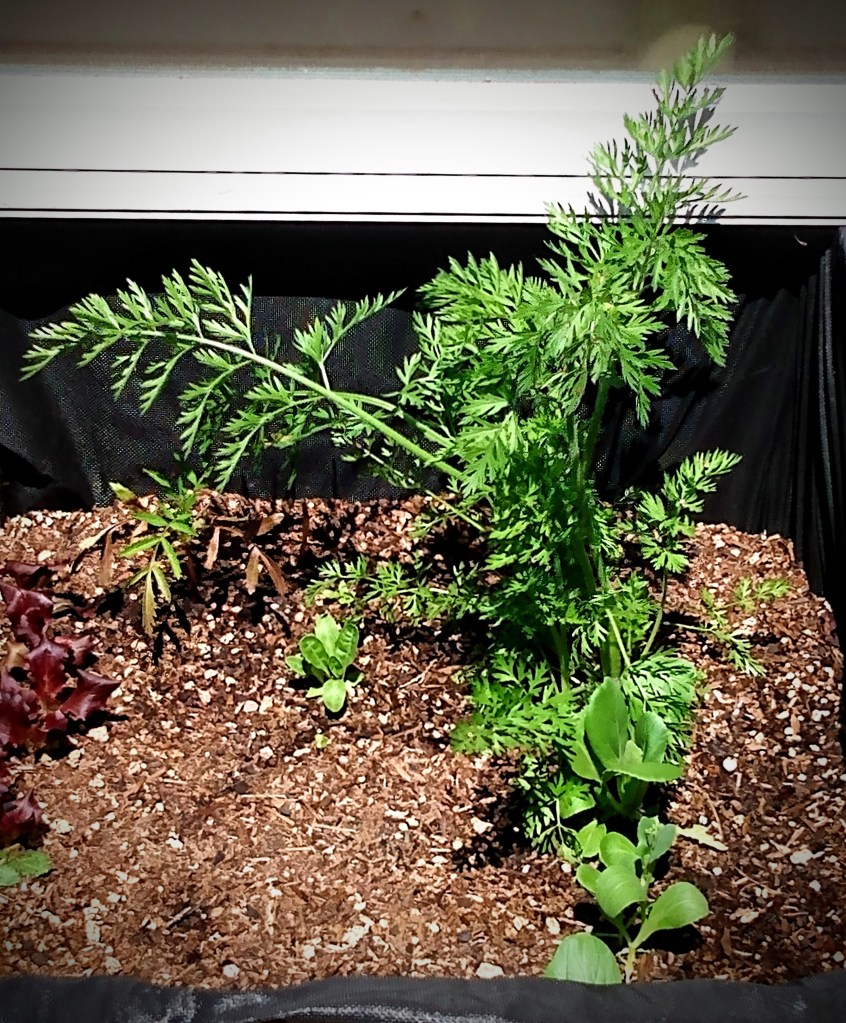
Growing salads in a container box.

One thing about moms, it seems pretty universal that sharing memories usually isn’t about the memory. It’s about reliving a moment in life that brought pleasure to them.

From this understanding, I knew that building a garden for this mom was a gift that would fill her love tank. Not only is it an opportunity for her to relive precious memories in the here and now, it also opened the opportunity to add more memories in association with these older memories. By building a garden and scheduling time to upkeep and tend to the garden, it was also guaranteeing visits and making time for her to spend time together.

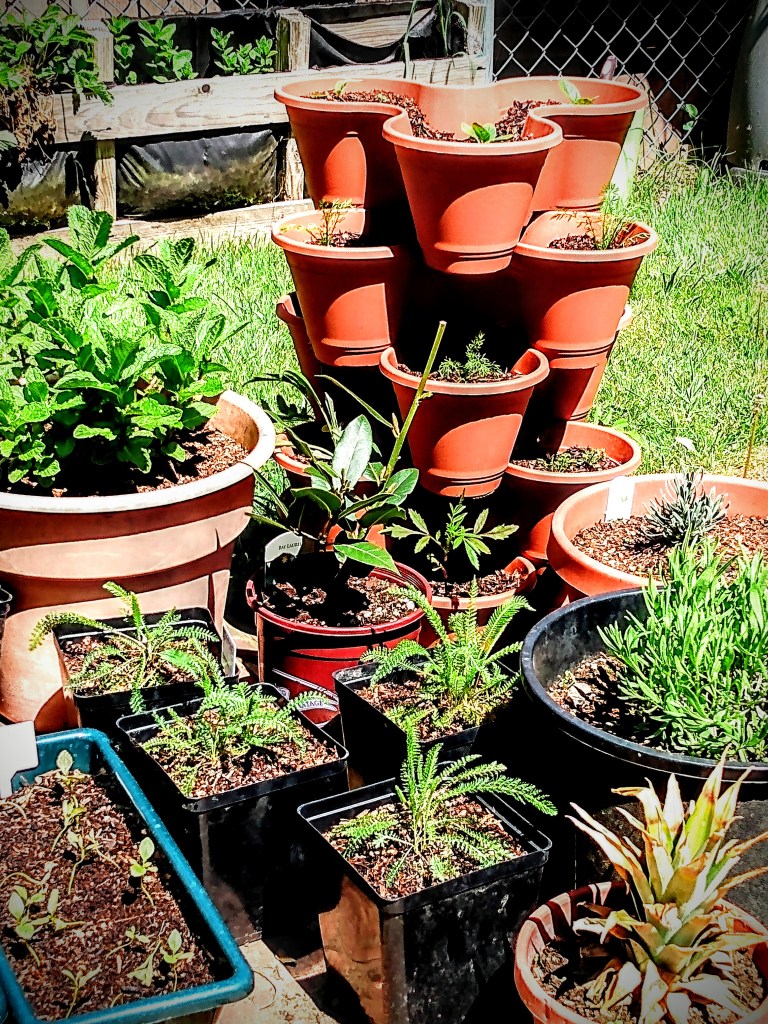
Container growing for small spaces.

For this mom, she has two love languages. Her primary love language is gift giving. Her receiving love language is quality time.

Making a deposit of part of this season’s garden was not just a simple arrive, dig holes, put in start, say good bye, and move on with the day.

Advertisements

For this Mother’s Day gift, it took in the appearance of leaving all the gardening supplies in the car and starting off with a sit down chat and getting caught up with all the news, even if it was only a day since we last saw each other. Then, I was able to go prepare the garden beds for this first plant installment.

Even before I could bring out the plants, this mom was already so filled with love that she wanted to spend some more talking. As much as I wanted to stay task driven (my personality is to knuckle down and get a project done quickly so I can move on to the next task), this day was all about showing love to this mom.
Pallet boxes for narrow spaces and hanging baskets on cyclone fence

So we had another chat session.

When I could find a polite moment to get back to the task of putting the starts back into the ground, I made that move. And with the final post plant watering, I went back and gave this mom one last extension to the gift I was giving her.

Remember, I said that this mom shows love to others by giving to them. So while I was building this garden for this mom, I know that the one thing that would bring her even more pleasure is by telling her upfront that the goal of this garden is primarily to meet her primary produce needs, I’m planting more than she will personally need so that she can give from the garden to others.
I wish I could share with you the look on her face, because she was bursting with love. Knowing that she was having a garden this year was more than enough to help her feel love, she felt seen and more loved because the gift was enabling her to show love to others without need to be reserved or anything else. It was a gift that was freely given so that she could freely give to others.

Growing herbs in repurposed gutters hung on a cyclone fence.

I know that this story may or may not show you specifically what you can give the hard to shop for person, but there is a valuable lesson here.

A good gift is designed to make a person feel loved because it speaks to how they most readily feel loved.

If you don’t know this love language, ask your person how they most feel loved. They will gladly tell you. It could be a tangible object or food that makes them feel loved. Or it can be a non-tangible activity, expression, or display.

A great gift is one that fills their love tank, but also doubles as a tool to enable them to share their love with others.

Container growing garden with DIY budget friendly or recycled components. Chicken wire trellis threaded through upright supports.

Maybe your loved one is not like this mother. Maybe they don’t show love to others by giving them things. Maybe they show love through acts of service. However their schedule is busy. By gifting them your time to do tasks for them or help them create time, this can free up time where they can show love to others by spending time with another person.

My encouragement to you today is to be inspired with a gift idea that doesn’t come from the shelf of a store. Yes, there are many store bought items that are amazing and meaningful. I want to strike the inspirational fire to give a gift out of love and seeing the other person at a core level. And also enable them to pass on love to others.

Advertisements

Right now we live in an interesting moment in history. It is an uncertain time for many families. But it is also a prime moment to celebrate others by giving to them in a way that shows them that you remember past conversations. Where you have heard and remembered things that could have easily been passed off as trivial information in the moment.

Let’s show our loved ones that we see them. And we celebrate them for who they are.

Again, Happy Mother’s Day!

publicdomainpictures.net

This post contains affiliate links to products. We may receive a commissions on products purchased through these links, but at no extra cost to you. This item link is to Amazon but may be purchased at local markets, and found at your local library.

If you are unfamiliar with Love languages, here is the book that started it all.

The Five Love Languages by Gary Chapman

Originally this was written for understanding your mate. There are several other editions available to meet other relationship needs such as children, being single, and in relationship of a military service member.

Processing…
Success! You're on the list.

Leave a comment

Advertisements
Advertisements
Advertisements
Advertisements

Finding Hardware

What are your feelings about sharing a garage/shop with someone?

I find it frustrating! I have my office/craft space organized with containers that are labeled with its contents. So even if I have containers down I know exactly what’s in it at a glance. And it’s super easy to put away and clean up.

The garage… I so wish, with every wish available I could send my family away for the weekend to organize it and find an official home for everything. And you can guess it. My problem is that my husband has a way he wants it and our two ways of organizing a work space for repairs, large projects, and keeping our hand tools are two very different ways of thinking. The funny part is that more times than not, it’s my husband who’s coming to me to find a specific tool. And yes, I keep my own stash of hammer, screw drivers, and allen wrenches that I zealously guard like my fabric scissors. If you touch them, you better put them back where they belong, LOL.

And if you’ve built anything for any length of time, you know how hard it is to find screws, nails, and washers specific for your project. God Bless my Husband, but he has that garage that we’ve all seen our grandfather’s have: screws in a coffee can, nails in jars… they may have a home but you have to dig for the style and size of hardware that you’re hunting for.

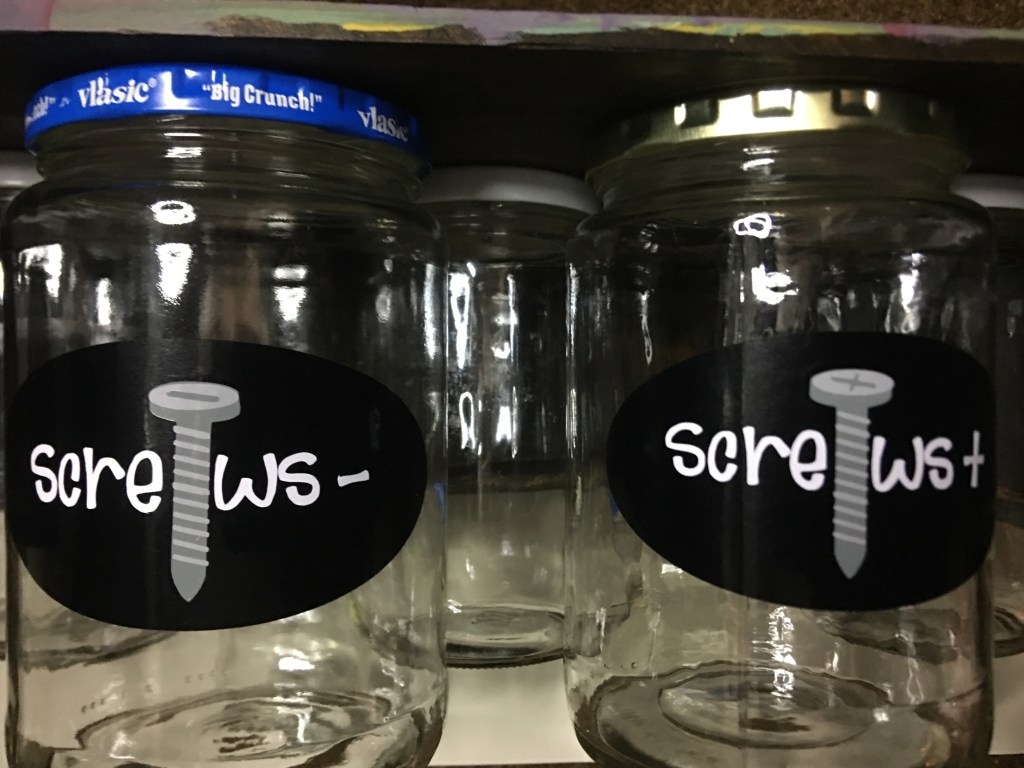
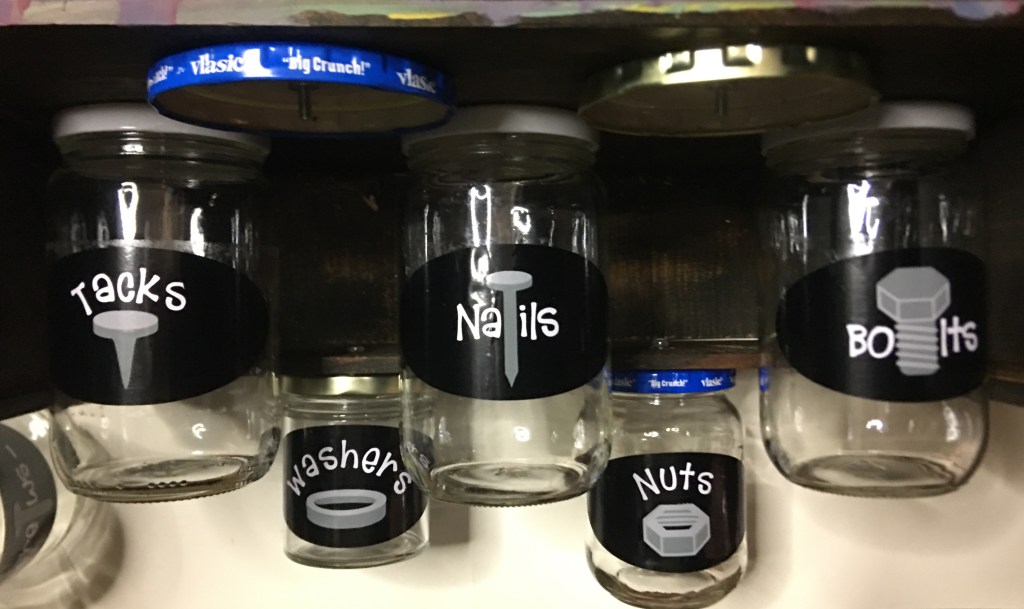
So for my husband’s birthday this year, I had my boys help me build my husband a caddy to separate all those pieces of hardware into an easy to access place that you can quickly grab without feeling like you’re sorting through that bag of unmatched socks. And Bonus for my bragging rights, is that I sourced everything for this caddy from our garage.

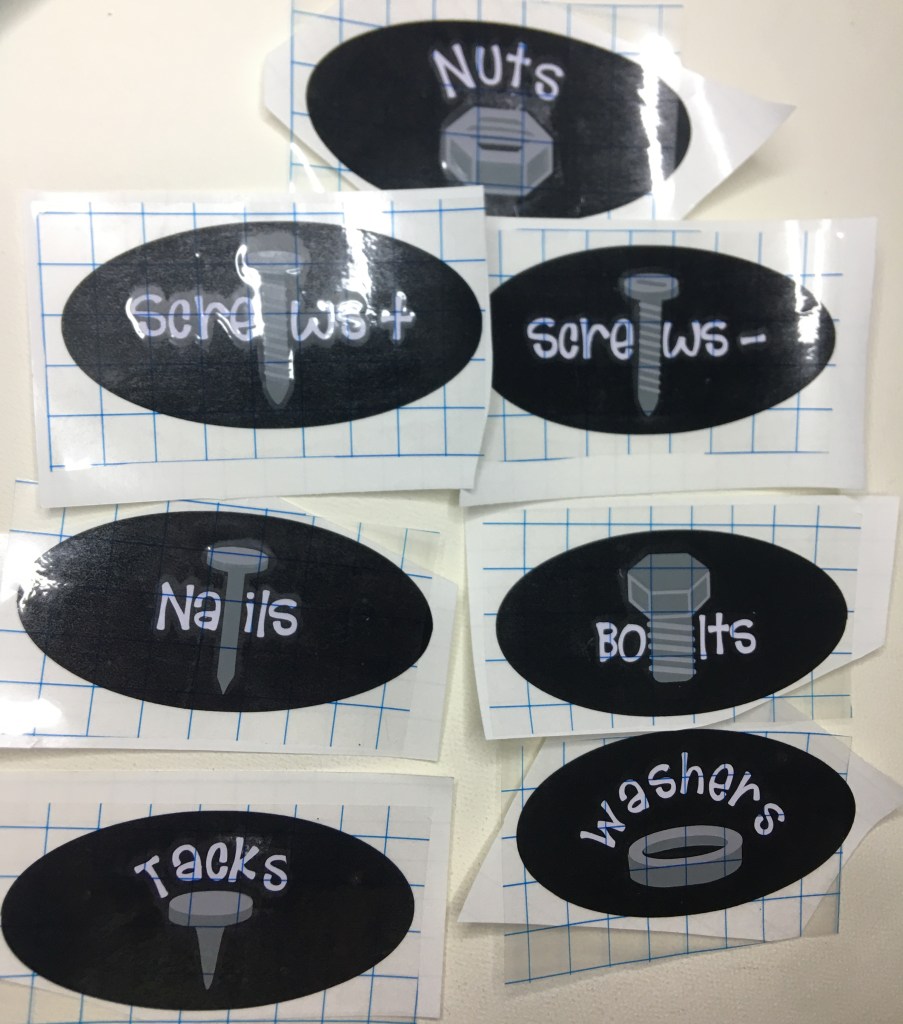
This caddy is perfect for a garage, craft room (of all types), office, or anywhere you need to space save and easily access anything. While you’ll see I labeled these specific for garage hardware, you can take this idea and run with it for crafting. Instead of nails, label it buttons. For a Teacher’s classroom, instead of tacks, label for push pins. Change bolts to paper clips. You can completely cater this project to anyone and their passion!

Advertisements

Here is everything that I used:

  • Wood Box
  • Hammer
  • Tack Nails
  • Hand Sander
  • Black Wood Stain
  • Acrylic Paint with Brushes
  • Glass jars
  • Electric Drill with Drill Bit
  • Nuts and Bolts (small)
  • Size Appropriate Wrenches
  • Vinyl
  • Hardware Labels
  • Weeding Tools
  • Transfer Tape

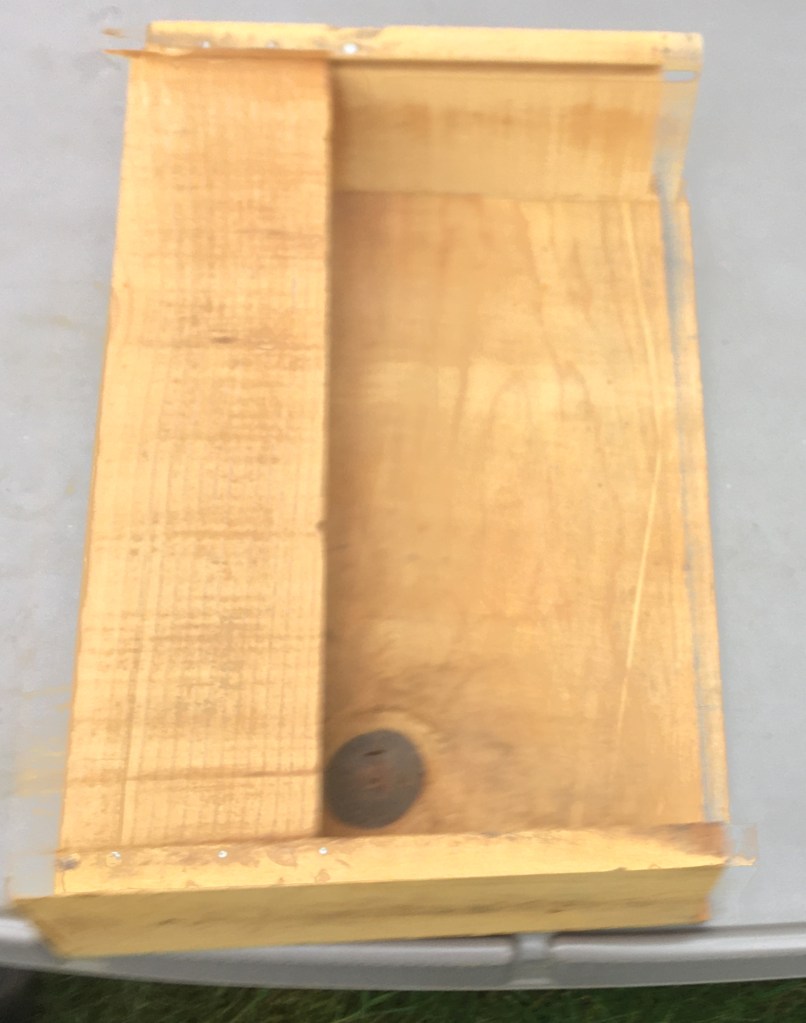
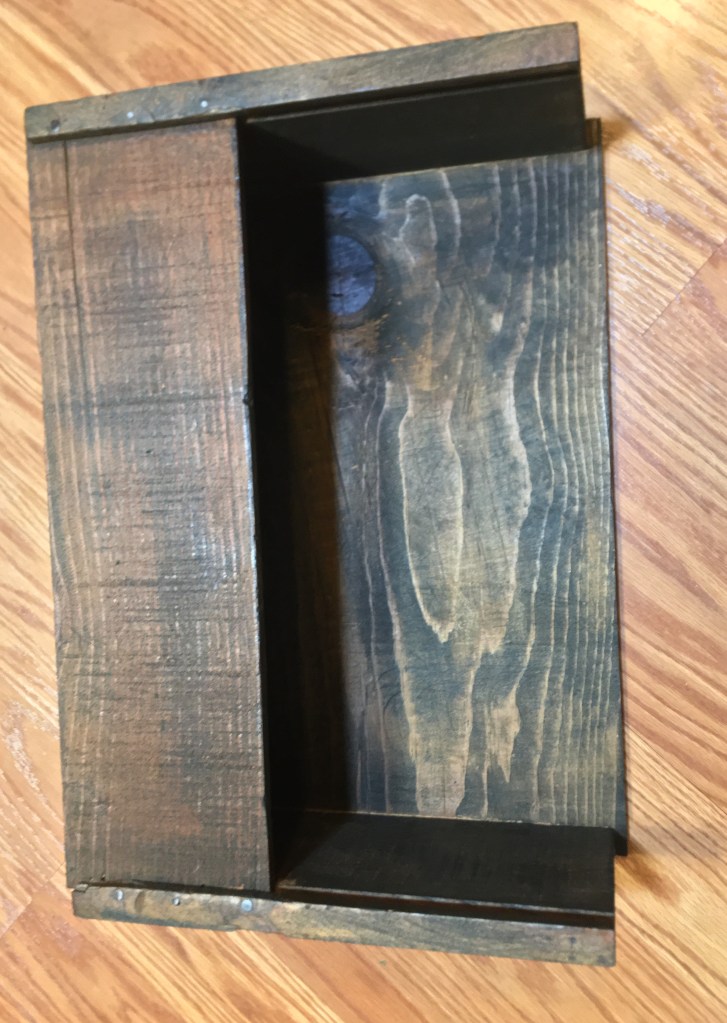
The box that I used is a wooden box (about 12″ by 8″) that’s very similar to a cigar box with sliding lid. The lid was missing and one of the long sides was about to fall off. So I just removed the lid and nailed it to the top of the box.

One reason why I wanted to reshape the box was to have a little hidey shelf, in case my husband wanted it. You know the little objects you want to put in a safe place, but usually any counter space is a place prime for losing the thing you want to put in a safe place. So here’s a safe place. This box was rough, because it wasn’t meant to be decorative. I sanded the box on all sided before staining it. Yes, it maintained the rough look and feel. But I also fully appreciate the rustic aesthetic.

Advertisements

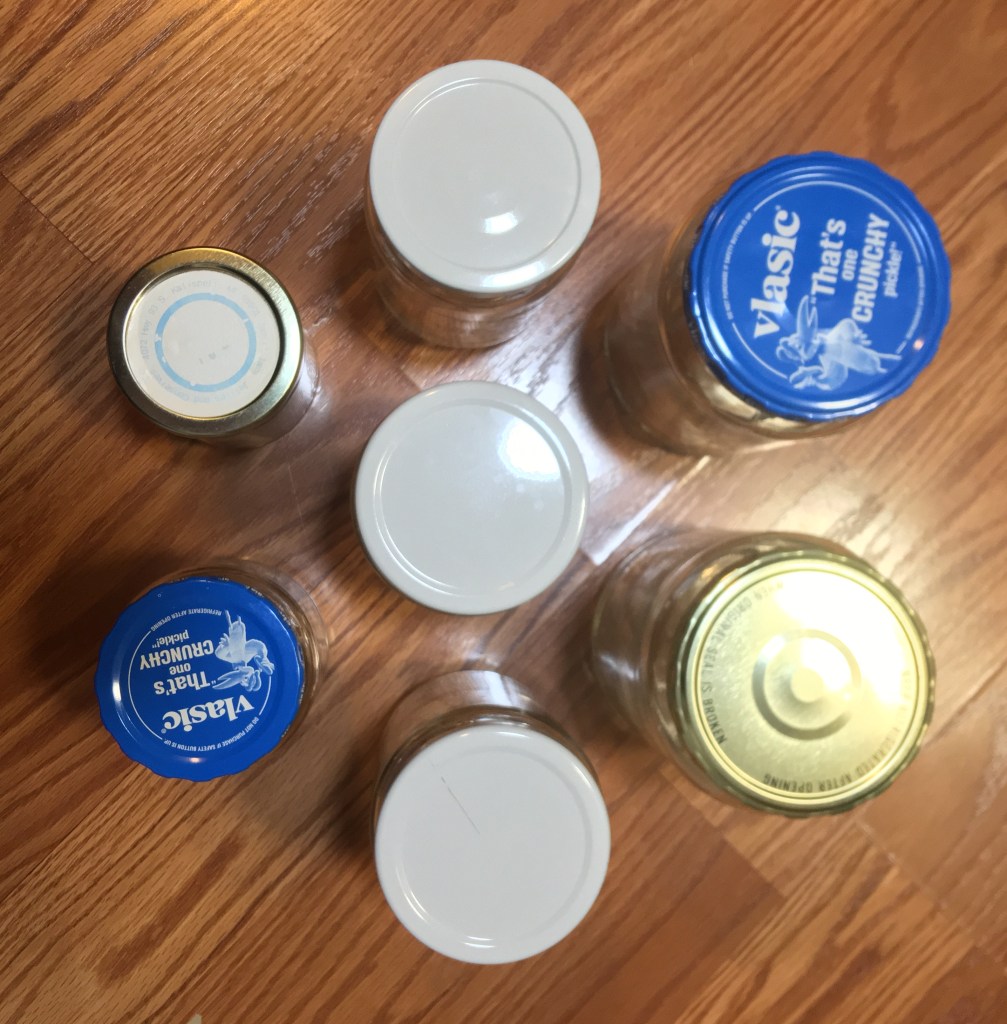
While the stain dried, I cleaned out my fridge from all the jars of pickled items. I’m not a pickle eater. Nor am I a fan of pickled vegetables. BUT my husband loves them. And my fridge door is where I sourced this collection of empty jars for this project. (I was not about ready to take from my canning jars, although I’ve seen people use canning jars for their hardware holders.)

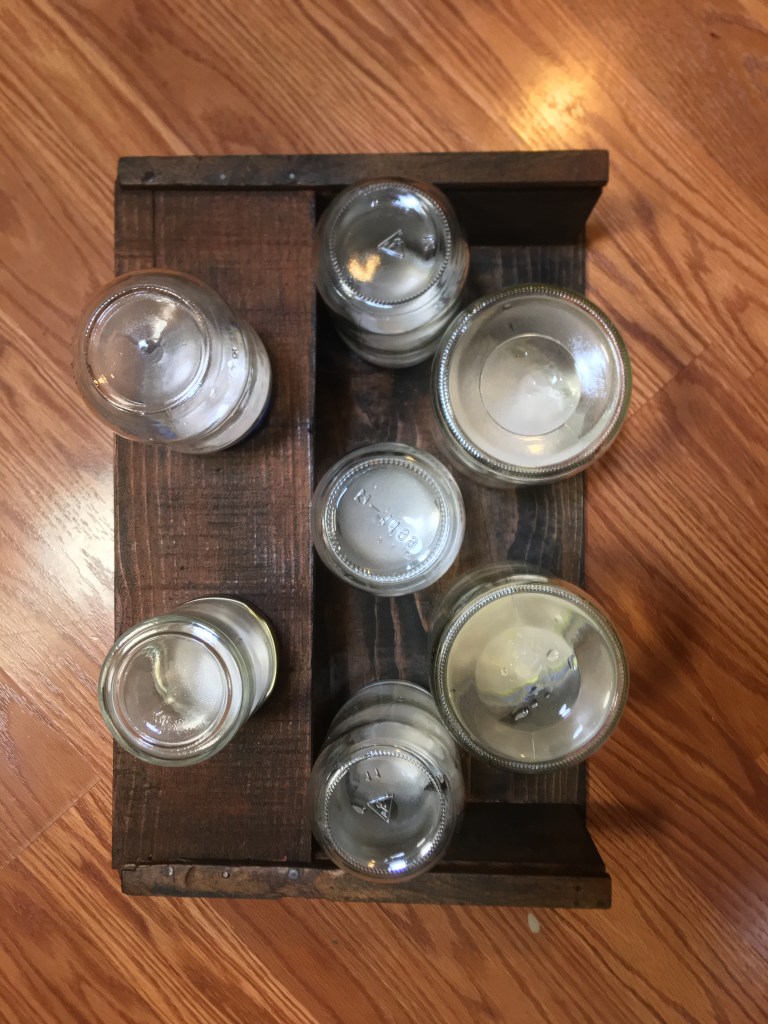
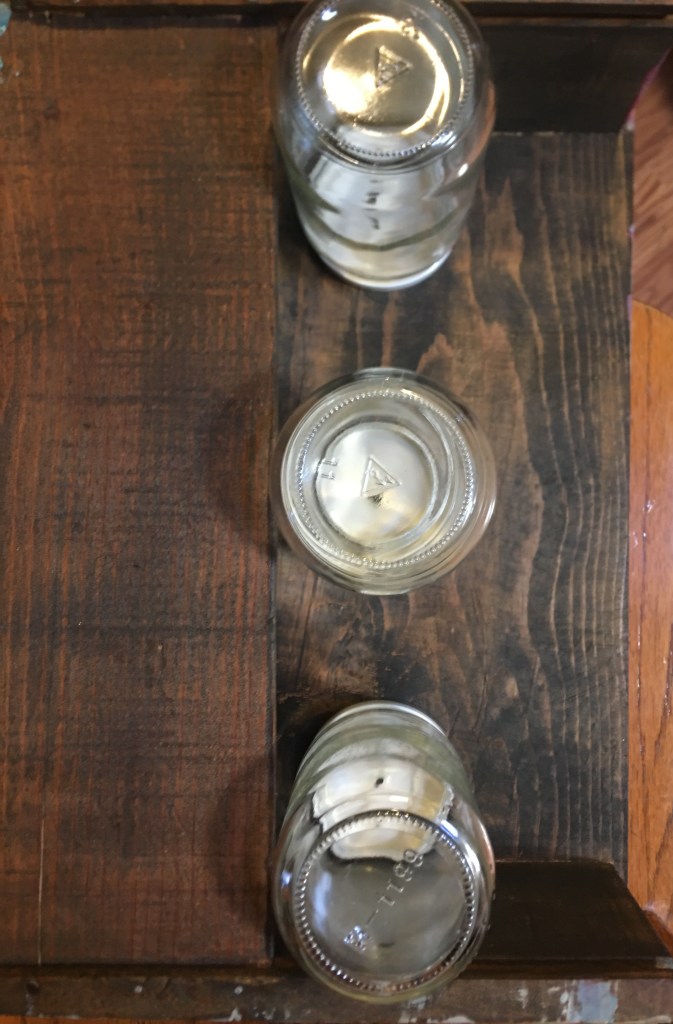
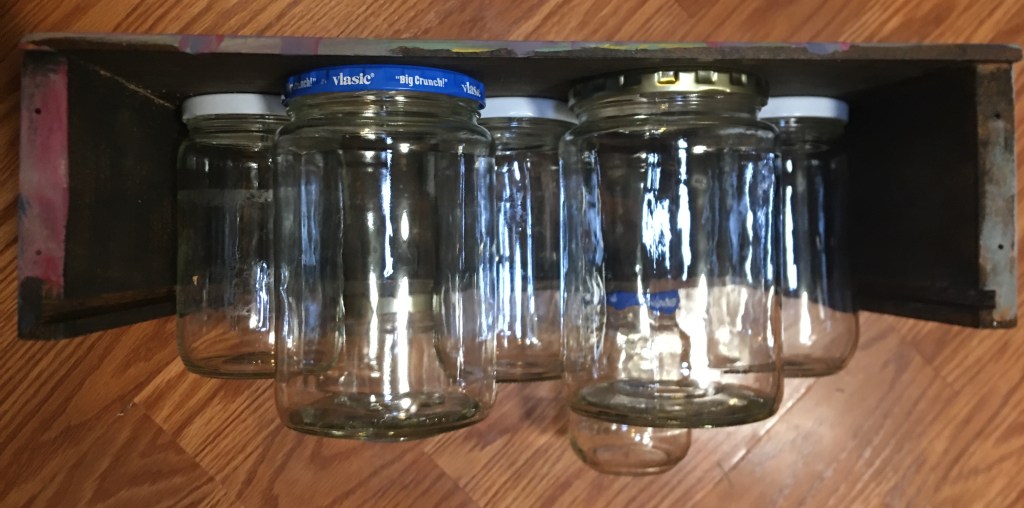
After the jars were washed and I found which ones were similar in size, I placed them on the underside of this caddy. The smallest jars I put on the shelf. And I went back and forth if I wanted the row of two or the row of three jars to be in front. I chose to put the set of three in the center just for symmetry. Plus, I knew the screws were going to go in the larger jars. And other than the nails, these are the most sought after hardware in my house. So I put those in the front to make it the most convenient to grab.

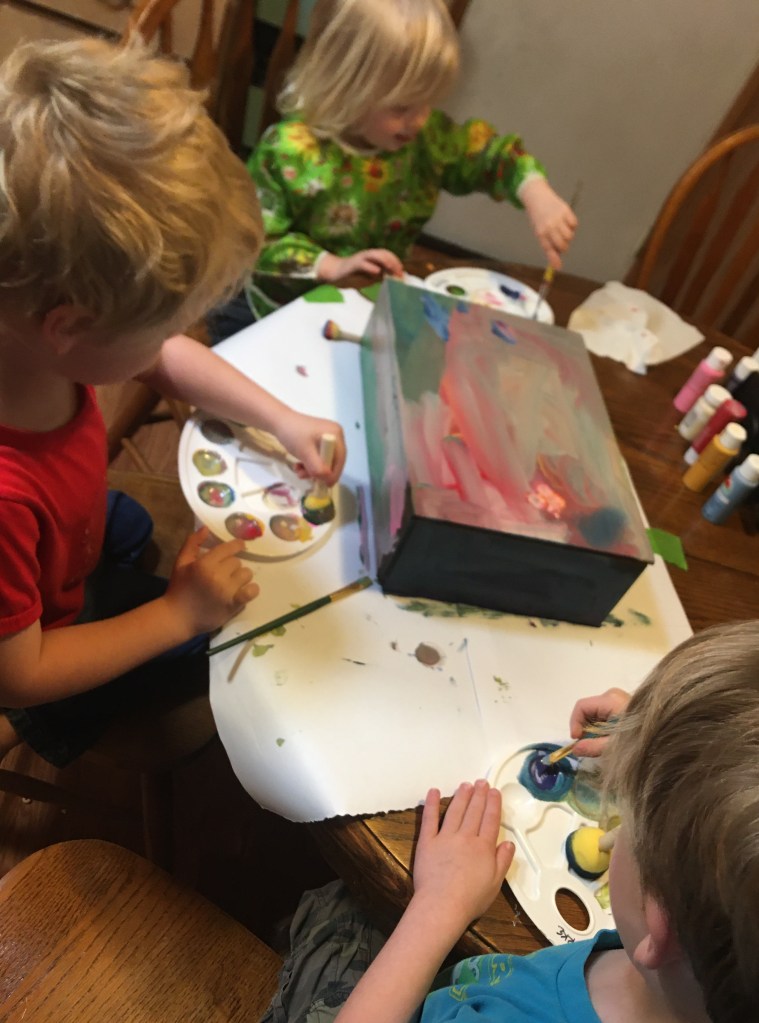
While the jars dried, from their scrubbing, I set the kiddos up for painting the caddy. They got a bit distracted and wanted to play instead of use tools, but they dropped everything to paint for their dad. And since my husband loves their art, I sacrificed my want to keep the wood stain, which was my favorite part. But I kept the underside stained so a piece of me was still there.

I’m showing you this step, because you can make your caddy however you favor it. You can keep it clean and upscale. Or you can make it very family orientated. There’s no wrong way to make this caddy.

Advertisements

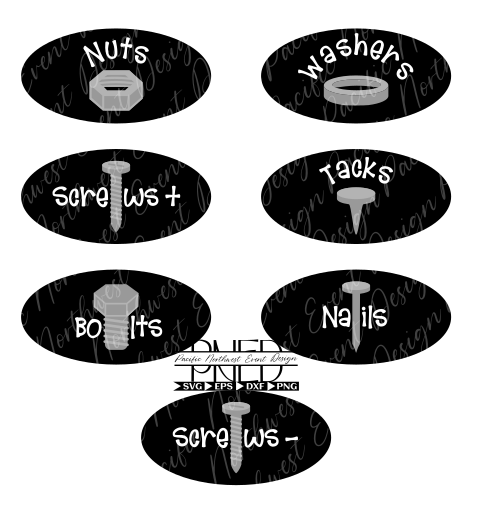
During this drying time, I cut out my labels with my cutting machine and assembled the layers ahead of time. That way when I was ready to apply theses labels, everything was lined up and ready for a simple peel and stick on the jars.

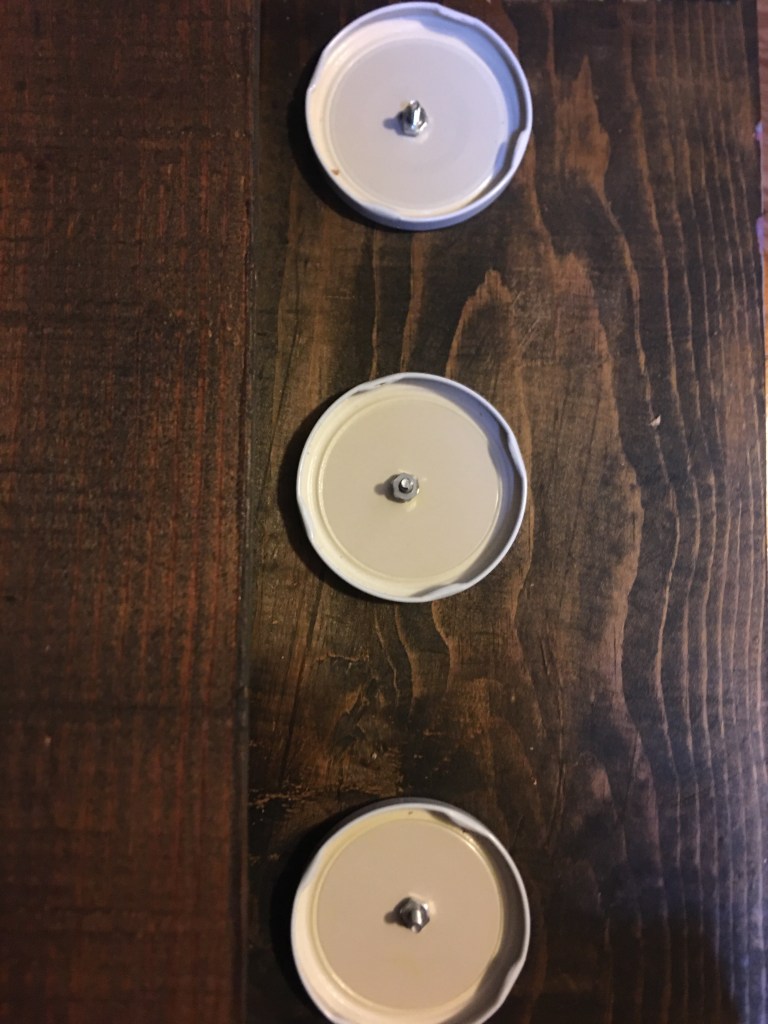
When the jars and the acrylic paint dried, I grabbed my drill, nuts, bolts, and jars. The first thing I did was drill a hole in the center of the lids. (If you are opting to use canning jars, make sure the lids you choose to use have already been used to preserve your food. That way you still have good canning lids ready to use in the future.)

After you are finished drilling, place your jars on the caddy in the exact places you want them. This pre-spacing is very important, especially when you have rows of jars next to each other like I have on the center and right side. I didn’t want the row to go over the edge, for esthetic reasons. If you have all your jars the same size and they second row comes over the edge, it’s okay. You may want to consider painting the jar lids to keep a uniform look. But the placement is also important because you will find that your jar lids are a smaller diameter than your jar sides. So by pre-spacing your lids, you will make sure you can screw your jars into your lids and not have an issue with the box sides or the shelf.

While you hold your lid in place, drill a hole through your caddy. When you hold is completed, you thread the bolt through the caddy and the lid and secure it with the nut. Hand tightening the nut and bolt will not be enough. You will want to tighten them with a wrench. This is most important if your bolts are short and if you want to be able to (un)screw your jar without holding onto the lid.

TROUBLE SHOOTING: If you find it difficult to keep your lid in the correct place for drilling, without moving, here are a couple of ideas you can use to assist in keeping your lids in place. Before drilling, use masking tape to tape your lid down to the caddy. Another option is to use a hot glue gun and place a circle of glue around the center of the lid. Be careful not to glue the center. You don’t want to drill through glue.

Advertisements

Once your jar lids are all secure, you’re ready to label!

To get labels to stick with the most success, clean your jar with a cotton ball soaked in rubbing alcohol. This will remove any oils, dust, soap, or anything else that could cause your vinyl to not secure cleanly to the jar.

It is crafter’s choice how you want to add the labels. You can place your jars on a work surface and apply them off the caddy. Or you can apply the labels while on the caddy. I chose to have all the jars attached to the caddy because the only jars that were a perfect match were the three that put in the center row. They were from the same company of pickled vegetables. All my other jars were different sizes, but very similar in measurements. However, if I applied my labels off caddy and centered them on the jars, then none of my labels would have lined up. However, with my jars on caddy, I could get the labels to line up near perfectly and give the illusion that all my jars are matching. The exceptions of course are my small jars in the back (washers and nuts). But those are tiny jars hidden in the back and completely understandable why nuts would be larger than washers.

However, if you’re the personality type that is bothered by things not absolutely, perfectly matching, then please ignore my chaos here. Work to your strengths and show us the beauty of our symmetry and perfectly lined labels. I love watching your work. But if you’re the type that can’t get things to line up perfectly, know that there are ways of lining things up even when your jars are millimeters off in their heights.

Mounting the Hardware Caddy

I’m sorry I do not have a picture of this for you today. We’re in the process of reorganizing our garage and we’re not sure yet if we’re wall mounting or rack mounting this caddy. I will update this post when we get that project finished, so you can see how you might choose to mount your caddy.

The one thing that you need to be aware of is how gravity is going to work when you have the jars filled with their hardware.

Remember, I organized my jars so that my heaviest and largest jars are on one side. If I install with screw jars forward, all the weight and pull are going to be forward. So I will need to compensate. If I install the screw jars in the back, toward a wall, there will be very little compensated needed because the center of gravity will be near the wall and negligible.

For wall mounting, I would want to have my screw jars forward and screw the back side of the box into the wall, with a screw in each corner of that board. Preferably I would want to screw the caddy into a stud, because that will carry the weight beautifully. If it’s impossible, hit at least one stud (which I would center the caddy on and put in an additional set of two screws, in additional to the corner screws). If all I have available is drywall, I will definitely put in wall anchors and drill the screws into those. That way the weight of the hardware will not weaken the dry wall and pull out of the wall under too much weight.

If we choose to go with mounting the caddy on our rack, I will do that using conduit bracket mounts. I will use at least three brackets on the screw jars side. That way, the weight of the screws will pull straight down. there will also be a bracket or two on the back just for stability purposes for when the screw jars are removed, and the center of gravity changes.

Another option for rack mounting is to use a block of wood. The caddy (jars removed for installation) I would put on the bottom side of the wire shelf, with the block of wood on the top of the shelf. Then drilling a screw through the open space of the shelf into the block of wood. This option is not the one I would personally go with, because it doesn’t work with how we use our shelves in the garage. But I did want to mention it because the caddy can be screwed into an existing shelf that you might have.

While there are many ways of installing a caddy like this, I want to put out one more idea. If none of the above work for your situation, you can add wall mounts to the back of your caddy. There are all sorts of alligator grip picture hanging mounts that you can use. With a trip to your local hardware store, you can find picture mounts that can hold portraits up to 50 pounds. That is over kill for this project, but I want to mention that this is another option that could work for you.

Please send in pictures or let me know who make this for. As I mentioned, this example of a hardware caddy I made for my husband for his birthday. But this is perfect for a Father’s Day gift, Graduation gift, something for a teacher, crafter, or even just as another option for home organization.

Files used for this project:

You can find Hardware Labels here.

Processing…
Success! You're on the list.

Taming Fly Aways!

I know these are common problems for family get-togethers. Either, your family is so large, that when you have a pot luck style meal there is always the problem of not having enough table space. Or your family is enjoying the sun with a BBQ and you spend more time than you can admit chasing down paper plates, napkins, and even silverware.

My family suffers from both of these problems. Every year.

Inspiration hit when I watched this video, tutorial using dollar store Jenga Blocks, from She So CraftDee. This video was so well put together with directions, that I don’t want to recreate what this talented woman did. So I will just direct you to her video if you want to learn how to create structures using Jenga Blocks. Instead, I will proceed with the road blocks I faced while working with this tecnique and how I made this Paper Goods Caddy.

Materials

  • (54) Jenga Blocks (I used 48 of one style of blocks and 6 blocks of another style)
  • Hot Glue Gun and Glue
  • Multi-Purpose Cement 0.5 fl oz (E6200 would be the best choice)
  • Ruler (Optional)
  • Paint
  • 1.25″ Nails
  • Hammer
  • (14) 0.5″ Wood Cubes
  • (3) Square Pen Holders
  • Glitter Paper
  • Metal Gift Tag
  • Vinyl
  • Transfer Tape
  • Elmer’s Glue
  • Glitter
  • Acrylic Paint Pen (optional)
  • Flat Face Rhinestones (optional)
  • Jewelry & Metal Glue (optional)

Project Dimensions

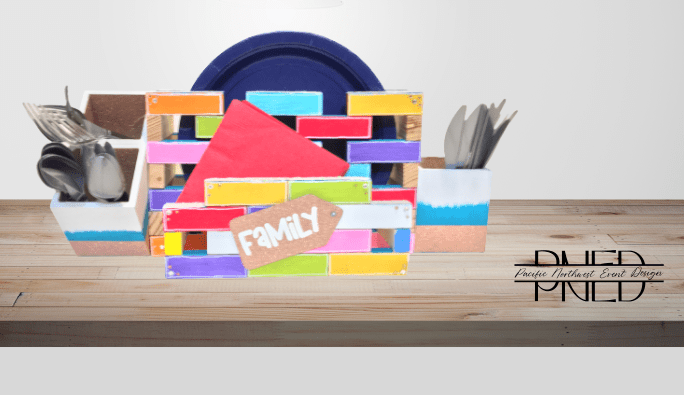
The overall dimensions are 17″ wide by 6.5″ high by 7.5″ deep. The interior of the silverware holder squares are 2.5″. The plate holder is 9.5″ wide by 1.75″ deep. The napkin holder is 7.5″ wide by 1.75″ deep.

This accommodates 9″ paper plates and standard sized napkins. In the picture are 9″ plates and cocktail napkins (6.5″). The dimensions can be adjusted according to your family needs.

Before I jump into how to assemble this caddy, I want to start with the pitfall of gluing options.

She So CraftDee only uses hot glue. I do want to draw attention to the fact that it’s not just any hot glue stick, but wood glue. Full disclosure, I have not yet worked with hot wood glue so I cannot attest to the strength or durability. But for the crafter who does not use hot wood glue or have never heard about it, it is not going to function the same way as the standard glue stick that you have in your craft stash. So please do not expect standard hot glue to work like hot wood glue.

I have decorated in enough wedding and other events that, professionally, I would not put trust in wood glue alone to hold a vase that holds water and everything else that adds weight. An LED pillar light is only going to weigh ounces. However, the weight of a glass vase filled with water, stones, flowers, and anything else of weight is going to add up quickly. There is no telling if and when glue will fail. So I would highly recommend that you reinforce your build in the legs and the base frame so that you can rest assured that you won’t have a catastrophe on your table tops. Wood glue and standard hot glue would all be adequate for any non-weight baring sides.

Advertisements

Because this Paper Goods Caddy is a functional piece, you will definitely need to use something much more substantial, for reinforcement. I used Multi-Purpose Cement (from the dollar store) as my primary gluing option, with the use of standard hot glue to hold the blocks in place while the Cement cured. For a home craft, the Multi-Purpose Cement is a good choice if you just need a little bit of glue. You will use the full 0.5 fl oz tube for this project. However if you are a professional, I would recommend E6200 over all other glue.

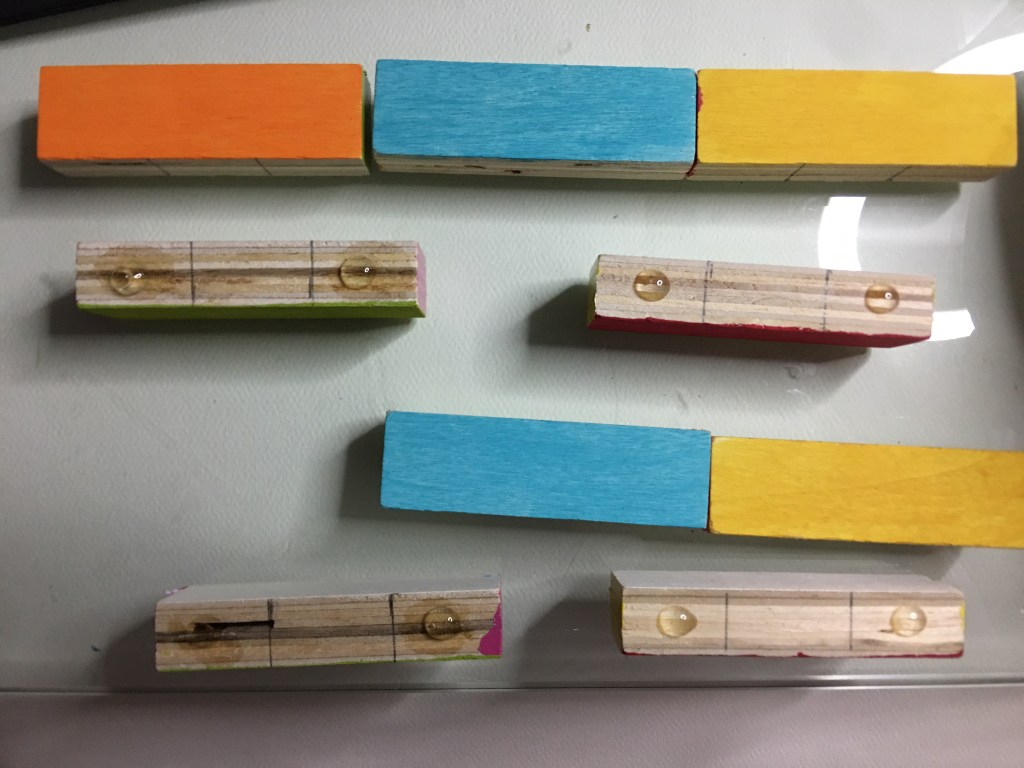
TIP #1: Examine your Jenga Blocks. You want to make sure they are solid wood with no cracks, grooves, or holes. The cheaper Jenga Blocks do not give you the easiest surfaces to work with. I had a couple of blocks that had a gaping hole where the wood was laminated together. The glue went straight down to my work surface. If sanding doesn’t give you a smooth working surface, paint your blocks. The glue actually held much better to the painted surface than the laminated wood surface. Plus, the paint fills the gapes and grooves for you. Just be sure to let your paint dry overnight.

TIP #2: If you are using colored blocks, like I did, set up the pattern that you want your bricks to be in before you start gluing. This will keep your pattern uniform in the front and the back.

Prep the Silverware Holder

Please feel free to decorate the silverware holders in your personal style. However if you want to recreate what you see in the pictures, these are the steps that I took.

  1. Paint the top 2/3 of the pen holder with white acrylic paint. (Allow to dry.)
  2. Paint the bottom 1/2 with teal acrylic paint. (Allow to dry.)
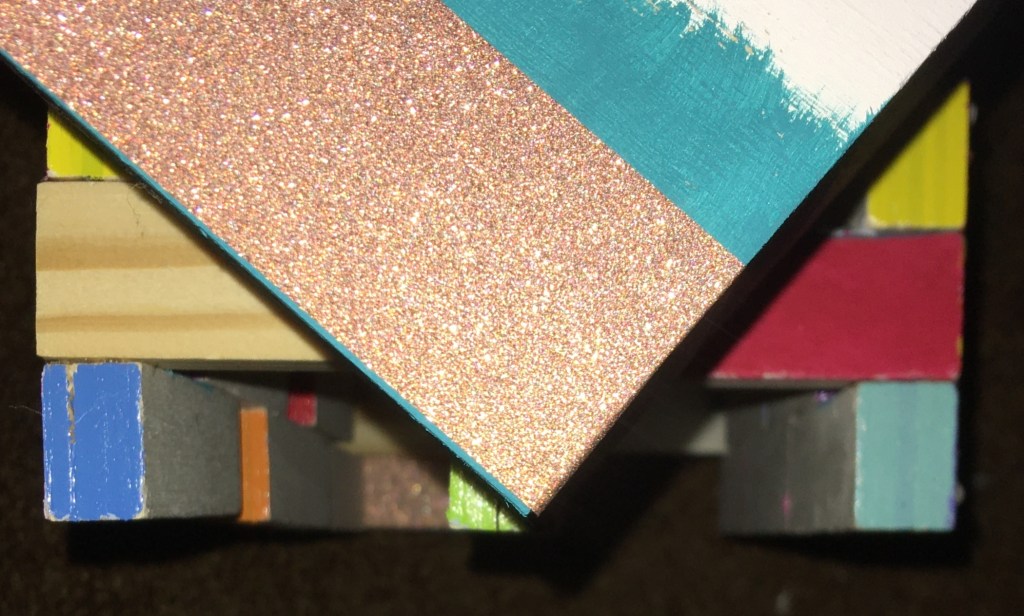
  3. Cut Glitter Paper (or vinyl of choice) into 2.5″ strips (the number will vary depending on the length of your Glitter Paper or vinyl choice). Also cut 3 additional strips at 1″.
  4. Slide a 2.5″ strip into a box and crease the edge. (This will give you the cleanest edge and prevent you from mismeasuring the inside of the box.) Trim on the crease.
  5. Remove the backing and place on the inside face of the box.
  6. Repeat 4-5 for the remaining 11 inside faces of the three boxes.
  7. Take a 1″ strip of Glitter Paper and apply it to the bottom outside edge of the pen holder box.
  8. Tack the edge of the Glitter Paper closed with a dot of glue.
  9. Repeat steps 7-8 for the other two pen holder boxes.
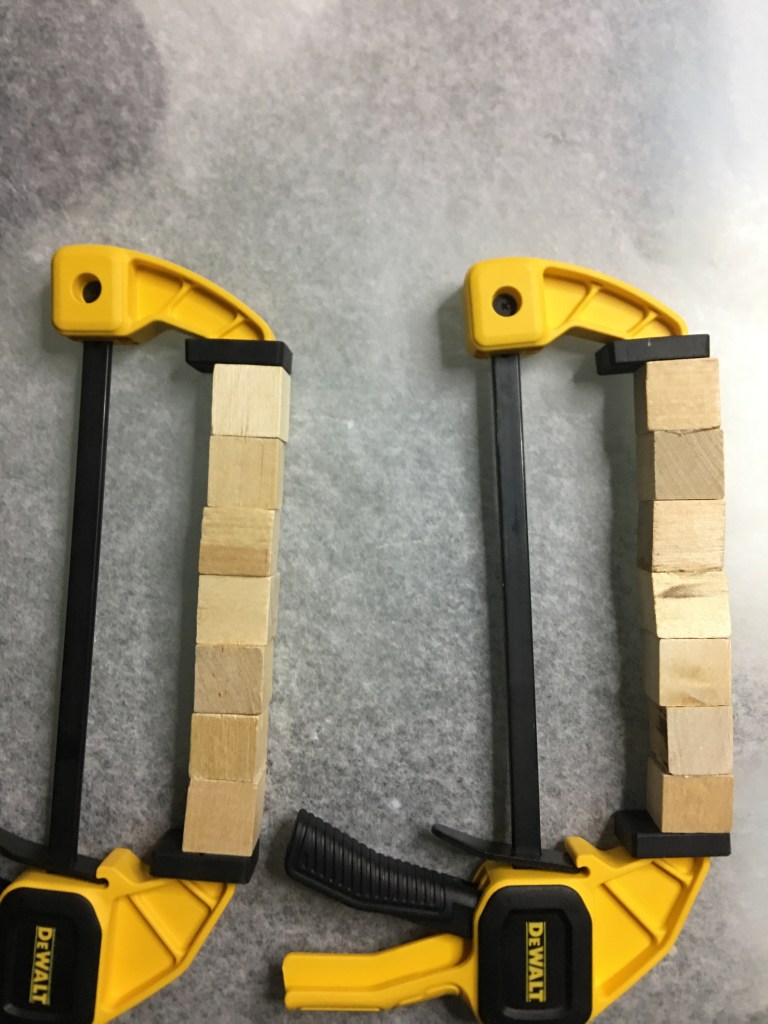
  10. Glue two of your boxes together, Glitter Paper seam sides together. Use a very liberal amount of Multi-Purpose Cement in the center, with a rectangular frame of Hot Glue. NOTE: Hot Glue does leave a gap between items glued together. So if you want zero gap please use Cement only. You will need to clamp together the boxes until the glue dries (an estimate of 1-2 hours).
  11. Set Aside for Assembly.
Advertisements

Prep Gift Tag

  1. Take a left over piece of 2.5″ strip of Glitter Paper. If it is large enough, wrap it around from top front, down, over the bottom edge, and up the back side. If it is not large enough, take two pieces that fully cover the front and back and cover each side.
  2. Trim the edges of the Glitter Paper that run over the edge of the metal gift tag.
  3. Create the hole, matching the metal gift tag, by piercing the Glitter Paper covering the hold.
  4. Using your cutting machine, cut “Family” (or any other phrase of choice). The Font I used was Chunky Confetti.
  5. After you weed your vinyl, apply “Family” with transfer tape onto your gift tag.

Prep the Paper Goods’ Feet (Optional)

My oldest son informed me that we needed to add a bottom so that the napkins and the plates could stay in the holder. He was concerned about his grandma having to put in and take out her paper goods. So I designed this so that the Caddy is not just a holder, but it’s a moveable container that can keep the goods in and be easy storage.

  1. Take 7 of the 1″ cubes and glue them end to end. This is one foot.
  2. Repeat with the other 7 cubes to make a second foot.

NOTE: you can use Hot Glue for this prep because the feet will not hold a lot of weight. I chose to the Multi-Purpose Cement because I have clamps, and I want to ensure that in the heat of the summer sun, the hot glue will not soften and become weak.

Advertisements

Paper Goods Caddy Assembly

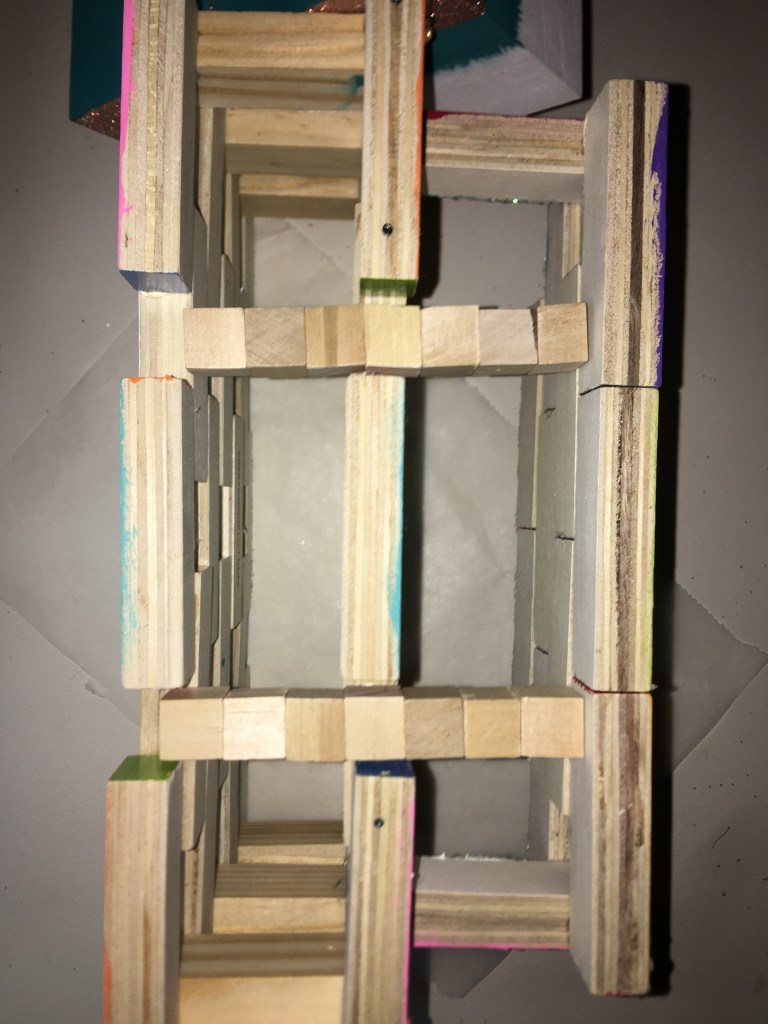
From my stash of Jenga Blocks, I wanted to use ones with colored ends, but didn’t have enough. So this is the reason why I used 48 blocks of one style and 6 blocks of another style (which were used on the sides of the plate holder). The two different styles of blocks had different heights, which lends to the floating brick illusion. The floating bricks could be more prominent by using an even smaller set of Jenga Blocks, still using the 2 row build.

  1. Mark off your Jenga Blocks. My blocks were about 3″ wide so I drew two lines at inch increments so that I could work fast and glue all the bricks together uniformly.
  2. Glue together your two row sections, 3 bricks on top of two. In the inch section I put a large circle of Cement with two dabs of Hot Glue on either side. Once Hot Glue dries, you are free to move on to the next piece to glue.
  3. You will have 6 sets of two rows.
  4. Glue together your napkin face plate, starting with the rows. Make 2 sets of 3 blocks, glued together end to end. And make 2 sets of 2 blocks, glued end to end.
  5. Start with the base and work your way up. One top of one of the 3 blocks, center a 2 block set and also glue on the arms that will attach to the plate holder. On top of the two arms and the set of two, glue on the other set of 3. On top of that glue on the last section of 2.
  6. Set the base for your plate section, by making 2 corners. If you are using two different sized blocks for a floating brick look, your larger blocks will be used here on the sides (they are the unpainted bricks in my photos). Glue your side piece on top of your front and back corner piece. Do this for the other side. NOTE: your center bottom piece is not going to be attached to anything for a few steps, so set those off to the side for the moment.
  7. Space out your corners by setting a two row section on top, do not glue.
  8. With your corners set, remove the two row section without moving the base corners, place your napkin face plate. Once you have the napkin face plate center, you know where to add the Cement and a single dab of Hot Glue.
  9. This amount of glue is not enough to keep the napkin face plate in place, so you will need to hammer one nail into each arm of the face place, into the base corner, so that it will offer the stability to the napkin face plate.
  10. Glue the two row section, which you used to space the corner sections, onto the middle arms on the side of the plate section. Use a dab of Cement and Hot Glue.
  11. Repeat this last step with a two row section for the back of the plate section.
  12. Glue a side arm, on top of the two row sections, on each side.
  13. Repeat steps 10-12 to form the middle of the plate section.
  14. Repeat steps 10-11 to form the top of the plate section.
  15. Turn the Caddy upside down and glue in the middle sections that were set off to the side, back in step 6.
  16. To reinforce the face plate a second time, you will use 4 nails to nail both sides of the left and right Jenga Blocks above it.
  17. Where you would like to add glitter, paint on your glue and apply glitter.
  18. (Optional) Use your acrylic pen and draw on a frame around the front edge of each of your blocks, front and back.
  19. (Optional) To add gems, place a dot of Jewelry & Metal Glue where you would like to add your Rhinestones. You can glam this up as much as you want, including using only Rhinestones instead of glitter (step 17).
  20. Hot Glue your “Family” Gift Tag to the Napkin Faceplate.
  21. Glue the single silverware box, upright on the right hand side. Apply the Multi-Purpose Cement Glue and Hot Glue onto the Jenga Blocks (to the height of the silverware box). Attach the silverware box.
  22. Tip the Cady on its side so you can position the Double Silverware Box. As you look at the side of the Cady, note that the middle row is the front of the Plate Holder. Use the Jenga block to create a 45° angle. The front bottom of the Silverware Box is lined up with the bottom edge of that middle Jenga Block. The top back edge of the box will be in alignment with the front of that back row of the Plate holder.
  23. Remove the double box and apply the Multi-Purpose Glue and Hot Glue to the side of the Cady where the Double Box will sit.
  24. Attach the Double Box to the Caddy.
  25. Turn the bottom of the Caddy upside down and apply Multi-Purpose Glue and small dabs of Hot Glue to the two recessed sections of the middle row.
  26. Attached the two feet, centered on that middle 4th square, into those recessed sections.

Congratulations! You have completed a space saving Paper Goods’ Caddy.

Please leave a comment how this caddy turned out for you.

If you’ve seen a project that you want more information on how to make, please let me know so I can set you up for success!

Empty Tomb is now live. 100% of preceeds will go to the support of orphans in Rwanda.

Processing…
Success! You're on the list.
Advertisements