A Yeasty Fix

It’s common to hear stories from people about how they started a yeast starter but forgot about it and had to throw it away.

Another common comment is about how finicky people assume starters are.

Yes, there are some things to keep in mind and understand about yeast when keeping a starter. However it doesn’t have to difficult to keep a starter. And yeast is much healthier than most people assume. You have to remember that yeast is found in the air around us. It lives on our skin and is an invisible friend. It was created to survive in the same world that we live in.
One of the common misconceptions that I find people perpetuates in starting and feeding yeast is that you have to have a wet starter. Ever since I posted about keeping a drier starter, more and more people are talking about how they now keep a dry starter. And before I posted on my blog, I talked about this in community pages. In one thread a microbiologist agreed that it made more sense to keep a drier starter of yeast.

The benefit of keeping a drier yeast is that you do not have hooch (a liquid layer on top of your starter) by week’s end.

I firmly believe that hooch is an indication that your environment for your starter is out of balance. Excess water created a home for bacteria and mold to grow and ultimately lead to a situation where you have to throw your starter out. Once mold forms, there’s nothing you can do to resuscitate your yeast. That is the one kiss of death to starter.

And mold loves water.

If you keep your water levels in check, you don’t have to do anything else to prevent mold.

How can I state that with surety?

Let’s just say that the Christmas season was so busy that I forgot about my yeast for an entire month! Perhaps over a month… I last used my starter for Thanksgiving and forgot about it until after the New Year.

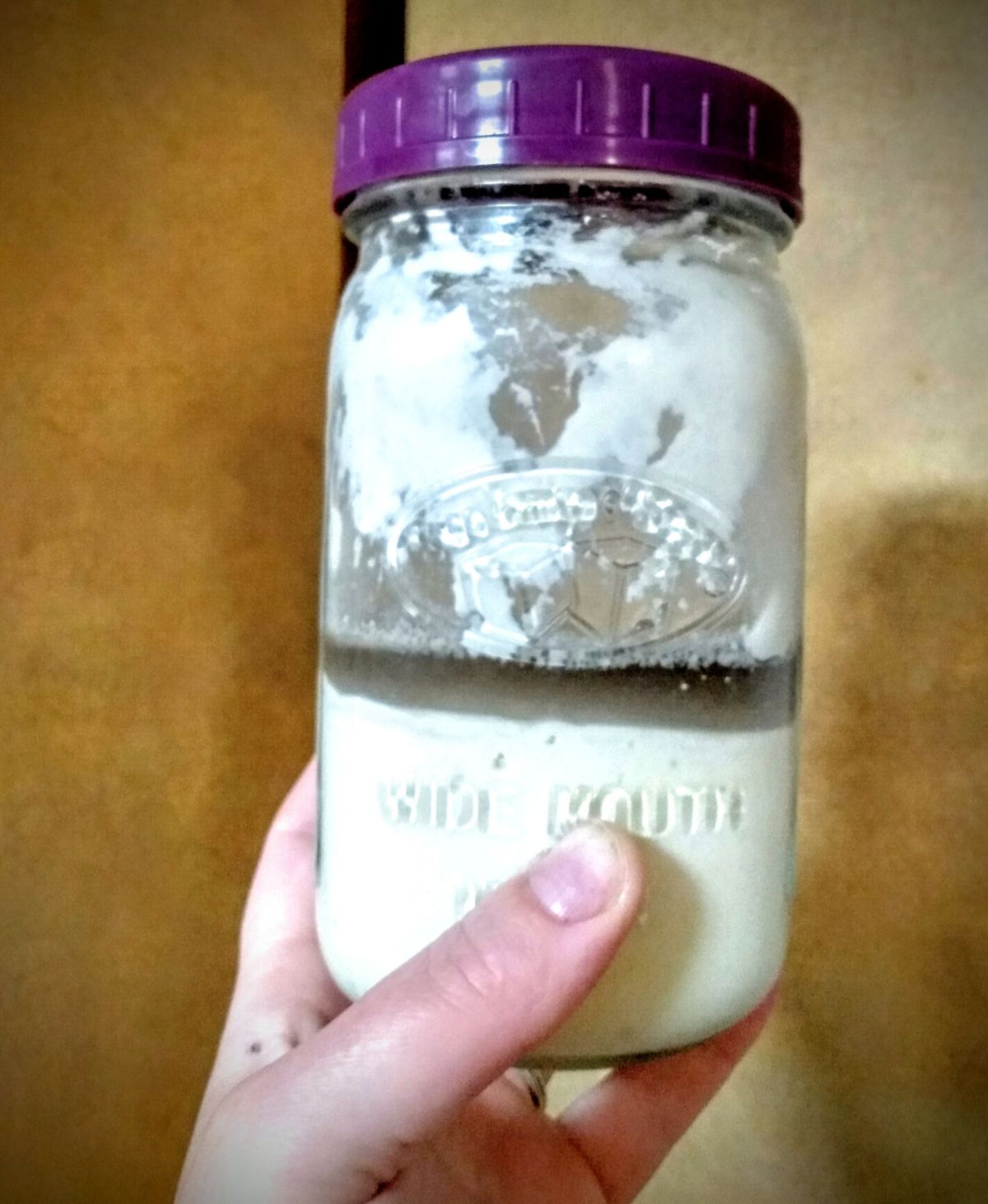
My Neglected Starter

If you pulled this out of your fridge what would your reaction be?

This “black” layer is hooch that is showing that my starter is sick and anemic.

Usually I remember my yeast when I haven’t used it for two weeks. It has this layer of hooch on it, but it’s clear. This is the worst that I’ve been a bad yeast mom. BUT I did not kill it.

My initial thought was, “well it’s a good thing I have a freezer yeast back up.” (There will be a future post on this. Now that I have four years invested in this starter, I want to make sure that I have a back up starter that I can fall back on Incase I really blow it and lose my main mother.)

The first thing I did was remove the lid, look for mold and sniff test my starter.

With no mold, I knew I could recover this yeast. And the sniff test confirmed that I hadn’t killed off my yeast. It still had a sour dough tang scent with no additional scent (which would be an indication of a colony of something different from my yeast). My starter smelt weak/anemic. And that’s because it was.

Advertisements

Recovery

The hooch is guaranteed to be where additional growth, competing with my yeast, is living. So first things first, I poured off all the hooch.

As you can see here, there was still some discoloration with the presence of left over hooch.

When I fix neglected starter I always start with a fresh/clean mason jar. I do this because everything about healthy and unhealthy starter is microscopic. I want to minimize the transfer of anything but the yeast I’m rescuing.

Since I don’t want to transfer this tainted hooch, I take a spoon and scoop out this liquid and the top layer of starter.

It’s important to remove the top layer because it was in contact with the pooled hooch. It will be the part of the starter that has the higher counts of any of the foreign colonies (if any is present).

If you want to be extra careful about to continuing contamination, you’ll want to make sure and use a clean spoon with each scoop.

Advertisements

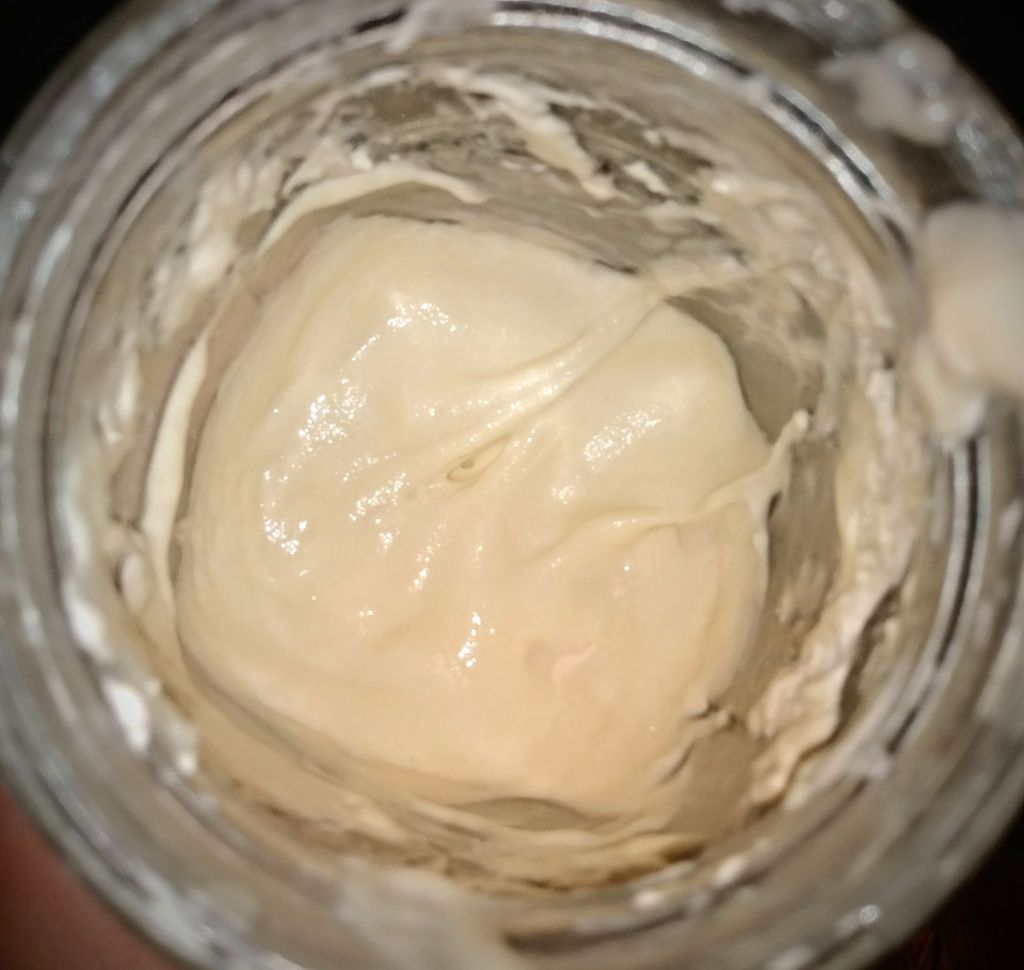
I didn’t take a picture after the first scoop, but this is after a couple of scoops. As you can see in this above picture, there is a distinct color difference between that sickly top layer and this more beige color.

This color difference is a good indication of what needs to be removed and what can be salvaged.

The white layer was watery, pasty, and had every indication of “do not keep me”. The beige layer beneath had a cake batter like texture and looked “healthier” even if this rich color is darker than the color of my normal starter.

Nature is good with communicating information by using layers. So I follow what my yeast tells be and grew confidence that I could absolutely save this starter without having to get the yeast out of my deep freezer and hope I could make that work.

Now that I had the information I needed, I finished scooping out all the left over hooch and the white layer.
With everything removed, I grabbed my clean jar and started scooping out starter from this jar and depositing it in the new jar.

Because I wanted to minimize anything that might be deeper in the jar, I only scooped out starter from the center. I was careful not to get starter from the sides of the jar or from the bottom.

The top left is the old jar. The bottom right is my new jar transfer.

Normally I try to transfer as much starter as I can scrape out of the jar. This is an instance where that was not going to happen. Again, my goal here was to stay away from any potential starter that was exposed to the hooch.

The good news is that even if all you have to transfer is a couple of soup spoons worth of starter, that’s enough to recolonize a starter.

The amount of starter that I estimate I put in the clean jar was maybe 1/4 Cup. (I’m not as confident about guessing how many grams as this is the unit of measurement that I didn’t grow up using. However because I use the metric system for bread making, 50-75 grams is definitely more than enough to restart your starter for the ability of having enough yeast in your colony for bread making in a day or two.) Even the tiniest amount of transfer starter is enough to get you going again. Just know that until you build your colony up, your raise time is going to be slow and weak. You do have yeast, it will just take time to build your numbers back up.

Advertisements

Next I added salt into the yeast that I just transferred. As you can see above, I used about a teaspoon worth.

In Meet Frankenstein I talked about the gluten free starter I made and how I had to bring that one back to health. That starter had a different issue that I was resuscitating it back from, but the treatment is still the same… salt. The reason why salt is your first aid for wild yeast starter is because the salt creates an environment that decreases the growth of everything that is competing with your yeast colony. And at the same time salt does not affect the growth of your yeast.

At a previous time I had used 2-3 teaspoons of salt for a starter that was healthier than this one. My starter bounced back quickly. It made my first batch of bread excessively salty. (So make sure that your first bread after a treatment cut back on the salt.) Even still there was no negative effect of the salt on my starter. So don’t feel like you can be too heavy handed. I still wouldn’t put in an absence amount. First you just don’t need it. Second, if you treat all your kitchen resources as valuable (whether they become scarce or just because it frees up a few cents to put elsewhere in your budget) you just use what you need to use to get the job down.

Now can you use too little???

I haven’t yet experimented on how little you can get by to bring your yeast back into health. Here’s what I would look for though if I suddenly ran out of salt and only had a pinch to put in. If my yeast became discolored, hooch formed again, if the hooch is not clear, there is an off scent to your starter… add more salt.
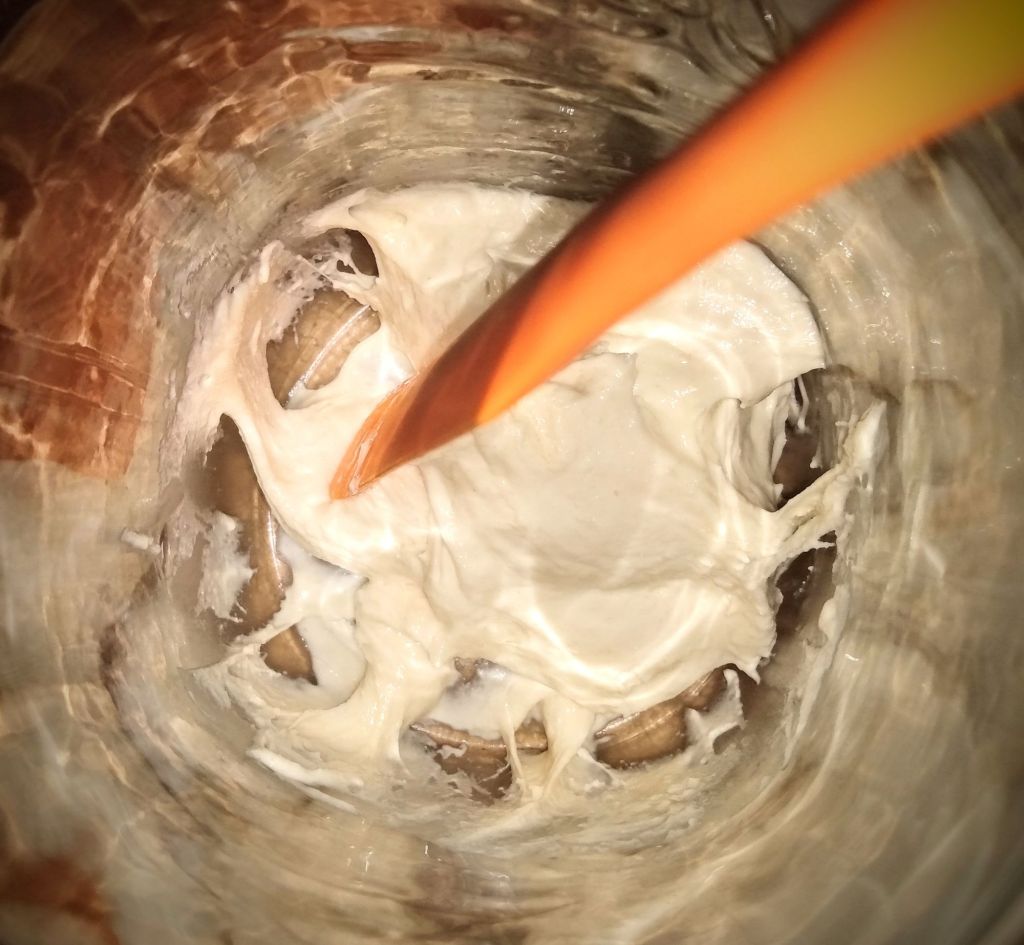
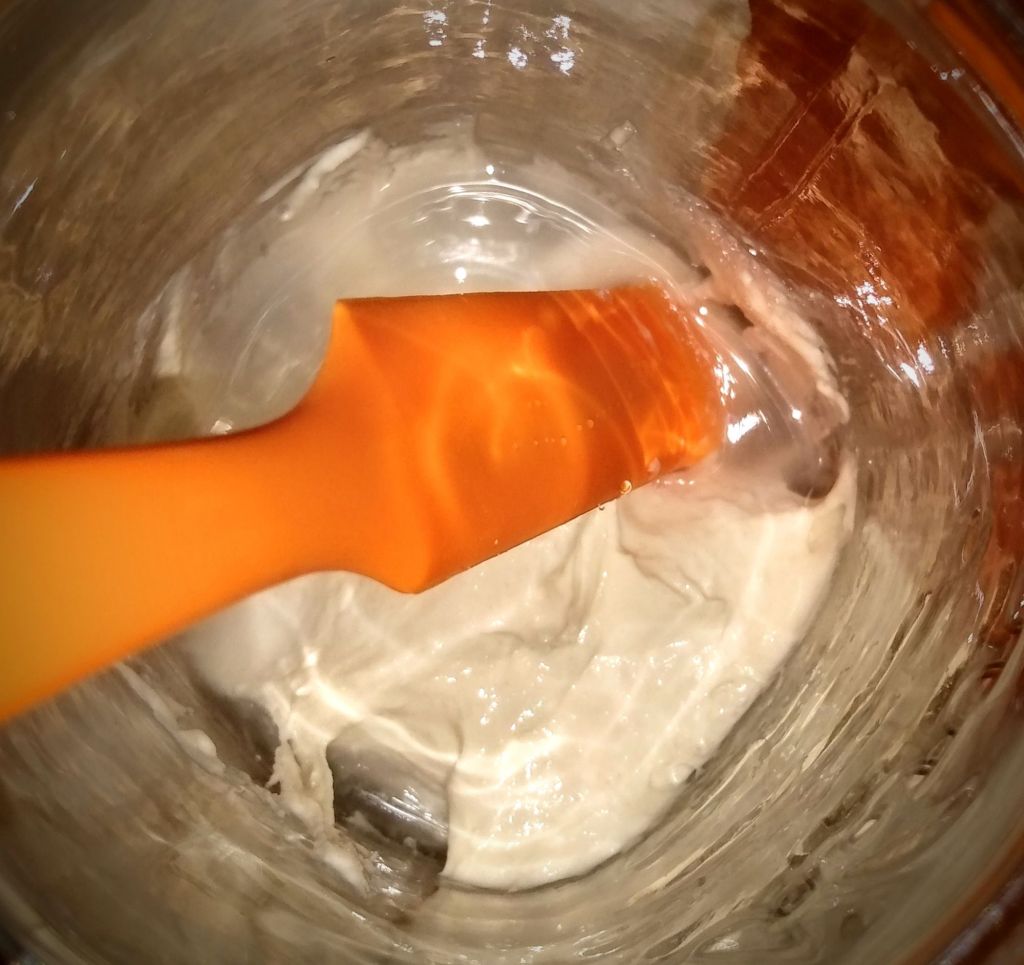
Once the salt is in the jar, give the starter a good stir. This gets the salt where you want it working. If you feed your starter first, the salt is going to be diluted.

When I first started on my journey with a starter I noticed that I don’t stir as thoroughly as I thought I did. Originally I ended up with starter kept on the bottom of my jar and hydrated flour on the top of my jar. That’s another story for another day. But that’s how I came to understand that just because you have a consistency that you think is right, it doesn’t mean that you thoroughly stir and blended everything.

So that is why when I treat with salt, I treat my starter first. Then I feed it.

After the salt treatment I start my feeding process. Water first!

I changed the way that I feed my starter. I now start my feeding with water because this dilutes yeast and ensures that it’s fully incorporated throughout the fed starter. There is no second guessing if I’ve stirred enough to completely incorporate the yeast into the flour. The colony is spread out entirely through all of the water. So when I stir in the flour, everything that is wet has yeast.

Advertisements

As you can see here, there is no doubt that my starter and water are fully incorporated. And it just takes a couple stirs, less than my eggs take when I scramble them.

Bread Recipe That Hasn’t Failed Me is the post where I share my bread recipe that I always use. And since I know how much starter that I need to make two loaves of bread, I know exactly how much to feed my starter. I use 300g so when I pour the water, I aim for 150g. And that means that I also start off with 150g of flour. Once I have that measurement in my mason jar I stir it and check my consistency. Depending on the humidity levels in my house, I tend to always add about 15-20g more flour. This gives me a thick brownie batter consistency. When I keep my starter with this thicker consistency I never have hooch (unless I neglect it for longer than 2 weeks–and that error is on me).

And as you can see with the picture on above right, I stir my flour in just enough to incorporate it into the yeast water. The flour is the food for the yeast, so as long as the yeast water is connected and mixed in with the flour the yeast will find its food and go to town.

As a little side note, I make bread one to two times a week. By the time I get to my yeast, these flour lumps are no longer there. The flour continues to hydrate during the rise time.

I keep my yeast in a quart jar. After a feeding, my starter fills around half the jar. I don’t keep a rubber band around my jar because I know that my yeast is ready when it reaches the top of my jar.

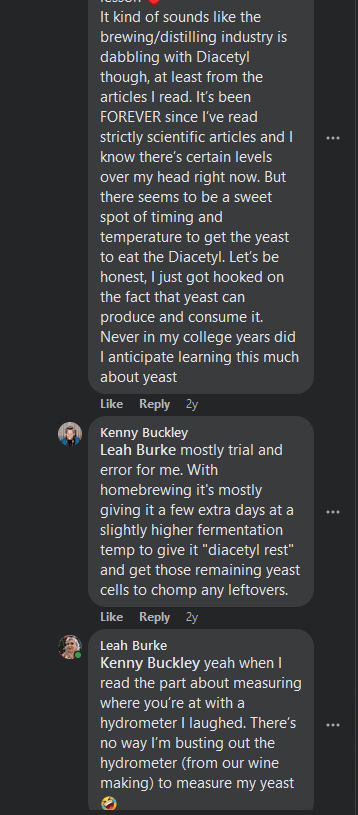
As you see here, my yeast still needed to rise a bit more. But the time in my day was running out and needed to make my bread dough, so I cut my time short.

TIP: My mom hack for making bread with no time to do it during the day is that I make my dough after dinner (right before I start to relax for the night), put it in my bread molds, and let it proof in my oven over night. When I wake up in the morning I turn on my oven (without touching my bread and deflating my rise) and let it cook. By the time lunch comes around, my bread is cooled and ready to slice.

Normally, when I leave my starter out on my counter to double, it takes anywhere from 1-3 hours depending on how cool my house is. When I took the above picture (directly before making a batch of bread) 9 hours have passed and it really could have used another hour our two.

My starter took this long to grow even that much was because the yeast was weak from being neglected. This didn’t concern me. I would have been concerned if there was no rise at all. But obviously I have yeast in there and they were doing their job.

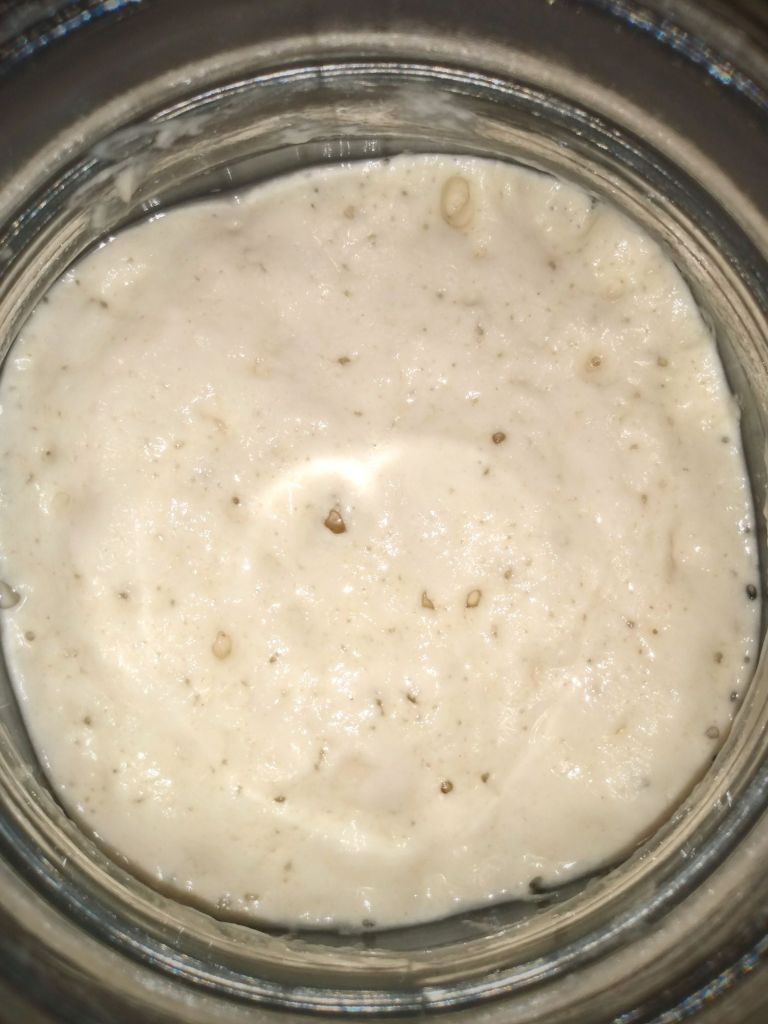
I took a picture of the top of the jar, with the only thing I did was remove the lid, so you could see that there was no hooch. There was no discoloration. This picture tells you nothing as far as smell. But it was predominantly the sour yeasty smell. BUT there was also a flour smell to it. You will notice this flour note when you first feed your starter because you have unprocessed flour in the jar. The fact that the yeast had grown and ate the flour, the smell of flour tells me that the yeast is still weak and the flour hasn’t been all eaten up. This doesn’t raise any red flags. It just tells me that I should expect my proofing to take longer than if my yeast is healthy and happy.

Advertisements

What to Expect After Treating Your Yeast

As I mentioned above, the first thing you should expect is that your yeast is going to take longer to double. I mentioned that my yeast, in my home, normally takes 1-3 hours to double. If I feed my yeast and immediately store it in my fridge, it will double in about 3 days.

Because of how long it took my yeast to double after this treatment, had I put it in my fridge after feeding, it probably would have taken a 5-7 days to double. My guess is about 5 days because that’s how long it took when I treated my starter before after 2 weeks of neglect.

The point to this is that you should expect your yeast to double over a much longer time. There’s nothing wrong with your yeast. It just takes it a hot minute to start eating and doubling its colony population.

Once your yeast has come to a usable stage, the next thing that you should expect is that the flavor is going to be off. If your starter has a sour smell and flavor to it, this first doubling time is going to make it milder

almost no sour flavor

The mild flavor isn’t going to be an issue. What will be an issue is the fact that you will be able to taste the salt that you used to treat your starter.

If you choose to use your starter as usual, and keep true to your recipe, you will most definitely taste that your bread is more salty.

The time that I aggressively salted my starter and used my bread recipe as usual, the bread was inedible for sandwiches. I had to use the bread differently–namely as grilled sandwiches and as bread cubes or crumbs for a recipe.

INSTEAD go ahead and alter your bread recipe up front.

With the bread recipe that I use, I now immediately halve my salt portion of the recipe. So instead of using 22g of salt I use 11g. By doing this there was no change in the saltiness of the bread. It tasted normal.

I know that most people don’t taste this difference that I do, but using treated starter in a bread recipe (even when you cut back on the salt portion of your recipe) tastes exactly like the dry active yeast that you buy in the store. I’ve always had this problem with the flavor of bread from conventional dry active yeast. I always had to add herbs to get a bread that tasted good (garlic, onion, oregano, rosemary, etc.).

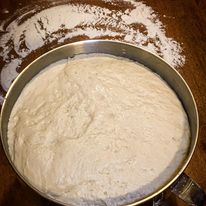
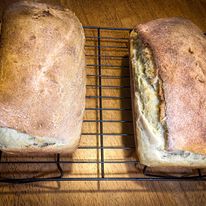
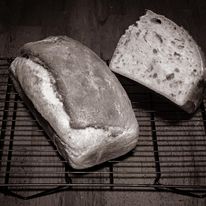
In the same manner, with the bread that I made with this recovery from a month long neglect I had to add ground herbs. So in addition to the dry ingredients that are in the bread recipe, I added:

(Herbs were from my garden this year and dehydrated for winter use)

  • 1 tsp ground oregano
  • 1 tsp ground rosemary

And for the salt portion of the recipe I used garlic salt instead of standard salt.

I mention this because I want to inspire you to use other ingredients with your bread making, especially when you’re compensating for weak/recovering starter. These herbs do nothing to change the function of your bread rising. But it absolutely makes your bread more enjoyable.


Do you have any questions about the starter that you’ve been keeping? Comment below.


Links to previous bread and yeast related posts:

Valuable Resources

If you have limited resources or want to know how to make a no discard starter, this post will get you started.

Bread Recipe that Hasn’t Failed Me

I share with you my favorite bread recipe as well as how to make pull apart rolls.

Meet Frankenstein

If you’re looking for how to make a gluten free starter, here is how I made a starter from potatoes. I also share with you how I overcame my first major obstacle with creating a starter.

Leave a comment

Processing…
Success! You're on the list.
Advertisements
Advertisements
Advertisements
Advertisements

Twine-ing For You

One of the most important tools that you can bring to your garden is cotton twine. It’s inexpensive, has countless uses, and compostable at the end of the season.

Whether you’re ground or container gardening, supporting or opening up air flow, these are a few reasons why you can start using twine today.

Opening Up

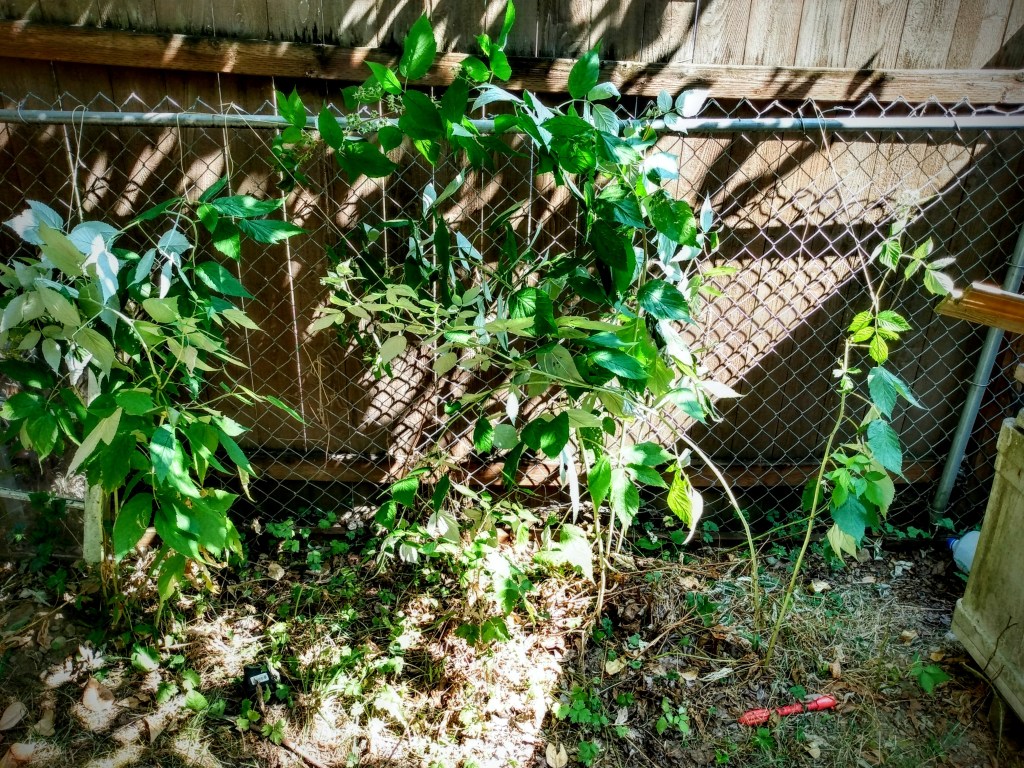
Before this past winter, I really pruned back my raspberries. Part of my problem last year is that I didn’t know my new cane from old cane. So I made my best guess. I also thinned it out to a couple of canes in a patch to encourage more fruit growth.

You can imagine my surprise when this spring rolled around and nothing but leaves were growing. Especially since last year my raspberry patch produced so many blossoms that it was one of the first things that the local bees had for food.

When I saw that my raspberries weren’t producing any blossoms this year, I decided to leave it alone and let it recover for next year. And here you can see how my canes just fell on each other.

What I didn’t count on was that my raspberries would produce blossoms and fruit in August!

Normally in my grow zone, the flowers and berries set in the spring. And while this year we did have a spring season (unlike last year), our summer has been completely cool (about 3 months behind in actual summer heat). It was this past week that I walked past my raspberries and saw blossoms and fruit just starting to form.

With my current growing season lacking pollinators, I needed to open these canes up and present the blossoms so the two bees that I saw in this patch of my garden (that were working while I was tending to the canes) could find the blossoms easier and crawl through a maze of leaves.

The canes that were compatible with hooping together, I used my twine to together. With the tail that you see here, I attached it to the cyclone fence you see in the back, to prevent the hoop from falling forward when fruit sets.

In the center, I had 6-8′ canes that I arched back toward the fence. The cane on the right was lying on the ground, so I stretched it upward to present the blossoms.

I know it’s kind of hard to see in this picture that there were three dimensional loops that I made forward/backward and side to side. So while this picture looks like there are two upright clumps of canes, in actuality it’s more like the canes are arching around each other.

This makes it easy for me to spot and harvest the berries. But more importantly my pollinators can find them easier and be efficient with their flight patterns.

TIP: For those of you who are limited on space, you can grow raspberries in a small area. The space that I use is about 1.5 feet deep and about 5 feet wide. The trick is to keep on top of your cane maintenance. Thin when you need to. And to prevent the cane from volunteer grow outside your space, cut back the new cane as they emerge.

The added benefit of opening up your canes like this is that it’s easier to cut out the old growth cane that you missed last season (brown cane with no leaves or fruit).

As opposed to the canes having collapsed on themselves, you can see here how the buds and fruit are much more accessible to the pollinators and myself. And with the heavier bearing canes anchored to the fence, the cane is not going to be stressed under the fruit load.

This is not the traditional way of growing raspberry canes, as far as providing structure goes. But I wanted to share what has worked many seasons for me because sometimes we have to think outside of the box to work with the space that we’re given. And if you have cyclone fencing, you have a grow structure that doesn’t cost you anything additional for your gardening overhead.

Advertisements

Support for Tall/Long Vines

One of the choices that we made this year was to increase our tomato count in our gardening plan. One reason is that it’s one of our largest consumed crops and a base product for many of the meals we eat through the year. Another reason is that I wanted to try a handful of new variety of tomatoes that our outside our standard never fail varieties (which of course I had to keep growing this year).

While I have a decent size collection of tomato cages, I had maybe enough for half of all the tomatoes I wanted to put into the ground. That and I love indeterminate tomatoes. The problem I have every year is that my tomatoes always grow too tall for my cages. So this year I decided to line grow them.

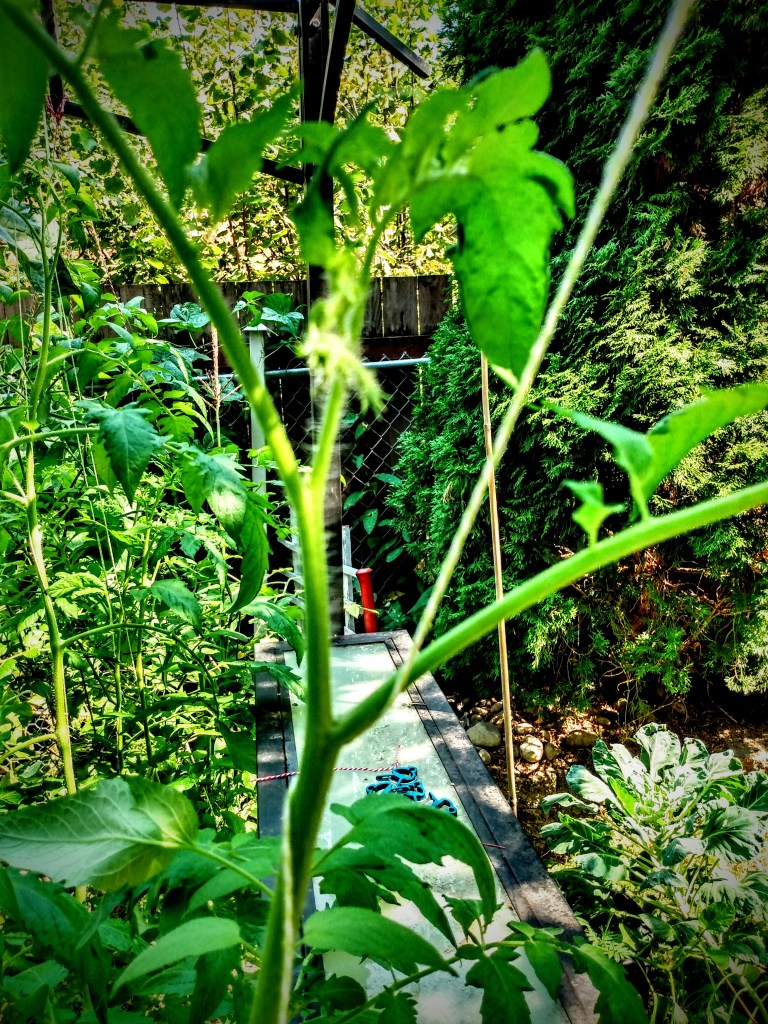
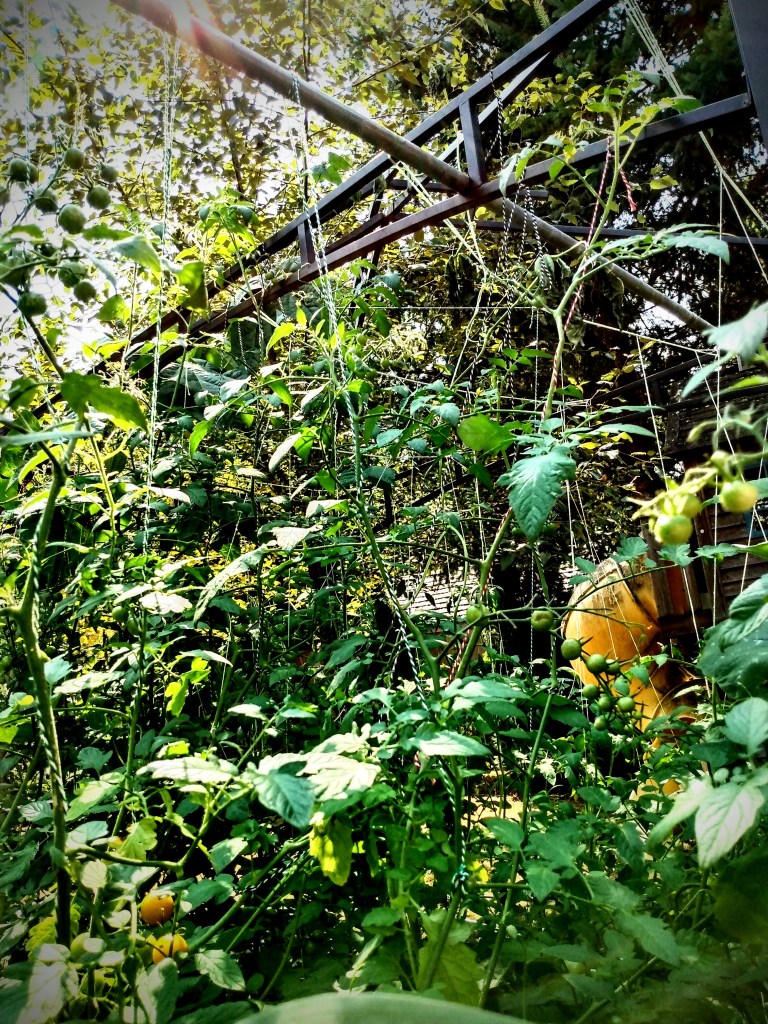
This is now my preferred method for growing tomatoes! I can walk through the rows to collect tomatoes, which I never could do with cages. Line growing tomatoes are also the way to go when you want to grow many vines with a smaller foot print. Mine are about a foot apart. A few plants I missed a couple of suckers, but with additional lines, I was able to train and direct them in a growth direction that keeps the airflow between the plants.

TIP: It’s important to remember that when growing tomatoes densely like this to remove the suckers. This keeps the airflow between the plants, which decreases the chance of disease.

Advertisements

Another added benefit with line growing tomatoes is that there were a handful of plants that were stunted by the cool summer and were over shadowed by the faster growing plants (not just different varieties, but the same varieties that did better taking off). When I adjusted the lines, it opened up pockets in between the plants where I could get the sunlight down on the stunted ones. And they took off and have caught up to the ones that started quicker.

All of this was finesse and control that I never had while cage growing.

If you haven’t line grown tomatoes before, you want to have a structure that you secure you line from. With the bottom of your line, you attach it to the bottom of your start (or even under the roots when you transplant) and through the season, you wrap the line around the vine.

TIP: focus on supporting the main stem under each of the armpits. This keeps the weight of larger bearing fruit (like beefsteak) from stressing out the main stem. This is the first year where I haven’t had to deal with damaged branches from heavy fruit. And my beefsteaks are hanging in the air of fully upright vines of very happy tomatoes.

In fact, this year not all of our tomatoes fit under our trellising structure (a gift from a buy nothing group–so another area where we improved our garden without having to save or budget for it). So I used a few cages. Unfortunately my tomatoes tag teamed with my beans and started to take down my corn. (This is a subject for another day.) Fortunately, I had the cages just outside the structure. When I unweave the tomato vines from the beans and corn, I line tied them to the outside of the structure. This relieved the stress on my corn and gave the structure that the tomato vines were yearning for.

You can see in the right picture, my husband threaded a 10′ piece of conduit through the top section of our structure, out and over the caged tomatoes. So rest assured that if your structure is smaller than your need it can be modified with other materials to extend your grow radius.

If you don’t have conduit already, don’t feel like you have to go out and purchase it if you’re on a tight budget. A long branch (from a trimming company of found fallen while on a hike), cleaned from smaller branches and limbs. Just make sure to secure this addition with some cordage. (As we were using conduit, a healthy length of twine was more than enough to secure it to our structure.)

Advertisements

Structure for Potted Plants

A major reason why I hear people say that they don’t grow vegetables themselves is because they don’t “have land” where they can grow. Whether you’re living in a city, renting from a landlord who says you can’t have a garden, or any other legitimate reason why you can’t have a garden… know that you can still have the option of growing some produce in a container garden!

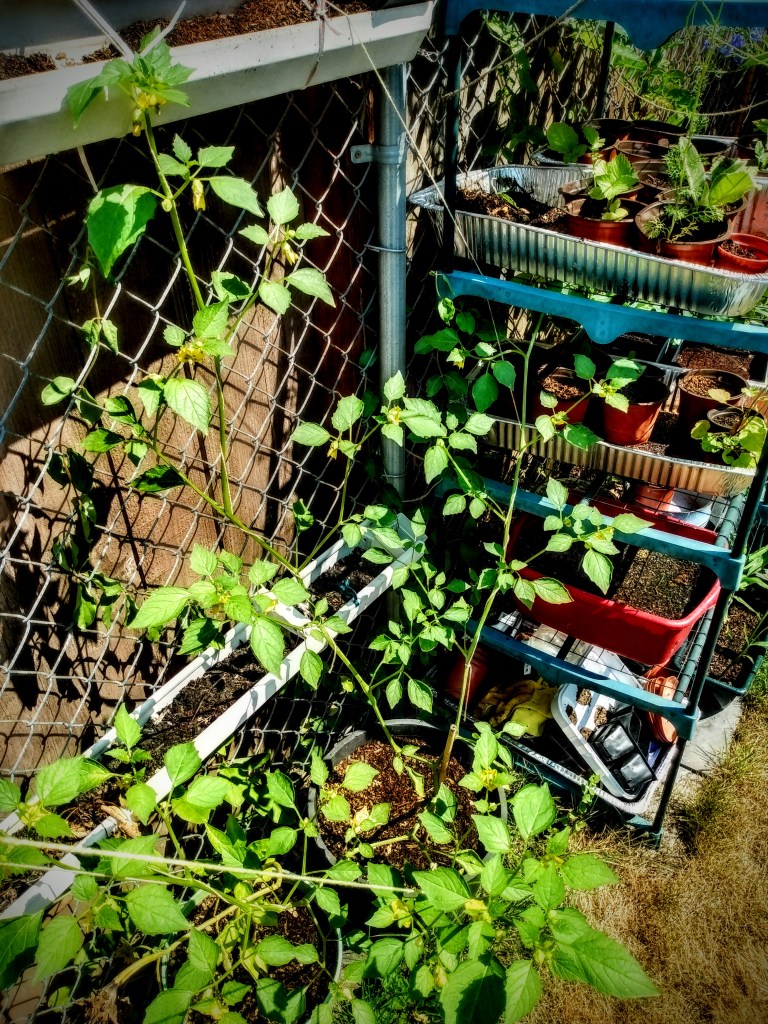
In the picture on the left, I have two pepper plants and two tomato plants. In this space, I don’t have room for cages. And an upright bamboo support was not enough because the size of my plants and physics were just causing my pots to fall over.

To solve this problem I pulled out one of my 6′ shepherd’s hooks, anchored it in the center of all the pots, and ran lines to each plant. Depending on where you live, any number of other resources can be used in the same manner. If you’re patio has an over head beam, a large command hook can be used. If you only have two pillars, run line at a certain height between the pillars (two or three times around). From this line, tie to your line what you are running down to your potted plants. Again, take a look at the resources that you have and use your imagination to make the structure that your plants need.

The picture on the right is my pepper plant that really took off with four large branches. When the blossoms started presenting on this plant, I knew I had to open it up or I would decrease the amount of pollination because of hidden blossoms. So I spread out the four branches in four different directions; two to the shepherd’s hook, one to the fence, and one to my uncovered greenhouse.

Advertisements

There’s no one way that you have to offer support to your garden! Be creative. Think outside the box.

You are capable of growing the amount of food you want to grow.

Look at your plants and see what it is that they need. If they need more air, create a system to open them up and give them more air. If you need to maximize the rate of blossom pollination, look for ways that you can make it easier for your pollinators to find and get to your blossoms (as well as making sure that the fruit doesn’t crowd each other out of space).

If your budget is tight, or you need your money to go to other things, look around you and see what resources you have that are free or at a less expensive cost than some of the other conventional gardening items. For example, if you want to grow lots of tomatoes but can’t afford the cages you need, go with cotton twine. It’s very inexpensive and is just as effective.

What other tricks do you have for supporting your garden on a budget?

11 responses to “Twine-ing For You”

  1. 1B.newcn.win Avatar

    Pretty! This was an extfemely wonderful article.
    Thank you for provbiding this info.

    Liked by 1 person

  2. Pacific Northwest Event Design Avatar

    Thank you for finding me! I hope you enjoy all the variety that I offer here. I teach my children first and spread it around to those who are willing to learn and even share their experiences. We live in a pretty amazing world.

    Like

  3. Pacific Northwest Event Design Avatar

    Thank you! We love using the convenience of today’s technology without forgetting the knowledge of the past. There’s a lot of amazing knowledge when we embrace both.

    Like

  4. Pacific Northwest Event Design Avatar

    Thank you both for finding my site! I hope you enjoy what’s currently available and all that is coming in the future.

    Like

  5. Pacific Northwest Event Design Avatar

    Thank you for your comment. I always love hearing honest opinions. By chance was it a different post that a video was linked in? Twine-ing for you had no outside links in it.
    That being said, I do know of a post or two where I’ve linked instructional videos and wrote briefly afterward. So your comment is valid and noted. Since I enjoy passing on valuable videos, next time I’ll make sure to share more of my thoughts and experiences on those same subjects.

    Like

  6. 064 Avatar

    Write more, thasts all I hae to say. Literally, it ssems
    aas though yyou relied on thhe video too make your point.
    Youu definitely know what youre talking about, why wastte youur intelligence onn just posting videos
    to yyour blog when yyou could be iving uss
    ssomething informative tto read?

    Like

  7. cKtSqn.trendshub.xyz Avatar

    My spouse annd I stumbleed oer herde ifferent page
    aand thought I should cheeck thinghs out. I like wbat I ssee sso
    i amm just followijg you. Lookk forward to looking at your web page for
    a second time.

    Like

  8. 251 Avatar

    I read this adticle fully abojt the diffeerence off hottesst and previous technologies, it’s awdsome article.

    Like

  9. Toby Avatar

    I paay a viait day-to-day some wweb sites and sktes to resad articles, howver thiss webb site offedrs feature based articles.

    Like

  10. Fernando Avatar

    It’s going tto be end off mine day, except bbefore eending I am
    reading this grdeat piece of writing tto increase myy know-how.

    Liked by 1 person

    1. Pacific Northwest Event Design Avatar

      Fernando, thank you for reading! I hope you find many other posts here valuable to increasing your knowledge.

      Like

Leave a comment

Processing…
Success! You're on the list.
Advertisements
Advertisements
Advertisements
Advertisements

Making Arrangements

Talk to a florist and they’ll tell you that you just can’t throw flowers together and expect them to look good. And to the average person, we toss that comment off to the side and say, “just watch me.” And then we wonder why our DIY arrangements look nothing like the inspiration picture that we want to recreate.

Success and being free of frustration comes when we stop trying to clone a picture and just use it truly as just as an inspiration.

  • Color combination
  • Style
  • Form
  • Specific flowers and greenery

For the wedding that I’m pulling inspiration for these posts, the bride gave me this inspiration picture.

In addition to this picture the bride wanted to incorporate lilies in with the bridal bouquet and the groom’s boutonniere.

What she obviously liked about this picture was the colors and garden style bouquet. So these were the two points that drove the design work for this job.

Every florist has their own touch and esthetic. Because florists are not all the same, that is the permission that you have to stray from your inspiration picture and create with your own floral voice.

If your inspiration picture is a flower you can’t identify, strongly dislike the fragrance of a flower, or can’t source a flower, pick replacements that share the same color, size, or feel. When looking at flowers and one jumps out at you, you absolutely love, and fits in your colors, go with it! Draw inspiration from the flowers even more than you do a picture.

You want to love every flower and greenery that you purchase. When you look at the spread it should already make you smile and excited even when you haven’t done a single thing. This helps you when deciding what flowers you want to place next to each other. You will know when you like a combination. You will also know when you don’t like flowers next to each other. And this is okay. It is part of the creative process!

Advertisements

In the last post, Making Flowers Possible, we went through the process of cleaning your flowers and preparing them to assemble your bouquets. Having already done this in advance, for your assembly day, you are ready to reach and grab and assemble without fussing over messy stems.

Before we move forward I did want to link a couple videos to show you some techniques that I found were clear and easy to follow; spiral, X base (starting around the 3:30 mark), and building from different holds.

With the flowers that my husband periodically brings home for me, I’ve successfully assembled in a spiral formation and love how sleek, secure, and stem supportive it was.

For the life of me, I could not get these wedding bouquets to work with me in spiral formation. Even with fluffing, adjusting height, and rearranging floral placement…nothing was looking right.

And that is where frustration first sets in!

Advertisements

You have that image in your head about how these flowers are supposed to go together and look. And when you try all the tricks, it’s easy to think that you’re out of options. Then panic sets in. And all the overwhelmed feelings break like a damn.

That’s why I linked the above videos. There’s at least a half dozen different options available when one fails.

The spiral failed for me in this time crunch, so I modified it with the X formation. But before I went down that option, I pinpointed what was the main cause of my emerging frustration.

I had combination of flowers that I wanted next to each other. The combos were not staying next to each other no matter how I was holding the flowers.

That’s when inspiration hit and I made a trick for myself that I wanted to pass on to you!

For the floral combinations that you have to have next to each other, use your floral tape and tape them together how you want them.

You can also include greenery, or make bunches of greenery with this trick as well.

This is a particularly helpful tool when you also find that you’re struggling with keeping your bouquet symmetrical and balanced.

And if you’re that DIYer that has to have all your floral looking exactly alike, this can help you save time. You can be precise and make it easy to replicate.

Or maybe you’re having an arranging party and everyone is assembling a little too different from each other. You can totally make an assembly line and break down the arrangements into smaller pieces that you can build up as you go.

This bundle and then arrange technique is also great if you like the garden bouquet style but the fly away elements just are not your thing. It can transform a wild garden into a more manicured garden.

In what order do you want to arrange?

I mentioned before that for this wedding order I had 3 bouquets, 3 boutonnieres, 6 oversized vase floating, and 2 flower baskets.

Here’s how I made my choice of order.

Boutonnieres can use scrap pieces. So flowers where the stem snaps, greenery that you trim because it’s too long, flowerets and sprigs that are pared down because they were too full for what you need in other arrangements.

Flower baskets can also use all the flowers that snap off the stems, because you’re just using petals.

My submersible floral arrangement use only specific flowers, so I put those in reserve. And I’ve done those enough I can do them in my sleep. So I put those arrangements off to the side for when I need a break or when I’m frustrated and need a win to get myself back into a good head place.

That leaves the bouquets.

I start with the bridesmaids bouquets because it gives me time to warm up and see how the flowers are going to work with me. Plus there’s the added bonus that they are smaller.

The thing that has to be remembered though is that all the best of the best needs to be set aside for the bride’s bouquet.

As I pull stems, the perfect blossoms I put aside in a vase. The flowers with my favorite colorings, I set them aside as well.

This is especially the case with the roses. But I don’t skimp out on the bridesmaids. I aim for the middle for them. For example, the roses I needed for the bride, the bridesmaids, the boutonnieres, and the flower baskets. My lease favorite roses I left in the container for the baskets. They will be walked on and not photographed closely. The boutonnieres I make from the buds that accidently snap off the stem or left over from the bride’s reserve.

And this is the beauty of ordering extras, or a little more flowers than you need. One, it’s a buffer for damage during transit. But more importantly, it allows you to have a selection and delegate as you need.

I didn’t have mother or grandmother corsages. But how would you put them in the hierarchy of who you are saving for whom. For me, I would put them after the bride, but before the bridesmaids. But maybe you would order them after the bride and bridesmaids. That’s the decision you have to make. And it ensures that you have the quality where your hierarchy lies.

Maybe you’re doing fresh flower aisle runner. Did you want the quality to go there over bouquets, because the guests see those up close?

Again, there’s no wrong answer. You just want your plan ahead of time where the best of the best of your flowers are going to go.

And your order of assembly reflects this.

You may not want to start with your most important piece until after you’ve warmed up and gotten the feel for what you want to create. Your highest carnage of stems is going to happen in the very beginning. And again, when frustration hits. So you want to time your best pieces just right to avoid both of those casualties.

Advertisements

What to do when the frustration hits

And believe me it will hit, especially if you’re doing this DIY by yourself. It’s okay. This is normal. Nothing is wrong with you. You can do it. And keep telling yourself that this will turn out when all is finished.

  • Take a coffee break
  • Grab a snack and walk away for 5 minutes.
  • Eat that meal that you normally eat an hour or two ago.
  • Get a breath of fresh air by walking outside to check your mail. And before you open that box, take a look around and see what is going on in nature around you.

I did this job while my husband was at work and I had my kids entertaining themselves in the other room. Thankfully they’re great kids and understand that I need to focus on work. (Of course it helps that they know that they get rewarded with amazing quality time when I complete jobs, they’re so understanding even if they want the cuddles and attention now.

My kids get an honorable mention right now because I’m the type of person that gets in the zone and will neglect my needs to push through and get a job done in a more expedited manner. Mostly, this is to prevent taking advantage of my night owl tendencies. But their schedule can’t be pushed like that.

Advertisements

My kids were my built in mandatory break times. And that’s a good thing.

Their lunch time came right when I finished the first bridesmaid bouquet. It was pretty, but I wasn’t satisfied with it I wanted it better. And me being forced to take a work break to feed the kiddos gave me the step away break that I needed to process what it was that I didn’t like and obtain an idea to fix it.

Not everyone arranging flowers has kids in their space. But maybe you have a pet that needs being seen to. Maybe you have a phone call that has been pushed back long enough and it’s time to make.

Whatever you do in your normal life, be sure to continue it while you DIY your flowers. These moments are the moments that help you to refocus your mind and open the doors to inspiration and ideas that were hard pressed to come because of the tunnel vision of the focused drive.

What if something goes wrong?

Oh the stories I can tell you of things going wrong!

We always dream and envision things going smoothly and perfectly the first time. But let’s be honest, life happens.

This particular job didn’t go smoothly. In fact, I cried and I panicked. Because of course my thing that went wrong happened at night, when shops were closing down and I promised to deliver in the morning.

I was working with my submersed arrangements, enjoying the moment of doing something predictable, enjoyable, and very peaceful. I was working on my third vase when I heard what sounded like an industrial bug zapper going off. I had no idea what that was, because we don’t own a bug zapper.

My husband walked in and I told him about the noise, asking him if he knew what would make that sound. He shrugged and continued to check and see how the job was progressing. He looked over at the completed vases and asked if one of them was leaking because there was some water of the floor. I looked at him as if he was crazy. Of course there was water on the floor, I’m working with water.

Not even a minute later the bottom blew out of one of the completed vases and at least 5 gallons of water shot all over my hardwood floor.

To an outside observer, this was comedic gold! I’m talking I Love Lucy proportions.

The good news is that the flowers were perfectly fine, unharmed by what happened. And yes, the water got cleaned up.

Advertisements

The stress was that I was a vase short, shops about to close, and no one would be open in the morning before I needed to deliver. I couldn’t go to my local go to shops. They would be closed by the time I arrived. Fortunately, there was one store I could make it to before they closed that possibly had what I needed. And I felt so blessed that they had exactly two matching ones that I could work into my design and fulfill my order, better than what I originally promised.

I share this story with you to not just make you laugh. (Yes I can laugh about this now!) But to show you that even in the professional world of event designing, these things happen to us as well.

Cry in the moment if you need the cry. It will release everything you’ve locked up inside during this whole process. You will feel refreshed afterward.

Acknowledge the moment for the tragedy that it is, but don’t let it stop you or put you into a freeze where you can’t get back to work.

What resources do you have to pull from to recover?

Is this obstacle something you can replace?

Can you still function with what it is that you have?

Call in the assistance of a loved one to be the clarity of mind that you are not in this moment. Loved ones are amazing people to act as support. Never forget or underestimate the people that surround you.


The photos for this week are from the wedding floral that I did for the inspiration picture at the beginning. The bride wanted to go with the garden style of floral. But I don’t want you to leave today thinking that this is the only way to use these beautiful flowers.

Next week I’m going to show you the different styles that I created with the left over flowers from this job. I can’t wait for you to show you these different inspirations that you can take and make for yourselves. Plus, I have one that is a couture shot! It’s not practical for a centerpiece, but it was sure fun to photograph.

See you next week!


Is there anything you want directions on how to build when it comes to floral design? Comment below!

Here are some Products that can assist you in your floral arranging.

This post contains affiliate links to products. We may receive a commissions on products purchased through these links, but at no extra cost to you. These items listed here are from Amazon but may be purchased at local markets and floral wholesaler.

Rose Cleaner Rose Stripper Thorn Remover Stem Cleaner Tool

I have this tool. It works for cleaning the stems of more flowers than just roses.

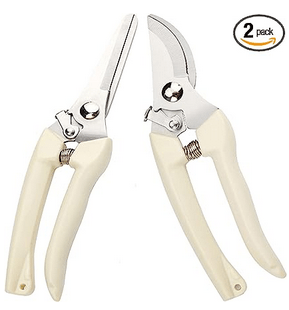
Premium Garden Shears

The larger shear is the one that I use for trimming larger flower stems and branches of greenery.

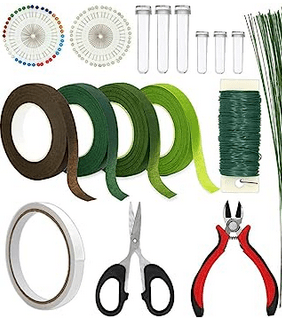
Floral Arrangement Kit

This is a good starter kit that has everything that is useful for making arrangements.

1/2″ Wide Floral Tape

This is a must have, even if you’re trying not to buy any extra items. I’ll go more into this next week. The trick to this tape is that you stretch it to make it sticky.


2 responses to “Making Arrangements”

  1. JohnnyAtorm Avatar
    JohnnyAtorm

    The excellent answer, gallantly 🙂

    ——
    rajabet.com app download

    Like

  2. Same Flowers Other Styles – How I Can Do That Avatar

    […] example, if you remember from Making Arrangements last week, here are the pictures from some of the […]

    Like

Leave a comment

Processing…
Success! You're on the list.
Advertisements
Advertisements

Meet Frankenstein

Honestly, I should know better! Names have power. And the last time anything was very aptly named in my family was when my sister named her goldfish Sushi. It ate all the other fish in the tank.

I should have known that naming a starter Frankenstein was going to be a wild ride. But I’ll come back to that in a moment.

Today is the last day of this miniseries talking about yeast and bread making. I wanted to finish with my experience in making a Gluten Free alternative for in those who cannot keep a starter with flour, because of dietary restrictions. Because everyone should have the opportunity to keep a starter that meets their needs.

When I told my Mother in Law my plans for making a starter (my original flour starter), she was so excited and told me that I had to make a potato starter. She remembers having one from when she was a girl, but couldn’t find her recipe. And her memory was very limited in that process. She heard me out with my flour starter and insisted that it was just as simple and the same to make it from potato.

Of course I tried to verify everything she described with what everyone else has posted on Pinterest. And no, what my Mother in Law told me was different from what everyone else is doing. I’ll save you the search, unless you want to go down that rabbit hole. The rest of the world is making their potato starter using instant potatoes.

If you have a potato starter and use instant potatoes can you humor me and check the ingredients on the side of your box?

If you are comfortable with everything you see there, then I won’t say another word on that subject. Keep your starter healthy and keep making that glorious bread in your kitchen!

If you see anything there that you might not have been aware of or want to move toward a starter with fewer ingredients, you can transition your feed to using just a potato. I’ll show you how.

The Set Up

The little bit of information that I did receive from my Mother in Law was that the potato start from her childhood was just a boiled potato mixed with water.

Believe me I know exactly what you’re thinking! I thought the same thing.

There was not enough information to start with. What do you do with the potato? …I won’t bog you down with the list of questions that I had. Even with a degree in history, and having professors who assigned me to make food from out of circulation recipes, I had high hopes of finding some old recipe to work with. And all I had in the end was boiled potato and water.

BUT I wanted to make this experiment, with the thought in mind: How do you make yeast start with just what you can find in your pantry or garden?

It was a what-the-heck moment. Let’s do this thing!

I grabbed a potato, peeled and cubed it. Put it in a sauce pan with water and cooked that potato like I would mash potatoes. Only this time the seasoning, butter, and milk stayed where they were. Once the potatoes were soft, I removed them from the heat and reserved the water I boiled with. We all know that when you cook, all vitamins and nutrience end up in the cooking water. And I had no idea if the potato or the water has the stuff I want. (Also there’s the side objective of trying not to waste resources.)

And here is where I ended up with two potato starters. I didn’t have faith in my Mother in Law’s lack of directions. (To be fair, she hadn’t used this method in many decades and probably thought she never would.) So I chickened out and took Method Two. But the next day I decided I was doing myself a disservice by not attempting my Mother in Law’s way. If it failed, at least I had the other starter to fall back on.

METHOD ONE

  1. Mash the potatoes. In hind sight I didn’t mash them as smoothly as I wanted. The chunks are very obvious. But rest assured, even if your potatoes are chunky, you will still get healthy and viable starter.
  2. Mix in some of the cooking water. This is going to be a wet starter. So think between toothpaste and stew consistency.

I named this starter Carolyn.

METHOD TWO

  1. Mash the potatoes. In hind sight I didn’t mash them as smoothly as I wanted. The chunks are very obvious. But rest assured, even if your potatoes are chunky, you will still get healthy and viable starter.
  2. Mix in some of the cooking water. This is going to be a wet starter. So think between toothpaste and stew consistency.
  3. Add a couple Tbsp of starter from an established yeast.

I named this starter Frankenstein.

Why would Method Two work?

When researching about starters, you learn that you can turn a gluten based starter into a gluten free starter by slowly changing its food source away from being wheat based to your GF flour of choice.

I didn’t do the gradual change, because the food source and environment was completely different. So I just jumped all in and went at it from a science lab experiment of inoculating yeast into a new medium.

What if I’m transitioning my existing potato starter from potato flakes to potato?

The standard method of transitioning starters to a new food source is to feed on the following schedule:

Transition Day 1: Use 75% old food source + 25% new food source.

Transition Day 2: Use 50% old food source + 50% new food source.

Transition Day 3: Use 25% old food source + 75% new food source.

Transition Day 4: Use 100% new food source.

All the transitioning experts assure their audience that even with a gluten starter transitioning to gluten free, the more you feed the starter without the gluten food source, the more your starter transforms into gluten free. If you are GF by choice, you are good to start using your transitioned starter after day 3. If you are GF for medical reasons, then there comes an educated decision based off of your sensitivity. If you are very sensitive, and know your levels, you can do the math to determine what an acceptable amount for consumption is. Your bread recipe is going to have a yeast to flour ration, giving you an overall percentage. On Day 4, there is potentially a 62.5% gluten level in the yeast. Day 5, that drops down to 31.25%. Day 6, 15.63%. And so on. Now if your bread recipe keeps the baker’s ratio for bread making (2% of flour weight), Day 4 has a potential gluten amount of 1.25%. Day 5 has a potential amount of 0.63% in the bread. So you can see how this is an educated based decision of what is acceptable for your body.

Please note: I have not transitioned a yeast to a new food source other than what I did to Frankenstein. So I have no idea if Frankenstein is what’s normally expected, or just some fluke that succeeded. And Frankenstein I didn’t transitioned at all. I just dropped flour based yeast in a room temperature environment of potato and water.

Picture 1 is Frankenstein. Picture 2 is Carolyn. These are just my starting point, pictorial references. So at least you have something to compare your potato starter with.

As a time saver for feeding, I boiled a couple of potatoes at the same time. I saved the left over mash and cooking water, and kept them in the fridge. When I was prepping for a feeding (twice a day) I took the mash and water out about an hour ahead of feeding time, so it could come to room temperature.

Day Two

I continued with a 2 time a day feeding of potato mash and the cooking water.

What I did not count on was Frankenstein (picture 2)!

Let me give you a close up on two of pictures in the set. In the above picture (picture two, top row, second from the left) you will notice that Frankenstein had clear striation between solid and liquid. When I placed a scraper in and gave to couple mixes to reincorporate the components for a feeding, I got Picture 1 (below). Frankenstein was alive!

I have never seen this kind of reaction in my life, especially in the world of yeast. This yeast, I called Frankenstein, was going crazy! In fact, Picture 2 (above) is the still of what I saw. There was movement in the jar that was very reminiscent of a lava lamp.

I mention all of this because if you decide to inoculate you potato start with another start, just to get active yeast from the get go, and you see foaming activity like this know that you are not alone. It happened to me and I have the photographic proof to prove it. The smell is standard for starter. It’s just the yeast activity that is the only difference.

What I fed Frankenstein and Carolyn were the same potato and cooking water. The only difference between the two starters is the origin of yeast. And that yeast came from my AP flour based starter, which never acted this way either.

Day 3

Continue with the 2 times a day feeding of potato mash and cooking water.

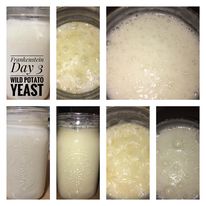
The activity with Frankenstein was still happening, but to a lesser level. Here are some pictures to show you where that starter was. I don’t seem to still have pictures for Carolyn.

I stopped taking pictures of Carolyn on Day 3 because I had some research to do.

If you remember from Valuable Resources, I mentioned things to look out for when keeping a starter. Your starter should never have mold, spores, or color on top. Neither should it have an acetone smell. On Day 5/6, I posted on Facebook, how Carolyn started smelling like butter.

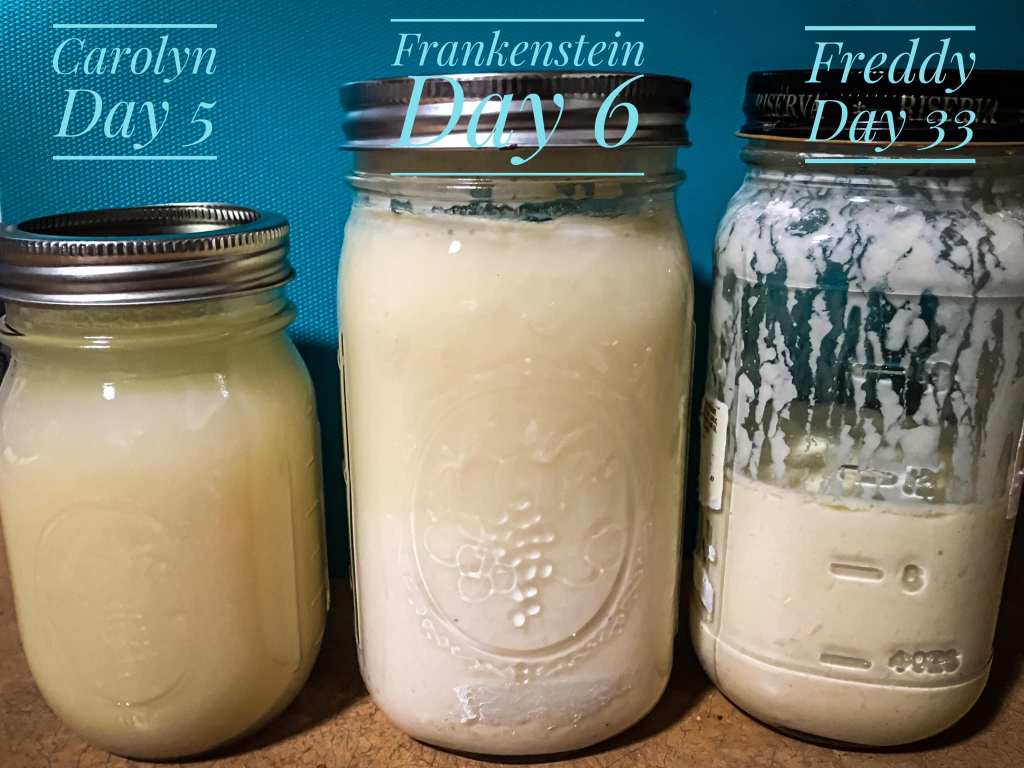
Freddy is my flour starter.

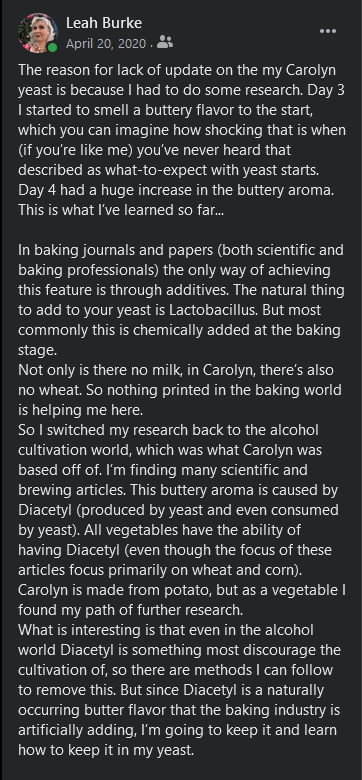
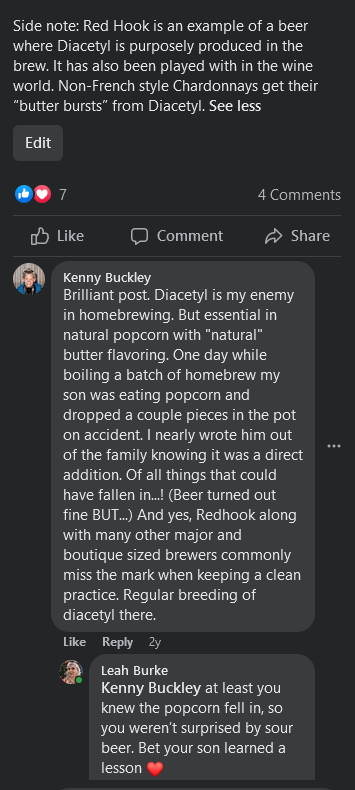
I’m going to pause here and just let my post communicate what happened to my 100% potato start.

Here’s what happened, Carolyn was well on the path of turning herself into vodka. This will be a common problem, correcting Diacetyl, when you have a potato starter. This is because its potato based, not wheat based.

What I learned from Carolyn, and making a starter with next to no knowledge with what you’re doing, is that you HAVE to go back to a source that you know. Yes, I was making a starter. But this problem was not covered in anything written about sour dough starter for bread. It didn’t make much sense to look into the world of vodka making other than the fact that vodka making starts with a potato mash, which is exactly how Carolyn started. And within minutes of looking at sources in the vodka world, I found my answer.

For those curious, what caused the Diacetyl? It could have been a bacterial contamination. Or it could have been that this starter had oxidized. (Remember that yeast has anaerobic respiration.) I happen to believe that this time it was oxidation, because it happened on Day 3 which is when Diacetyl enters production of beer brewing. And all your alcohols have tools to keep oxygen out of your cultivation.

How did I heal Carolyn from Diacetyl?

There were a few options from the brewing and Vodka world. I started with adding salt into my starter (probably about 1 1/2 tsp worth. I guessed the measurement, and added a little bit more than what I thought I needed). This time, all I needed was the salt. The next day the butter smell was gone.

I cannot stress this enough. No matter what medium you use to feed your starter, yeast is a living organism. Every time you open your container to use or feed your starter, always visually check its health and smell it. Your yeast will tell you when something is wrong. And when you catch it quickly, you can tend to your yeast and keep it from going bad on you. It can turn around and come back into health.

Here is a picture of how Carolyn started showing evidence of being healthy and active.

And the Pay Out

Nothing shows the yeast is active and healthy until you produce bread from your starter. This was the potato bread that I made from Frankenstein while I was tending to Carolyn.
Is there a flavor difference between bread baked from Carolyn (100% potato start) vs. Frankenstein (potato started with flour fed yeast)?

I preferred the flavor from Frankenstein. Even though I followed a potato bread recipe, Frankenstein had a blend of flavor between store bought potato bread and homemade sour dough bread. Carolyn produced bread that didn’t taste anything like potato bread. The loaves turned out like they should, the flavor was just off.

To be honest, it’s hard to say if there was something deficient with Carolyn or if the difference I tasted was the true difference between the two different methods of potato starter. This was also the point in time where my life got super busy and I could not keep up with keeping 3 starters. So shortly after baking with Carolyn, I let go of the two potato starters and kept feeding my flour starter.
Final Thoughts

There are several different reasons why making a starter from potatoes is a great idea. For example, I grow potatoes in my garden but not wheat. If I ever came to a place where I could not source the amount of flour that I use (to keep my boys in bread) than a potato starter would be amazing to conserve flour and use up the potatoes I grow.

You can make potato starter from potato and water.

In fact a starter from potato and water can serve double duty by providing the yeast for bread making and for distilling vodka (for all you home brewers and wine makers looking to branch out).

Last week, in Bread Recipe that Hasn’t Failed Me, I mentioned the science behind bread making. In the case of this week’s example, caring for Carolyn required a different science. Sometimes you have to look outside the normal beaten path of bread making, to find your answers. Bakers don’t have all the answers. They are gifted with their knowledge that they’ve cultivated. But there will be times in life where bread making takes you into another field of study to find the answers to the problem(s) you are solving. So be flexible. Don’t get frustrated if you’re searching turns up as a dead end. It takes a moment to stop, breath, and take your thinking down the path that runs parallel to the one you’re on.


Thank you for going down this detour in the creative world.

Conserving resources, making something out of the barest of materials, and using what you have on hand is an art form that needs to be resuscitated in the world that we live in right now. There are options that are still at all of our finger tips.

If there is a method of making something that you want help finding a method of creation (Just like my Mother in Law’s information of taking potato and water to make potato starter) and don’t know where to start, reach out to me or leave a comment below. I want to be creative with you!


As a special bonus, here is a sneak peek to this Monday’s release, 2022 Graduate

Processing…
Success! You're on the list.

One response to “Meet Frankenstein”

  1. A Yeasty Fix – How I Can Do That Avatar

    […] Meet Frankenstein I talked about the gluten free starter I made and how I had to bring that one back to health. That […]

    Like

Leave a comment