Clove One Clove All

The frost has come to my neck of the woods. And that means that it was time to get some of my fall gardening work done. I pulled out the wood chips that I bought on sale at the beginning of summer.

Originally the wood chips was supposed to go over our garden beds this past season, along with some drip irrigation, to start us on the path of water conservation. However a cold summer and life happening just kept pushing that task lower on the to-do list. Not that I’m sad about that. It meant that I had the materials to winterize my garden in a way that I was not planning almost half a year ago.

A lot of our projects turn out being out way of adding to our grow space without taking up more yard space. And this should be encouraging to you, because it means that you also have permission to make your own grow space one small project at a time. There really is no need to wait until you have farmable land to start growing your garden. Start in your urban or suburban area, one space at a time, building up what you can grow, however you can grow it.

We started off with one small garden plot with a blueberry bush, a few raspberry canes, and two different types of vegetables.

Today, I worked on expanding my grow space for garlic. Up until today I was growing garlic in one garden plot about 2 feet by 4 feet. And we wanted to grow more garlic to become self sufficient in that produce. We love it as a seasoning and main ingredient in the foods we eat throughout the year. But we’ve also come to appreciate it more as a food that is also a medicine. So it was time to grow more because we can control how it’s grown.

Advertisements

Growing Concerns

Something you may not be aware of is that in the US market most heads of garlic, in the grocery stores, are being imported from China. And depending on how you view your food choices, Chinese garlic may not line up with how you want your food to be grown.

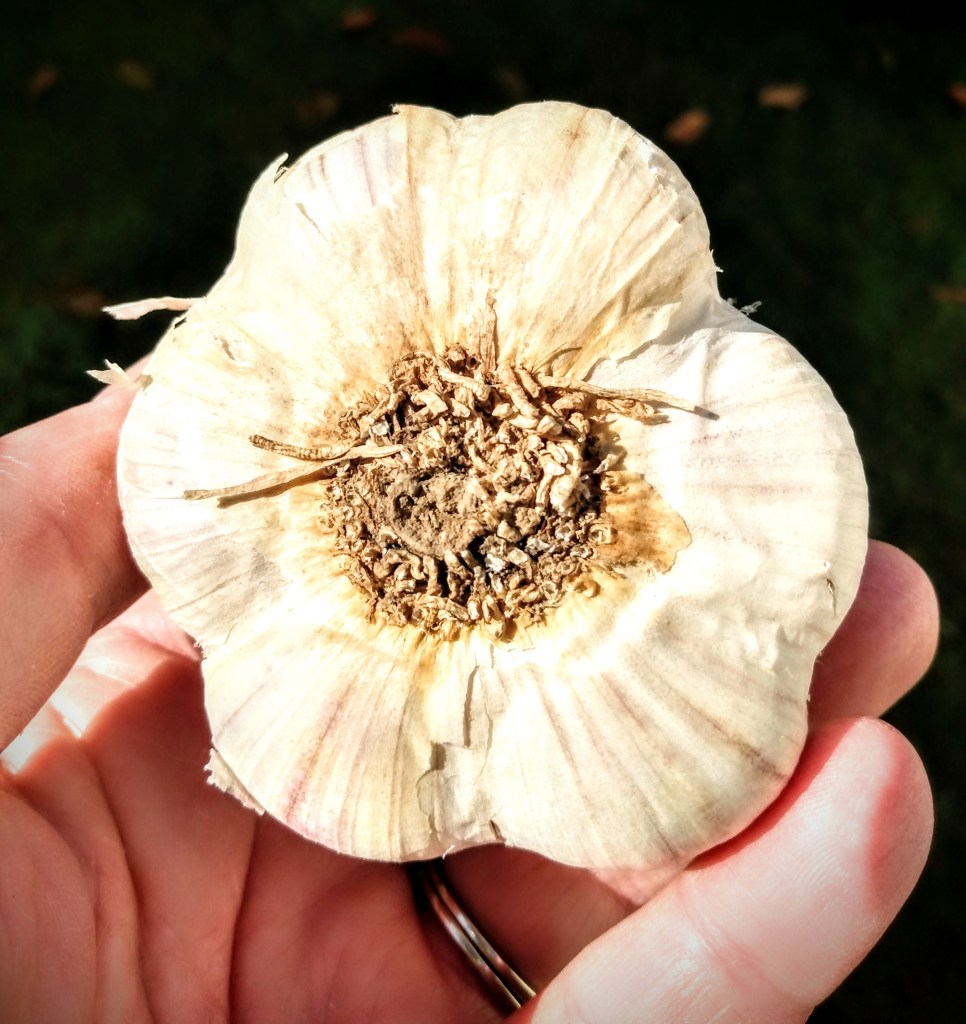
Note: garlic grown locally will still have some of the roots still visible in the bottom of the garlic head. Garlic that is imported from China, the roots are shaved off so that you have a smooth, flat surface where the roots should be.

Another concern with foods bought at US grocery stores is what you can find on the produce ID code. On the stickers placed on produce, you can learn what type of product you are buying. If the four digit number starts with a 3 or 4, it is conventionally grown. Pesticides have also been used on those products. (Dangers of pesticides can be seen here. Although this is a huge conversation and this is a brief mention in this post. But I do want to note that food is being brought in from less regulated countries.) If the number is 9, it is organically grown.

But there are other numbers to be aware of. A five digit PLU code starting with a 3 means the fruit was either irradiated or electronically pasteurized. (Dangers of irradiation can be found here.) A five digit code, starting with an 8, means that it was genetically modified.

These are just a few points of interest that overlooked that the average consumer may not be aware of. And growing your own produce gives you awareness of how your food is grown from start to finish.

Advertisements

Setting up Garlic Grow Boxes

A few months ago I had fixed loose boards by using a power drill and screwing the boards back to the frame. Had I not done that earlier, this is the time of year that I would normally to that mending job. But the best time to mend grow boxes is when you have one crop harvested and right before you put in the next one.

Make a Container You Will Love is how I start off all my new boxes. This time I reused one of my existing boxes. My onions didn’t do so well in it this past grow season, so I’m changing it up to see how my garlic will do here.

Before I put the garlic in, I needed to break up the compacted soil, remove some grass that had started to grow, and more importantly, mend the box. After three full seasons of growing, the liner in the grow box had started to rip away. So once the weeding was done, I pulled the black liner back up and staple it in place with a staple gun.

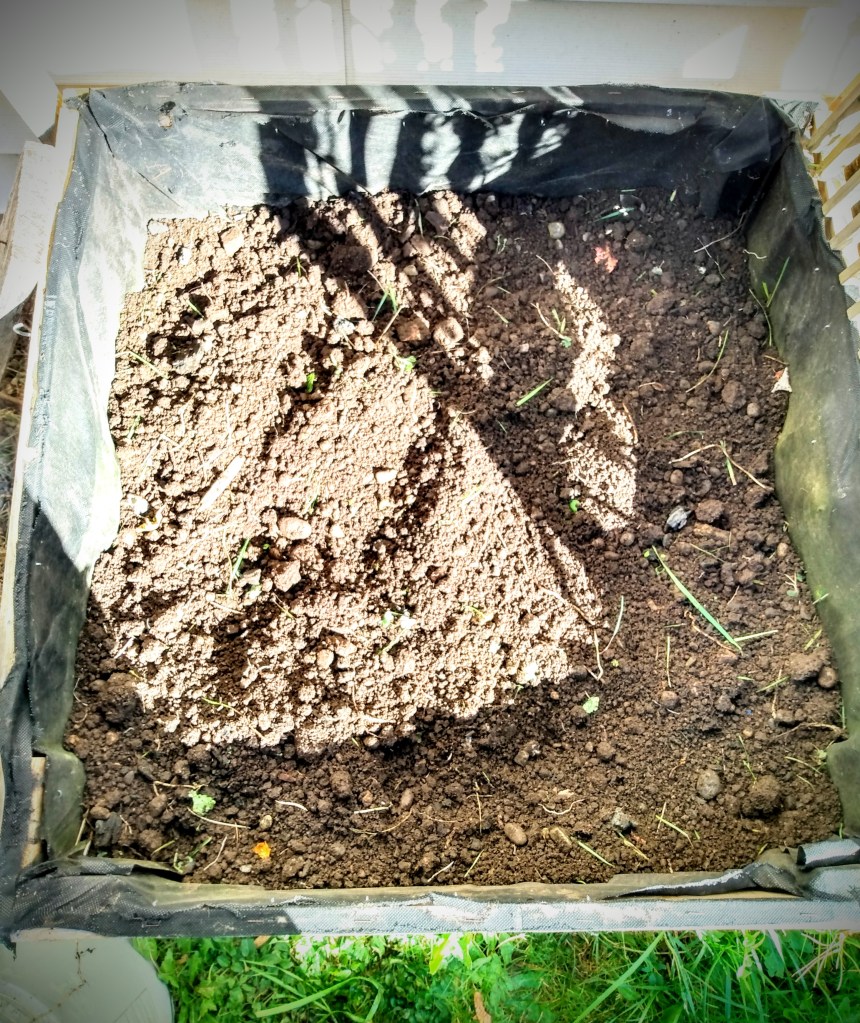
With the liner secure, this frees me up to really dig into the soil to fluff it up and move it around and break up all the compacting that has happened over the last couple years.

Once the soil was ready to go I reached for the new garlic that I ordered to plant this year. In this box I’m planting German Extra Hardy Garlic (a hard neck variety).

Earlier I mentioned looking at the roots of the garlic head. Here you can see the roots (trimming the roots is part of the curing process, but you can see the individual roots. This is what you want to see when you buy garlic).

Now that I’m ready to plant the garlic, I break the head down to individual cloves. Once they’re broken down, they’re ready to plant.
When planting garlic, the general rules are:

  • Plant the cloves 3″ below soil level
  • Plant each clove pointy side up
  • Plant each clove 6″ away from each other
  • Add an additional 1″ soil over your whole plot
  • Then add 3-6″ of mulch on the very top

I have modified and moved away some of these rules in the past. In the previous location that I grew garlic, it was in a sheltered garden bed next to the house. So I never mulched those garlic and they grew perfectly fine in my climate.

The cloves that I planted in previous years did well when the tips of the bulbs were 1″ below soil level. If I put them 2-3″ deep, they remained dormant until I moved the soil around and those cloves were brought higher up.

Advertisements

If, when spring comes, you don’t see the shoots of the garlic popping through the soil, then you may want to consider pushing away a little bit of the soil. But garlic is one of the produce that has been one of the easier crops to grow and there shouldn’t be problems at all.

Seeing how I’m growing new garlic varieties, and in raised beds, I set up the boxes closer to the “rules”. The only modification that I’m making is the spacing between each clove. As you see below, I’m offsetting the rows. By offsetting, this allows me to plant an additional two rows that I wouldn’t have had room with if I kept the cloves is a perfect grid like pattern. This is something I’ve learned from other gardeners and have applied with other produce that I’ve grown. And seeing how I grow with limited areas, this is a smarter way of using space and maximizing harvest.

Once all the cloves were placed where I wanted them (larger cloves more to the center of the box and smaller ones towards the edges–larger cloves are expected to grow larger heads) I put soil over the top, about an inch or two, and leveled it off.

Then to finish off the box, I topped it off with bark mulch.

This year I mulched my boxes because I have more containers that I’m using over the winter than I’ve used in the past. And since I don’t have enough greenhouse plastic to cover everything, I’m going to use the mulching method which is more commonly used. I do have a few small, new, boxes that I’m using this year that is away from a warm shelter. So I will be keeping an eye on these boxes in particular. If it looks like the soil is going to freeze over too much, the plan is to set up some carbon fiber hoops and surround the boxes with greenhouse plastic. (I have one variety of garlic and my ginger that I definitely don’t want to lose.)

Always have a backup plan!

One brief thing that I want to mention is to be aware of what kind of material that you are using for mulch. Always look at the Ingredients on the bag.

Most people are at least aware of looking on ingredient labels when they are going out to buy food from the store. Whether it’s a food allergy or just awareness that some gross things are being put into our food that effect our overall health, more and more people are beginning to take on this practice.

The same is true about what you put on your garden!

I bought this mulch, on sale, about 6 months ago. The original mulch that I was going to buy had a better sale. But when I found the ingredient list on the bag of wood chips I saw more than a handful of chemicals that were used in the product. It was advertised to prevent weeds from growing. But the reason why they could make that promise was because of what they were using in the wood chips. There was not just herbicide, but also chemicals that kept the wood color treated. Nothing of what I saw on that label reflected how I try to keep my garden as natural and organic as I can.

If you take a look at the picture above, on the left, you will notice that this ingredient list is listed with only one thing–aged forest product. For me, this was a better choice than the one that had well over 20 ingredients. I didn’t mind spending an extra $1 a bag when it meant that it fit a closer to my gardening philosophy.

Advertisements

Prepping an Existing Garlic Bed

Earlier I had mentioned that we’ve been growing garlic for several years, before we became aware of the wonders and beauty of different varieties. My earlier garlic bed is kind of funny because we grew so many different varieties in there that we have no idea what kind of garlic they are. That is other than Elephant Garlic. There’s no mistaking that variety with the others that we have grown.

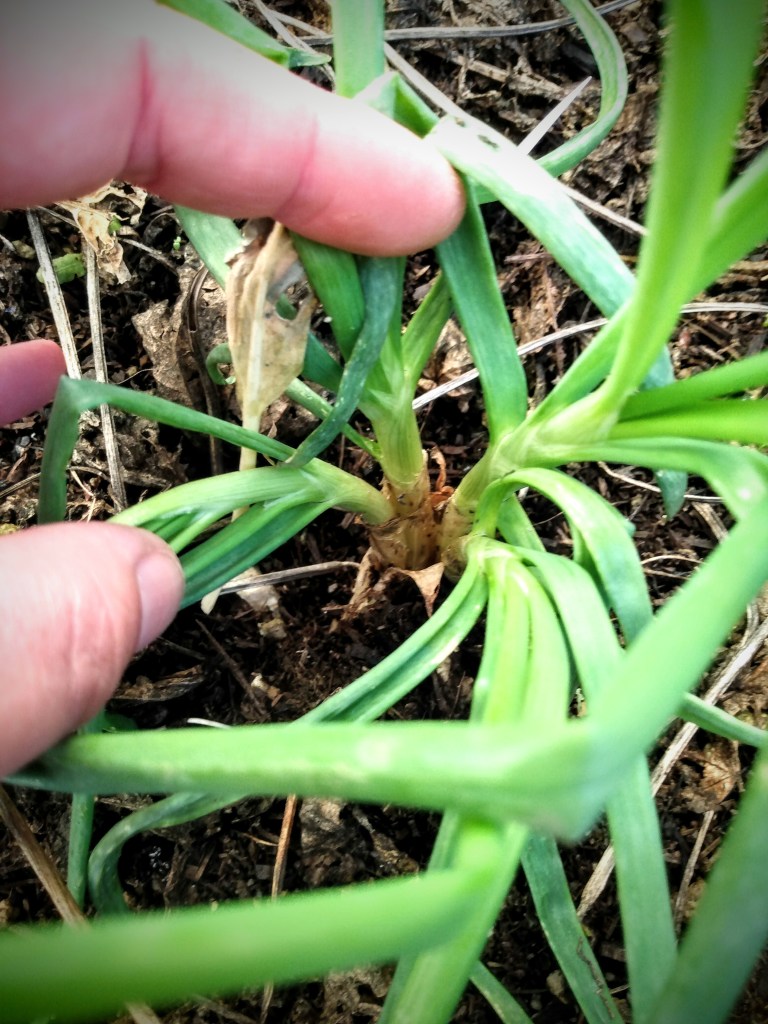
This past growing year, I let this garden bed go fallow (something that I will talk more about in the future). As you can see here, you will notice the shoots of the garlic already coming up.
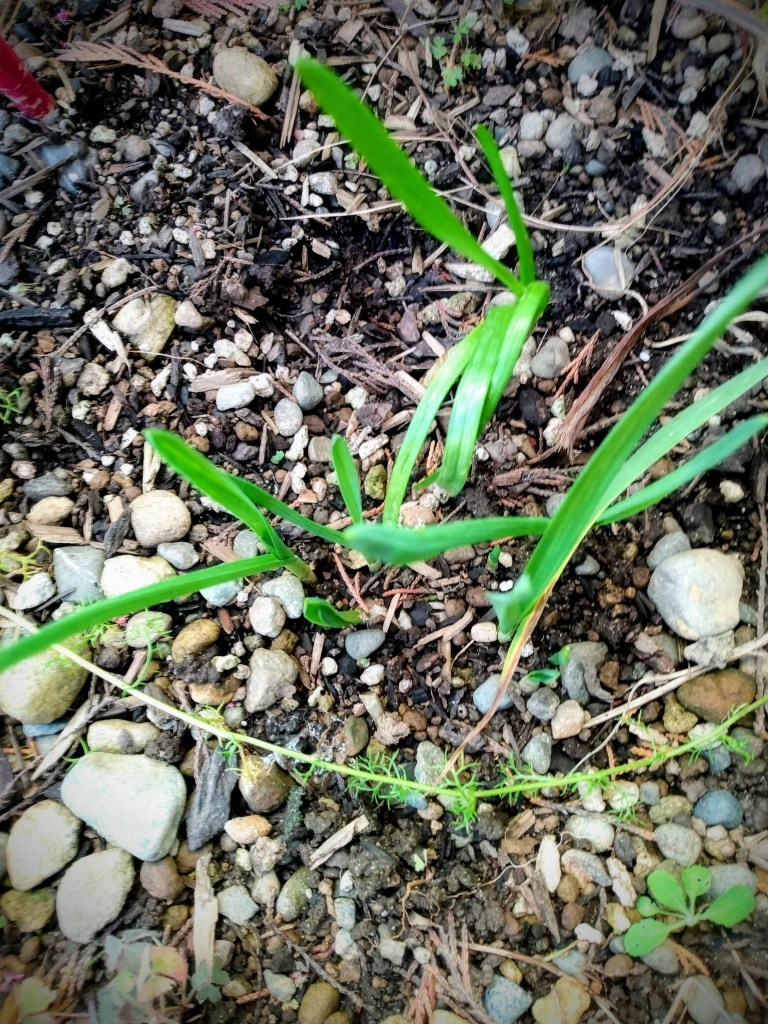
When I say that we had a crazy grow season, I’m not joking. We had two springs instead of a spring and a summer, so quite a few of my plants are off on their cycle. But these shoots are great when it comes time to getting garlic beds ready for the winter.

With how close these shoots are, my guess is that these were some of the cloves that had been planted too deep and didn’t get a chance to grow because other things were growing near them. With this bed allowed to go fallow, these cloves were able to have the opportunity to sprout.

Each year I take these clumps, dig around them to loosen the soil, and separate out the cloves that had at one time been a whole garlic head. Once they are all dug out, I loosen the whole bed and mix in some compost. Then I replant all the cloves with the proper distance.

I’m beginning to think that my garlic bed acts much the same as where you plant potatoes. Once you plant them there, they will keep growing back.

Advertisements

Another Theory for Garlic that Keeps Growing Back

When we first started growing garlic, we were told that we needed the garlic to go to seed before harvesting. So for a few years that’s what we did. We even tried to harvest the seeds. I just couldn’t seem to sync by time right with the seeds.

Then we learned that harvesting the scapes (the part that develops and grows the seeds) changes the flow of the plant. Instead of making seeds, energy is redirected to the bulb to enable the bulb to grow larger than it would if left to go to seed.

So my other theory for garlic growing back year after year, when I pull all the garlic that grows, is that the seeds that fell to the ground germinated and started to lifecycle of new garlic, not from planting cloves, but from seed.

Photo by Pixabay on Pexels.com

Closing Thoughts

The amazing thing about growing garlic is that it is one of the easiest things you can grow and least demanding. You can work a full time job and have busy weekends and still successfully grow garlic.

If you’ve wanted to try and grow something, I highly recommend garlic.

It is forgiving. And it tells you when it’s ready to harvest. Through the season the garlic grows a tall stalk. When it’s finished growing, the stalks will brown and fall over. And that’s not even talking about how many different resources are available if there’s a specific question you have about growing garlic.

If you’re looking for something new to grow or found that the garlic cloves you have in your kitchen starting to grow a green sprout, go ahead and plant it in some soil and grow your own garlic!
Leave a comment

Processing…
Success! You're on the list.
Advertisements
Advertisements
Advertisements
Advertisements

Saving My Freezer!

Now that Fall weather has set in, there’s one concern that comes up every year. What do we do when the power goes out this year?

You would think that with the frequency that my surrounding area loses power due to snow fall, that there would be changes in the electrical system. Or even something as simple as taking preventative measures to eliminate more outages. But instead the average number of outages remains the same. And the outage time remains the same, 24-72 hours. Some areas have outages for longer.

But none of them have hit the fame as the President Day’s Storm of ’92. Roads were thick sheets of ice. Trees were breaking from an obscene amount of cumulative ice. And the power lines were down just from the weight of the ice on the lines. That’s not even taking into consideration the transformers that were blown.

I remember that my family had no power, with snow and ice, for longer than a week. I wish I could remember how much snow we had that year. And I wish I could remember how long we were really without power. My family did quite well in that storm because we had a wood fireplace, where we could keep one room sufficiently warm, with a flat top that we could cook on.

Even with all the power outage skills that my husband and I have, it only mildly prepared us for the day that an Otter Pop propped our freezer open this past summer.

Fortunately for us, the freezer had only been ajar for a couple hours and we caught it before we had a complete loss of our frozen foods.

And for as much as working in campus dining wasn’t exactly my job of choice, I do value the information that I learned getting my food handler’s permit. In this particular instance, I had the information to easily recall safe temperatures to prevent food borne illnesses.

A couple of my meats were between 38-39°F. Most were further away from the danger zone. And the majority was still frozen solid. My defrosted meat was still safe so I cooked that all up and prepped my pressure cooker for canning hot packed meat. The rest of the compromised meat, that could safely sit in my fridge and defrost the rest of the way, was saved to process the next day.

So with storm season quickly approaching, what plans does your family have for saving food for when the power goes out? Or even your freezer gets accidently propped open? Or your fridge fails you for one of a handful of reasons?

If your fridge or freezer contents can be handled in a timely and food safe manner, there is absolutely no reason why you can have zero food waste when the unforeseen happens.

Pressure Canning

Just about everyone I talk with, who are familiar with food preservation have the skills of water bath canning (the process of canning in glass jars acidic foods). I’m sure you’ve seen people’s canned jams, jellies, tomato sauces, and fruits. Foods that are under the pH value of 4.6 can all be water bath canned, be shelf stable for 18 months, using current lids (when stored properly in a cool dark place, like your pantry or storage closet).

What about the rest of your food that is not acidic; vegetables, milk,
butter, and meat?

That’s where a pressure canner comes in.

Before moving on, I want to acknowledge those who say that they mama, grandma, or auntie still water bath can everything (even the food above a pH 4.6). I’m not going to argue with your mama, grandma, or auntie. Food is one area where I prefer to not take my chances. The risks I make in life, I prefer to make elsewhere. Pressure canners can be purchased for less than an Instant Pot. So I choose to use the pressure canner and encourage everyone else to use a pressure canner as well. It also has the least processing time. Those who claim to water bath meat do so with a processing time of over 3 hours. With the pressure canner, processing time runs from 75-90 minutes (for elevation 1,000 feet above sea level and lower) depending on the size of your jar and type of meat you’re canning. So from the money and time perspectives, the pressure canner is still the best way of processing (all other food risk issues put aside).

Another bonus to investing in a pressure canner is that it’s two canners in one. You can pressure can with it as well as water bath.

Pressure canning weights and processing times vary dependent on the elevation at which you are cooking.

Another subject that can bring some heated conversations is cold pack vs. hot pack pressure canning meats. What you need to know is that cold pack means that you put raw meat into your jar and the processing time cooks your meat. Hot packing means that you cook your meat until a little pink is left and then you pack it in your jar with a stock or water. There are safe ways of processing both ways, when you look at the cuts of meat, how it’s packed, and what proven canning recipes state.

A bit of it comes down to common sense decision making as well. For example, the meat that I took out of our compromised freezer (38-39°F) was safer to hot pack. The reason is that once you come to 40°F bacteria start to grow and cause problems. So I immediately cooked the ground beef, even a little longer than until only slight pink remains, because I didn’t want to start the canning processes with a possibility of the meat being compromised. When canning, the meat nearest the center of the jar doesn’t reach the high temperature to kill off bacteria as quickly as the meat nearest the edge of the jar. So by making sure the meat would all be thoroughly cooked (between pan and canning), I make the chance of food borne illness less. Of course, this meat I’m going to use before the other meat I have canned, but this is all about making the choices that make sense with the science behind food preserving.

Something worth noting, that in the ideal situation where there is no compromise to your meat, how you can it is going to determine how it turns out. In the instance of ground beef, if you hot pack it, you will end up with canned beef that is small crumble in shape and texture. If you cold pack ground beef you will end up with a product that is solid–comparable to a meatloaf or a pressed meat like SPAM. So if you’re canning meat in a non-emergency setting, think about how you would like to use your canned meat. Because that is going to help you decide how you preserve your meat.

Things to Watch Out For

Obviously, the first signs of failed seal are if your lid buckles or the lid never seals to begin with.

When you remove your jars from the canner you can immediately spot the first failure type, a buckled lid. It’s any type of warping that you see on the lid. Even if the seal feels sound, it could be a false seal that will break on your shelf after you let it sit for a week or two.

Think of this issue as soundness of a structure. When you build a house, you don’t use warped wood or a broken foundation because it can cause problems to the soundness of the house in the future. Everything could be fine for a few years, but the time comes where the house gives way to other problems because of unsound structural sources of the house. A buckled lid may have a sound seal, but it’s only a matter of time before it fails.

In this instance, it’s just best to remove the lid and reprocess the jar. Your food is not going be harmed by processing it a second time. But, giving it a new lid with a proper seal is going to give it the sound structure your food needs to be safely preserved on your shelf.

Now the failed lid seal, that problem is the one that sneaks up on you. And it’s the number one reason why for good practices you never store your jars with the rings on.

Once your jars have cooled over night it’s time to remove the rings and test the seal. Pick the jar up by the edge of the lid alone. If sealed properly the jar will suspend off the lid. (I still brace myself for my jar to crash to my counter or floor, even though I haven’t ever had one do that.) If a jar is not properly sealed, you’ll hear the lid pop and it comes right off. No big deal, clean the rim of the jar off with vinegar and apply a brand new lid before processing it again.

Now the reason why we don’t store jars with rings on them is because when you go to check your jars (ideally every week), you can immediately see if a lid’s seal is broken. The couple of times it’s happened to me, I opened my pantry door, barely touch the jar and the lid clatters to the floor. Usually this happens before anything starts growing or smelling off. So, early detection of a failed seals is great.

I’ve seen many pictures and heard stories of people who left their rings on their jars. More times than not, they smell something off in their panty and have to figure out where the smell is coming from. They never say it, but I can guess the process of elimination they have to go through in removing rings. Sometimes they don’t have to touch the rings because they see a science experiment going on in a jar. A regular inspection of lids, with rings off, prevents spoiled jars from going this far.

Siphoning

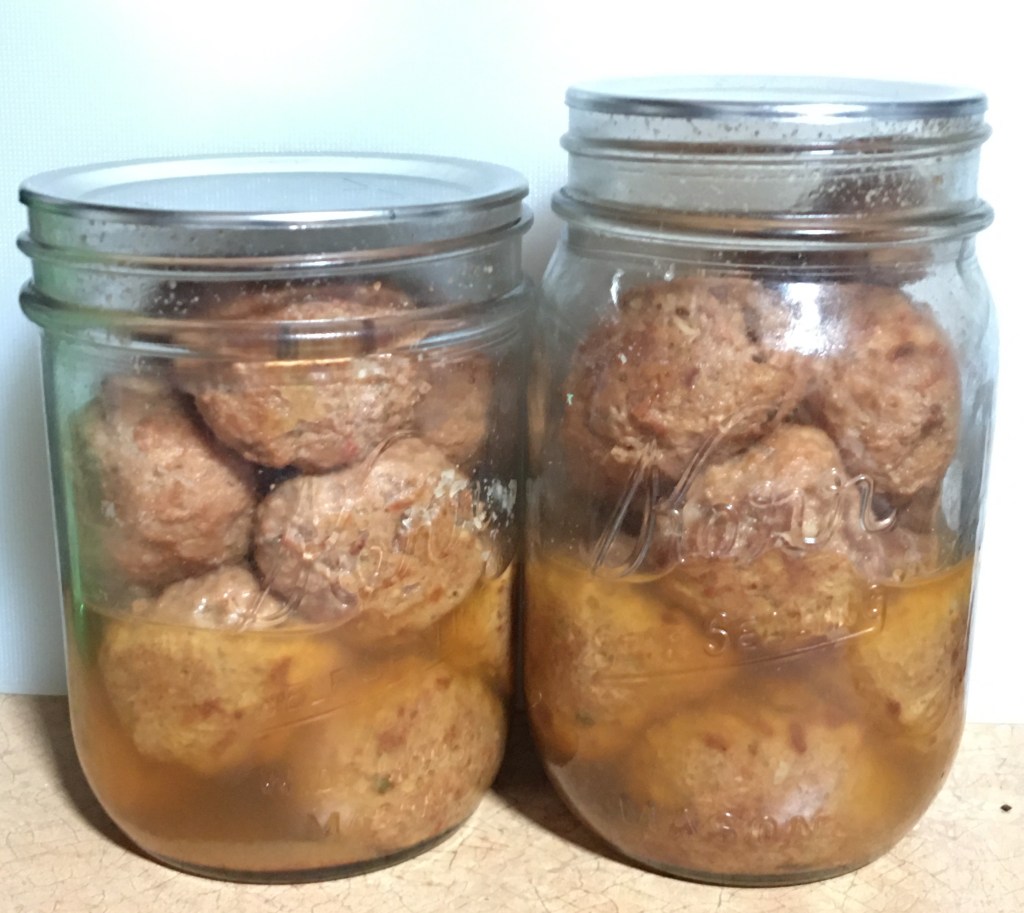
There are a few reasons why your jar siphons (loses liquid). This is a great article in covering all the possible reasons. I want to point out what it looks like.

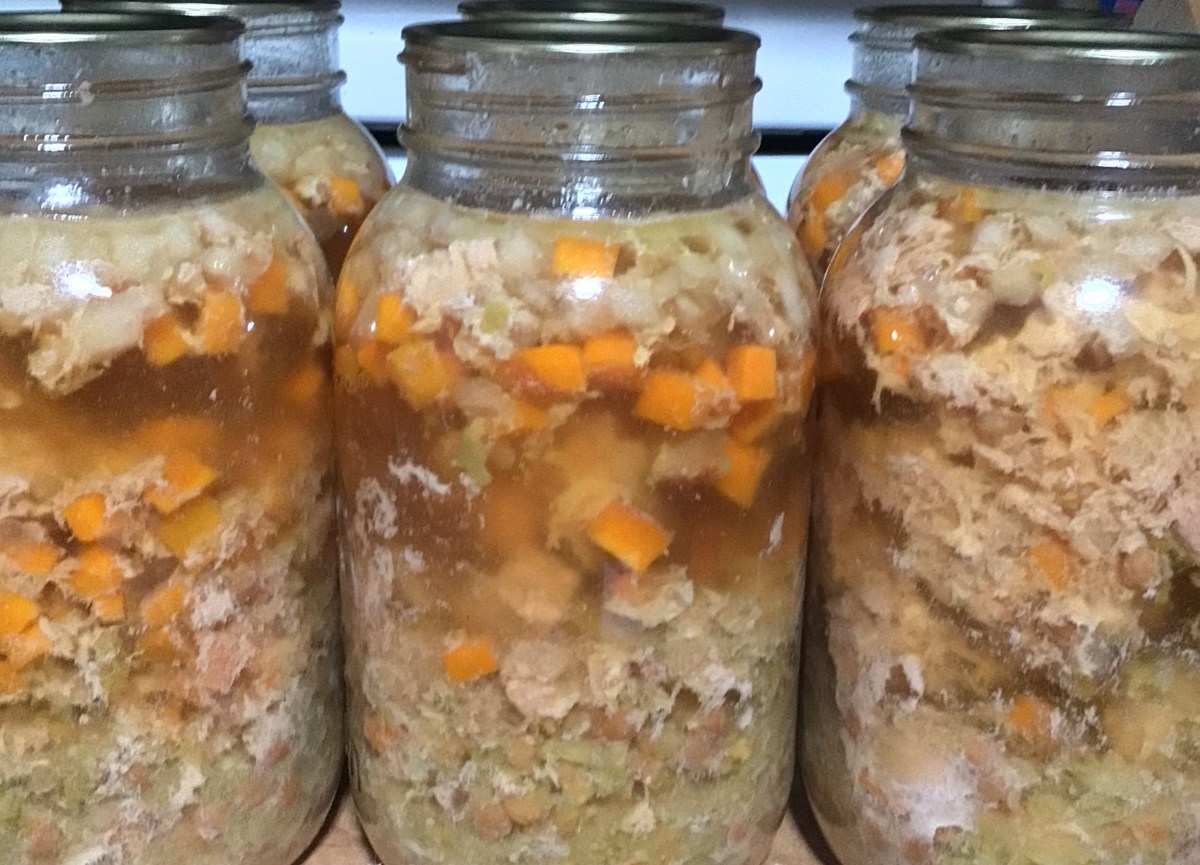
This is one of my canning sessions. These two were the only two jars that siphoned, out of the 7 in my canner. Both lost over half their liquid before sealing. Truth be told, I have no idea why these two failed (losing half a can of liquid or more is a failed seal). But with this much liquid missing, there was no way I could put these on my shelves. I could have put these in my fridge to eat the next day. Instead I chose to put in more beef stock and re-can them with a fresh lid. (They didn’t lose any liquid the second time.)

Siphoning is only a problem when you lose a drastic amount of liquid like this. Otherwise, siphoning is a common occurrence in canning and generally not a problem. Any meat (or other canned product) above liquid line will be discolored over time. It’s still good, just not visually appealing.

An interesting story is that I never learned how to pressure can from my mom or grandma, because my grandma tried pressure canning and could not figure out why she kept siphoning like this. After a few fails she just called it quits. Mom was pretty impressed when I had this conversation with her. The bottom line is that technology is pretty amazing in this day and age, where we can teach ourselves new skills and problem solve with a little research.

So please know that if siphoning was a problem with your previous attempts at pressure canning, know that making one or a couple adjustments can solve this problem for you and you can prevent it in the future.

Back to the Meat Save

As I mentioned earlier, I was so glad to have the skills to can the meat from my freezer. At first my husband was freaking out because he thought it was all lost. (And the freak out would have been rightful had I not been able to save our meat.) But his reaction is what most people have. Especially with food prices so high.

I cannot tell you the value of the calm of pulling out the pressure canner and setting up for an unplanned canning session. The best feeling of all was knowing that the whole incident was not a lost moment. My husband learned how to can meat. Up until this moment, it was something that I did and he just popped into the kitchen to find out how I was doing. But now, if we have a moment where we have to marathon can again, we can take shifts and not lose out on sleep or meat.

What are your plans for the coming storm season?

Are you prepared for a moment where your fridge is not working for you?

What cooking sources do you have for a no power situation?

Some ideas I would like open for consideration is pressure canning soups, meats, and vegetables. In a worst case situation, these are safe for you to crack the lid and eat straight out of the mason jar. Or you can warm them in the matter of minutes over your grill.

Another option is freeze dried foods. All you need alternate fuel for is to boil water. The water can then rehydrate full meals for you that are warm.

I know power outages are hard on the whole family. But by thinking in advance, it is possible to turn it into more of an adventure instead of worrying about food loss (by opening and closing the fridge) or getting burnt out by cold food.

If you’re interested in new recipes that require nothing more than a camp stove, this is the first site that I go to search, Trail Cooking. Under her tab, Trail Cooking, Sarah has an amazing list of recipes. Usually I find a handful of interesting recipes on most sites. Here, I have a list that rivals the lists I have for my cookbooks on my shelf at home. So please be sure to check out her menu offerings!


If you’re not yet into canning but still would like to prepare for no power meal options, check out The Good Steward.


After the Tree is down

I don’t know how your family tradition goes, but normally we don’t take our Christmas tree down until after the New Year. This year was different. We got snow the day after Christmas and my three young, very active boys find themselves confined inside a little bit more than usual. Not a problem, except we have a very small house for 5 people. So the tree came down just to make a few more feet of playing space. Not to mention, the boys got balls and shooting toys for Christmas. So yes, all my fragile decorations also had to go away. I have no intention of putting my mom’s nativity scene in the line of fire, literally.

Do I have an empty house now?

No. I love decorating. And my boys always look toward the changing of the seasons when I bring out new decorating elements. With it being too early to bring out the Valentine’s decorations, it was time to expand on my winter (post-Christmas) decorations.

Exterior snowflake lights were part of the lighting on the tree this year. So once I boxed all that away, I left the snowflake lights out and hung them from my ceiling with the white hooks I permanently installed in my ceiling.

For in my home, I got the idea of decorating my living room ceiling from my sisters. It started with one sister hanging air blown birthday balloons and streamers with thumb tacks from the ceiling. Another sister put up Christmas balls on her ceiling. What haven’t I put on my ceiling? I’ve even done a Valentine’s Day pillow with my boys’ names on it.

From the years I decorated in venues in the greater Seattle area, you learn how you can or cannot hang items, especially overhead. And that is where using items that are secure and installed once comes in great use. You have less chance of things falling on you and switching out decor items becomes quick and fuss free. White hooks in the ceiling are perfect for in home party decorating because they blend in with the ceiling, you measure out your spacing once, and then you can change out your ceiling decor in about 15 minutes, instead of over and hour of pushing thumb tacks in your ceiling, figuring out how to keep items from falling off the tacks, and having to re-space your items because of holes

For anyone who is decorating your own larger event in a venue (hall, lodge, hotel ballroom, barn, wherever your fancy takes you) make sure to ask questions about what items you can and cannot use in hanging your own decorations. You will find that push pins/tacks, your own hooks, command strips and other commonly used items are not allowed. I can totally respect this rule, because these items can destroy walls and fixtures really quick when there are a handful of weddings each weekend and during the week. Even though you may think that this forbidden list takes care of everything, I promise you it does not. There are other ways of rigging overhead decorations. Depending on what you want done, you might just have to hire the professional decorators for this element for your event. But you might just be surprised at what rigging features the venue might already have in place. For example, the decorating company I worked with, years ago, had a relationship with a venue that is a historic building. Through the relationship, and the decorating package established between the two companies, specific rigging was installed. It allowed for certain elements to be used for weddings, while maintaining the integrity of the building with very minimal damage. Knowing this feature, it opens the door for a conversation with the venue sales person or manager if this is something you can use for your event. But this also puts more on your to-do list (making sure you have a qualified/venue approved person doing the decorating, you have all the equipment to safely do the work, and several other little things that need to be in place). Not impossible, just reworking your thinking to problem solve in this area.

In honor of this snowflake post-Christmas theme, and our recent snow fall, I am promoting this Let It Snow SVG cut file. Until the end of January 2022, you can download this file for free at my website http://www.pacificnorthwesteventdesign.com or you can click on the link above the image and it will take you straight to item. Be sure to see what other files inspire you to create. New files are added regularly. And if you sign up for my email newsletter, you will receive a code for 20% off of your first purchase. Emails are sent out once a week to let you know of new blog posts and design products. I do not sell or give away any of your information.

Let It Snow

Processing…
Success! You're on the list.