Relish for the Non Pickle People!

This was one wild ride for the growing season for my little garden this year. Here in the Pacific Northwest we had absolutely no spring, just an extended winter until June.

Normally we can start planting things as early as April. Most home gardeners wait until Mother’s Day to plant starts out into the garden. May is when all surprise freezes are no longer a possibility. So you can imagine the thoughts running through my head when halfway through June we still hadn’t broke past the 60’s. I even planted double my usual tomatoes because it looked like the grow season was going to be that far off of the norm and we were not going to get as many tomatoes.

Hope returned when August showed summer in all its gardening glory and continued through September. Usually September is our Indian summer. But the beautiful weather continued all the way through October. Actually traditionally cool and rainy October kicked in that last week.

All this time I left my tomatoes going. There were so many green tomatoes and I hoped beyond hoped that they would turn red on the vine before we lost our extended summer.

This first week of November was when I had to pull the plug. And that meant I had somewhere around 6-7 quarts of green tomatoes–hands down the most green tomatoes that I’ve ever had to figure out what I was going to do with them. Mind you, I didn’t grow up where fried green tomatoes or green tomato sandwiches were common place. I know of these things, but they were never part of my childhood diet.

Looking up green tomato recipes, there was one that stood out–Green Tomato Relish.
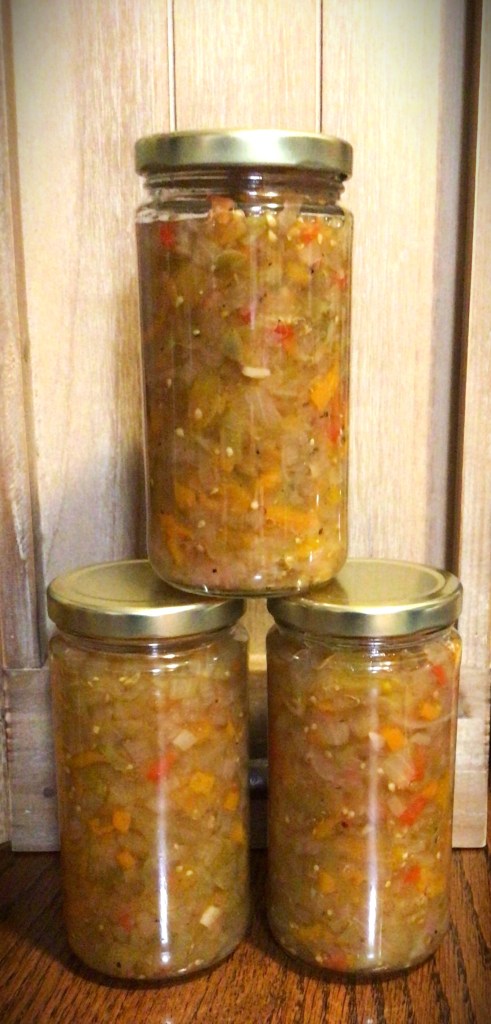
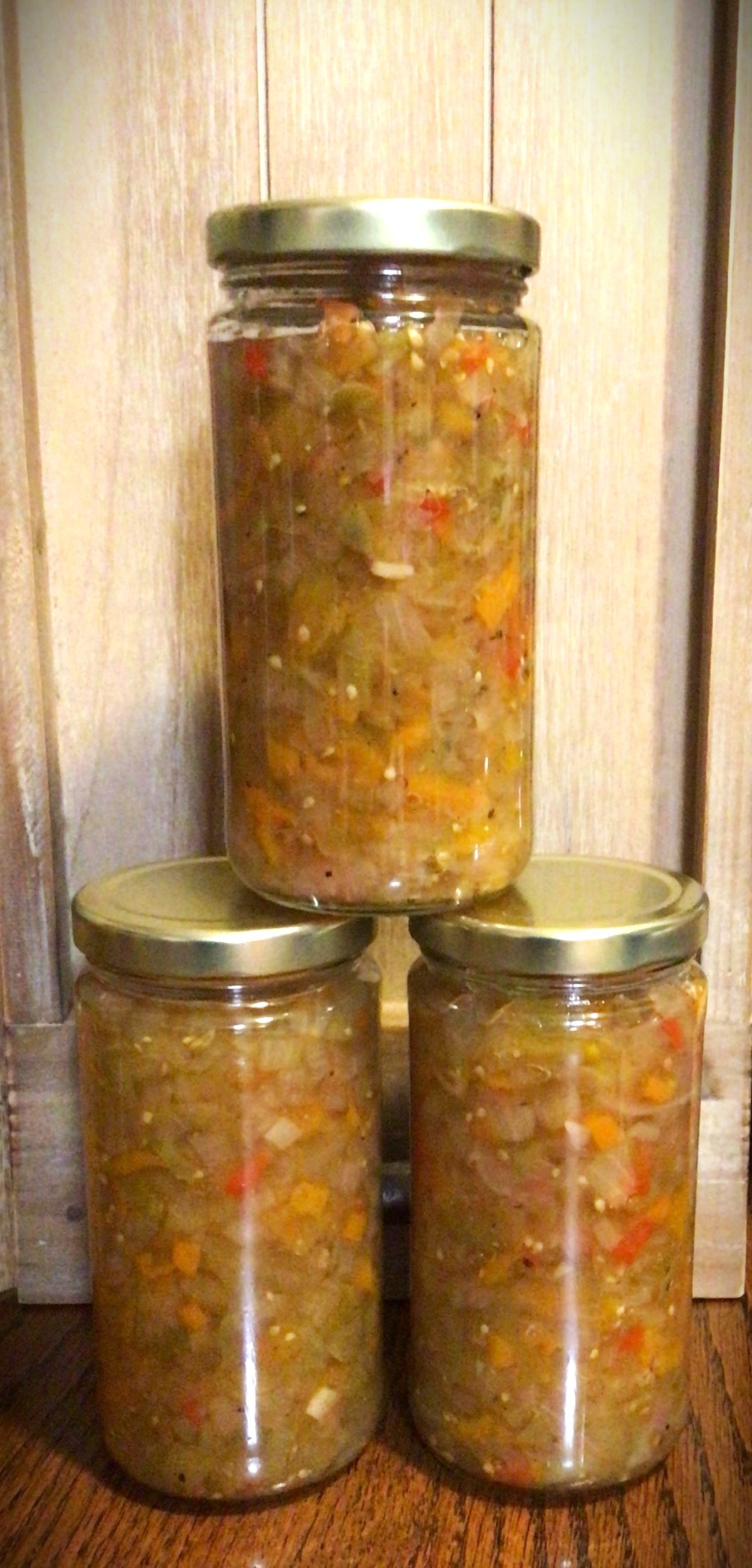
I am not a pickle person. That’s story for another time. But I married a pickle person (who by chance isn’t a tomato person…and I am!) who loves pickles and especially relish. I figured that I would can some green tomato relish for him so that he had some homemade condiments that were right up his alley.

From what I found time and again with green tomato relish recipes is that it’s comparable to pickle relish and several people commented about how they preferred it over pickle relish. That caught my curiosity!

As I began to read through several different recipes I saw most of them were very similar in ingredients to fresh salsa. I love salsa!

Then the thought hit me that maybe, just maybe there is a relish in the world that a non-pickle person would like. (And when I say I don’t like pickles, I mean that I can pick pickles off a restaurant burger and taste exactly where they were place on the patty just by the residual brine that was left behind.)

I used this video from OurHalfAcreHomestead, Green Tomato Relish 2018. Besides the fact that I had nearly all the ingredients in my kitchen already, the huge selling point for me is that Miss Volfie is my kind of woman! The way that she cooks is how I cook (you make things so frequently that you go off of the recipe in your head). It was how I was taught to cook and how my dad was taught to cook. So this cooking technique automatically flips a switch in my head that starts the fanfare that this woman knows what she’s talking about. She’s not after the fame and money but honestly passing on what she knows best.

I highly recommend that you watch the video. But in the case that you just want the recipe and steps without the talk, here it is.

Green Tomato Relish

Miss Volfie’s batch is broken down to this ratio:

  • 2 Cups Green Tomatoes
  • 2 Cups Onions
  • 1 Cup other Vegetable (Sweet Bell Pepper in this instance)

I love this ratio because it’s easy to make you “batch” based off of the amount of green tomatoes that you have. No need to be short or waste what you have on hand. Your green tomatoes are literally your limiting factor.

(This is the measurements that were used for a triple batch)

  1. Mince your Tomatoes, Onions, and Bell Peppers
  2. Sprinkles about 2 Tbsp of salt over your vegetables and let the salt extract the water from the vegetables over night.
  3. (Next Day) Prep your jars for water bath canning your relish.
  4. Add your vegetables to a colander.
  5. Rinse the excess salt off your vegetables and drain them off.
  6. In your stock pot add the following seasonings: *2 cups sugar, *2 cups cider vinegar, 2 tsp salt, 1 tsp mustard powder, 1 tsp celery seed, fresh cracked pepper.
  7. Bring to a boil.
  8. Bottle and put in water bath canner.
  9. Process for 10 minutes.
  10. Cool

Modifications and Verification of Safe Canning

I’ve been teaching some safe canning classes for people who want to learn this skill for the first time. I’m also part of a few communities where I see the debate of safe and not safe recipes more often than I care to admit. Most arguments seem to be around processing times. So if you are a higher elevation, 10 minute processing time is not going to be enough. If you are a low elevation, I only need to process the tomatoes for 5 minutes.

When in doubt, always be mindful of your elevation and go to a trusted source for processing times.

For example, I wanted to verify if this recipe was a safe recipe or just a family recipe that hasn’t changed with updated food safety research. Other than processing time, the other important bit of information to verify is the acidity (the ratio of tomatoes to other ingredients and the added vinegar).

I found a very similar recipe at the National Center for Home Food Preservation (NCHFP), Pickled Green Tomato Relish. The most notable difference between these two recipes is that the NCHFP actually lists cornstarch as an ingredient. Flour and cornstarch are on the list for things not to add to recipes for home canning (with the exception of Clear Gel, which is a modified cornstarch that was created for canning–but this isn’t what’s listed in this recipe).

Cornstarch is a thickening agent. And from my experience in the kitchen I can only assume that the cornstarch was listed in this recipe to thicken the relish juice. Even though the NCHFP is a trusted source for safe canning practices, this is one instance where I am NOT comfortable in following their recipe.

Nobody likes a soupy relish, so here’s how I made my modification. Safe canning means that a certain amount of 5% acid (vinegar) needs to be added to counter the water content of the recipe. Miss Volfie did strain her vegetables, but there was obviously going to be a bit of water content still left–her vegetables were sitting in their juices over night and I think there was a shake in her straining before she potted her vegetables.

With my colander, I added a muslin cloth inside before adding my vegetables. I rinse and strained them. Then I picked up the muslin and compress strained the excess water out of the vegetables. There were several cups of water that I extracted out of my vegetables that would have been otherwise added, thus diluting the 5% Apple Cider Vinegar to a lower acid percentage.

Because I did extract the extra water from my vegetables, an additional step not taken by Miss Volfie or the NCHFP, I had no problem in following Miss Volfie’s lead in slightly reducing the vinegar and sugar volume. (My tomatoes were enough for a 7 batch and I added 4 cups of vinegar–slightly more vegetable weight than the NCHFP recipe, the same vinegar measurement, plus less water content from the straining step, and minus the cornstarch for thickening.)

Now I do agree with the NCHFP for simmering for 5 minutes once the relish comes to a boil. Some people will say 10-20 minutes, but the goal is to get the relish up to a hot temperature so that the center of your jar reaches proper temperature while processing. So I did modify Miss Volfie’s recipe by simmering those extra few minutes.

Advertisements

Here’s the walking away point.

Understand what the science is saying about processing your food for preservation. Food preservation is not just packaging to put food on your shelf. There is microscopic life that we share our world and food with. Safe canning isn’t about being a kill joy. It’s about understanding the world we live in and the food we share with other life forms. It’s about understanding how to create an environment, inside our food, that prevents these bacteria from taking over and leaving us with their food waste that makes us sick.

So look for those recipes that interest you. Check and verify those recipes with the people who spend their occupational lives studying in this area. Are they going to be right? Yes. And sometimes they do something that’s questionable. Go by what you know and at the same time get up to date on new information that’s found. Make your judgments based off of what risks you are comfortable with. And be prepared to answer and describe your thought process.

Advertisements

Now the Fun Part… how did it turn out???

My pickle loving husband couldn’t wait to try what I made, thinking of him. In fact, while I was cooking the relish to jar up, he has already planned out that we were going to have burgers. Let’s face it, my man adds so much relish that you think a burger bleeds relish!

Off he went to the store to pick up ground beef. But he returned with fish sticks because our 6 year old went to the store with him and they decided that the best price by weight was fish over beef. (The things and decisions that come from my family LOL.)

Once the relish was finished processing (one jar was not up to proper head space, but I still processed it so I would know how the vegetable texture would come out and the blend of flavors) I popped open the not-safe jar and taste tested the Green Tomato Relish.

First Impression–It’s not pickle tasting. That’s a win.

Second Impression–It doesn’t fresh or cooked salsa. The Apple Cider Vinegar adds a tartness that just isn’t present in a salsa. That’s a pass.

Can I eat this? Yes.

Will I go out of my way to eat this? Probably not.

What about my pickle loving husband? Will he be okay if we move forward in our married life with this relish and not buy store bought pickle relish again in the future? Maybe. I didn’t ask him that specific question.

However, I did ask him what he thought. He said it tasted good and he ruminated on the flavors going on in his mouth. He said next time he would probably add more vinegar.

So the next time that I make this recipe I won’t go light on the sugar and vinegar ratio to keep the relish less soupy. I’m not in love with this recipe enough to put my foot down and claim it as a favorite and it has to be this way because I’m making it for me. I’m still making this for my husband. So I’ll add the vinegar next time to see if it has a better flavor to him.

That being said… THIS IS WHAT I ABSOLUTELY LOVE ABOUT THIS RECIPE!

You remember that I said that my husband came home with fish?

I took this tomato relish and mixed it with mayonnaise to make a homemade tartar sauce. (Yes, this pickle hater is a tartar sauce snob. Yes, I’m aware it has pickles in it. And this is the exception to the rule of my hate for pickles.) This was by far the BEST tartar sauce that I have ever had. It was just the right combination of sour to creamy to crunchy ratio!

My husband and I do agree on one thing pickle related…the best tartar sauce. We both grew up eating fish from the Skipper’s chain of seafood restaurants. They had the world’s best tartar sauce. And when the chain shut down and we were no longer able to buy fish from them, we had a massive hole in our hearts for what tartar sauce to buy for when we cook fish at home. NONE of the brands in the grocery store came close to our favorite.

THIS homemade tartar sauce is NOW MY NEW FAVORITE! This Green Tomato Relish with just some mayonnaise is all we need to have the happy happy love love all over again for tartar sauce. And let’s just say that I laughed when my husband gave me the face for taking the last of the homemade sauce. He took the jar of whatever was in the fridge and made a gagging sound when he tasted it. Funnier still he searched the jar for the pull date to see if it had gone bad. Nope… it was still “good”. But it’s no longer consumable now that we have our replacement tartar sauce.

Advertisements

For My Fellow Pickle Haters…

Should you make Green Tomato Relish?

If you have a pickle lover that you life with, then yes! Kissing them after they eat Green Tomato Relish, you’re not going to gag over that pickle aftertaste.

If you happen to want a fish or seafood condiment that you will actually eat, definitely!

This recipe is far enough removed from the dreaded pickle that you can appreciate this recipe.

Even if you are not a relish condiment consumer, this recipe is worth having on your shelf or in your fridge. You can make your own tartar sauce. Of I recently fell in love with German Pickle Soup. I had no intention of ever making it, but was willing to order it at my local Bavarian restaurant. NOW, I will most definitely search out a pickle soup recipe that I can substitute out the pickles for this green tomato recipe.


I hope you make this recipe. When you do, please comment below and let me know what you think.

If you’re a pickle hater and have concerns about a specific flavor profile, ask all your questions below in the be comments and I’ll let you know my opinion.


Processing…
Success! You're on the list.

Leave a comment

What about the Shell?

This was the first year that I grew a shell bean. I grew up with my grandparents and mom growing snap beans. In fact, snap beans were pretty much the only vegetable that I ate without issues. So I have a special place in my heart for beans.

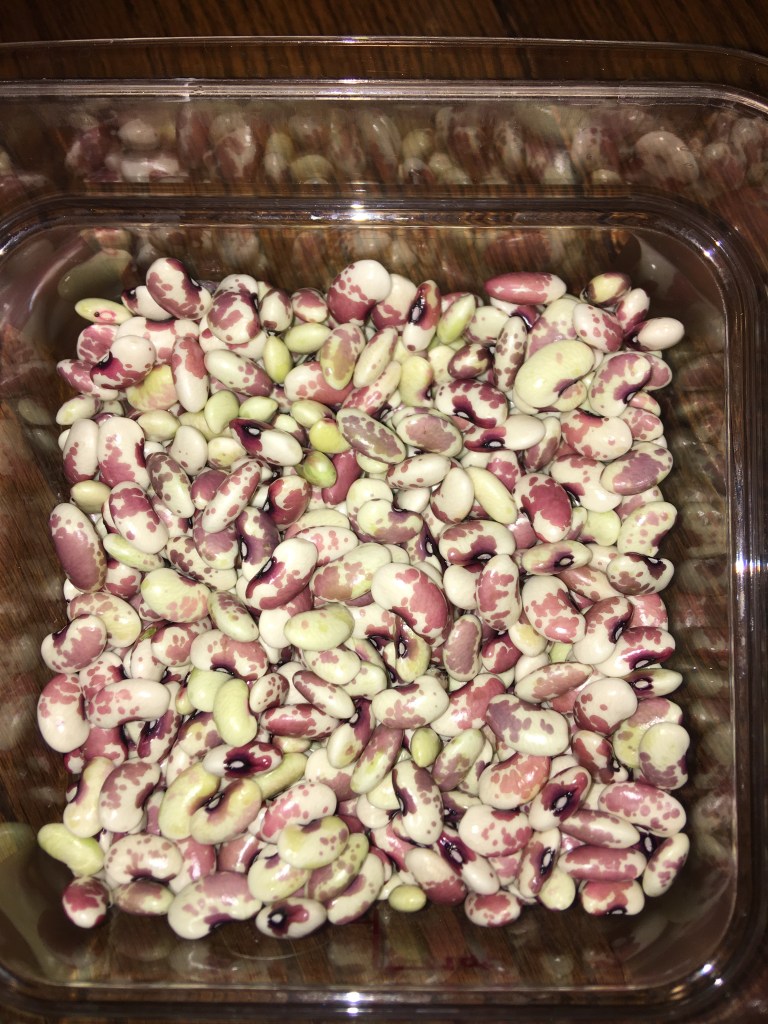
This is the shell beans that I grew this year, 1000 Year Cave Beans.
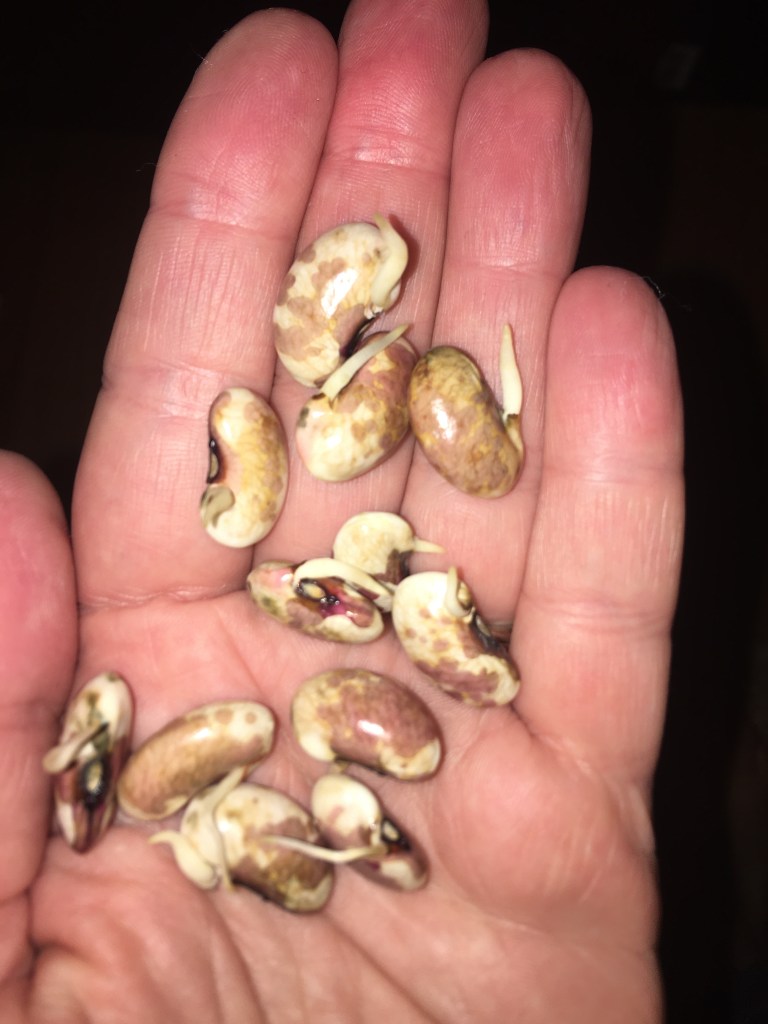
And just to show you how fresh these beans were, I didn’t anticipate them sprouting with in 3 days of me shelling them and waiting for more to mature so I could can a couple jars at once.
Advertisements

The one bit of information that I thought was prevalent was preserving beans of all kind. But with every safe recipe that I looked up every recipe was either for snap beans or dried beans.

When I teach people how to can, I always hand them safe recipes to select from, depending on what they want to can. And so these are the first sources that I turn to when I look to can a new food item that I’ve never canned before. And so I trust that what these experts say are what you are going to get. This is the one time that the extension office failed me. Here is the recipe that I used for my fresh shell beans. In full disclosure, if I were canning dried shell beans (such as the bagged beans from the dried foods aisle from the grocery store) this is absolutely the recipe that I would use.

But for fresh beans… I didn’t have canned beans. Instead I had half beans, half refried beans.

What happens when you can fresh shell beans the same as dried shell beans?

The gray in the water is the starch from the starch from this particular bean, 1000 Year Cave Bean. In fact, the starch left over in the bottom of the pan that I cooked these beans for the 30 minute stove top cook for a hot pack, was a richer version of this gray. In fact, it matched the gray on a pair of my camo pants. Next time I harvest these beans and prep them, I’ll take a picture of the bottom of my pan for you!

As you can see here, my beans started to break down due to the 75 minute processing time on top of the 30 minute hot pack cook time.

On the positive side, if you want to have canned beans that you can eat straight out of the can without needing to warm it up, the extension office recipe is perfect for it. All I added was the hot beans, hot fresh water, and 1/2 tsp salt for my pint sized jars. The beans were perfectly seasoned, soft, and very tasty. I am absolutely canning these beans again from here on out for the unforeseeable future.

The Extension Office recipe was also very pleasant for adding to my enchiladas recipe. In this instance, I really do appreciate a soft, smashable bean.

Unfortunately I need canned beans that I can toss into a soup, stew or chili where some firmness is needed.

Advertisements

Is there another safe recipe available?

I’m going to connect you to one of my favorite safe canners Melissa Norris, Pioneering Today. Please click the link to go straight to her directions. A video is also available.

If you’re on a time constraint, here’s the quick read of her directions:

  • Wash your jars.
  • Fill the clean jars with shelled beans until 1 1/2″ head space remains.
  • Add salt (1/2 tsp for pint, 1 tsp for quart).
  • Boil water and pour over the beans until you have 1″ head space.
  • (Remove air)
  • Clean the jar rims with a damp cloth, place lids, and screw down bands.
  • Place jars in your pressure canner.
  • Vent your pressure canner for 10 minutes.
  • (Once at pressure) process the beans at 10 lbs. of pressure for 50 minutes.
  • Once time is up, remove from heat and let your canner cool on its own.
  • When the lid unlocks, remove the lid but leave jars in the canner for about 10 minutes.
  • Remove the jars from the canner and set on the counter to cool for at least 12 hours and seal.
  • Store in your pantry.

If you are growing beans to supplement some of your grocery purchases, love gardening, or various other reasons… know that you can absolutely can your own beans. You can control what is used on your plants and what ingredients you add with your beans when you can them. The beans that I canned have 3 ingredients: beans, water, and salt. In comparison, the sale beans that I have in my pantry have an additional ingredient Calcium Chloride (an additive to absorb moisture which causes bacteria to thrive, “used pre- and post harvest to maintain firmness, reduce decay and prevent certain diseases… [and] as a drying agent.” (ingredi.com)

Advertisements

Store canned beans do have their benefit. I’m not going to pretend that I avoid them like a plague. For my family, we’re choosing to make a switch to lessen the additives in our diet. And with my young children, I want them to know where food actually comes from. I don’t want them to assume that food just mysteriously shows up on the store shelves. I want them to know where their vegetables come from. And where their meat comes from as well. (We love our local farmers!)

Plus I have the added bonus of not just hearing my oldest say, “Mom, can we can ____? I’m interested in that.” But it also helps establishes what we learn with our homeschooling. Math and science do matter on a daily basis. We can understand our world by working with it.

But most important of all, pressure canning beans (and other vegetables) make growing or store sale purchases a massive benefit to the family budget because we can preserve it and eliminate some of our food waste. And that is a win win for everyone!

Processing…
Success! You're on the list.

Leave a comment

Advertisements

Saucy Saves

It all started when I had a West Coast Clam Chowder that was too thin….

I learned how to make clam chowder from my mom. And she started her chowder with a roux. Nothing says “please give me a headache” more than trying to fix a roux based sauce or soup than your sauce being too thin. It’s not like you can add more flour because it’s not cooked out. And you can’t make corn starch slurry to thicken it up. I mean technically you can, but it’s not the same. The flavor gets thrown off and the texture is also not the same.

That’s when I had the brilliant idea of adding instant potato flakes. I put diced potatoes in my chowder and so the potato flakes made sense because it’s dehydrated powder that absorbs your excess liquid AND you get to keep the potato flavor.

Over the years, from this dehydrated potato beginnings, I have started dehydrating more and more of my vegetables.

It just made more and more sense, because if you really look at all the seasonings in the seasoning aisle in the grocery store, just about all of it comes from plants, herbs, and their seeds. We already season our food with produce. It’s not a far leap to move to use vegetables as seasoning.

Advertisements

From my chowder I moved to thickening my brown sauce made in my caste iron pan when I once again added too much water. This sauce the water evaporates relatively quickly. But this time I added dehydrated mushroom powder. It added an earthy note to my brown sauce and thickened up in just a few minutes instead of the several minutes that cooking off the water takes. Once again, the flavor improved.

And to be honest, I’ve hated working out the lumps of flour when I tried to re-thicken with flour like my mom use to. Depending on the day, I’m convinced that the flour was giving me attitude, “I’m just going to stay lumpy because there’s nothing you can do about it!”

So my comeback to my lippy flour has become, “Oh yeah? Well I’m going to use vegetables then. They don’t lump up like you do.”

I’m still waiting on some of my produce to finish growing in my garden to replenish some of my vegetable powders, but I’d like to introduce you to some of my favorite powdered veg.

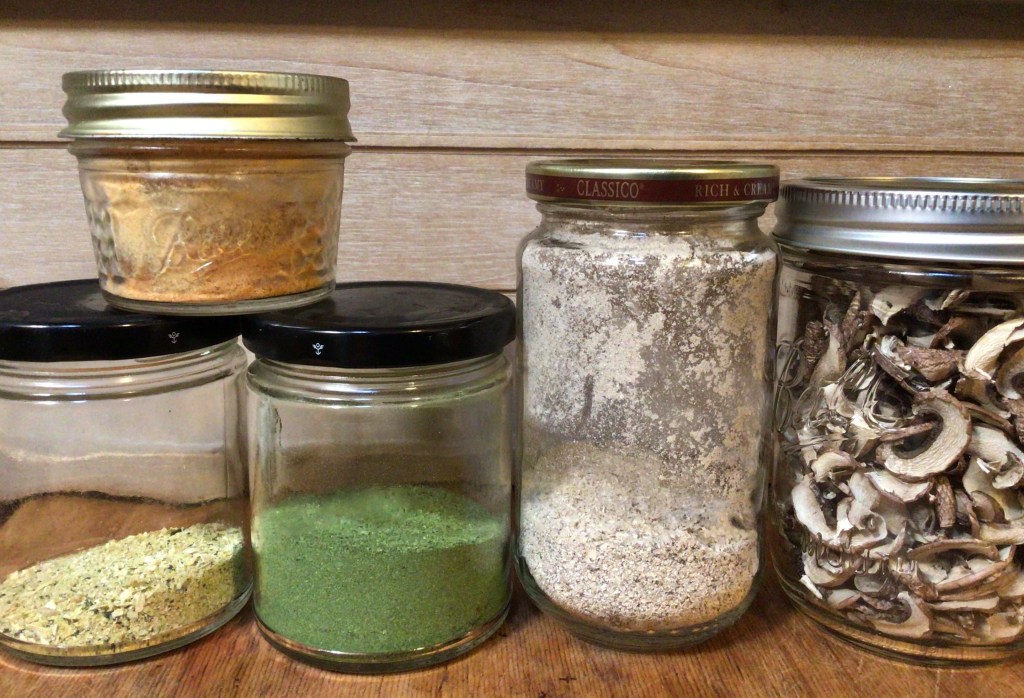
From left to right you Zucchini, Spinach, Mushrooms, and sliced Mushrooms. The orange powder on top is the combination of yellow, orange, and red sweet peppers. You know that bag of small peppers in the produce department? Those are the ones that I dehydrated and turned to a powder.

I’m all out of my powdered Butternut Squash. This one is actually my work horse. It has a nice sweet flavor that my boys don’t know that I’m adding vegetables into a meal.

Not only does my powdered veg work as a thickener, it doubles as my mom hack of hiding vegetables from my children who don’t want to see certain vegetables on their plates. Peas and Carrots are still acceptable on the plate, but all the others, I have to get pretty creative. And instead of renaming vegetables to some weird name, like my mom did, I just prefer seasoning everything with it.

Do you have a recipe that your family is always asking for?

Do you always tell them “Absolutely not!” because it’s your recipe and you don’t want anyone else to have it?

If you want to be generous this Christmas, you can dehydrate and turn your secret ingredients into a powder and make a seasoning pack or bag of instant soup.

This is particularly a great idea for loved ones who live across the country from you and shipping out a sauce or soup just isn’t practical! You don’t have to ship glass containers, liquid, or even have the weight of the ingredients that still contain their water content.

Maybe the person you’re gifting is a hiker or camper. But gifting them dehydrated food, in the form of seasoning, you’re able to give them the nutrition they need and taking up a fraction of their pack space.

Not sure about that statement?

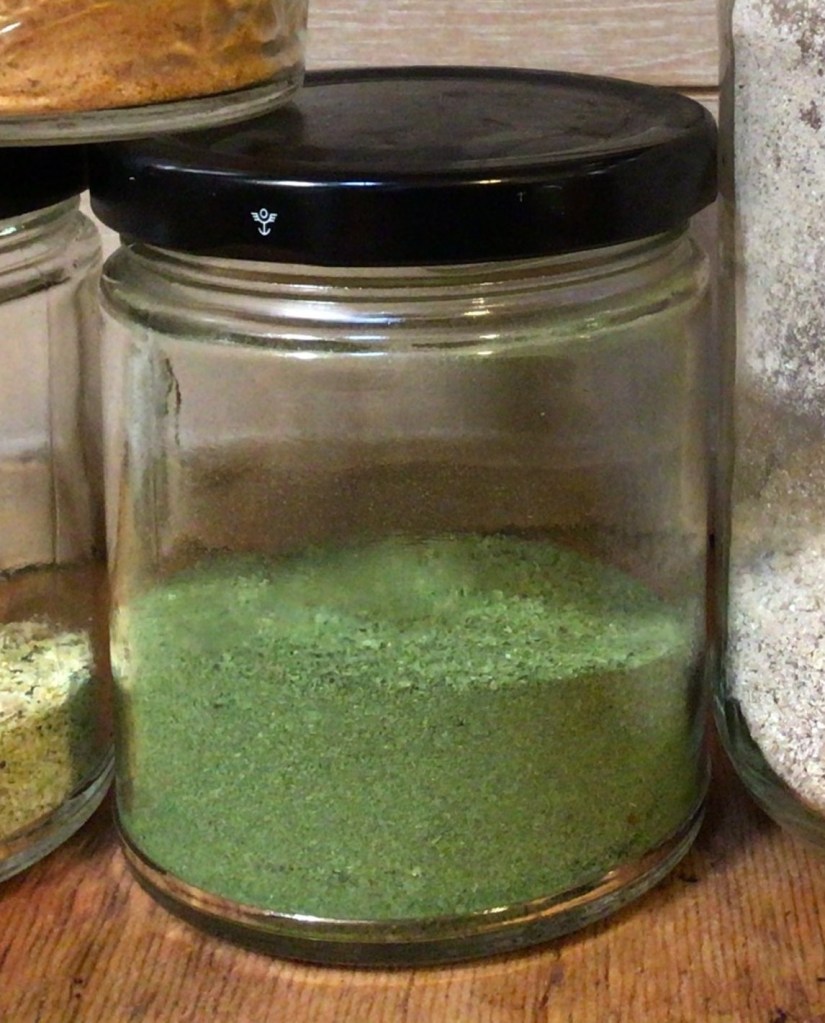
Take another look at the pictures of my powdered vegetables. The Spinach is contained in a 9 oz jar and is currently holding two bunches of spinach. Yes, that is two grocery store bunches of spinach.

Looking for a funny gift for your cook or baker this Christmas?

Here’s a design that can take on many different meanings. It’s perfect for your secret recipe cook, a white elephant present, or for that home cook whose mystery meals are not exactly the best surprises to hit the dinner table.

Here’s a sneak peak for Abstract Cooking, which is officially released on Monday.

Processing…
Success! You're on the list.

2 responses to “Saucy Saves”

  1. Lyle Avatar

    This article extremely informative, I have learnt so much from it.

    Like

    1. Pacific Northwest Event Design Avatar

      Thank you for reading! I am so glad that you were able to learn from me.

      Like

Leave a comment

Advertisements

Fresh From The Garden

(This post contains affiliate links to products. We may receive a commission for purchases made through these links, but at no extra cost to you.)

I am so happy that the recent sun and high heats have hit my garden the last couple of weeks. The spring here has been cold and wet and I second guessed, third guessed, and fourth guessed whether my spring plantings were going to be viable in making produce.

The great news is that my leafy greens are all doing well and have come to maturity for harvesting. My tomatoes are finally putting forth fruit. Truth be told, I keep looking for more blossoms and hunting for more new fruit. I really want to put away more pasta sauce and try my hand at tomato paste. Usually we just go through so much sauce that I really don’t get the opportunity to make anything else. So fingers crossed, I am so hoping to make other tomato products.

My corn is finally starting to outgrow my oldest child. Fortunately I drive past farms that grow fields of corn, so I compare my humble hobby garden to the professionals. And I’m glad that my few rows of corn are keeping pace with the large farms. So there’s hope. And particularly since I grew popping corn last year, for the first time, my boys are hooked with “our” popcorn. And I planted more corn than I’ve ever done before in hopes of making a year’s worth of popping corn. When the ears have matured, I’ll make a post on this so you can know which types of corn to grow to make your own popping corn. Also, you can see just how easy it is to make pop corn. Other than the wait, making pop corn is super easy!

I won’t go into all the details of everything that I’ve grown this year, but I will end here by stating that my fall seeds have already sprouted and are doing so much better than my spring planting. And even today, I’ve come across so many videos on YouTube talking about what crops you can plant in August and still harvest in the remaining time for this growing season. So if you are curious to try your hand at growing something before fall hits, there is definitely still time!

Fresh is what’s for dinner!

Out of the five items I harvested from my garden this morning, I used three of them for dinner tonight; Cabbage, Bok Choy, and Mizuna.

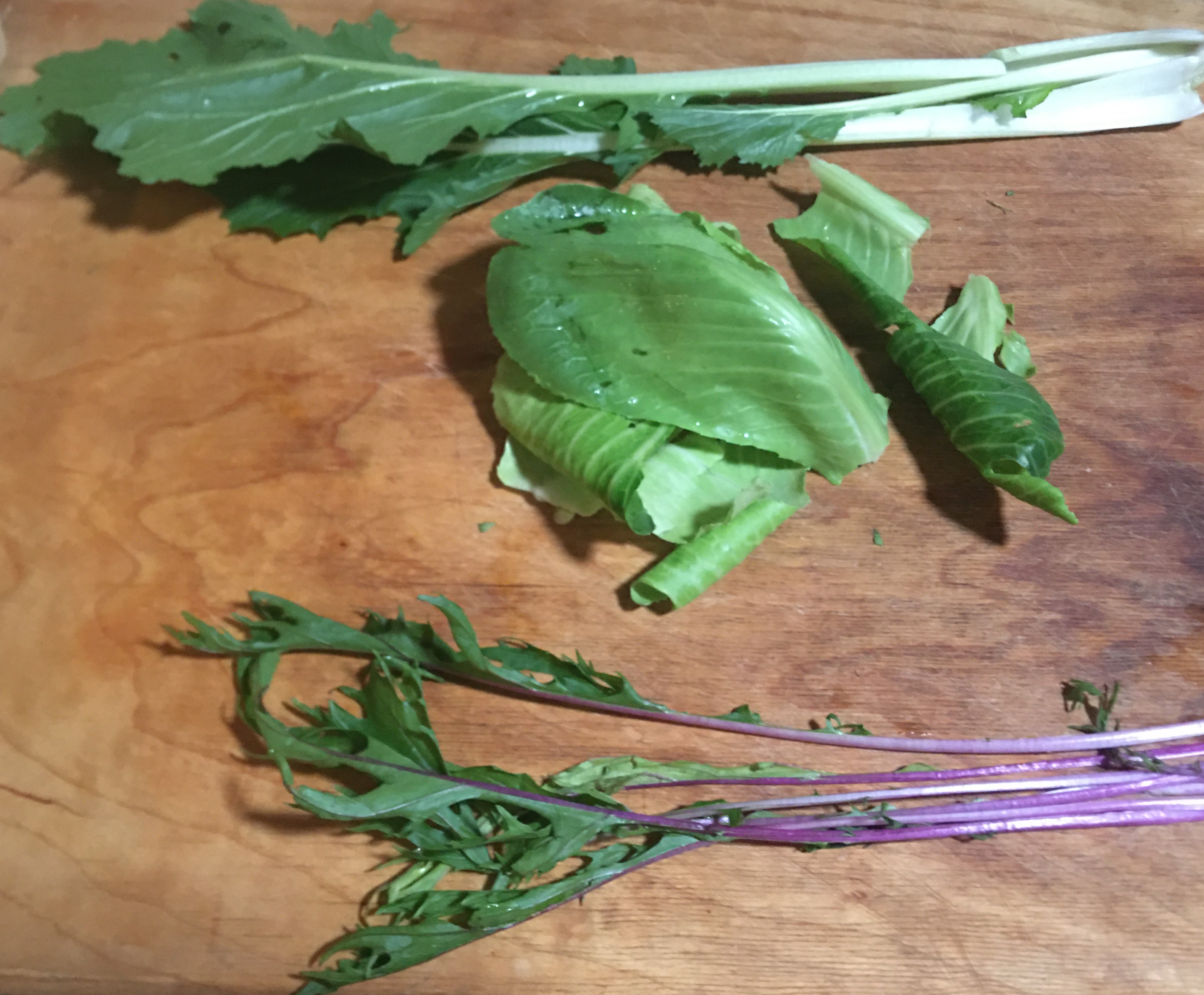
If you’re asking, “what is mizuna?” believe me, so did I. This past fall I bought seeds from Baker Creek. (Not an affiliate link, just a great product.) When I got that delivery I found out that the gift packet of seeds I got from them was mizuna. I had never heard of this green before. So I took a chance and grew it on the blind. And tonight I found out that it is a type of bitter green. Some of the bitter greens are quite bitter and I have to douse restaurant salads that come with them, because they’re so bitter. However the mizuna is not so strong. It has a mild bitter flavor, but is not bad at all if you’re sensitive to the bitter profiles, like I am.

Advertisements

Knowing that I have so many green to bring in starting tomorrow and for the next week or so, I had to come up with a new idea on how to use them. Other than dehydrating my greens and turning it into a powder to use in countless recipes, I can’t think of a way (other than freeze drying, but I don’t have that machine yet) of preserving them without becoming a wilty mess. Granted Cabbage is good for kraut and ferments–which I will be doing when I get a few more heads ready for harvest. Once my green cabbage comes in I’ll post an amazing Italian ferment that I found. And with the red cabbage I’ll post on making a red kraut. So there are a few things to keep an eye out for.

Back to dinner, I needed to find a use for these three greens to make dinner. Cabbage and Bok Choy can both handle some cooking. But one look at Mizuna and I knew I couldn’t do a stir fry with it. It’s definitely a salad green.

But Asian sounded so good!

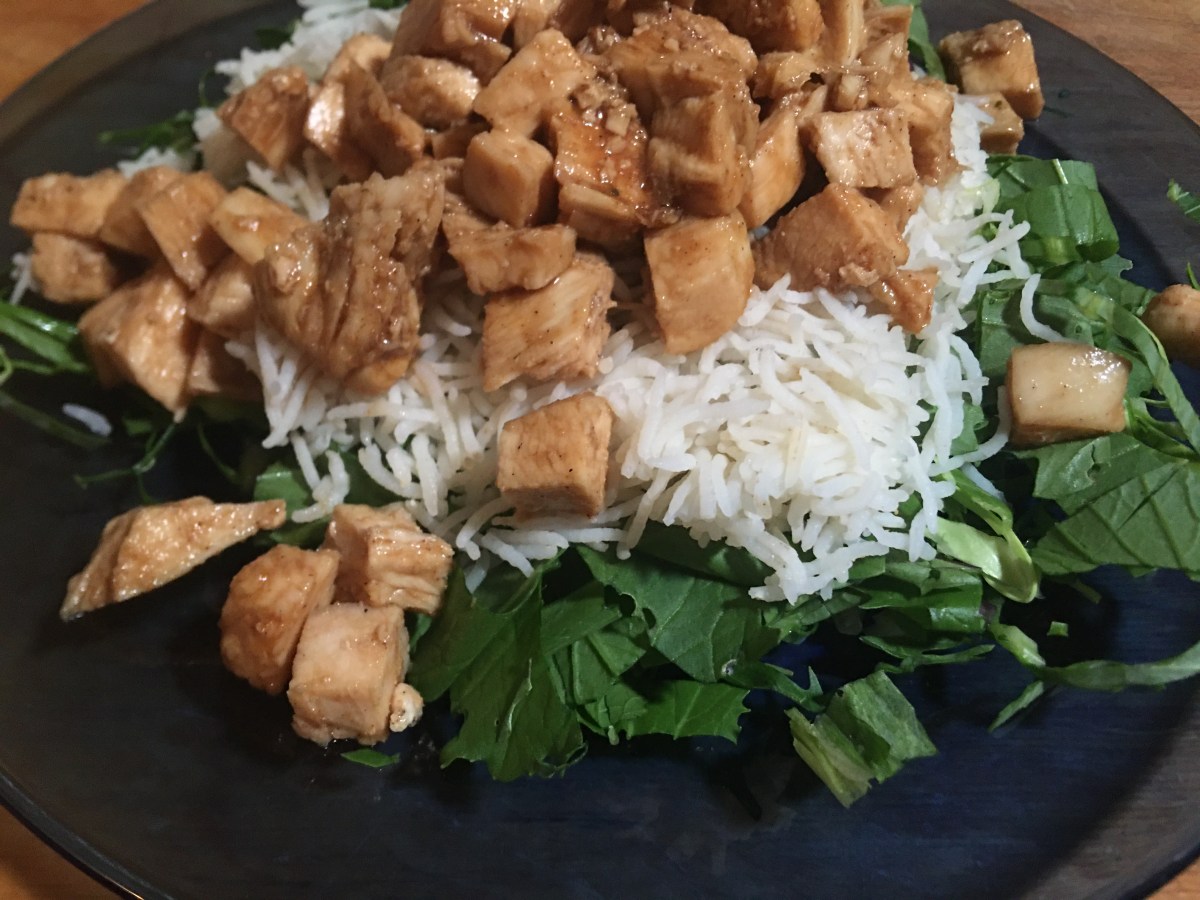
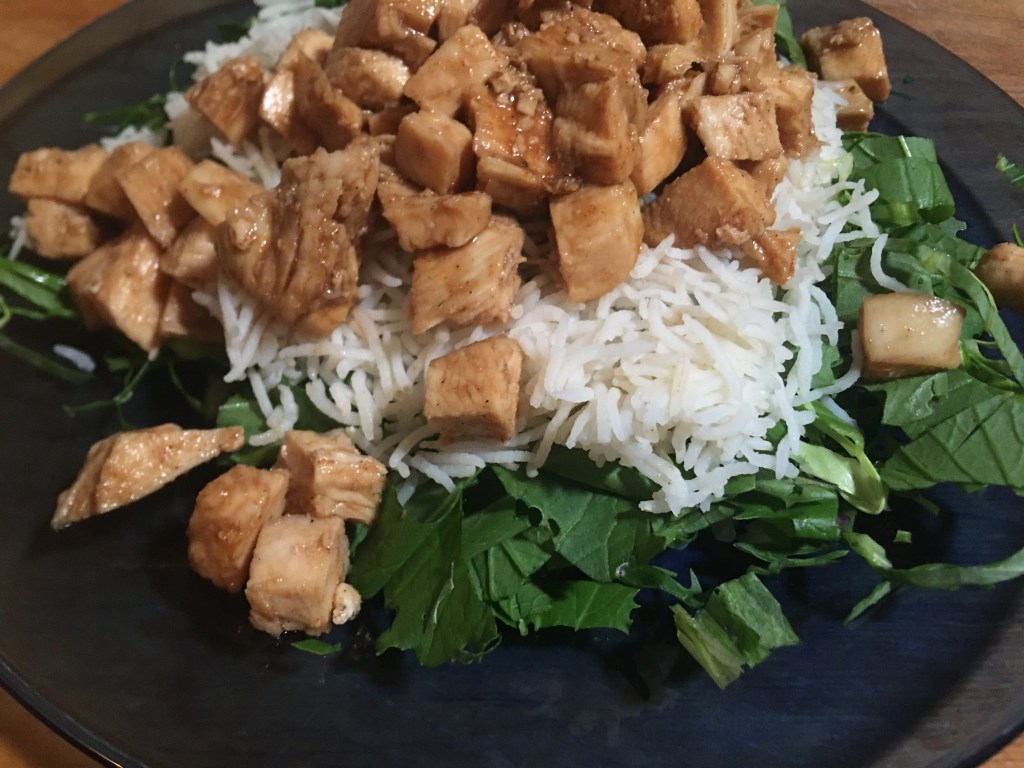
And that’s when inspiration hit. Two of the three greens could handle the heat, so I cooked my rice and chicken in a marinade (Mr. Yoshida’s Original Gourmet).

While everything cooked, I prepped the greens.

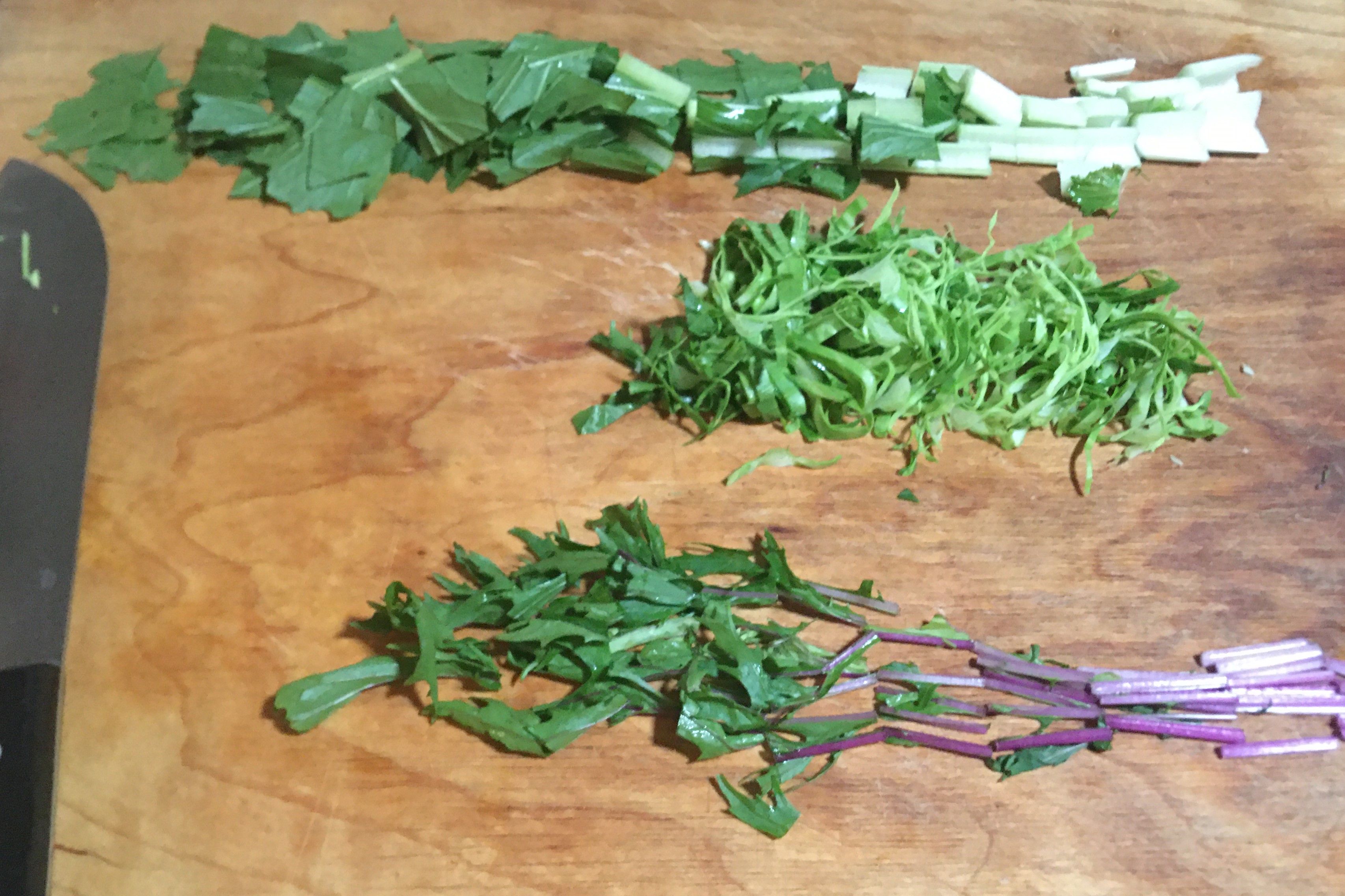
For a single plate I used (from top to bottom) 4 stalks of Bok Choy, a few leaves of Cabbage (the head was small, so I used about 5 leaves), and 4 stalks of Mizuna.

The Bok Choy and Mizuna I chopped. Because the cabbage is raw, I rolled the leaves together and julienne cut the leaves. Once these are cut, they just mix together easily like this.

I usually dread buying mixed salads at the store because either their mixes don’t taste good to me, are old, don’t keep long in the fridge, or all the various recalls over the last few years. Now that I have these greens ready to pull from my garden (plus spinach once it reaches maturity), I can put together a salad mix that is far superior than what’s found in the stores AND it takes less time than driving to my local store (about 4 minutes away).

The great thing about this mix combo is that I can place hot rice right on top of the salad and it retains its crisp texture. Cabbage isn’t phased by the heat. Bok Choy naturally can be cooked for a couple of minutes and keep firm texture in the stalk with mild wilt in the leaf, but retain full pleasurable taste. Mizuna, I fully expected to not hold up to the heat, just because it did wilt in the time between me rinsing the greens off and making dinner.

All in all Mizuna acted much like Bok Choy. The greens did wilt. BUT the beautiful purple stalks remained crunchy just like the Bok Choy stalk.

Top off the salad greens with rice, and then marinated chicken. And as a side note, left over chicken is just as perfect as having warm chicken. I ate this both ways.

You can see here that the rice I had on hand in my kitchen is basmati rice. I couldn’t have picked a better rice for this dish. White (short or long grain) rice tends to be sticky and would just be globular bunches of rice on this dish. Brown rice could be used. But if given the choice between basmati and brown rice, I would pick basmati for textual reasons. But know that you can choose your favorite rice.

Alternate Ingredients

I don’t have much experience with grain alternates to rice. I wouldn’t recommend quinoa (too nutty for this flavor profile), potato, or riced cauliflower(too gummy of a texture). Couscous could work, especially if you use a different marinade for the chicken.

If you didn’t want to use Mr. Yoshida’s Original Gourmet, Teriyaki would be just as perfect for this rice on salad. Sweet and Sour would be a fun alternate. I’m leaning toward trying the next time I make this, using a honey ginger sauce. And maybe you’re not into a sauce at all, for any dietary reason, but prefer vinaigrettes. You are most certainly not limited in how you dress your chicken or rice.

And once you opt for a different dressing, you can make any of your other alternate grains work in the place of rice.

You’ve also then opened up the window for other additional ingredients. Have garbanzo beans that you’ve been looking for something new to make with it? What about dehydrated fruits or vegetable chips? Pomegranates, fruit slices (fruit or canned)… as you can now see, you can really turn your salad on its head with adding a heated element on top of something traditionally thought of as being a cold entre. You can use dehydrated or preserved ingredients–especially if you need to use up some of your previously shelved preserves to make room for what is coming up in your current garden.

I can’t even begin to share with you just how excited I am about this! With all the recent hot weather and the lack of desire to cook dinners, I am actually looking forward to making this a meal a couple of times a week, different meats, different dressings, different additions. Plus it’s the bonus of eating all the leafy greens that don’t normally keep well, like some of the other produce I grow to preserve. And that’s not even taking into consideration all the edible flowers that abound this time of year (such as culinary lavender and dandelions)!

As you can see here, with how beautifully this all mixed together I’m positive your imagination has already added in additional ingredients to make this meal individually you!!!

Here’s the cut files that were newly released this past week. New files are released every Monday!

Processing…
Success! You're on the list.
Advertisements

Would You Like a Cuppa?

It’s funny how beverages of choice are so regional. For example in the United States, there has historically been a continental divide between coffee drinkers and tea drinkers. Tea has been pretty regional for the East Coast and Coffee the West.

The history of this divide started around the foundation of this country. We all know about the Boston Tea Party and how they threw tea over the sides of the ships, all over a 3 cent rise in taxes. (I find this historical fact both interesting and funny in the context on how there has been upwards of 14% inflation on so many products across the grocery shelves.)

Coffee started making its footprint in the United States with the colonization (and yes, even subjugation) of the Caribbean Islands and South America. But it found its biggest consumers with the people who moved west, not just the Mid-West but also the West Coast and upwards into Alaska.

In fact, before Starbucks became established and took over every major street corner, I grew up where you could tell whether your family was West Coasters or from back East. If your family had spent a few generations on the West Coast, you had a coffee pot in your kitchen. I grew up with many people whose grandparents drank tea, but their parents, coffee. Those were my New England transplant friends. And then in High School I made friends with a transfer student, who came from Virginia. She hated coffee and only drank tea.

What is funny is what the transition from tea drinking family to coffee drinking family looks like.

A set of grandparents came up from the Texas area. One was Texan, coffee drinker, and the other was from the Deep South. The only tea that was in this grandparents’ house was sun tea. And there was only ONE way to make it–so obviously a tea drinker. Every summer there was sun tea that was made, that beautiful dark golden brew. There is really nothing like it. Mind you, this isn’t the sweet tea that you will find in the Deep South, where verbal wars can be started on the proper summer time tea. Just good strong, dark, rich sun tea.

Now my parents were both coffee drinkers. And yet almost each summer growing up, my mom would brew at least one sun tea.

This dedicated coffee drinker, I’m a very picky tea drinker and it was only this summer, when the sun finally came out that I caught myself thinking “I need to make some sun tea”. You can imagine the “What the– where did that come from?” moment I had because I don’t make sun tea. And yet this summer was it.

So that prompted me to ask on my social media for recommendations and recipes from my tea loving friends who have the tea that even a coffee lover would love. Obviously the majority of my friends and acquaintances are coffee drinkers because I only had a few responses. But the responses that I received shocked me because I never knew about these teas and they never crossed my mind.

The following yellow product buttons are affiliate links. I earn a commission off of these products at no additional cost to you.

Mint Sun Tea

One recommendation sent to me was:

  • 1-2 Regular Tea Bags
  • 3-5 Bags of Mint Tea OR Fresh Mint Leaves

Add the above tea bags into a glass gallon jug of water (which you use to brew your sun tea). Brew for 2-3 hours, in the sun, or longer if you want your tea stronger or you’re sun is hiding behind clouds.

When finished brewing refrigerate.

This friend also said that she adds honey into the tea before refrigerating.

I was excited about this recipe because my absolute favorite tea is Stash’s Moroccan Mint Green Tea. If I’m craving tea, this is the one I hunt for because it has the world’s best flavor. I’ve tried to get into the Green Tea fad, but I find the vast majority of green tea either tastes like grass or soap. (I’ve recently learned that the majority of people who don’t like cilantro is because of it tasting like soap. There is actually a chemical compound in these green that to certain taste buds taste like soap. So this is real and there’s a reason!)

If you’re like me, and not a green tea person, seriously try this one. It’s not just me. I have a friend who use to be a Japanese tea distributor, says that she’s extremely picky, and assures me that this tea is one of the greatest to make a sun tea with!

This friend is currently cooked with brewing Chai with Hojicha, Green Tea with Self Healing and fresh mint from her garden.

Strawberry Tea

This one surprised me when a friend suggested this. I don’t know why I never thought of fruit sun teas. Fruit just makes sense because of summer. Strawberries are appealing because I’m growing them and I love strawberries. And the recipe passed on is super simple.

  • 6-8 Strawberry Tea Bags
  • Strawberry Puree

In your glass gallon jug of water (which you use to brew your sun tea) add the Strawberry Tea Bags. Brew for 2-3 hours, in the sun, or longer if you want your tea stronger or you’re sun is hiding behind clouds.

Once your tea is done brewing, remove your tea bags and chill your tea. If you can’t wait, pour your tea over a glass filled with ice. Mix in strawberry puree for a stronger strawberry flavor. If you like sweet tea, add sugar to your liking.

Sweet & Spicy

This one was recommended by two different friends, one from Tennessee and one from Texas.

This tea I found intriguing because the ingredient list reminds me of staple recipes from Asia. In fact, reading the ingredients made me start craving Thai!

I’ve been assured that these tea bags alone are all you need for some of the best sun tea you’ve ever had. And since I grew up on sun tea made from plain Lipton tea, I can see how this is going to be amazing!

Along this line of tea, I was also introduced to the idea of Cinnamon Tea. This blew my mind!

I’ve never heard of Cinnamon Tea before. And I learned that 2 cinnamon sticks in about 4 cups of boiling water will give you a nice tea.

This is definitely on my list to make once fall comes. I love cinnamon, but I’m on a kick with my mint right now. However, my Chocolate Mint might need the cinnamon to bring it to the next level. It’s still missing something for me, and this might be it!

Natural Sweetener Alternatives

There are various reasons why people choose an alternate to sugar for sweetening foods and beverages. I’m personally leery about many sweeteners because the last thing I want to do is add more chemicals into my diet. So when it was brought to my attention that Stevia is a plant based sweetener, this product had my attention.

I’m hooked on the idea now that I have located stevia plants to add to my garden. So I will soon be growing this and learning how to make sweetener.

My mom has cooked with stevia and says it does well with baking. She also used it with alternate flour sources.

I’ve used the packets of stevia and sprinkled in my large water cup and 4 leaves of mint. So with nothing to hide, I was able to taste the stevia. I didn’t notice any off flavors that I’ve noticed with other sugar alternatives. The flavor is slightly different than sugar, but not enough of a difference for me to say it’s “different”. The huge bonus I can say about it is that I like how stevia melts into the water. If you’ve added sugar in cold water you know how much of a gritty feeling there is until the sugar has been well stirred and sat for a while. That’s not the same experience I had with stevia. I only had to give a good stir and I was good to go. No textural difference.

When my mom gifted me stevia, I seriously wondered what I was going to do with it. Other than just keep it in my cupboard for when my mom visits. Now I know what I’m going to do with this natural sugar.

I recommend giving this sugar alternate a chance.

Here is the packets:

And the bag:

Looking for an alternative to tea?

I know that there are still some people who just do not lean towards tea drinking at all. Or maybe you’re looking for a tea that is kid friendly. There is one more option I have for you.

Infused Water

While waiting for some good leads for sun tea, I instantly ran across a post from on of my favorite bloggers. She just got me hooked on putting fresh mint leaves in my chilled water!

I have a 36 oz. water “cup” that I use to make sure I get my daily water in. The only thing I add to my water is 4-6 leaves from my mint plant of choice. Before you put the leaves in your cup, stack and roll them up, crush the leaves in your fingers, and then add them to your water. By crushing the leaves, you break open the cell walls of the leaves and release the oils within.

The best part about using fresh leaves from your garden (or produce stand if you haven’t yet planted fresh herbs at your home) is that you are not only drinking something tasty, you’re giving natural medicine that give your body the building blocks to bring you back into or keep you in health.

What I recently learned is that by putting mint leaves in your water, it can help combat ailments such as GERD (Gastro-esophageal Reflux Disease). I personally am not afflicted with GERD, but summer heat does a number on my body. Not only is my appetite affected, but I’m more prone to upset stomach. In fact, my stomach was upset when I first put mint in my water cup. By the time I finished drinking that cup, my stomach was back to normal. And since I’ve been using the mint daily, it hasn’t returned.

Anyone who works with herbs will tell you that the mint family does have properties that benefit your gastrointestinal system. I love learning about these things, because I try to keep off of as much over other the counter or prescribed medication as I can.

Here are some ideas of what mints you can use:

  • Mint
  • Chocolate Mint
  • Pineapple Mint
  • Orange Mint
  • Lemon Balm
  • Spearmint
  • Peppermint

And there are other types of mint that you can find at your local nursery for produce stand that sells starts. Better yet, maybe your neighbor has a mint they are growing. For example, I have Chocolate Mint and Spearmint. I had Orange Mint, but this crazy spring may have killed it. (I thought it died on me, but I recently saw a new sprig come up from the soil. I’m waiting for it to grow a bit bigger before seeing if it’s Orange or Chocolate.) One neighbor has Lemon Balm. Another neighbor has Pineapple Mint. And I only found out what my neighbors were growing by telling them about what I’m growing and what new projects I’m working on with my herbs.

Here are the flavors of the mints that I’ve tasted.

Chocolate mint just tastes like mint to me. The reason why it got its name is because when you crush the leaves, it stains your fingers brown like milk chocolate. I mentioned before that I’m very particular about my tea. I found my pickiness kicking in on putting this mint in my water. A tiny sprinkling of Stevia was just enough to pull this infused water around to allow me to drink this. Even though I found I could drink this, none of my kiddos liked this flavor. Instead, two of my boys leave my water alone if it has mint, because of this one. So mamas, if you want your water left alone, this one may do it for you!

Pineapple mint really does smell like pineapple. I can’t wait to get this in my water, because it smells like a Piña Colada. My neighbor just gave me a few sprigs this evening so I’m excited to try them tomorrow!

Lemon Balm, I swear it tastes like lemon! I usually don’t keep lemons in my house because they turn on me before I use them. However, I’ve used lemon balm in my chicken broth and it tastes just like I squeezed in some fresh lemon. You better believe that I have a new friend in my kitchen. I’m so using this herb instead of lemon or lemon zest.

Spearmint brings back so many fond childhood memories of incessantly chewing Wrigley’s spearmint gum. And yes, I’ve almost picked my spearmint plant bald for my water. And this is the infused water that my youngest will still steal my water. So this mint gets my recommendation if you’re looking for an herb infused water that is kid friendly.

I so hope you’ll join me in dressing up your water this summer!

What’s your favorite water infusion or Sun Tea?

I’m still looking for new ideas on sun teas in particular. But I want to hear what everyone is drinking right now to stay hydrated. Please comment below!

Processing…
Success! You're on the list.

Leave a comment