

There’s something about the scent of fresh rosemary. I’m not talking about the dried needles that you find in the herb aisle. Those over priced dried herbs have nothing on the fresh branches you can harvest from the bush.
If you haven’t handled fresh rosemary, I encourage your to get you hands on some.
The first thing I noticed was that there was the classic rosemary scent, but there’s also a spruce/pine under note that surprised me.
For many years we’ve sported an artificial tree. That started because there was a season where my husband and I were going through a financially rough. I had an artificial tree that I used in the past for a Christmas tree decorating competition. But we took over into using that tree for our family in order to free up money that would otherwise be spent on a fresh tree. As much as we prefer fresh trees, it’s just made more sense to use the one time fresh tree money and put it toward a fake tree and reallocate that money each year toward some other area in our budget. (This by no means negates how the trees are made and that they just don’t disappear–but this is a whole other conversation for another day.)
I mention this not to enter the tree debate, but to highlight the point that when I first smelt fresh rosemary, it completely brought back all the childhood memories of having fresh Christmas trees in the house. And once I found this out, I’ve started taking some rosemary inside during Christmas time just for that scent during this time of year. And also because of the amazing health benefits that rosemary has for our bodies, especially during known cold and flu season.
Growing Rosemary
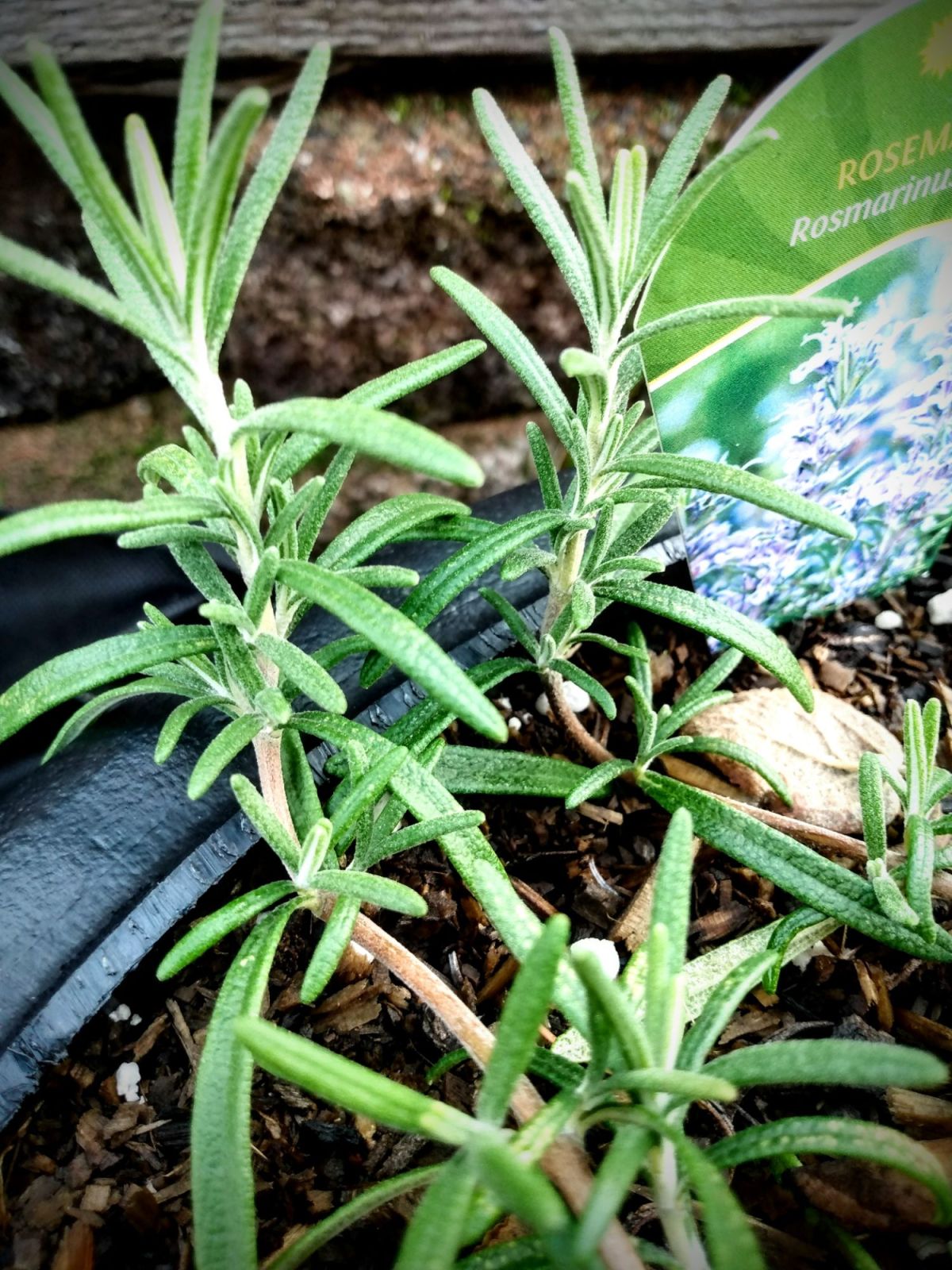
The first picture that I started with was taken last year when I attempted to root some rosemary sprigs for some free rosemary plants. I wasn’t successful with those sprigs. But as I look back at this picture I see that 4 of the 5 sprigs are wood growth instead of green growth. And just like lavender, there’s a difference in cloning these plants depending on if you’re using new/green growth or wood/brown growth. Once I’m successful in propagation of rosemary, I’ll make a new post on how to do it and eliminate the guesswork.
Until then…
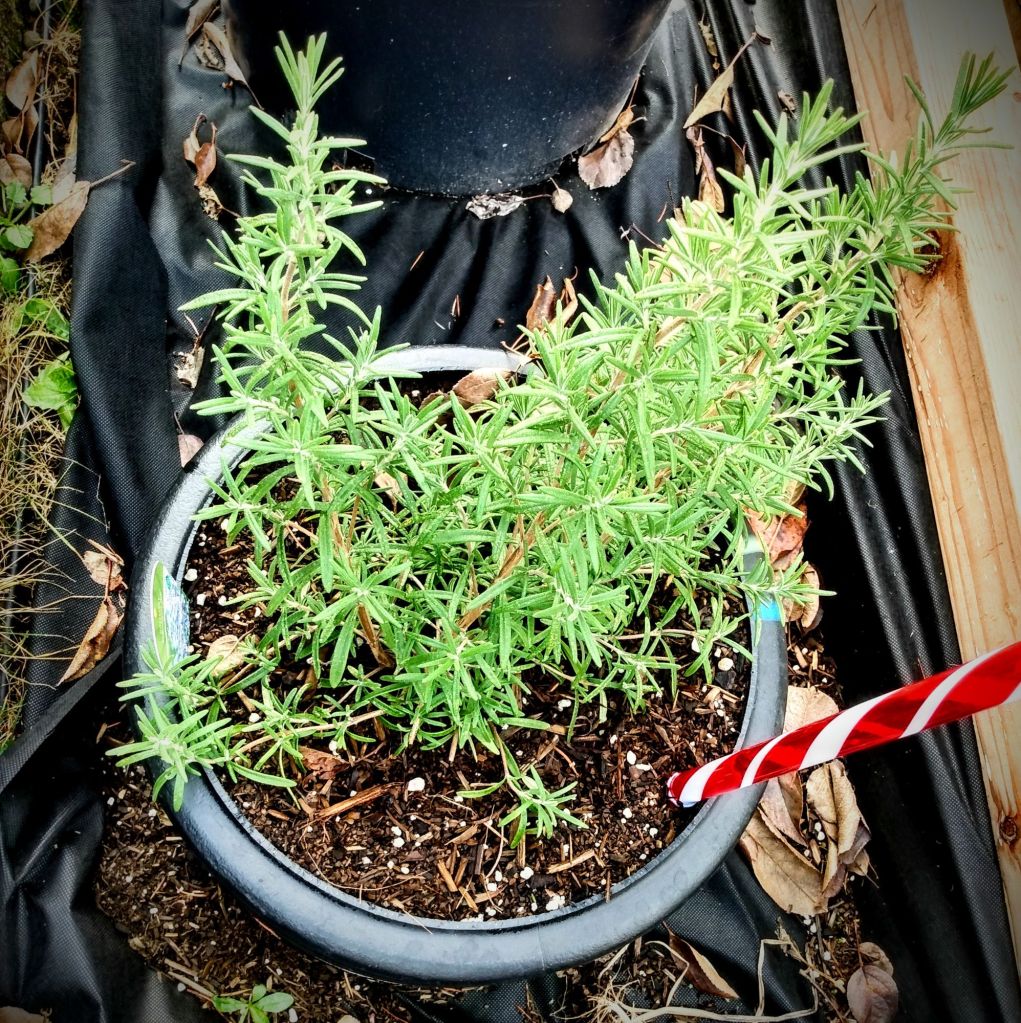

The rosemary on the left is a spraling variety. The plant on the right is an upright bush.
I found two plants at a local produce stand, at an amazing price, over the summer. One rosemary plant is more than enough for a family, with enough left over to share with friends, neighbors, and whoever else you can give it to. If you’ve seen the memes about zucchini season, warning people to lock their car doors before neighbors deposit excess zucchini in your vehicle, then you have an idea of how prolific that rosemary can be. I bought two plants because I’m a sucker for variety (thus the reason why I got a sprawling and an upright bush varieties). But rosemary is one of my favorite ingredients that I love putting into hair and skincare products and soaps that I’ve been making.
As you can see above, I’m in the process of making a new flower/garden bed. It wasn’t ready as all when I got the rosemary so I improvised. And I’m sharing this unfinished project because I want you to know that you don’t have to be finished with a build before you can get a plant “in the ground” and start establishing itself. I’ll come back to this in the future, when I have the build completed.
In the mean time… note that I used cylinder pipes and filled it with soil. When I planted these rosemary, the root ball literally fit in my hand, so the 12″ cylinder, that stand about 10″ tall were more than enough to set up these starts. There’s more than enough room for the root structure to grow over the winter. And in the spring, which I plan on having this bed finished, I can remove these pipes once the soil has been laid. In the mean time I need to lay some woodchips down to help insulate these plants before we get our expected snow in about a month or so. We live in a temperate area, so I’m not concerned about killing off the root system. I would be more concerned if we lived in an area with subzero winter weather.
One thing that I love about rosemary is that it is a drought resistant plant, as it is originally from the Mediterranean area. Once rosemary is established, it’s a plant that all you have to do is keep an eye on it to make sure that is free from pest and disease. One valuable resource for that information can be found here at Farmer’s Almanac. But this plant will be here for you for many years.
Health Benefits
This is absolutely one herb that you want to keep ready in your kitchen for not just maintaining your health, but also for food medicine.
Food medicine is alternative pharmaceuticals. If you are trying to reduce the amounts of chemical medicine (because of side effects or other complications), medicine from herbs and other foods are great for giving your body the building blocks it needs to maintain your health or boost your immune system to do the work it was designed to do.
Some of the benefits of rosemary are:
- Contains antioxidants
- Boosts mental alertness
- Active studies on combating Alzheimers
- Stimulate hair growth
- Antimicrobial properties
- Relieve indegestion
- Promote metabolic health
- Anti-Inflamatory
- Studies in protecting against brain damage of stroke victims
- Studies in slowing the spread of cancer cells
- Relieve muscle and joint pain related to arthritis
- Insect repelent
- Increase circulation
- Boost immune system
- and so much more!
It was not so long ago that the pharmaceutical industry was created. Before then, families would treat themselves with food and herbs. This is not to say that pharmaceuticals don’t have their place. But what we are not told is that drug companies cannot patent plants, found in nature. So there is a huge industry in modifying plants. If a plant can be modified so that it cannot be grown in nature, then that plant can be patented and then be purchased at a premium price. The same goes with pharmaseudicals. They started out with plants found in nature and then the natural compounds are extracted and manipulated until they are at a point where they cannot be found naturally. These compounds can then be patented and sold at a premium price. These compounds are manipulated to be “fast acting”. So when you see “fast acting” on packaging on over the counter drugs, it is in comparison to natural compounds.
There is a large conversation that can be had on this subject. I bring it up because most people are not aware that the natural compounds are available in common plants and are just as effective if not more effective than some drugs because the natural compounds are not subject to being ineffective (drug resistance) by our immune system, as our body starts to recognize that these “medicines” are not natural/found in nature. So our bodies are not able to break the compounds down and fuel our immune systems to combat the situation we’re dealing with.
Again, this is not to negate or berate necesary pharmaceuticals. I just want to draw awareness of where drugs actually start from and why they might not be effective or stop being effective. And if this happens, it’s not the end all that causes you to stop having hope of being treated for whatever it is that you’re facing. So please do your own research and have conversations with your healthcare provider. There are always scientific studies on natural plants, like rosemary, and big health issues. It’s just that they aren’t publicized in commercials and the media because these natural plants are not and cannot be patented. So there’s not as much money that can be made from treatments from natural plants in comparison to what can be made off of patented medicines.
Identifying Rosemary
This past week I was at a party where the table decor was pine branches and rosemary sprigs were used on one of the appetizers. One of my friends happened to have one of the pine branches shed it’s needles on her plate and she couldn’t identify the rosemary to the pine needles.
If you remember what I mentioned above, about how rosemary smells like Christmas to me, smelling a pine and rosemary needle side by side may not help you decide which needle you want to eat. So I pointed out this one unique identification feature to my friend.
The underside of rosemary leaves have a white stripe down the middle.

In this case the misidentification of a pine or rosemary needle is not going to be a life threatening moment. Pine is known to have Vitamin C. In fact, during the spring I look for the new growth tips (bright yellow/green) of pine and spruce trees. The amount of Vitamin C found in this tips put citrus fruits to shame. So depending on what health needs you have, making tea from the tips of new growth pine and spruce trees, will give you far more vitamin C than eating citrus fruit or taking Vitamin C supplements/chewable.
With that little tid bit of information aside, another feature that you might want to know is the difference between the new growth of rosemary and the woody part.

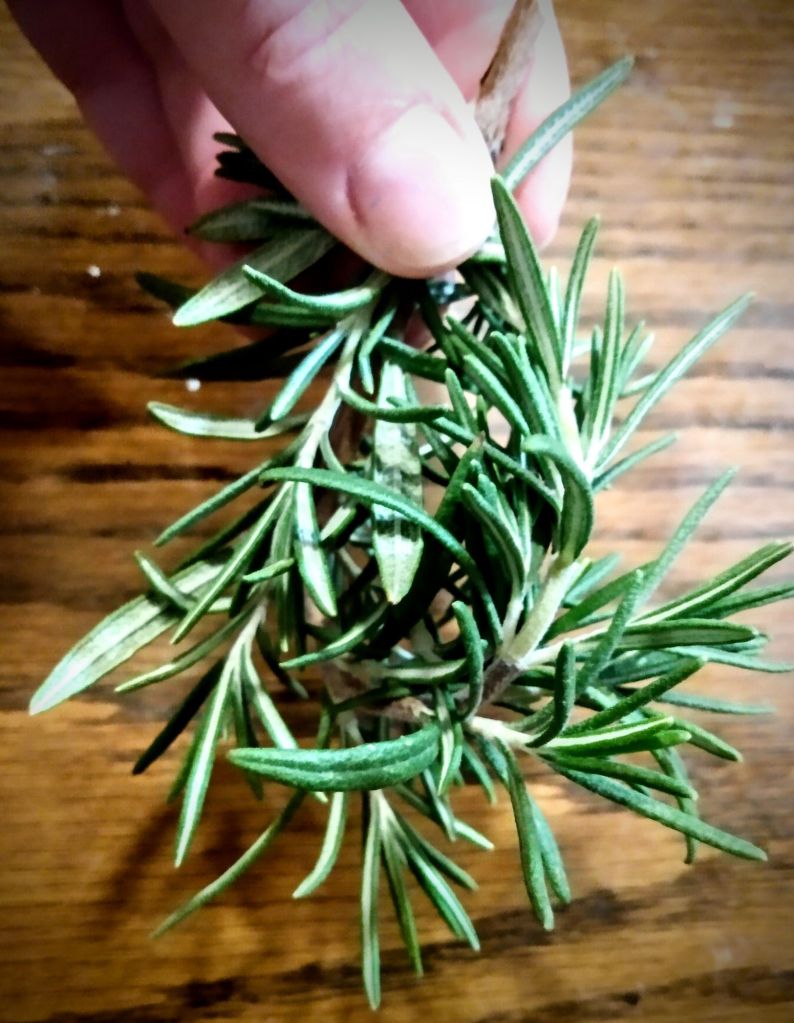
With new plants, like what I have, it’s a little harder to differentiate between the two parts in comparison to an older plant. But as you see above, the new growth is white and the woody portion is a reddish brown. With a young plant like this, the woody part of the stem is still flexible. But in an older plant, the woody portion is very rigid like a tree branch.
The higher concentration of nutrients, and valuable compounds, are going to be found in these new growth portions of the branch. This is where the plant is sending all of its energy to. So if you’re looking to use your rosemary as a food medicine, this is the part of the plant that you are going to want to harvest and use.
That doesn’t mean that the rest of the leaves, lower on the branch are not useful. They still have the rosemary flavor that you want when you’re cooking with rosemary. They just don’t have as much of the active compounds that are found in the new growth region of the plant.
Useful Preparation of Rosemary
There are two ways that I preserve rosemary the most; dehydrating and infusing in oil.
For dehydration I’ve tried two different ways. I’ve left the leaves on the branch and dehydrated the branch with the leaves. And I’ve also removed the leaves. Dehydration time is the same either way, in my experience. But it’s easier to remove the rosemary from the dehydrator on the branch then collecting the individual leaves. So I’ve just left them on the branch and then when processing is down, I run my fingers down the limb, over a bowl, and quickly strip off the leaves. From there I save some leaves as is, which promotes the longevity of the healing compounds. Then I take some and grind it up into a powder in my herb grinder. In powder form, the compounds start to break down and become weaker around 6 months. So I only grind what I’m going to use in the near future. Otherwise I leave the leaves whole, where they retain their compound integrity for a year, upwards of two years (depending on who you talk to).
But I don’t use rosemary just for when I make my meals. I use them in the lotions and soaps that I make. In fact, the shampoo bar that I make for my hair has increased my hair health so much so that I cannot remember when my hair was this thick and healthy. It’s more healthy then even when I was pregnant with my children (which are one of the things that most pregnant women notice is that their hair health is improved). I use the leaves in the soap, but more importantly I use rosemary infused oil.
I use rosemary infused oil for everything; food and skin/health care products. So I use rosemary oil more than every other preparation. But one thing to note is that if you have more rosemary than you can process (either drying or infusing) rosemary freezes beautifully. Just leave the leaves on the branch, bag it and put it in your freezer. It will stay fresh and will not break down or wilt when you’re ready to use it.
Making Infused Oil
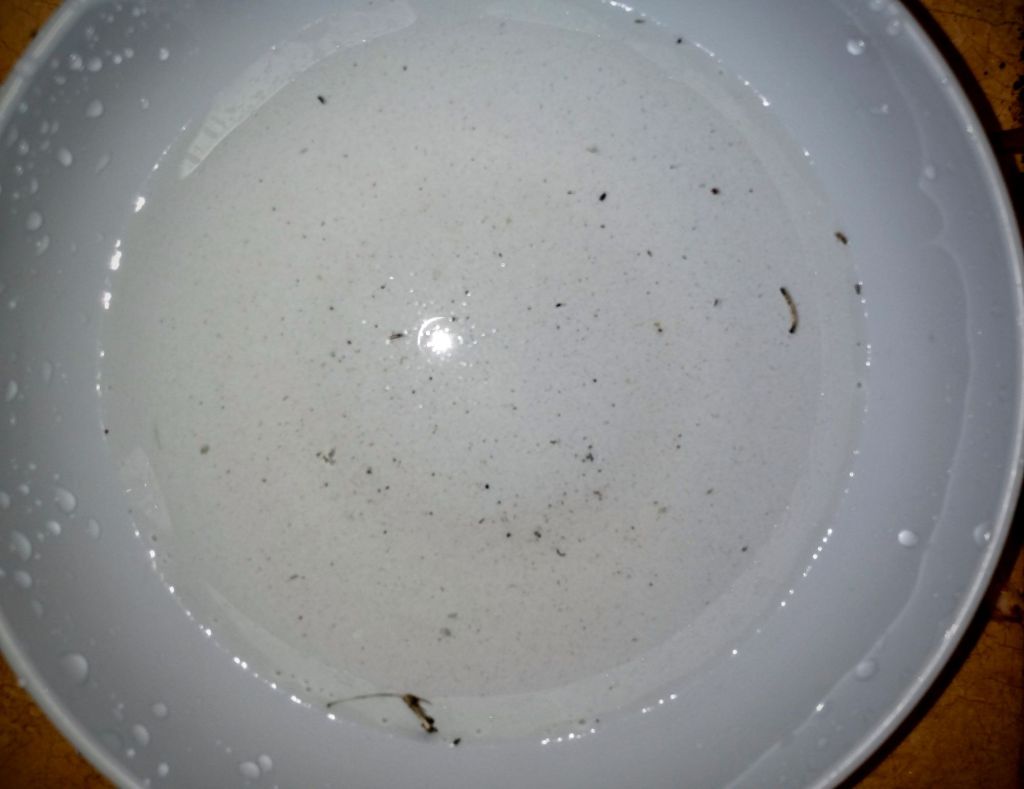
The first thing that you want to do after you cut the rosemary you will use is to rinse the branches off. Even though my plants are only a couple months old and I grow them organically, you can see below how much came off of my branches and they looked clean. All of this debris would have compromised my infusion and caused problems that are common when you read about mold and other issues people have when infusing herbs in oil.
Another problem that people have when infusing is that they put wet herbs into oil. Please remember that oil and water do not mix. What happens with water is that it becomes the medium for mold to grow (which is usually jump started by the debris that’s not washed off).
The three components that cause organic materials to break down and spoil are water, heat, and light. These three things are what feed and promote bacterial and mold growth. So whether you’re preserving food or making infusions, you want to keep these things in mind.
After rinsing off the rosemary, I air dry off the water.
There is a whole other conversation around whether to use fresh or dried herbs for making an infusion. I won’t go into that conversation here, but for delicate leaves I dehydrate them first. Plants like rosemary and lavender I go ahead and infuse fresh because of these are drought resistant plants, have thicker branches and leaves that are designed to not release the water that they have stored up inside of them. That’s not to say that I haven’t had mold grown on an infusion with these hardier plants. The times that I have, it was when the branches were above oil level (access to oxygen) and I didn’t remove the branches 6 months after the infusion was supposed to end. (It took that long for a mold colony to grow where I noticed it.)
There are also two different type of infusion you can do: stovetop or solar. Both use heat as the extraction method of the plant compounds into the oil (which I use olive oil. This is a great universal oil for cooking and soap making.)
For stovetop (or crock pot/slow cooker) the important thing to remember is to keep the temperature on your lowest setting and let it process for a few hours. I don’t do this method, but if I did I would let it run for 6-8 hours.
I prefer using the solar method because I love how it looks. And more importantly I describe myself as a busy mom. Nothing is better, in my opinion, than to spend less than 15 minutes setting something up and letting it do it’s thing over a longer period of time that absolutely does not involve me.

So after my rinsed rosemary is dried, I put the sprigs (stems and leaves) into a jar. Tightly fitting in the plant material is great because it prevents parts from floating to the top, keeping everything fully submerged when you add the oil.
On the subject of oil, not all oils are made alike. And this is another one of those points that people have failed infusions. They chose inferior oils. When you pick your oil, keep in mind what material you are using. Olive oil, grape seed oil, and a few others come from plants that are not known to be modified and with less processing. Vegetable and Canola oils are both produced from crops that are known for being genetically modified and are heavily processed (an indication that their natural plant compounds have been changed and have less natural benefits). But when you also look into the history of their origin, you will realize that they were never created for human consumption. Canola oil was formulated for World War engine lubricant. After the war, the oil was then marketed as a cooking ingredient in order to make a return on investment and because it’s cheap to produce. (For a short history of Canola, and some comparisons to other oils, can be found in the article Rapeseed to Canola: Rags to Riches by R. Keith Downey.)
For today, I used smaller mason jars. And to keep most of the rosemary stems submerged for this solar infusion, I coiled the stems into a ring shape and placed them in the bottom of the jars.

Next I poured my olive oil to the top of the jars. Then I capped them with a lid and ring. (I prefer lids and rings because you can tighten the lids tight enough so that when you shake the jars, there won’t be a leaking of the oil.)


For the next 6-8 weeks I will shake the jars and make sure the rosemary stays submersed in the oil. During the summer, I leave them in a window sill. During winter, I put the jars on my south facing windows during the day and then move them to a warm space during the dark hours. Sunlight is what causes the heat that opens up the leaves to extract the compounds and oils from the leaves.
Solar infusion takes longer than a stove top or slow cooker method because the heat temperatures do not go as high or stay sustained like a controlled heat. But the one thing that I haven’t been able to find is an article that talks about the effect that the sun has on the oil compounds themselves. (For example we know that the sun has a bleaching effect on laundry. So what else is the sun capable of doing when using it a part of the oil infusion process?)
At the end of the infusion process, no matter which method you choose, you will want to strain out the rosemary. Store it in a clean glass jar and lid. And then keep it in a cool dark place.
As with all herbs, medicinal compounds start to break down 6-12 months. This doesn’t mean that they are empty of any good. It means that they lose their effectiveness. The flavor can still be there. So as long as rosemary (and other herbs) is properly stored, they are good to be used.


 How I Can Do That
Leave a comment